This post contains mentions of supernatural activity, historic deaths, execution and suicide.
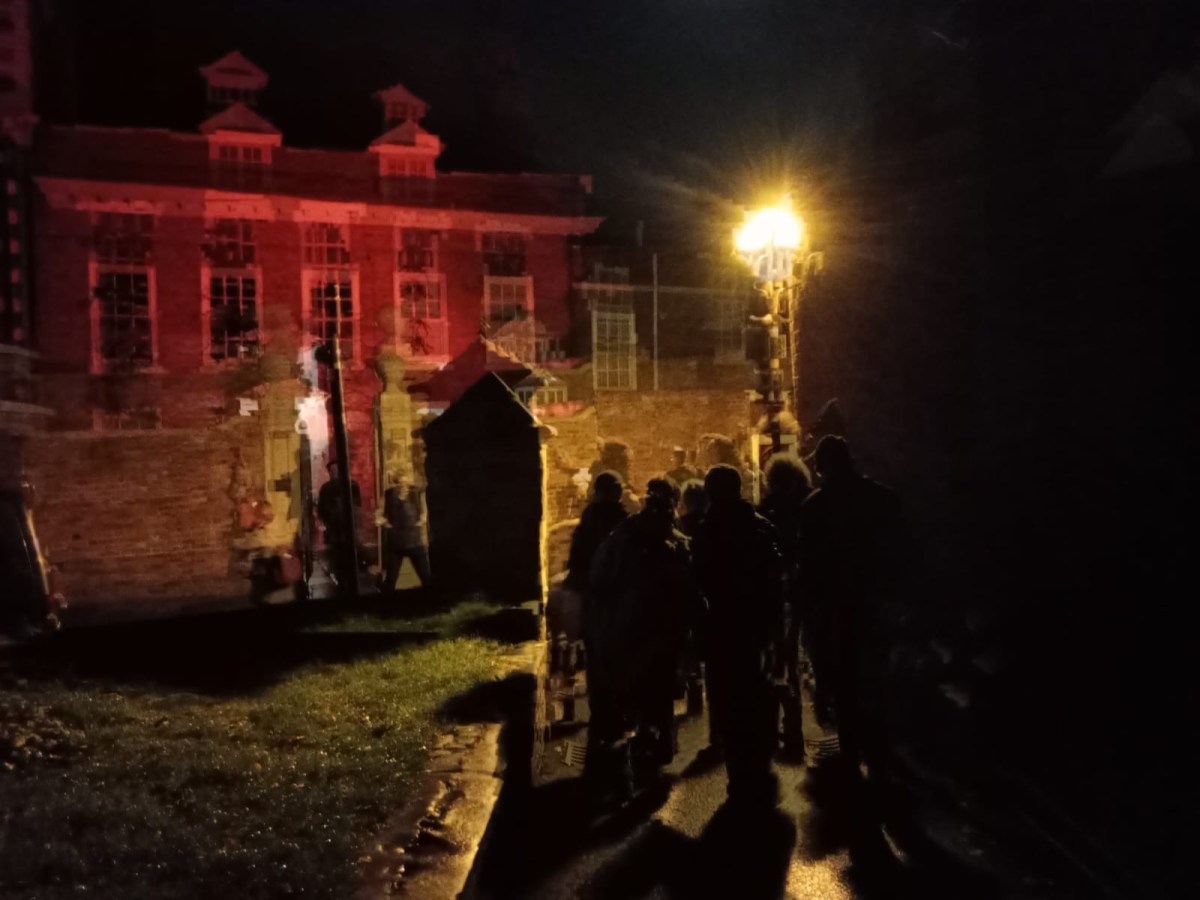
On 31st October 2025, a cool but luminous Halloween evening, the Shrewsbury Skull walk was launched as a public walking event. The light was already thinning by late afternoon, the sky clear but brittle, and by the time dusk arrived the town felt poised – streets holding their breath, shadows gathering in corners and alleyways.
For five years previously, Walking the Stirchley Skull, devised by Walkspace members Andy Howlett, Fiona Cullinan and Pete Ashton, had taken place as an annual event. In his essay ‘Walk Your Neighbourhood Skull this Halloween’, written for the book Night Time Economy published by Floodgate Press, Andy articulated a loose but evocative recipe for the skull walk: a blend of psychogeography, ritual, storytelling, and embodied attention, mapped onto the outline of a skull traced through familiar streets.
The Shrewsbury Skull came about when I moved to Shrewsbury in October 2024. Unable to join the Stirchley walk that year, I decided instead to create an alternative version, adapting the skull to a new town and terrain. This was done with the assistance of Andrew Howe (not to be confused with Andy Howlett), another Walkspace member already resident in Shrewsbury, whose local knowledge proved invaluable in shaping the route.
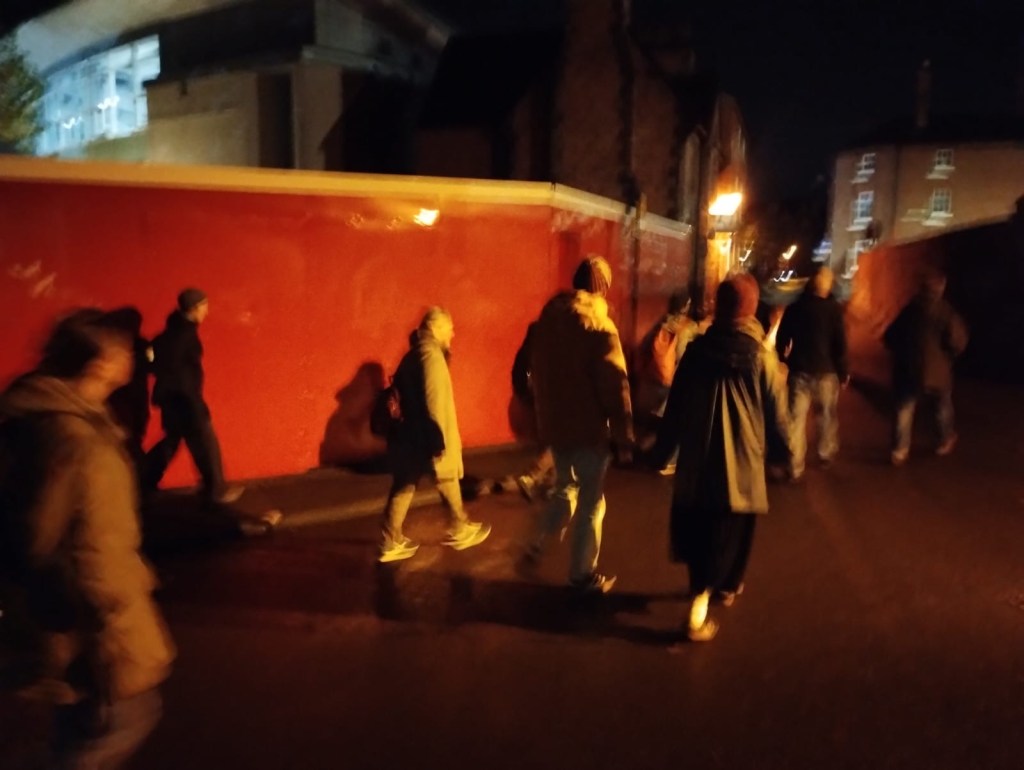
The first Shrewsbury Skull walk, held in 2024, was deliberately modest: a limited event with only a small group of invited guests taking part. It functioned primarily as a recce – an exploratory walk intended to test whether the skull could be convincingly mapped onto the town and whether the rhythm of the route held together at night. The intention from the outset, however, was that it would eventually become a public event.
For the 2025 walk, the event was advertised across social media and through The Shrewsbury Scoop, a new local listings platform. At 7pm, fourteen intrepid explorers gathered outside the Grade I listed St Chad’s Church. The church is believed to have been originally founded by King Offa, and its circular churchyard sits slightly apart from the bustle of the town centre, already lending the meeting point a ritual quality. St Chad’s graveyard also contains the grave of Ebenezer Scrooge – a former prop from the 1984 television adaptation of A Christmas Carol, starring George C. Scott. Sadly, due to vandalism, the churchyard itself is not accessible in the evenings, and so we stood outside its railings, peering in at the darkened paths and headstones.
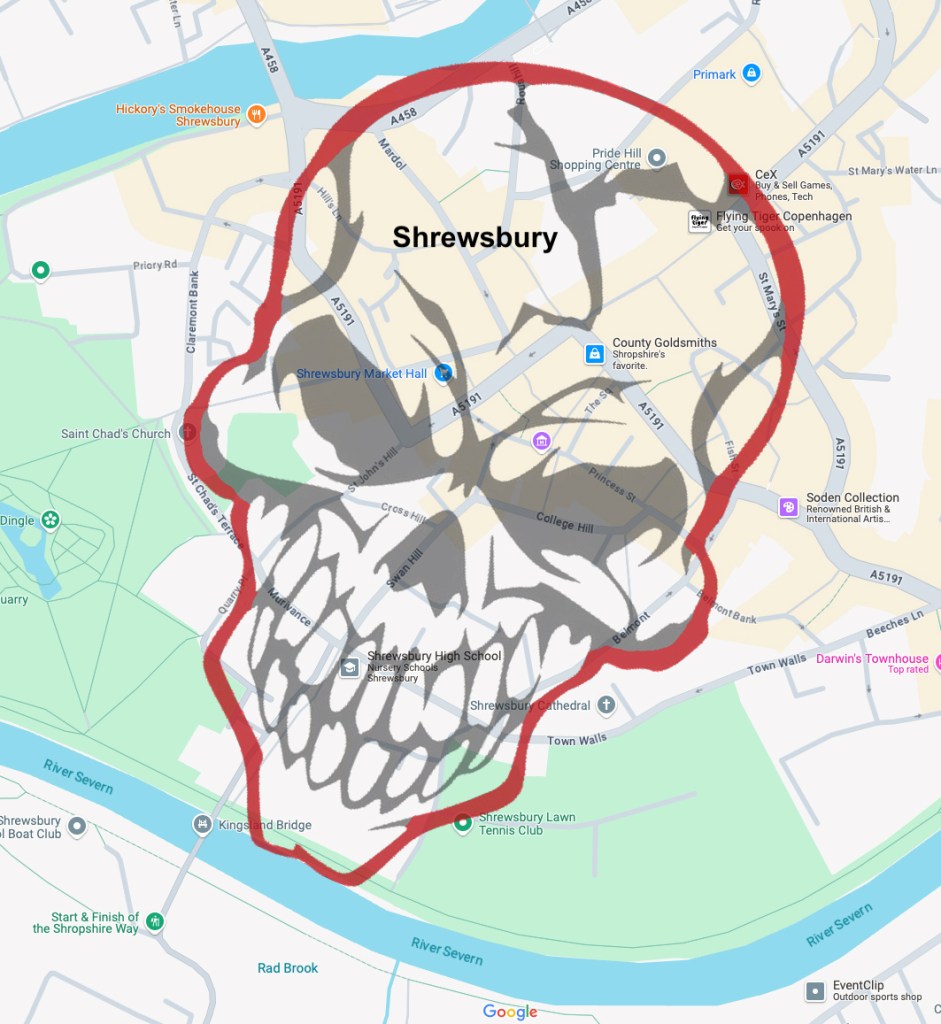
Although the route had been planned in advance, one decision still had to be made: whether to walk the skull clockwise or ‘widdershins’. Widdershins is an old term meaning ‘against the way’ or to travel in the opposite direction to the sun’s course, and as Andy Howlett writes, “this can be an effective way of invoking darker energies” (Howlett, 2024). Given the date, the hour, and the appetite of the assembled walkers, this method was unanimously selected.
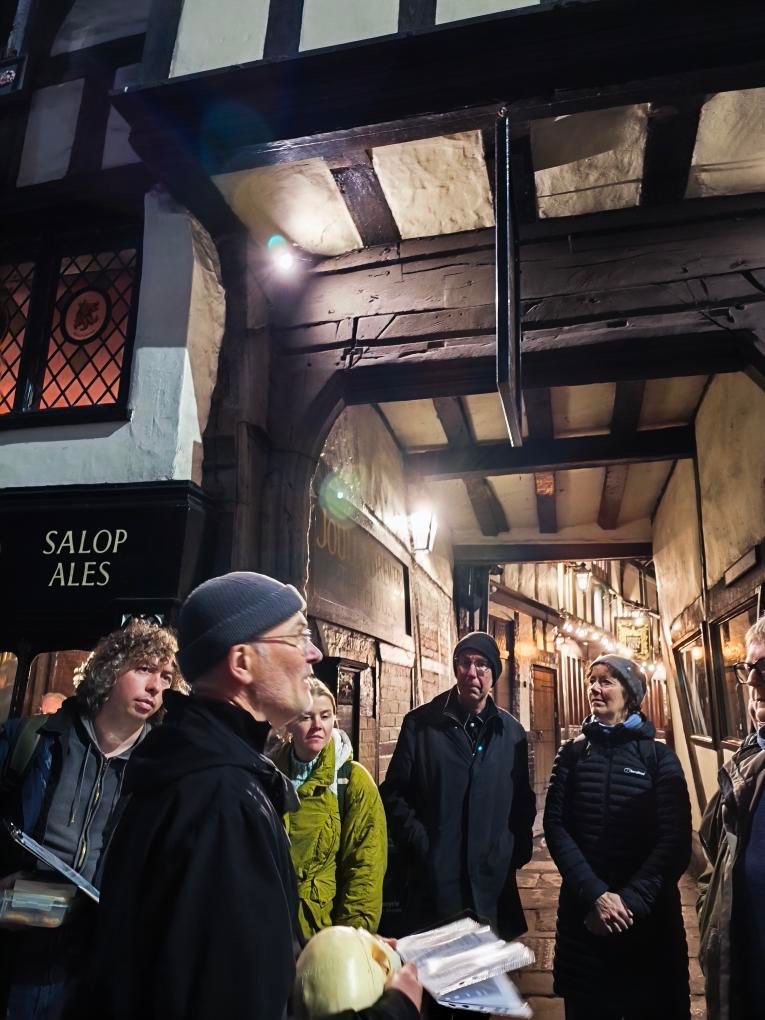
Shrewsbury is particularly well-suited to a night-time walk. Its medieval street plan remains largely intact, with half-timbered buildings leaning over narrow streets and numerous alleyways known locally as ‘shuts’ threading between them. At night, these shuts compress sound and light, amplifying footsteps and fragments of conversation, making it easy to imagine other presences moving just out of sight.
As we walked, various stories were recounted: tales of historic figures such as Captain John Benbow, who switched sides during the Civil War and was executed by firing squad, his grave now lying in the Old St Chad’s churchyard; and Ludovick Carnavon, after whom Carnarvon Lane (one of Shrewsbury’s many shuts) is named, a route that dates back at least to 1460. Alongside these were stories of visitors from the ‘other side’, including repeated sightings of men milling about Barracks Passage, thought to be soldiers killed at the Battle of Bosworth Field who returned to Shrewsbury because they had been warmly welcomed there in life.
From Barracks Passage we wandered up Wyle Cop (from villa-coppa, the town on the hill), a street with a long and bloody history. H. T. Timmins captured this past in a rhyme recalling the mutilatory executions once carried out there:
They hew and they hack and they chop,
And to finish the whole they stick up a pole
In the place that’s called Wylde Coppe,
And they pop your grim, gory head on top.
(Timmins, 1899)
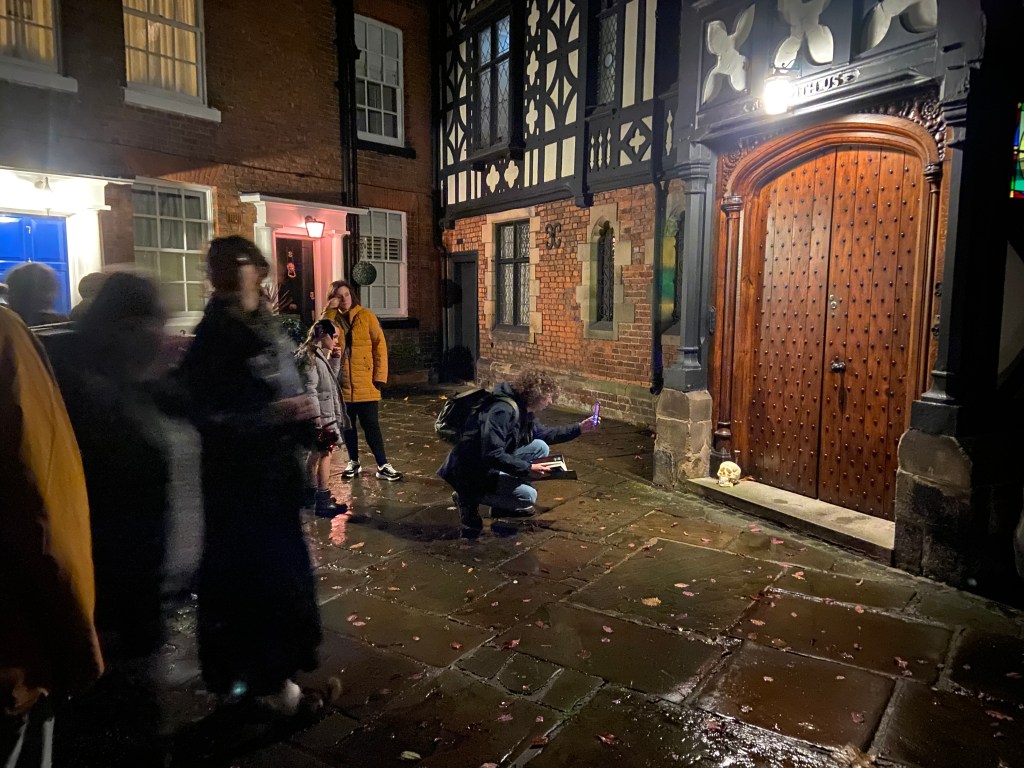
Partway up Wyle Cop stands The Nags Head, a pub reportedly haunted by the ghost of a coachman who hanged himself there in the 17th century. Footsteps, crashing noises, and the sound of heavy breathing are said to mark his presence – details which felt especially vivid as we passed beneath its darkened windows.
At The Parade, once the site of the town infirmary, further hauntings were noted. These include a figure thought to be a former visitor to the soup kitchen that operated in the basement during the 1700s, as well as the infamous ‘grey lady’. She was reportedly seen at the foot of patients’ beds, who by morning had passed away (Wood, 1979, p.79).
At various points we consciously leaned into the structure of the skull itself. As Andy Howlett suggests, it is possible to “turn the walk into an anatomy lesson: when you reach the point on the skull where the ear would be, tune in to the soundscape of the night by walking in silence. When you come to the mouth why not get out some tasty treats?” (Howlett, 2024). Accordingly, when we reached the ‘mouth’ we paused to indulge in offerings that included ‘soul cakes’ served from a skull, before continuing on. Later, upon reaching the ‘ear’, we walked the final stretch in complete silence, attending closely to the scrape of shoes on stone, the distant hum of traffic, and the occasional burst of laughter drifting from unseen streets.
The walk concluded back at St Chad’s Church. Before dispersing to the Admiral Benbow for drinks, we were encouraged to “consider the transformation that has been enacted tonight. Stand for a moment with the ghost of your former self. These streets will never look at you in the same way again” (Howlett, 2004). On Halloween night, with the town dimmed and subtly altered, this felt less like metaphor and more like a simple statement of fact.
Do keep an eye on our public walk announcements here on the Walkspace blog and in our newsletter over 2026.
References
Howlett, A (2024) ‘Walk Your Neighbourhood Skull’ in Night Time Economy, Birmingham, Floodgate Press.
Timmins, H.T. (1899) ‘Nooks and Corners of Shropshire’ cited in Palmer, R. (2004) The Folklore of Shropshire p35, Almeley, Logaston Press.
Wood, M (2007) Haunted Shrewsbury, Stroud, Tempus Publishing.
 Walkspace