Have you made a piece of work, walking or otherwise, in response to the Coronavirus pandemic? As the world suddenly changed a lot of us found our art practice was a vital way to make sense of it all and the National Academy of Sciences in the USA is looking to archive this hopefully unique moment. You just need to fill out a short form with a link to your work and they’ll do the rest.
I’d encourage people to take their criteria as a broad invitation, not a narrow “proper artists only” filter. Creative responses that seem small, indulgent or insignificant are often the most interesting in a situation like this, coming as they do from the gut.
We announced ourselves to the venerable Walking Artists Network (WAN) email list this weekend, asking for any people doing walk-work in the West Mids to say hello. And a few did! So this is the first WAITWMWRCA, roundups of people new to use that you might want to check out.
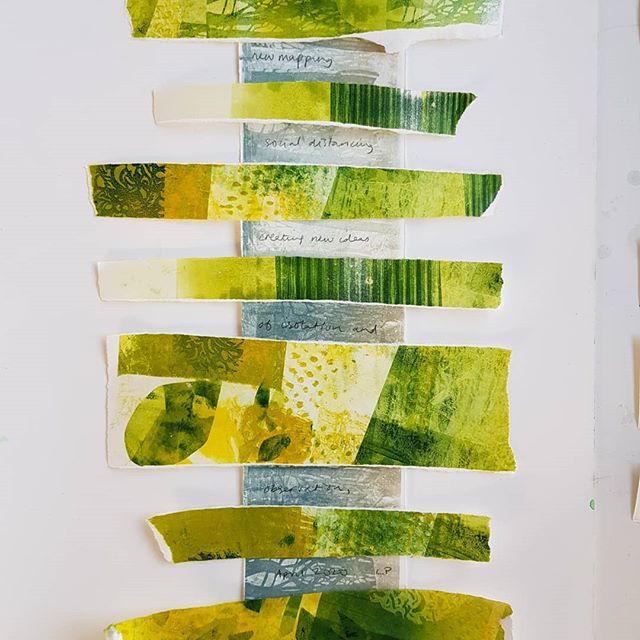
Lucy Parris is a printmaker and walker who lives in Kiddiminster but is finishing a fine art MA at Birmingham. She’s a member of Walking The Land, a Gloucestershire-based group of artists who we will definitely be investigating further, and is exploring the concept of socially distanced walking to conclude her MA.
Petra Johnson is an artist currently in China but returning to Stourbridge once air travel is a thing again. Her Walk With Me project took place in Beijing, Cologne, Shanghai, Xiamen, Taidong (Taiwan) and Berlin where she and a participant walk from a convenience store or kiosk to building or a landscape that defines the city. In 2017 she produced this short film from her work.
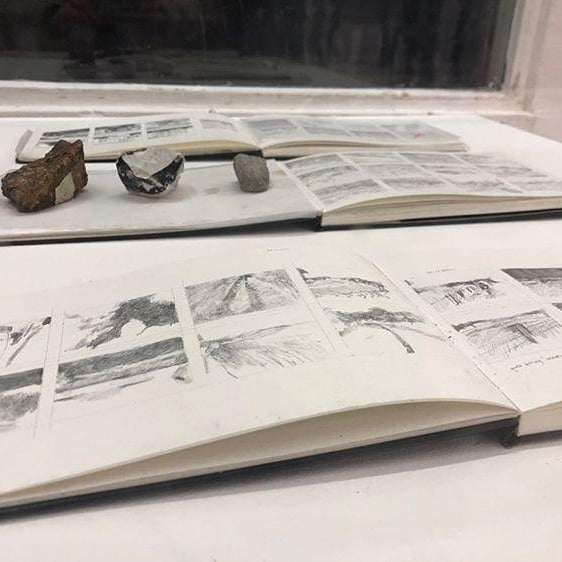
Daniella Turbin returned to Wolverhampton after completing her fine art masters in Glasgow but on the way stopped in Cumbria for 6 months where she got the walking bug. Her current (lockdown permitting) project is DRAWER where she’s “walking the UK, simply, to explore, meet and document the landscape and its inhabitants. These walks could be instigated for any number of reasons – from historical and political through to environmental or personal.” Lots of pics on her Instagram.
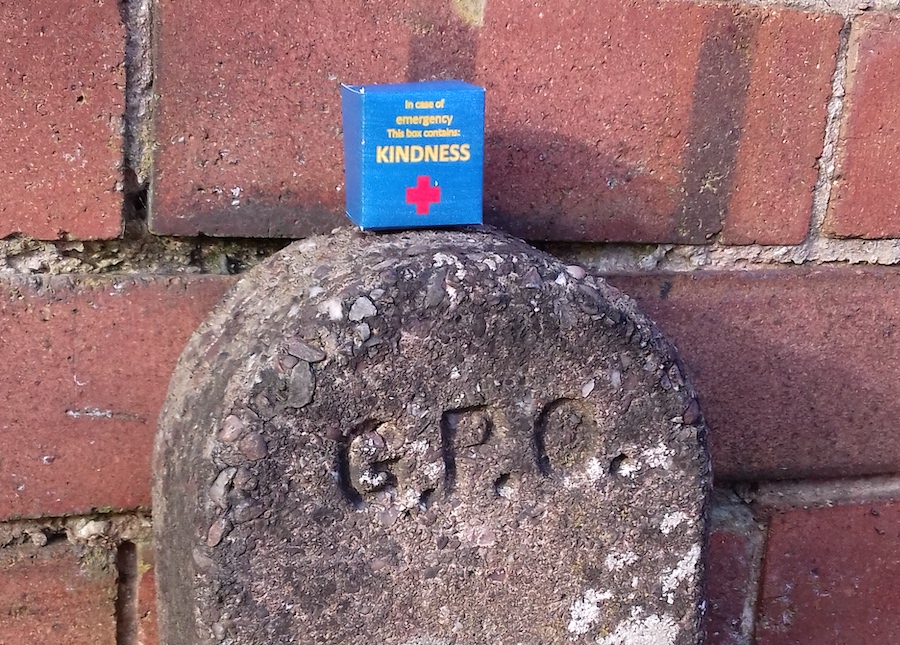
Andrew Howe is an interdisciplinary artist based in Shrewsbury who uses walking and mapping to explore how people interact with places. He sent a very long email detailing lots of exciting projects and works, far too many to mention here, so we recommend ploughing through his website. A good starting point would be his blog post on the Acts of Resistance project involving small boxes left in public spaces.
If you’re a West Midlands based artist, writer or some other variety of maker-of-things (we prefer the broad definition of “artist” here at Walkspace) for whom walking is an important part of your practice, please get in touch. We’d love to hear what you’re up to, and if you include a link to your work we’ll include you on the next WAITWMWRCA!
Following an arbitrary line is a tried and tested technique for the curious walker. The landscape and its contents will reveal themselves in a sequence determined by your line. Pick a start, an end and draw line between them. Follow that line and keep you eyes and ears open.
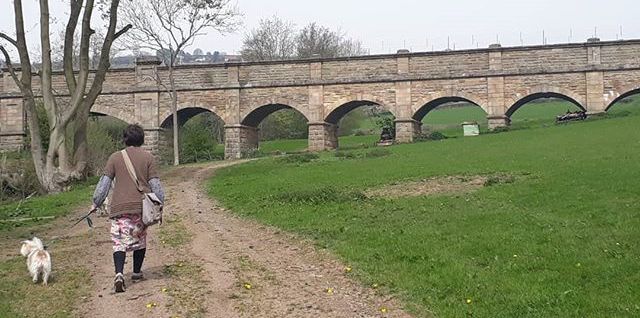
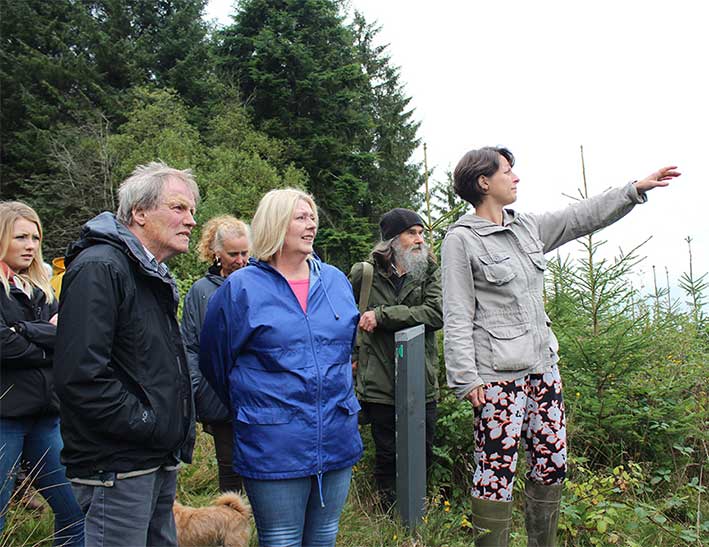
Kate and her dog by the aqueduct.Kate employing the walking-artist’s trope of pointing at things.
Thankfully the Elan Valley is 52 metres higher than Birmingham. A pipe angled at a gradient of 1:2300 will transport water over a day and half using gravity alone from the waterlogged mountains of mid-Wales. Building started in 1896 lasting a decade, and that’s why we rarely have a hosepipe ban in Birmingham!
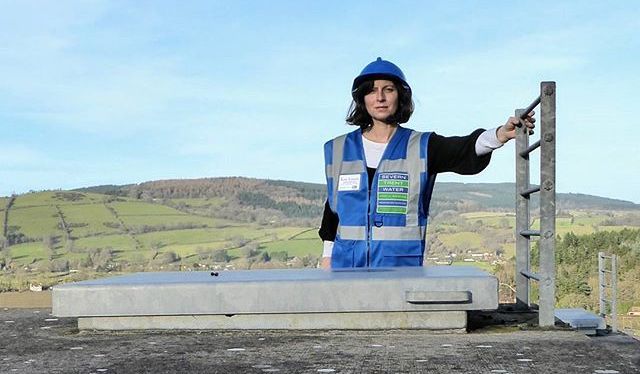
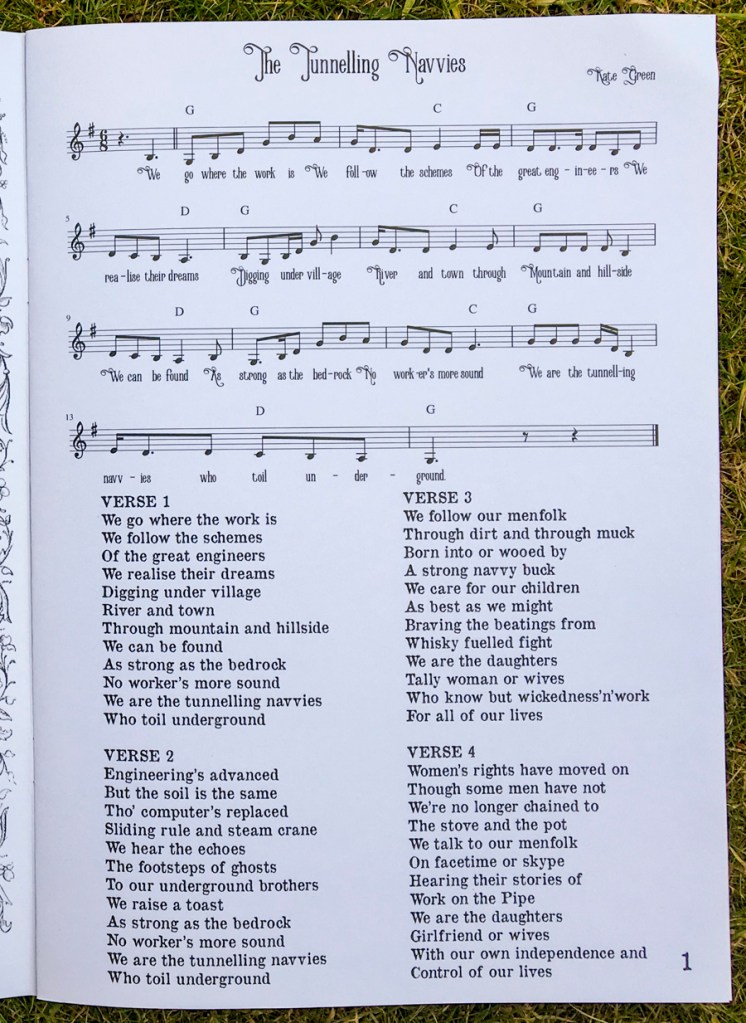
But I digress. Kate, who describes herself as a short interdisciplinary artist with dark hair, decided to walk the Elan aqueduct primarily to gather and share stories. She does this by writing and performing songs in a style that would have been popular during the build, drawing parallels between its creation and the present day. For example the navvies that built it were itinerant workers, moving their families from one job to the next. A century later the workers repairing and maintaining the pipe are predominantly migrants from Europe.
The Tunnelling Navies from the Walking the Pipe Song Book
Her project has seen her run workshops, coffee mornings, exhibitions and performances along the towns and villages near the pipe, all fed by a steady walk eastwards. They’re documented in The Pipe Chronicle, a cod-Victorian newsheet.
We got to meet Kate and her infectious personality when she presented Walking The Pipe at the Plymouth walking conference in November last year. Rather than a lecture, is was wisely run as a singalong performance in the evening when beers had been consumed. We’ve been singing “This is the damn, this is the damn, that feeds the thirst of Birmingham” ever since.
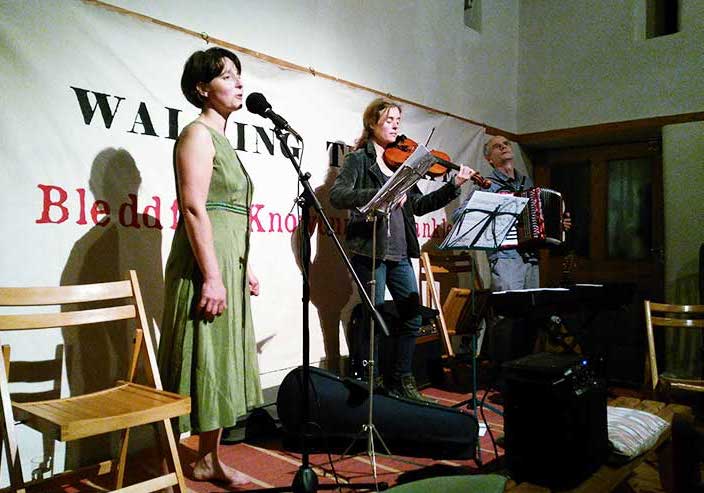
Kate performing at an event along the pipe.
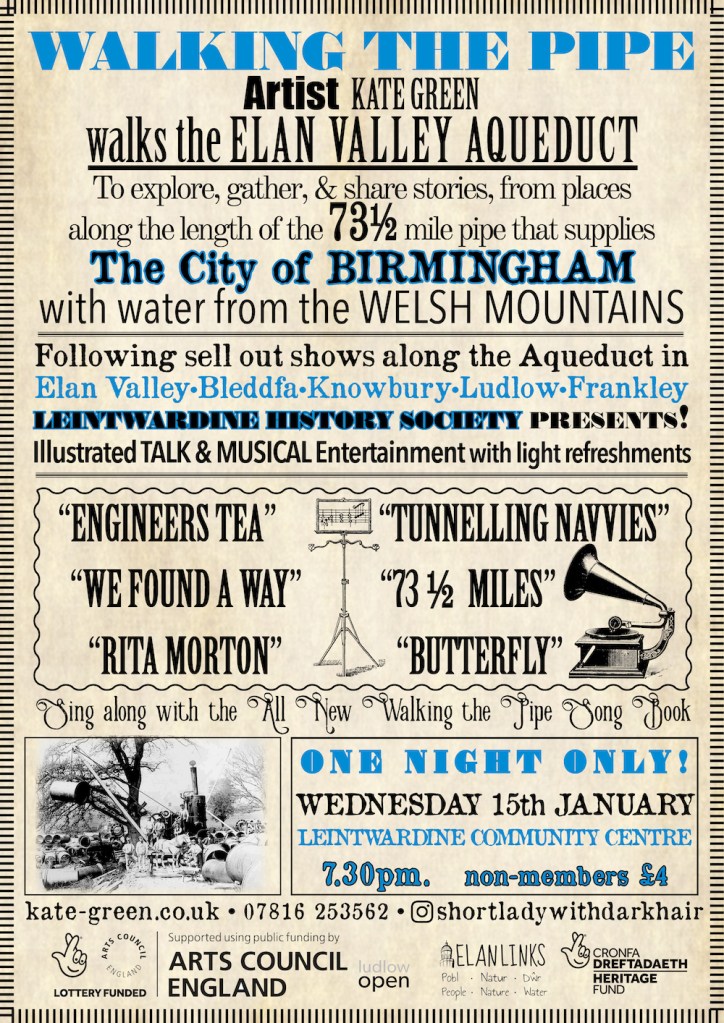
A poster for an event.
It’s rare to find art that is both high-concept and high-nerdery while also being fun and accessible. Walking the pipe is a gem.
Kate has produced a songbook and zine-style collection of her newsletters. A formal Walking The Pipe book is in production. Contact her for details.
Note: This project has been a success and is now ongoing! Please visit Mapping Stirchley for updates.
Everyone currently involved in Walkspace lives in the Birmingham suburb of Stirchley and the lockdown has made us keenly aware of our immediate surroundings. Walking the same routes again and again means we’re noticing things for the first time and figuring out new routes to perambulate along.
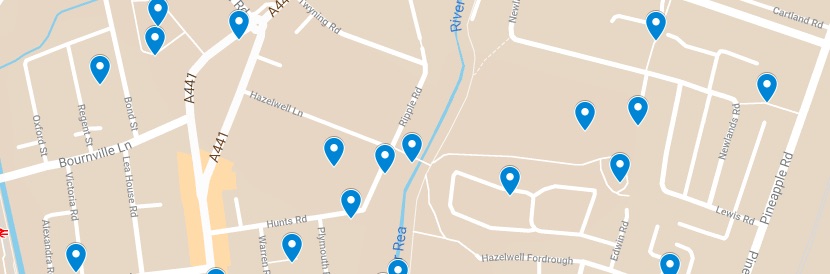
So we’ve started mapping things-of-note. It’s currently just a Google map, because they’re easy to manage, but in time we’d like it to be something more interesting on OpenStreetMap data, maybe like that excellent Tree Talk service that builds walks around its database of trees in London.
Right now it’s just got stuff from the four of us, and that’s not good enough. If you’re also from Stirchley (and we know at least 20 of you are because you came on our pre-lockdown night walks!) and would like to contribute a thing-of-note, there are two ways.
Send us a pin
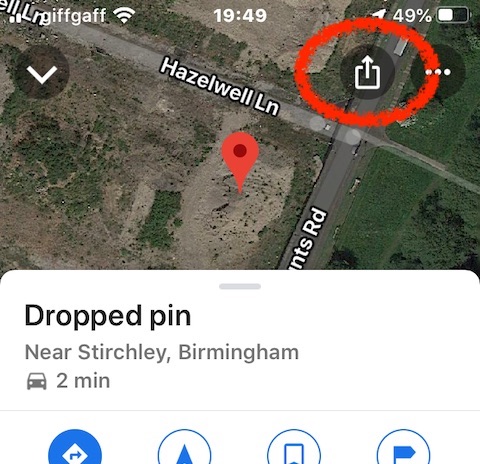
In your mapping app of choice, drop a pin where the thing-of-note is. Look for the Share button (usually a box with an arrow leaving it) and email it to walkspace.uk@gmail.com. Make sure you include at least a title and feel free to provide more context. Your name won’t be put on the map but we’ll keep a record in case we want to credit people in the future. (We won’t use your email for anything else, promise.)
Make your own map
If you’re a regular explorer of Stirchley and have loads of pins to send it’s probably easier to just make your own map. That way you also have your own map! Google Maps is probably the easiest but any service that lets you export the data will do.
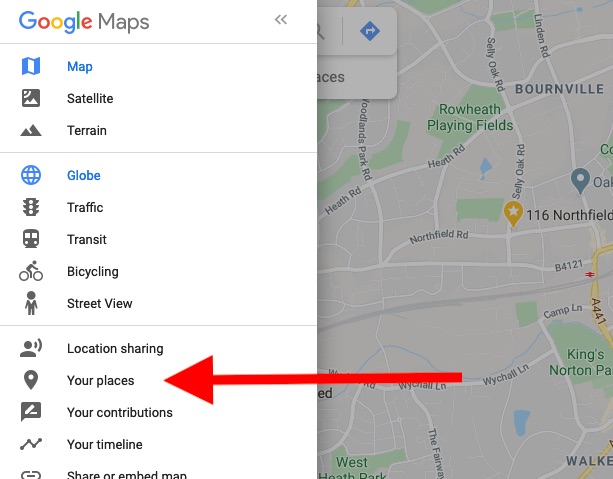
To create a Google Map go to google.co.uk/maps on your desktop browser and click on the menu bar in the top right. Look for Your Places and click on that.
You should see four tabs, Labled, Saved, Visited and Maps. Click on Maps and then, at the bottom, click on Create Map. You can now drop pins on the map and label them. Feel free to write descriptions or link to pages with more info. Photos are also great.
Once you’ve made your map, click on the Share button and figure out how to copy a link that means anyone with that link can view the map. (Google keep changing how to do this). Send that link to walkspace.uk@gmail.com.
Phew! Anyone would think Google don’t want you to make your own maps! But once you get through the setup it’s all really simple. If you need help, drop us a line.
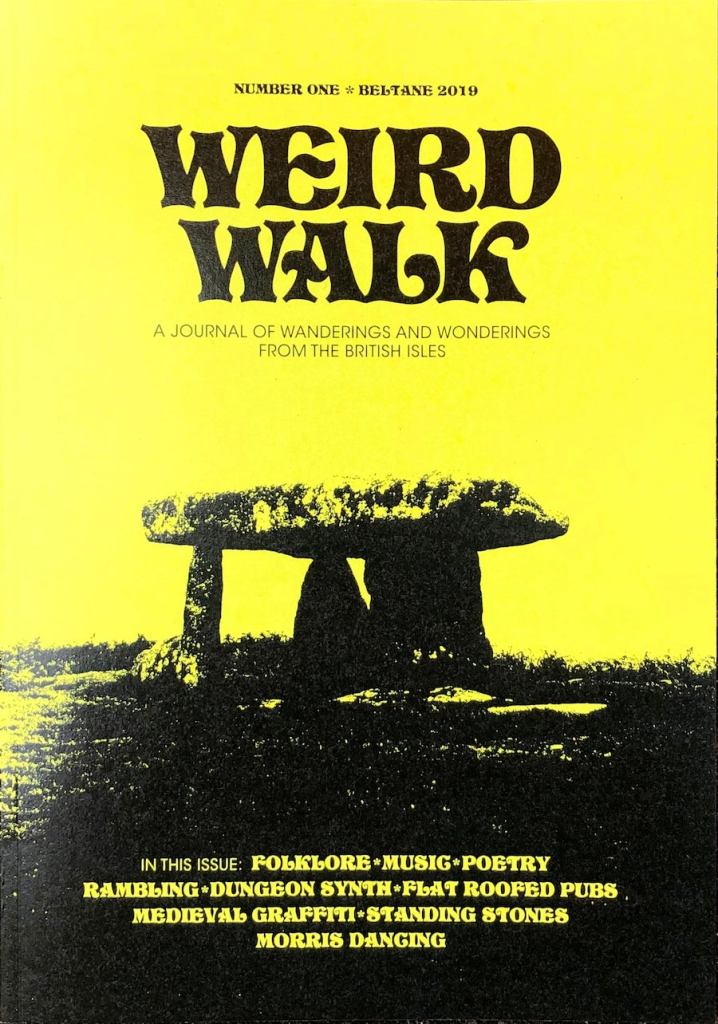
Weird Walk is a zine in the true sense of the word. Sure, it’s an A5 publication of 40-odd pages that you get in the post, but it’s also a collection words and pictures about a thing that the authors are obsessed with and which they need to put in a package to send into the world, hoping it reaches others who are equally obsessed with said thing. A zine, in other words. And in an era of zines-in-name-only (don’t get me started) it’s refreshing to see a real one.
Weird Walk is about walking, obviously, and the stone dolmen on the cover, not to mention the typeface, indicates an interest in the old and ancient. Heading the editorial introduction is Julian Cope quote from his Modern Antiquarian period which pulls us away from traditional heritage and focusses us on a more contemporary take on the old, a revivalism of the pre-modern, looking far, far back for something, anything, that might save us from the eternal now of regurgitated pop-culture nostalgia. A search for something weird.
This idea of the New Weird has been bubbling around for a few years. John Doran of music/culture site The Quietus coined the phrase New Weird Britain as a bucket for all the acts he was seeing at gigs and festivals that didn’t fit into the music industry but also weren’t really part of the art world. Freaks and weirdos doing their thing because they needed to. He wrote a nice introduction to the concept for the BBC and themed The Quietus’ guide to Birmingham’s Supersonic Festival around it. Notably, however, New Weird Britain isn’t a unifying sound or genre. You will find stuff that sounds like folk music in the NWB bucket – Richard Dawson springs to mind – but that’s not why it’s in there. It’s more about being outside of the mainstream, but not in a tedious rebellious way. Less punk, more WTF.
When the New Weird crops up in movies the aesthetic is much more focussed. Paul Wright’s Arcadia, a feature formed from 100 years of archive footage, leans hard into Weird Britannia, joining up ancient pagan rituals with 20th century non-comformity. It’s a celebration of that which the Victorians and Modernists found horrific, but whose attempts to remove it from British identity left an urban, post-colonial Britain unmoored.
I always find it quite telling that, according to the horror tropes, we’re supposed to root for the Edward Woodward’s policeman in The Wicker Man but modern audiences are all about the islanders. Summerisle is no longer a heathen backwater but a utopia that has escaped the futility of the modern world. We want to follow Christopher Lee’s Lord Summerisle, to sing songs and copulate in the fields and burn Christians.
For contemporary movies I always think of Amy Jump and Ben Wheatley’s A Field In England as epitomising the New Weird. This story of four civil war deserters tripping balls in a mushroom-infested 17th century field bypasses heritage period drama, neatly sidesteps Monty Python absurdity and barely nods at Hammer Horror. It seems to be reaching for something older, something Shakespeare or Chaucer might have struggled to reach. The hallucinogenic mycelium threading this field brings the soldiers into contact with a land so vast and unknowable it’s closer to a Lovecraftian void. Britain is old. So old that even people in olden tymes could get lost in it.
English identity is a particularly fraught thing to go in search of, particularly when you associate it with the land. Richard Smyth’s article on Nature Writing’s Fascist Roots is a cautionary tale for those who would seek answers in England’s green and pleasant land. When we talk of the land we think of the countryside and forget that villages and farms are as “natural” as an urban factory and just as infused with class and race inequality, if not more so. In navigating this the weird is a helpful guide. When confronted by an idealisation of England, does it make you feel comfortable? Or does it seem a bit weird? Always go with the weird.
In the introduction to his epic survey of 1970s esoterica, High Weirdness, Erik Davis spends a while unpicking the word and its many applications through history. This bit on “weird naturalism” felt relevant.
Most of us have had experiences that, unless we have utterly misread them, put severe pressure on conventional realistic accounts of how the world works. We may have had a prophetic dream, or been struck by an absurdly recurrent synchronicity, or received advice from a forest creature, or glimpsed a bizarre object in the sky, or felt the presence of a loved one at the time of their distant death. Or we know people who report such experiences in ways we have no reason to disbelieve. If we want to earnestly describe such experiences without rejecting common-sense realism, we reach for the language of the weird. “I know it sounds totally weird but…” or “Pretty weird, huh?”
Why do we do this? One reason is that to characterize a phenomenon or object as “weird” is to sneak in no extra metaphysical claims; no divine writ or occult rumor is needed to vouchsafe the existence of strange and uncanny impressions or experiences. They are part of human life, at least if you are paying attention. At the same time, the weird does announce the appearance of something like anomaly, or at least deviancy—inexplicable, aberrant, or unsettling events or encounters that pull or twist against the norm. Statistically, such deviations may be perfectly routine. But they never feel that way. So we don’t know where to put them. Many of us forget such events, or sweep them under the carpet. And by using the label weird, we acknowledge them, but also trivialize them. The weird twists the profound depths it seems to point to into banal, even throwaway, surfaces.
High Weirdness, p8
The weird is the bucket we put things in that don’t make sense but don’t really matter. Once that bucket fills up and overflows, maybe we should start looking at it.
Weird Walk is a zine about walking. It has photos of prehistoric standing stones and Tudor woodcut figures. The typeface evokes a 70s hippy publication found in an Avebury cafe. Other than a feature on a suburban pub east of Birmingham, its content is firmly beyond the city. It’s a zine in search of something old, something from before. Something weird.
After invoking the arch-drood Julian Cope our editors ask “What is a Weird Walk?”
For us, walking is an active engagement with the British landscape and its lore. Whether traversing the chalk paths of the South Downs, or the shifting landscape of the Black Mountains we want to not just stretch the legs but also get thinking and talking and creating around the land and its history, both real and imagined.
Which strikes me as an admirable refusal to define the weird! You know it when you see it, and when you see it you put it in your zine.
The two main pieces in the first issue are interviews and mark out the boundaries of Weird Walking quite nicely.
Justin Hopper is quickly established as the spiritual father of this enterprise with his book The Old Weird Albion serving as a touchstone for the zine. An exploration of the South Downs, I was struck by how he approaches his walking as someone disconnected from the land. Like myself, he had a rootless upbringing, not really being “from” anywhere specific. So when his grandmother took him on walks he was like a sponge, ready to be “part of something old and wise”. The familiar is the enemy of understanding. To really see something it helps for it to be strange, beyond our everyday understanding. It’s an understandable irony that the rootless are the ones who best see the roots.
The other interview is with Matthew Champion of The Norfolk Medieval Graffiti Survey who leads a growing community of amateur historians looking for ancient markings in churches and other surviving buildings. He sees these scratched symbols as a link to all levels of medieval society, not just the priests and nobility. They also tell us about how people related to these buildings in an active way, physically manifesting their prayers with markings. Indeed, leaving a mark only became frowned upon in the Victorian era. It was seen as an acceptable way of communing with god, to leave your mark in his house.
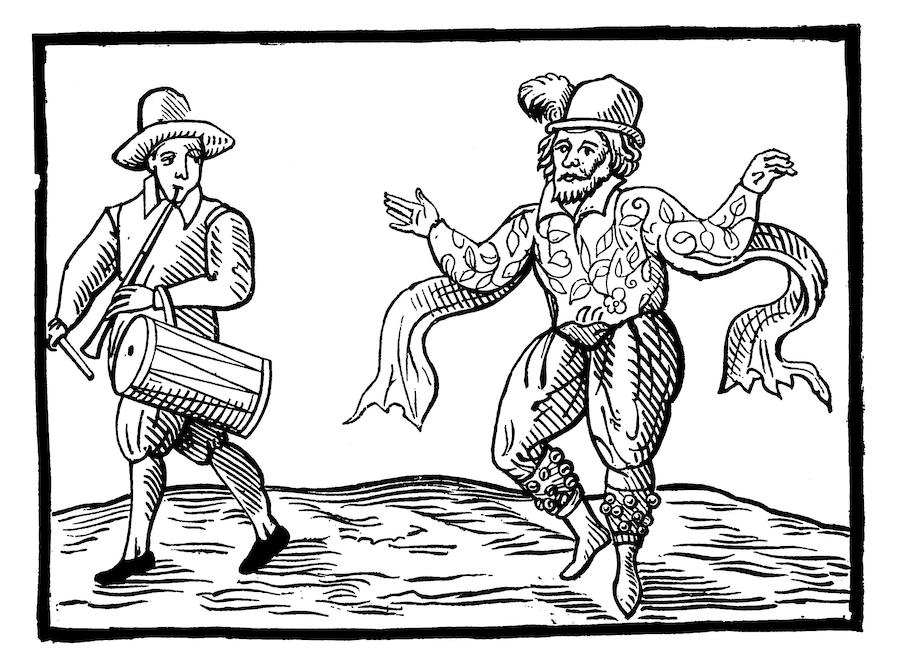
These two interviews give a necessary depth to the Weird Walk venture, anchoring and contextualising what would otherwise be fluffy zine-staples like music reviews and the obligatory poetry page. A two page history of William Kempe, the Shakespearian comic actor who undertook a 100 mile morris dance from London to Norwich, takes on a new pathos in this context. Kicked out of the theatre for his anarchic tomfoolery he embarked on his long dance across the land, embraced by the public and imbibing of much ale. But within three years he had died in poverty and obscurity. The English Renaissance had no place for his medieval pagan nonsense.
Kempe makes for a worthy icon of the weird walk because he was there when the sensible really started to kick in. Let us walk in his shoes and imagine a different, weirder world.
Weird Walk issues 1 and 2 cost £5.50 each plus postage and can be ordered from weirdwalk.co.uk.
This review covers the first issue. I’m saving the second for later, once I’ve properly digested this one.
Trees are our companions, man. That said they do not generally walk with us, unless you have been lucky enough to take a stroll with an Ent in your local Fangorn Forest. They do however live where we live and ‘breathe’ the air we breathe.
Some of the first to signal the arrival of spring are cherry trees. They burst into flower, like the earth venting clouds of pink and white blossom, billowing from between buildings, from behind houses and in parkland. A few weeks later horse chestnut flowers look like the gleaming spires of a city in the branches.
Trees change quickly at this time of year. Four weeks ago most trees were still quite bare, now they are in leaf or at least in bud. As they do so they soften the landscape in which they grow. The dark silhouettes of winter blurred by new growth. When you can get farther afield go to see trees on hills, where the weather is naturally a bit harsher. These trees are often two or three weeks ‘behind’ their cousins in the relatively protected valleys and cities.
If you look a a patch of woodland from a short distance you will run out of words to describe the different verdant greens of each species of tree. Adam Nicolson, in his brilliant book The Making of Poetry, describes spring as having ‘rhapsodic freshness in every molecule’. Some leaves are not even green, there are bright yellows and deep reds as well. Visit a local tree once a week from the start of April to the end of May, throughout the year in fact, and you will see it transform. The effort the tree exerts in spring is worth pondering. A mature oak is thought have around a quarter of a million leaves, all of which it replaces every year!
Charles Simic sensuously describes leaves in his poem, called Leaves,
… Watching leaves,
The way they quiver At the slightest breath of wind, The way they thrill, And shudder almost individually, One of them beginning to shake While the others are quiet, …
and later, in the same poem,
On this oak tree casting Such deep shade, And my lids closing sleepily With that one leaf twittering Now darkly, now luminously.
The dappled shade of spring leaves, now darkly, now luminously, enable carpets of bluebells, wood sorrel and wild garlic to flourish.
When summer arrives you can almost watch as trees wilt on long hot days. All the effort of Spring replaced by a staid endurance in the dusty summer air. Trees provide their own shade. Stand under a big tree on a hot day and the cooler air is lovely, don’t fall asleep though, you might wake up in Faerie.
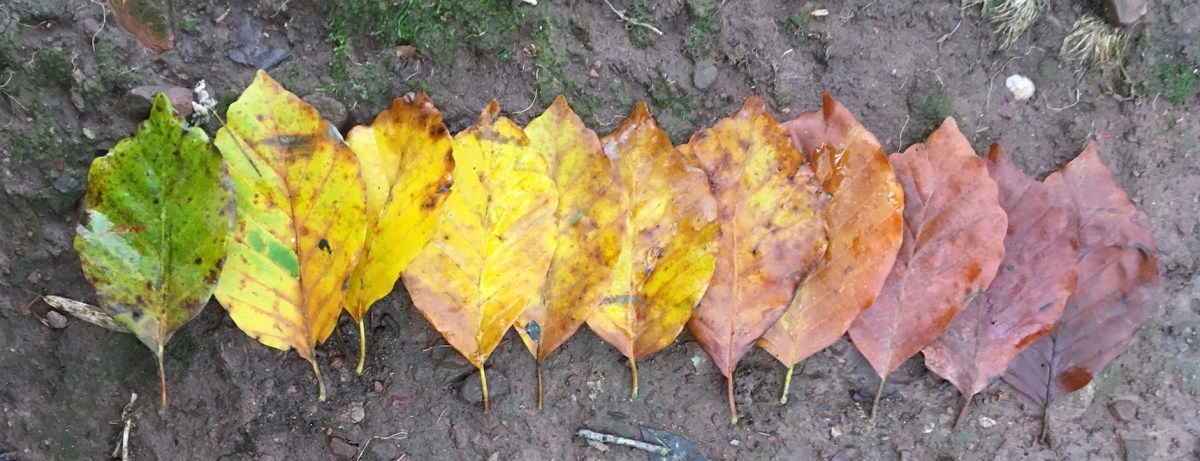
In autumn the colours of the leaves seem to compliment the lowering sun, it’s like someone planned it. They didn’t. Autumn colours are the result of the trees no longer photosynthesising. The leaves lose their greenness and, as decay sets in, change to yellows oranges, reds and browns. The shorter, cooler days make the trees realise it’s time to start hunkering down. Walking through still autumn woodland is one of the delights of the season.
Winter trees stand stoic against the cold, their dark branches punctuated by crows. The view through woodland is no longer ‘hindered’ by leaves so you can often see views unavailable the rest of the year. Many of the original map makers of these islands did their best work in winter when they could see further from trig points. Trees are basically hibernating in winter although it’s called dormancy. By not maintaining their leaves they are saving energy for when it’s needed.
And so back to spring. All the recent evidence suggests that humans, that’s most of us reading this, get tangible mental and physical benefits from spending time in woodland. So spend some time amongst trees. Watch them ebb and flow across the year and go for a walk.
Since the start of lockdown I have been walking for an hour, around sunset, almost every day. This is great time of day to watch wildlife and the unseasonably mild spring has made it a daily delight. Animals are of course, entirely unaware that the world is a bit more unsettled than usual just now. I find that somehow reassuring. In these uncertain times a feeling of ‘kinship’ with non-human earthlings can help, even if the feeling is not mutual.
Some of those earthlings, the avian ones, are quite easy to see. Birds often gather together as this slightly improves their odds if we, or any other animals, decide to hunt them. If you’re missing crowds go and watch gathered water-fowl, pigeons, gulls, sparrows and crows all go about their work. More solitary are blackbirds, grebes, jays, woodpeckers, robins, wrens and herons, the latter can often be seen on the canal.
I have seen a falcon, a Peregrine I think, hover over it’s prey in one of the less built-up suburbs. Birds of prey are still rare in cities but can be seen quite often in the edge-lands, where the distinction between urban and countryside blur. Watching one hunt is a mesmerising.
Ted Hughes brilliantly describes a hunting hawk in the first poem of his first collection, with the same title, The Hawk in the Rain.
… but the hawk
Effortlessly at height hangs his still eye. His wings hold all creation in a weightless quiet, Steady as a hallucination in the streaming air.
I encourage you to read Hughes’s bird poems, he usually writes with a directness that is accessible and conjures tangible images of many different creatures.
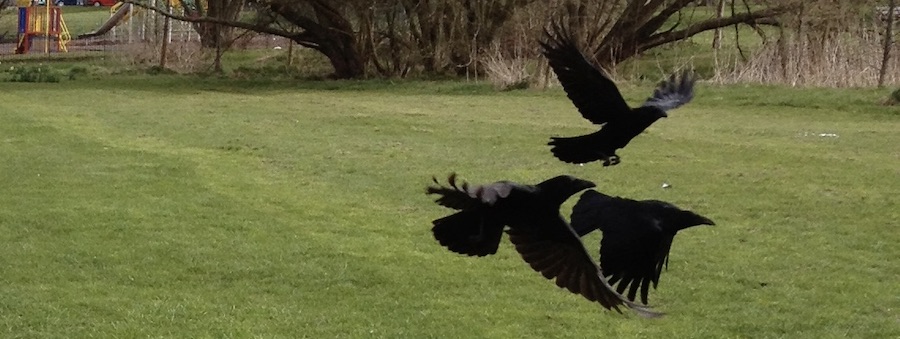
Less direct is Hughes’s collection Crow which tells tales of the mythic trickster crow of many cultures. Look for the deep iridescent blue on the backs of crows and ravens. You can spend the rest of the day trying to decide if it was indeed blue or a colour as yet unknown to science. Watching crows along the canal squabbling over a discarded chicken takeaway is one of natures true wonders.
Waterfowl, ducks, geese, swans and moorhens, seem to like a good old-fashioned punch up at dusk so it’s a good time to observe them. There is no doubt a good evolutionary reason for this boisterousness but, to my unknowledgeable eye, they appear to simply enjoy a row. They settle down again as night creeps in.
Gulls are ubiquitous in town and country and, of course, by the sea. That said you can leave the ‘sea’ part out of their name, most gulls have never seen the it and, apparently, they think it’s a myth. Read Landfillby Tim Dee, it’s a lovely look into their lives and how those lives are linked to ours. Wood pigeons and their tough inner city cousins, with their often mangled feet, make interesting viewing. When startled, you may have noticed, pigeons ‘batter’ almost straight upward to evade a threat. This is thought to be because they used to live on mainly on rocky ground in the ‘olden days’ and this was a way of evading lizards and wild cats that stalked that terrain.
In Birmingham there is a growing population of starlings in the city centre. Their seemingly anarchic ways and punk feather-styles make them a good lunchtime distraction.
Farther off red kites glide over Wycombe and the Chiltern Hills and can be seen easily from the train to London. Kites are often a bit scraggy looking but are still majestic and they are slowly moving to new grounds so keep your eyes to the skies.
I haven’t even mentioned the dawn chorus! Get up really early and listen.
During the current time we, perhaps, feel less connected to our fellow humans. We might also be less at the behest of our usual daily timetable. Take advantage of that time, if you can, and connect with the feathered fauna that live near you. Feel part of something, no matter how passively, and go for a walk.
Partly inspired by our Fiona’s piece on great tits.
Here’s another selection of walking-related media to help you through this time of going nowhere.
Audio
Eve Phillips and Roxie Collins are co-hosts of Corporeal, a themed music show on Brum Radio. In a different lifetime Eve came on our Full Moon Walk and she told us about the show and in particular an episode they had done on the theme of… yes, walking. Join Eve, Roxie and special guest Ben Waddington of Still Walking Festival for two hours of songs and conversation about walking.
Long ago a path was created by the passage of feet tramping through endless forests. Gradually that path became a track, and the track became a road. It connected the White Cliffs of Dover to the Druid graves of the Welsh island of Anglesey, across a land that was first called Albion then Britain, Mercia, and eventually England and Wales.
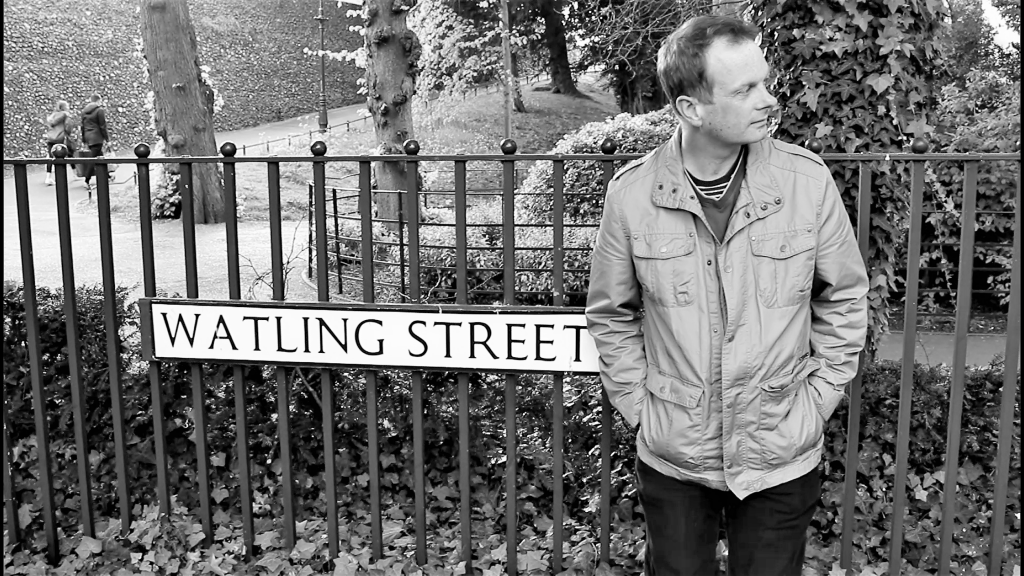
Long ago Pete lent me his copy of Watling Street by John Higgs. The book charts Higgs’s journey along this ancient route (now variously known as the A2, the A5 and the M6 Toll) in search of “the hidden history that makes us who we are today”. I never got round to reading it but luckily they made a podcast. In episode one Higgs and author David Bramwell travel to Kent to explore the themes of pilgrimage and the conflict between spiritual and political powers.
Film/Video
In response to the pandemic our friends at Video Strolls have compiled a COVID playlist on YouTube. “Being in lockdown affects everything, but artists and film makers are still making journeys of one sort or another.” Join a voyage around a bedroom, become a back garden archaeologist and witness a herd of goats reclaiming a Welsh town. I found it particularly poignant joining John Rogers on his last walk before lockdown.
In a similar vein kottke.org has shared a selection of videos from all over the world of people simply going for a walk around their city (pre-lockdown). The videos are mostly unedited and without music or narration, just ambient city sounds. Very therapeutic.
I’m going to take this opportunity for a bit of shameless self-promotion and direct you to the latest video I’ve uploaded to my YouTube channel Footnotes. I’ve been re-uploading my old stuff until I have something new to share and this one is a tour of some of Digbeth’s ghost signs and typographical curiosities with Ben Waddington (yes, him again) from 2014.
Words
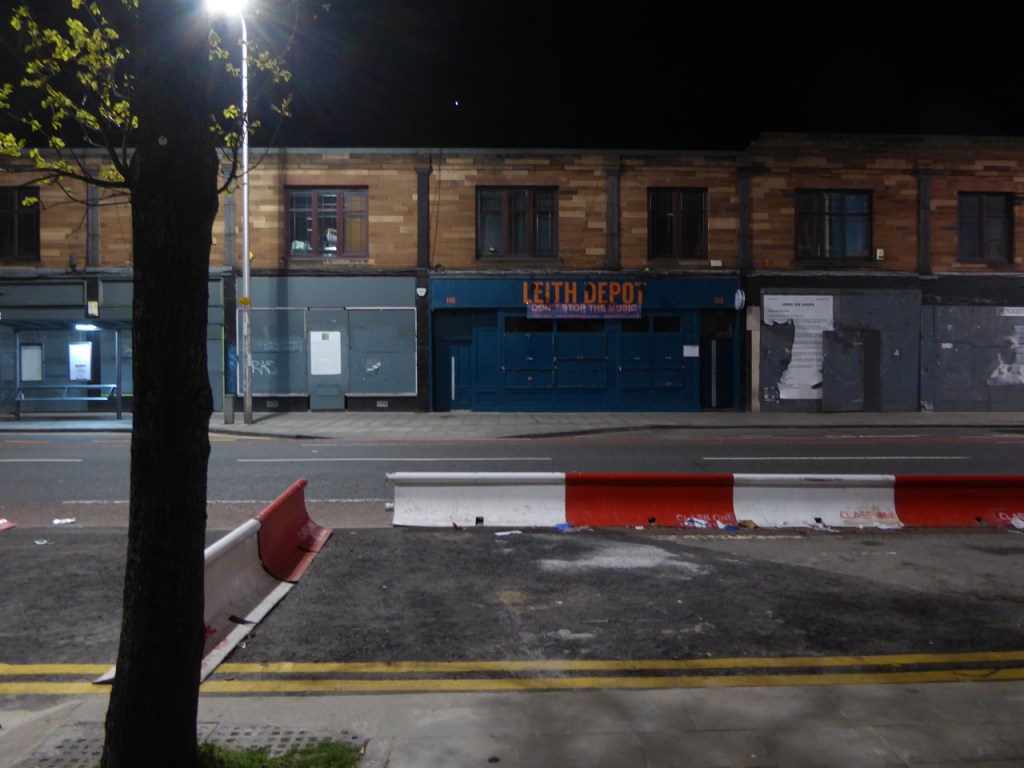
The Liminal Residency is “an alternative writers’ retreat which takes place in a range of neglected and unusual spaces, from service stations to theme parks to the terminals of international airports.” Their latest blog post is an evocative write-up of a walk around Leith on lockdown.
A suitcase lies open in a door, bedding and plastic cups and clothing scattered in a pall around it. In another doorway a meal kit delivery has been plundered, ripped open, the contents disgorged. Signs are everywhere. They adorn shutters, are taped to boards. In one case a notice of closure is scrawled in pen directly onto a wall.
Read the full piece here and check out some of their other posts which include a tour of Alton Towers’ hidden relics and an ode to New Street Signal Box.
Stay safe and if you have any recommendations of your own get in touch!
In two previous pieces I wrote about walking alone and in company. It feels remiss to write about walking at the moment and not properly acknowledge the current situation and how walking can help.
Our current choice of walking companions or lack there of, is somewhat imposed upon us but walking can still provide nourishment. As you are probably aware, with all the current extra anxiety and uncertainty in the world it is important to give our brains a chance to reset, recalibrate, relax. We will all be dealing with lockdown in our own ways but below is a short list of simple ‘walk-experiments’ that might help, particularly if you are struggling with isolation, anxiety or just good old fashioned boredom.
First up, go for a walk. You’ll feel better afterwards.
Go for a walk and try counting your steps. Don’t use fitbit (other pedometers are available), or if you do, count yourself as well and compare the totals. Counting your steps involves you directly in the act of walking. By the end of lockdown know exactly how many steps each street around you home is, how many steps it is to the shops or the pub (this might prove useful when it reopens). These distances will be in your very own measurement, as it will be your paces and no one else’s.
Go for a walk and look for angles, curves, straight lines in the buildings or natural environment around you home. You will almost certainly find something you had never seen before. You might find patterns in the lintels on a particular street, there might be a particular curve to a section of river or path that catches your eye.
Go for a walk at the same time each day. If you are working from home, or do not currently have work to go to, this will help create a routine. If you limit your walk to one hour, as you should, you won’t get too cold or too wet at this time of year and you’ll always be quite close to your house should a spring storm provide too much of a soaking. Note what changes, the light, the flora, the fauna, the atmosphere, the pavement.
Go for walk at different times each day. Walk an hour at each hour of the day for 24 days. For example, day one, walk from 0700 to 0800, day two, walk from 0800 to 0900 and so on. The 0200 to 0300 walk on this one is a challenge but a reward too.
In Notes Toward a Supreme Fiction, a long poem on the making of poetry, Wallace Stevens considers the act of walking and the finding of a version of ‘truth’, he writes,
… Perhaps
The truth depends on a walk around a lake,
A composing as the body tires,
Your walks do not have to help you compose lines of poetry, or reveal a cosmic truth of the universe, but they might reveal an interesting truth about your neighbourhood, your street, your local park. They might reveal something about a part of your area that you have not been aware of before. Think of your own walk-experiments too (if you have children, once they come round to the idea, they are good thinking of new walking ideas).
So, try to give yourself some time to consider the outside and, most importantly of all, go for a walk.
I recently wrote regarding my preference, and indeed need, for solitary walks over hill and vale.
Having said that in recent years I have come to enjoy some of the pleasures of walking with a companion or companions. I have gained accomplices for both local walks and those taken farther abroad.
A conversation at work revealed a colleague who likes to do hill, moor and mountain walking. So I have spent the last two or three years, exploring the Peak District, Snowdonia, the Brecon Beacons and the Welsh Marches with an able collaborator. Those walks have become important and are missed.
More recently and more locally I was introduced to a someone through a mutual friend with an interest in walking in all its forms. Before all this ‘bother’, said friend and I would walk about once a month from the car park of the British Oak pub, in fashionable Stirchley. The walks thus far have been to ‘local’ places that caught our attention. This has included an angry wall in Highbury Park, a couple of moated sites from the Civil War, some entirely invisible burnt mounds in Woodlands Park and following Icknield Street, the Roman road built around 2000 years ago. When conditions allow we’ll be walking to, or from, Birminghams omphalos in Duddeston, the concrete fish at Fox Hollies and, at some point, the length of one of Birminghams rivers. As poet Roy Fisher noted of rivers of Birmingham, there are ‘Two. More or Less.’.
Both these types of affable regular walking put me in mind of Mary Shelley’s Frankenstein in which Robert Walton, the ‘narrator’, writes to his sister Margaret of his adventures in Arkhangelsk, northern Russia –
But I have one want which I have never yet been able to satisfy, and the absence of the object of which I now feel as a most severe evil, I have no friend, Margaret: when I am glowing with the enthusiasm of success, there will be none to participate my joy; if I am assailed by disappointment, no one will endeavour to sustain me in dejection.
Walton has secured the services of dependable sailors for his trip but craves some one he knows to share his adventure. Some one with whom to look at the sun setting over the ice fields and exchange a glance of mutual recognition.
I read Frankenstein many years ago and have forgotten most of it but, for all my preference for solo wanderings, this section always resonated with me. The acknowledgement that, sometimes, the view is somehow ‘more’ when shared.
Lastly, all these words about walking are making my feet itch. I will be out this evening for my hour a day, letting my feet lead the way. So, if you can, get out of the house and go for a walk. If you’re isolating with others sometimes it is OK for them come with you. Share the experience, make an effort take joy from a walk with a comrade.
To be clear, I still prefer walking alone but now it would be a much closer contest!

 Walkspace