Categories
Posts Projects Walk Reports

Submerged – walkers in residence at the Elan Valley

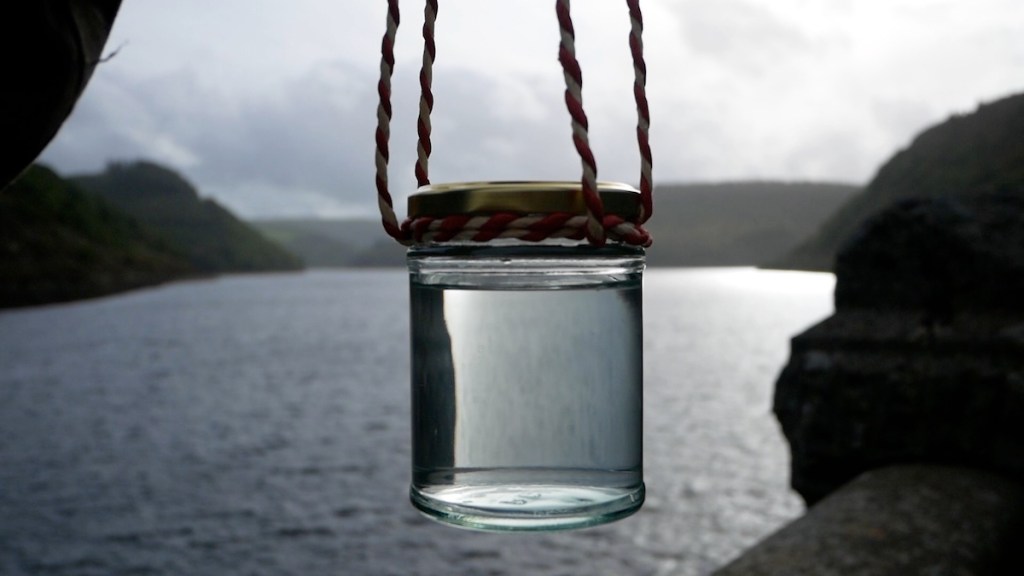
In late September 2023, eight Walkspace members took part in a micro-residency at the Elan Valley in Wales, the source of Birmingham’s drinking water. We undertook our journey in the manner of a pilgrimage, carrying with us a jar of Birmingham tap water to return to its source. We had thought we might respond to themes such as sustenance, displacement and extraction, but Dan Carins soon found there was something else bubbling up. Here Dan reflects on day one of our visit and the walk from Rhayader. This trip was made possible with the support of Elan Links.


We would walk from Rhayader to the bunkhouse not far from the top reservoir of the Elan Valley: approximately eight miles through beautiful Mid Wales countryside. We’d be there by the late afternoon and the others would go on ahead by car with our bags and the food we’d just bought. On a mild, sunny day in late September there would be plenty of daylight – there’d also be a kitchen, hot showers, wine and beds with pillows. There didn’t seem much else to worry about.

Photo © Charlie Best

We five follow the path along a disused railway keeping a brisk pace, and we talk. The conversations skip and jump back, finding grooves of common interest among the frequency of observations. We spot a slow worm (or is it a grass snake?), a face in the front of a church made of windows and the door, maybe that’s a kite circling over a field. Someone runs off to take a picture of a river – a proper river! – and to scrump a couple of the largest pears we’ve ever seen. There are giant mushrooms growing on straight, tall trunks. Lambs’ ears growing alongside the path. There are pines – although we can’t agree on which species they are. I opt for Loblolly, only for the word; later I’ll conclude they’re Scots Pines. I say I’ll point one out when I see one.

I don’t see many, and the few that I spot were probably planted ornamentally – they appear at the end of large back gardens of the houses on the edge of town. Pines used to cover Britain from top to toe, but now I associate pines with Greece or Rome, after Respighi no doubt but I distinctly remember being struck by a row of majestic pines, dark green against a brilliant blue Roman morning sky, probably on the way to the forum – unless that’s the name of a TV sitcom that was old when I was young. With the other fruity chap who wasn’t Kenneth Williams. I spot another pine where the former railway disappears into a tunnel. Maybe it grew there naturally, left alone by farmers and protected by the ghosts of a Beeching line.
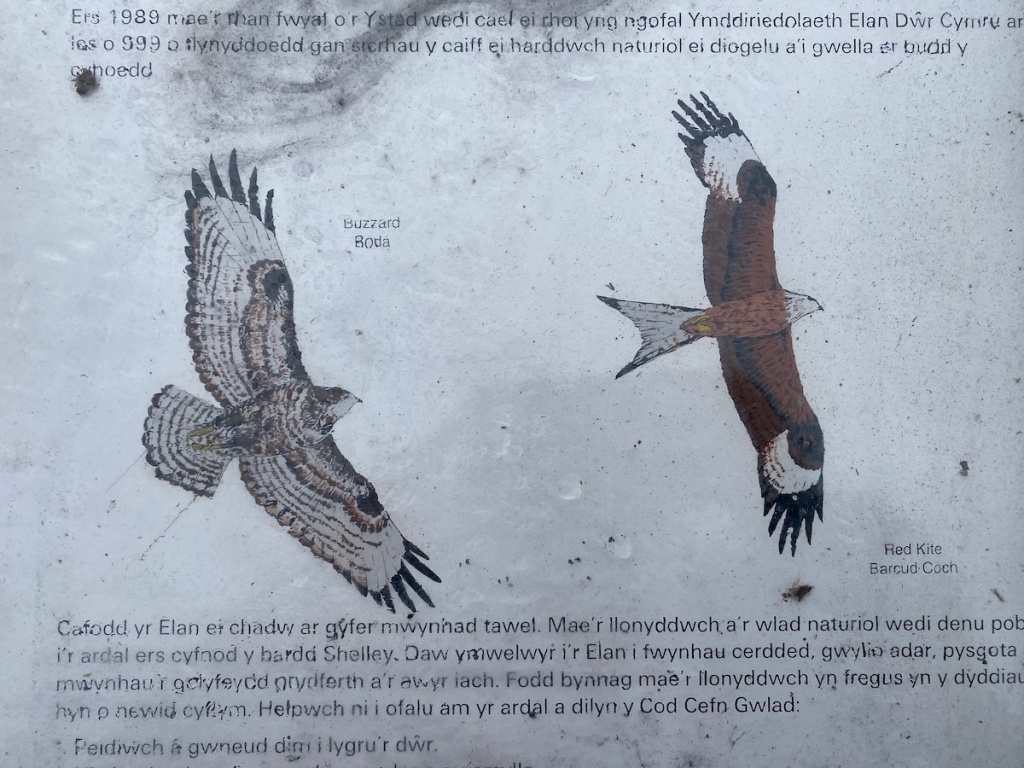
Photo © Charlie Best

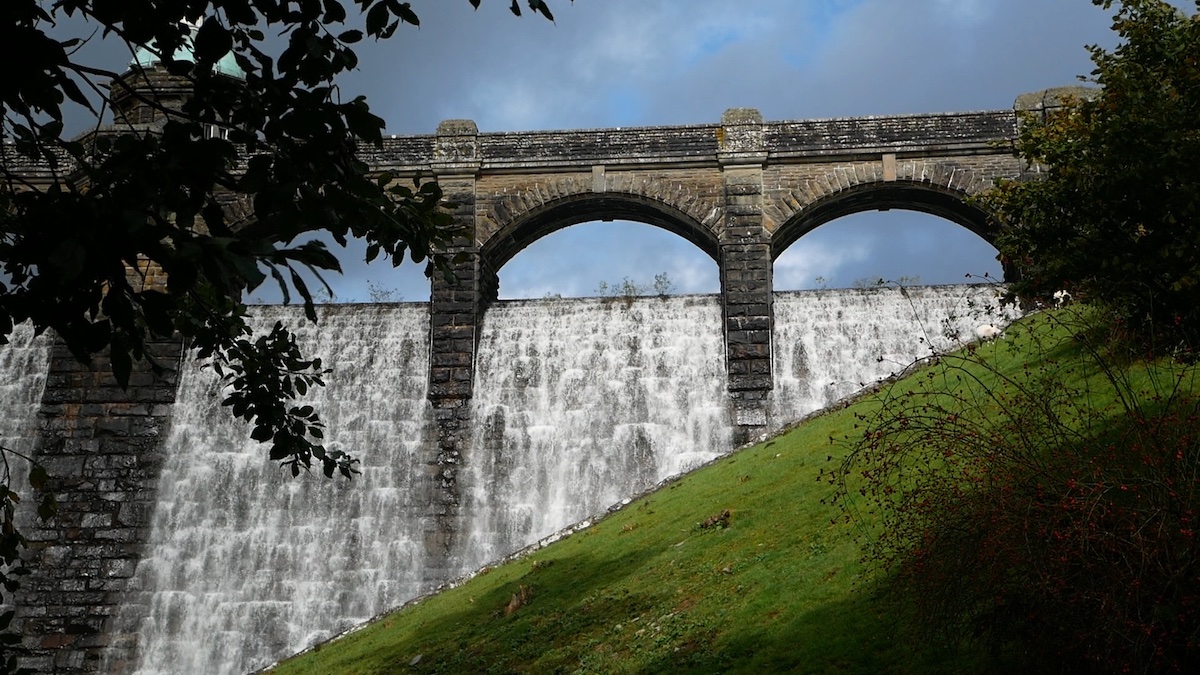
The halfway point will be the visitor centre at the first reservoir. We head past the car park straight for the dam further along the valley. It’s here we see the first water and begin to piece together the first blocks of understanding the significance of the trip. The valley below the dam wall, the water above it. The scars cut into the rock on the steep valley sides, the bulk of the dam wall. The sluice at the bottom of the dam, the mass of the reservoir behind it. The broadleaf woods we walked past on the valley floor, the firs high up in the hills behind the reservoir. Two old blokes in flat caps talk quietly nearby as they look out across the sun-dappled water.

A couple try to arrange a picnic on a table whilst their young child, wrapped up warm in a pink puffer suit, attempts to gain their attention. She tugs on her dad’s coat as he pours from a flask. The water in the reservoir makes another persistent tug, relentlessly lapping against the top of the dam wall. The sluice thunders below.
Screenshot

From here, it all looks serene and entirely natural: God’s in his heaven – all’s right with the world. Isn’t that Robert Browning? I once set that poem to music: I was proud of it. No – that was Porphyria’s Lover: the preceding poem in my Penguin Poetry Library paperback from 1992. On a plinth, we read the list of numbers and dimensions from the construction of the reservoir and agree that there’s a lot of water behind the dam, and a lot of men and horses moved a lot of earth and stone to build it. We realise we should make a move if we want to keep to our timetable.

I relax more as the walking begins to feel monotonous. We follow a narrow road around the edge of the reservoir, which stretches out far into the distance. The firs I’d seen from the car park have huge scars carved through them: they’re plantations, of course. Suddenly a raven flaps above, making its ridiculous croak: I thought ravens only lived in the Tower of London, and it turns out I’ve been completely wrong for the 12 years since I took my son there. We spot a small white wooden box marked “FISHING RETURNS” on a gate and speculate as to its purpose. There are few people about. Did Fishing ever leave? Who was she? Thoughts like these pop in and out of my head: they’re welcome distractions. I imagine synapses lighting up as we spark from one subject to another.
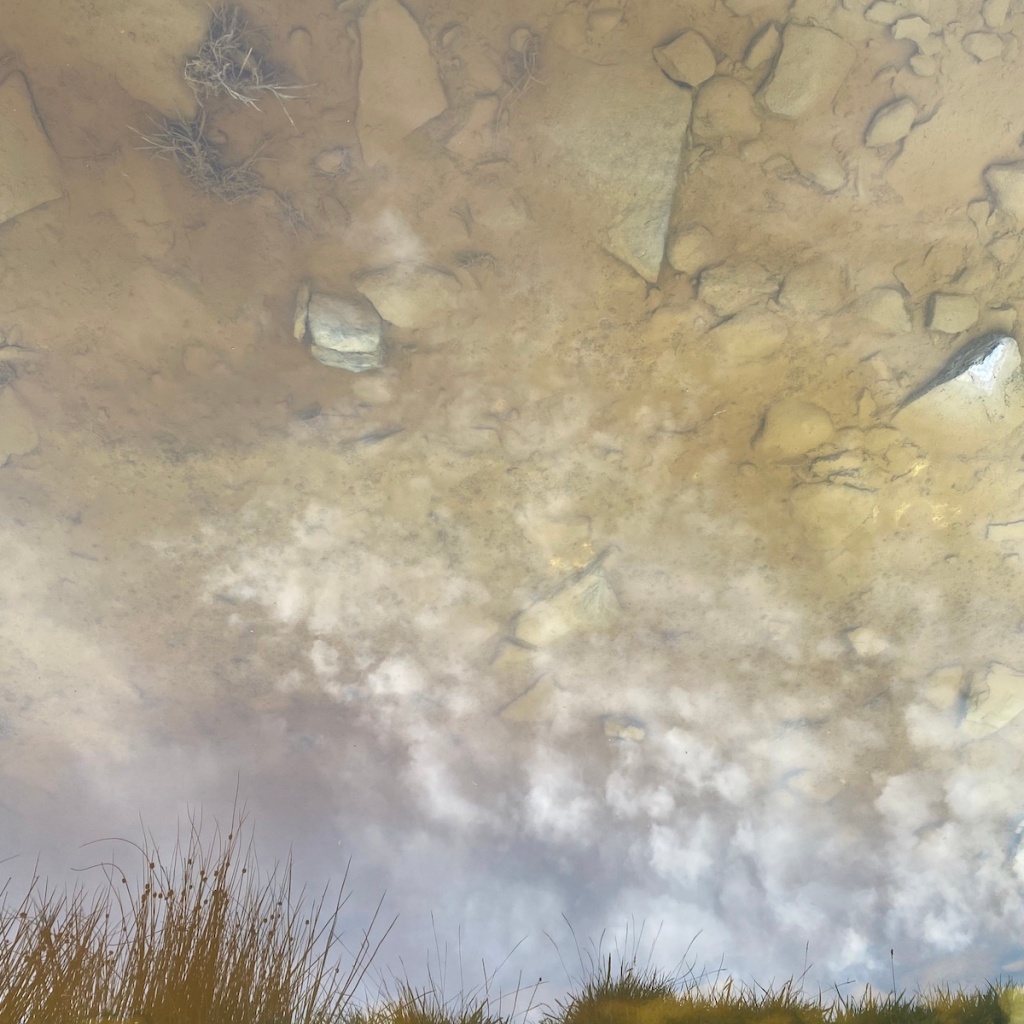
Photo © Charlie Best

When I’m walking alone, I find that the more interesting thoughts quickly bubble to the surface once I’ve stopped worrying about work and daily life admin. The same applies when I’m doing the washing up, or cooking – but walking is much more fun. I can make a walk last much longer. Walking in a group doesn’t have the same effect: either there’s no time for the bubbles to rise to the surface, or I remain guarded and awkward. Or: too many ravens. It makes me realise the sheer weight of the daily life admin, and the pervasiveness of my work. I wonder what might have been: what could I have discovered if I hadn’t wasted half my life thinking about employment numbers of now obsolete companies, or how I could have encouraged them to invest? Too late. My brain now feels sluggish, reliant on the vim at the surface of my memory – whatever’s most recent is what sparks my contributions to the conversation. I get by this way. I feel I never dive down deep and really submerge myself these days. It’s probably why I keep talking about the same things, telling the same stories, and mentioning the same books or music or events. There must be some shockers down at the depths.

We approach a bridge that crosses between two reservoirs, past the green cupola of what we call “the plughole”. It’s in the distinctive and unique Birmingham Gothic style, straight out of a Wes Anderson film: not quite British, not quite Austro-Hungarian; not quite fin-de-siecle, not quite anytime else. It reminds me of the Palais de Justice in Brussels, not necessarily because of its style, but more its incongruity: its oddness visible for miles around.
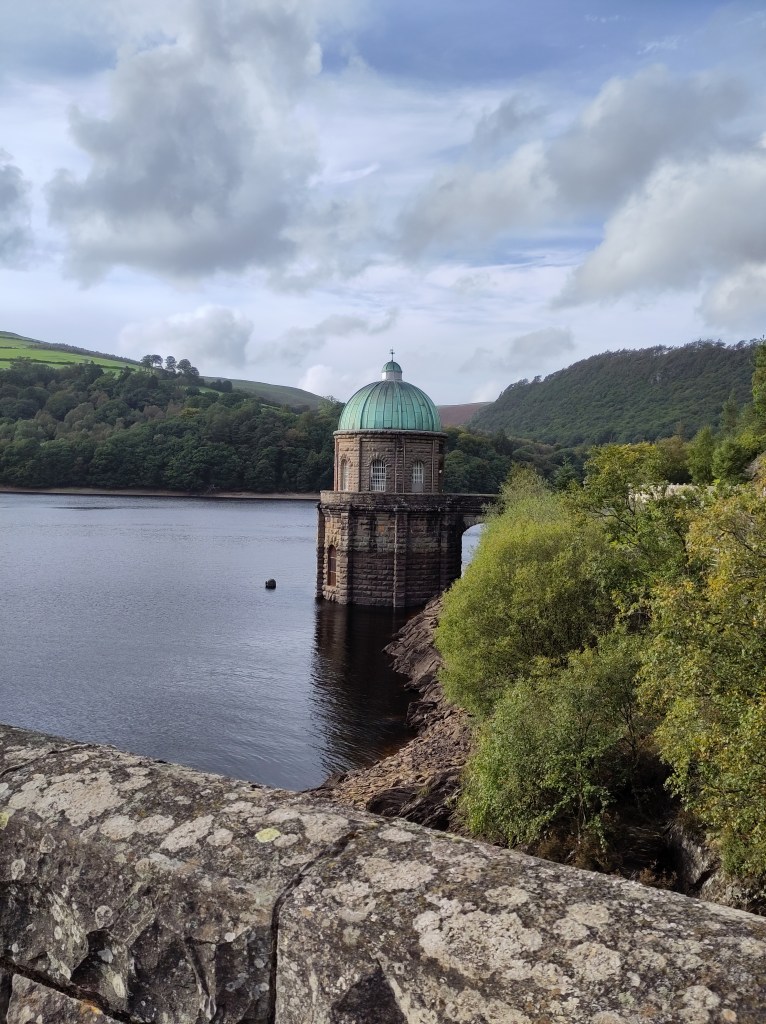
Photo © Dan Carins

I learn afterwards that this bridge runs atop a submerged dam: it makes sense now, but at the time it simply felt like a footpath built for our convenience: so much infrastructure, so little time to appreciate it. I make a mental note to talk to the others at some point about heuristics, my new reductionist Answer To Everything. On the other side, however, I’m interrupted by a more immediate indicator of what used to be below the water: a small church built to replace the one now submerged on the valley floor. Maybe because it’s slightly elevated from the road, or maybe because it’s a building with a dedicated purpose rather than a more general road. Or maybe because there’s a panel by the road explaining the church’s history. Either way, we stop to ponder and think for a while about what may lie beneath. Apparently, Shelley’s uncle owned a property down there. I think of the plughole, and now this becomes a very tangible and probably very concrete, connection between here and all the way back home. It looks tiny as we begin to walk uphill. It’s covered in a metal grille.

I start to think about the monsters in that Douglas Adams novel that think if they close their eyes, they can’t be seen. Which book was it? What were they called? I hate the way my brain instantly tries to shut down gaps in detail and memory, rather than focus on the problem in hand. I’m worried about what lies beneath, not about The Restaurant at the End of the Universe. Bingo! That’s the one. If we can’t see a submerged church, is it still there? Is it still a church? What was lost – for them, or for us? I see a reservoir below me. Before, it wasn’t there, and instead people would have seen a wooded valley either side of a river. Would they have had the same thoughts? Or would they be thinking about getting to church on time, and whether their bonnet was fastened securely enough? We don’t think much about what might have been, but we think a lot about what might be: ask anyone objecting to a planning application for new houses on greenbelt who lives in a house that was built on greenbelt. Ask National Trust members: preserving a particular point in history, rather than what was there before it. It’s called loss aversion – finding a £ in the underground generates less excitement than the annoyance we feel when we lose a £. We keep walking, and I keep my eyes peeled for pine trees.
Screenshot

We speak about the project we’ve been asked to complete. I’m minded to prepare some drawings of the reservoirs and dams. Only, drawing water is incredibly difficult. Drawing moving water sounds impossible, especially since my drawing skills don’t extend far beyond buildings and trees. I think about inserting drawings of cross-sections into a model valley made from card, to create a sense of movement, place and scale. This quickly turns into a simple V-shaped structure once I realise how difficult making a paper model of a valley will be. I’ll worry about the purpose later: for now, I’m eager to think of what I can draw.

Pine trees feature highly, but I need broad vistas. I scout the horizon. I’m grateful for this: before I started drawing, I would look around, and up, but I’d be looking for the economics, the human geography. I’d be looking for the implications of public policy on the built environment. I’d be looking because of my work. Whilst interesting, it also feels remarkably limiting – or futile. So what if I notice the layouts of factories along the Colne Valley, or observe the customers of retail outlets in North Norfolk? They might help me relate to someone at an event or talking to consultants. But ultimately, no one cares. Meanwhile, I’m not paying attention to whoever I’m with because I’m too busy noticing the flows of stock or material, and observing people spending money they don’t have. Starting to draw gave me a different incentive to pay the same attention to detail, but with a far more modest and practical purpose: subject matter for sketches. At this point I’m less interested in aesthetics and composition, and more about whether I have the technical skill to draw places faithfully enough to resemble the real thing.
Photo © Charlie Best

And so I look. After a while, it stops me thinking. And when I stop thinking, more thoughts rise to the surface. Different thoughts. Thoughts that were lying further beneath the surface and which haven’t seen the light of day for a long time. These in turn, give me new perspectives on what I’m looking at, which generate novel thoughts. There must be an awful lot buried down there.

I’ve been reading about how stress and trauma can alter the shape and form of our brains as we learn to obfuscate, ignore memories and associations, and try to skirt around the past or to ignore it altogether. What was past is past – how we remember it is plastic, as are our brains. We assume that the past is singular: that fact is fact, truth is truth and history is history, like we think time is precise and measurable against a universal constant. But if our brains change shape and form, then so must our memories, and so must our pasts.

Is their knocking relentless, those memories against my skull, but so quiet I don’t notice? Or do they remain silent, waiting to be unearthed? It often strikes me how memories can appear so suddenly, apropos of nothing – or so it seems. Had the “so it seems” always been there, a frantic semaphore, desperate to bag my attention? For how long? Does it get tired? Or had it in turn been triggered by something else? Do we knock holes into our brains by repeatedly ignoring memories: like the shapes eroded into tree canopies by dozens of buses passing each day – we grind them down until they disappear. But their outline will give them away, like how rain won’t fall underneath a man wearing a cloak of invisibility.
Screenshot

I’m sure dreams operate in a similar way: we create our dreams after we wake, grabbing memories from whatever is near at hand. This to me explains why some people’s dreams, when they recount them, last for ages: it strikes me as implausible that people were dreaming for this long. The silence of the surroundings lulls more and more memories from the depths as I walk. We’ve grown quieter now: possibly increasingly anxious of the lateness of the afternoon and how much further we still have to walk; possibly due to the seemingly endless stretch of regimented fir trees (they’re not Scots Pines, that much I know) creaking alarmingly in the breeze.

The reservoir narrows on our left as we continue. It’s not far now. I think of the volume of the water, the force this must exert on the dam walls, the calculations required, and the compasses and slide rules the clerks and engineers must have used in stuffy, gaslit offices back in Birmingham. Weight and mass and volume. Resistance. All of which must equal an opposite force = a lot of stone hewn from the valley walls, a lot of navvies and horses hewn from villages and towns. That gentle lapping now feels more mechanical: did they calculate for erosion and decay? How long will the dams endure?

We spot the others coming by car the other way. We realise how long we’ve been taking, and how bored they must be waiting for us: they’re off to try some bouldering. They tell us it’s only around the corner. My arthritic toe hurts.
Screenshot

I have a sense of what lies beneath. Or rather, I have a sense there must be something below the surface. I know there are leaks which erupt now and again. I know I have triggers, and I know there are topics of conversation that are taboo or make me tense. Maybe I was too young. Maybe I’ve created monsters that aren’t there, for lack of anything interesting to say. I think again of the grille covering that plughole, and of the void behind it: 70 miles of slime-covered pipes drawn up by dusty Leonard Bast clerks taking the water to my taps, or the black hole of trauma. Which could it be?

It turns out to be much further than “around the corner”, but we eventually arrive at the bunkhouse long before the sun sets. We cook. We eat. We sleep. We talk some more. Over the next day, those dam walls get bigger and bigger the further and further we walk up the valley.
Categories
Posts Projects Upcoming Events

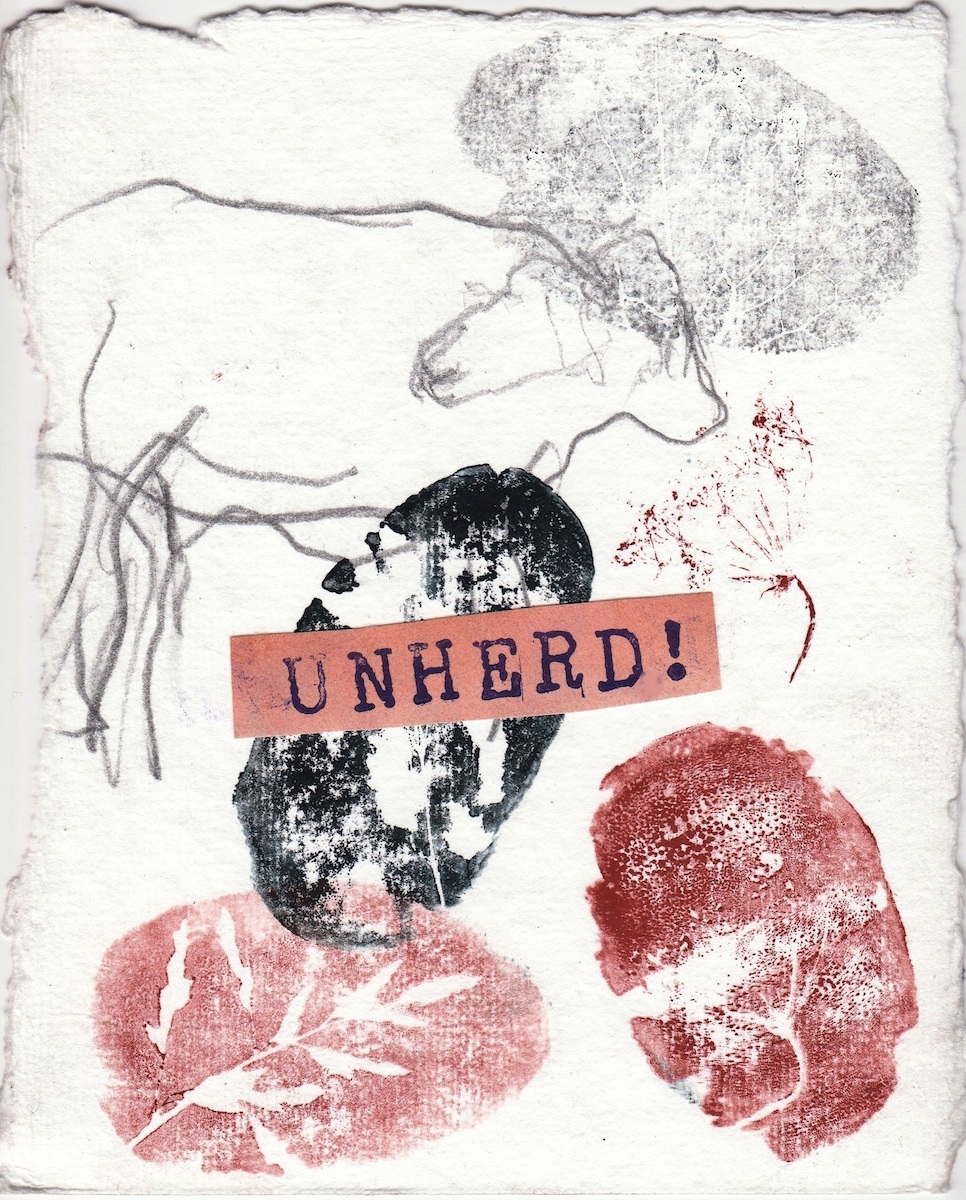
Unherd! Walking the Land

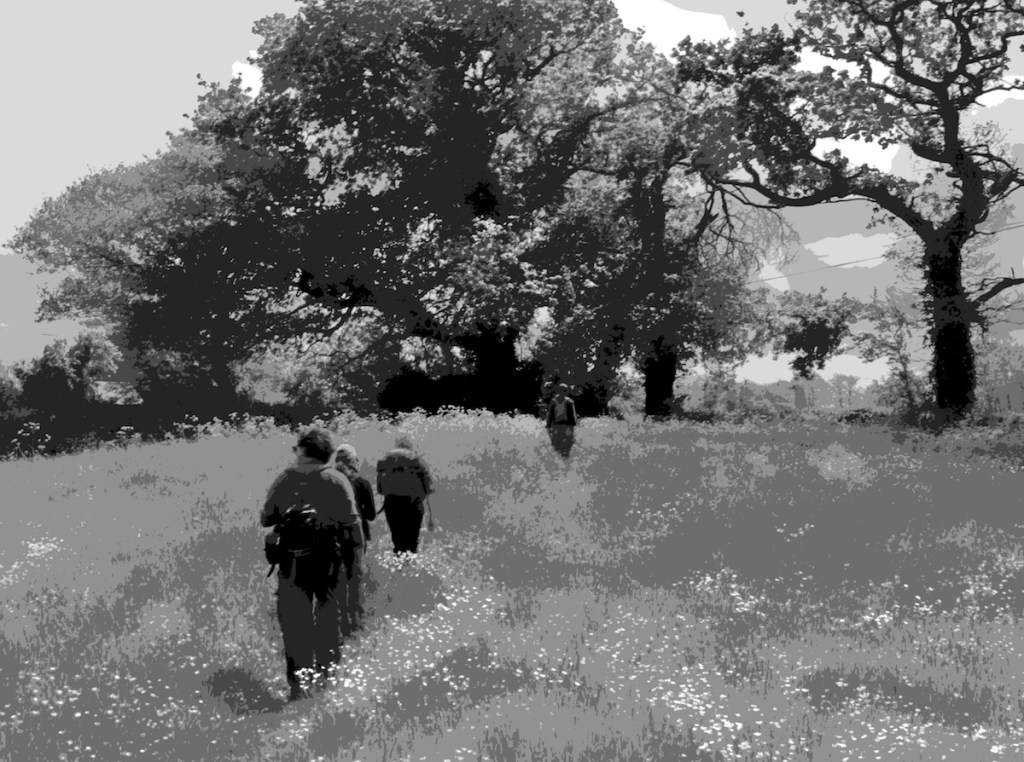
A group of artists and writers gather together for Unherd! Walking the Land events to explore themes of land ownership/access, climate change, community resilience, rewilding, growing, justice and indigenous culture through walks, creative activities, mapping, discussion and research in the landscape around the Marches Mosses and Rural Art Hub close to the Welsh-English border in North Shropshire.

This is an inclusive group enabling artists to follow their individual artist practices or to find ways to collaborate. We are working together to develop longer term plans for a funded project involving the local community, creating both audiences and activists, raising awareness and much-needed hope of arriving at a collective manifesto.

All are welcome to join our events. For more information email Andrew at: andrew@andrew-howe.com

Next Events

The next event Digging Words is scheduled for Friday October 7th 2022 starting at the Rural Art Hub, 10am.

For Digging Words participants will be invited to pause on different stages of the walk and respond to a range of provocations and instructions which will invite play with words used commonly to describe the experience of the rural. These improvised texts – both writings and readings, sonic and visual – will accumulate to form the basis for a final collective performance-installation at the end of the walk. No experience necessary. All welcome.

Each event has a different theme with walking and or creative activities devised and led by one or more artists. Please consider making a donation on a “pay what you can” basis to contribute towards paying artists/event leaders, Rural Art Hub hosting, general events co-ordination and planning and potentially building towards future projects and community engagement.

The last Unherd! event of 2022 is scheduled for Friday 25th November

Values.Voices.Action.

Unherd! emerged from conversations started by Andrew Howe with other artists about extending the Mosses and Marshes project and it has opened out to link with other ventures.  We are picking up on some of the themes explored during the Mosses + Marshes international discussion panel in November 2021 which led to the Values. Voices. Actions. initiative. Read more

Unherd! is:

  • breaking away from fixed, established narratives in the rural landscape to reveal more nuanced stories
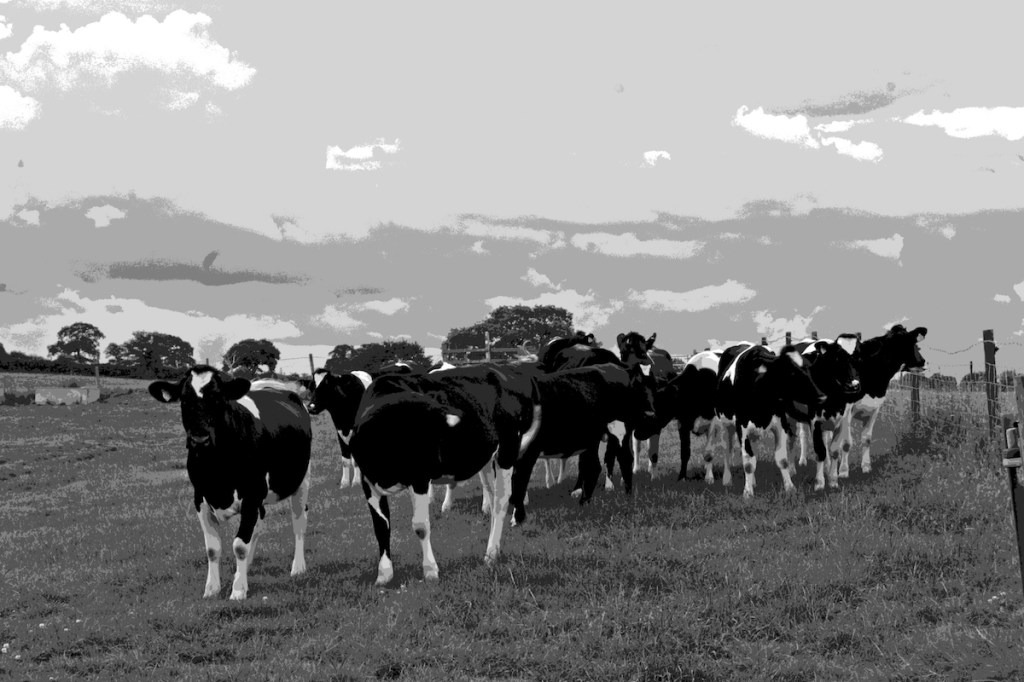
  • hosted by the Rural Art Hub, itself bringing new creative life and perspectives to a former dairy farm, home to the Willenhall herd
  • seeking to give voice to those less heard from across the local community and further afield

Previous Events

Previous events have investigated historic timelines and themes of access to land and justice, rural utopias and deep time.

Walking the Land

Led by Andrew Howe, this circular walk of just over 6 miles to Bettisfield Moss, traversed a timeline rich with stories of Iron Age/Bronze Age bog bodies, land seizure by Norman lords, Turbary rights, Land Enclosures, contentious construction of canal and railways, wind powered and steam powered corn mills, fine churches built by local aristocracy, target practice and bombing during two World Wars, industrial peat extraction, forest clearance and finally peat bog restoration and natural resurgence. 

We walked with the themes of access to land and justice in mind and returned to the Mothershippon studio at the Rural Art Hub to make creative responses.

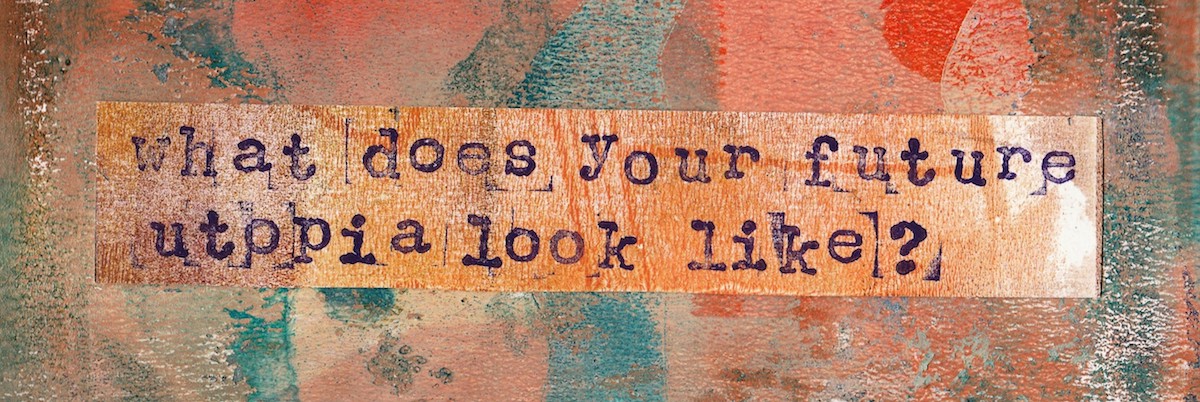
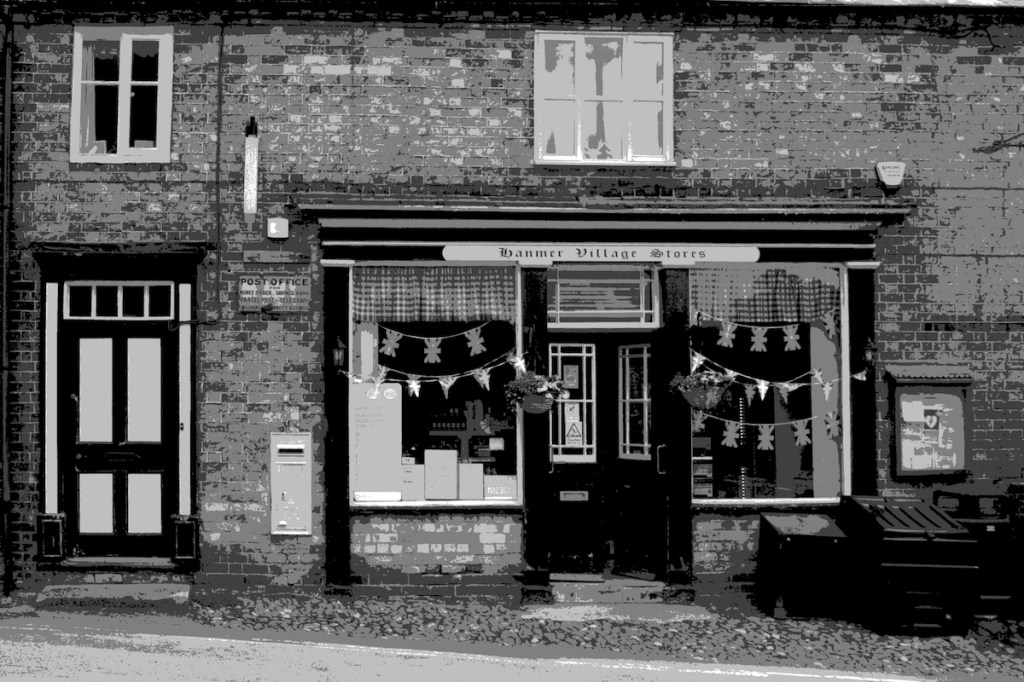
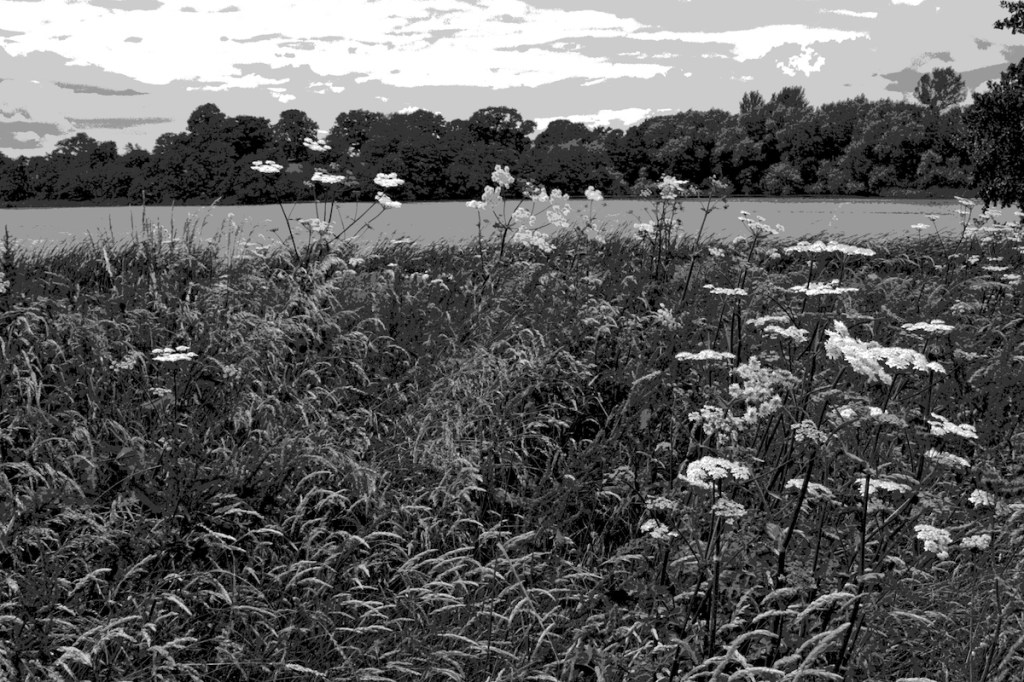
Rural Utopias – A walk towards Hanmer Mere led by Andrew Howe and creative activities in Hanmer village.

The 6 mile circuit took us from the Mother Shippon to the edges of Bettisfield Park and the epicentre of the Hanmer estate which has had such an influence on the Mosses and surrounding landscape for many centuries. The family descends from an officer of Edward I, and later a supporter of Owain Glyn Dwr – descendants included Tory MPs, high ranking lawyers, local benefactors and they were one of the main instigators of the Enclosure Act which led to large scale peat extraction at the Moss.

During the walk we reflected on what would be different in our rural utopia – for example, if there was reduced demand for meat production, there would be less need for secure boundaries for holding livestock, and land could become more accessible and potentially open to other public uses.

Deep Time

Julie Harrison led this 4 mile walk through the landscape of Fenns Moss, describing some of the geological history of Shropshire and evolution of the Earth through a 4.6km section of the walk. This walk was inspired and based on the work of Dr Stephan Harding, whose own Deep Time Walk is available to download as an app www.deeptimewalk.org

Resources and maps for others to follow these routes and make creative responses are available.

For more information about these and other future events

All images © Andrew Howe

Categories
Projects Upcoming Events

Roaming Flags: The Earth Parade

The Roaming Flags of Bumble Hole concludes on Saturday 13th August with a colourful parade featuring music, readings, rites and of course, flags. The parade will celebrate the miraculous transformation of the site now known as Bumble Hole Local Nature Reserve, from a blackened hive of extractive industry into a teeming haven of natural abundance. Our observances will ensure the continued thriving of nature on this land for many years to come.

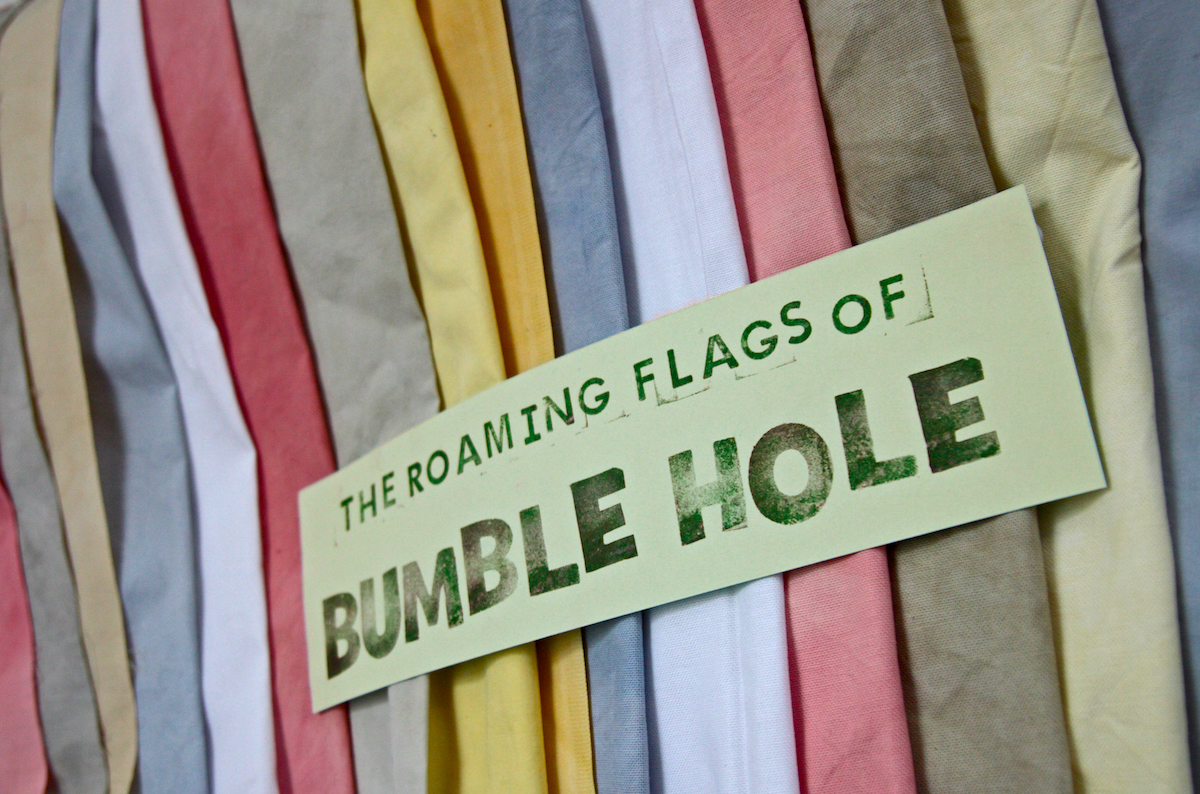
This is a participatory event and the more people who take part, the stronger the magic will be so please do come along and bring a friend (or several). There will be enough flags for everyone. The cotton flags have been coloured with natural dyes and were decorated by the participants of our previous event in July. Now that we’ve created the flags it’s time to fly them.

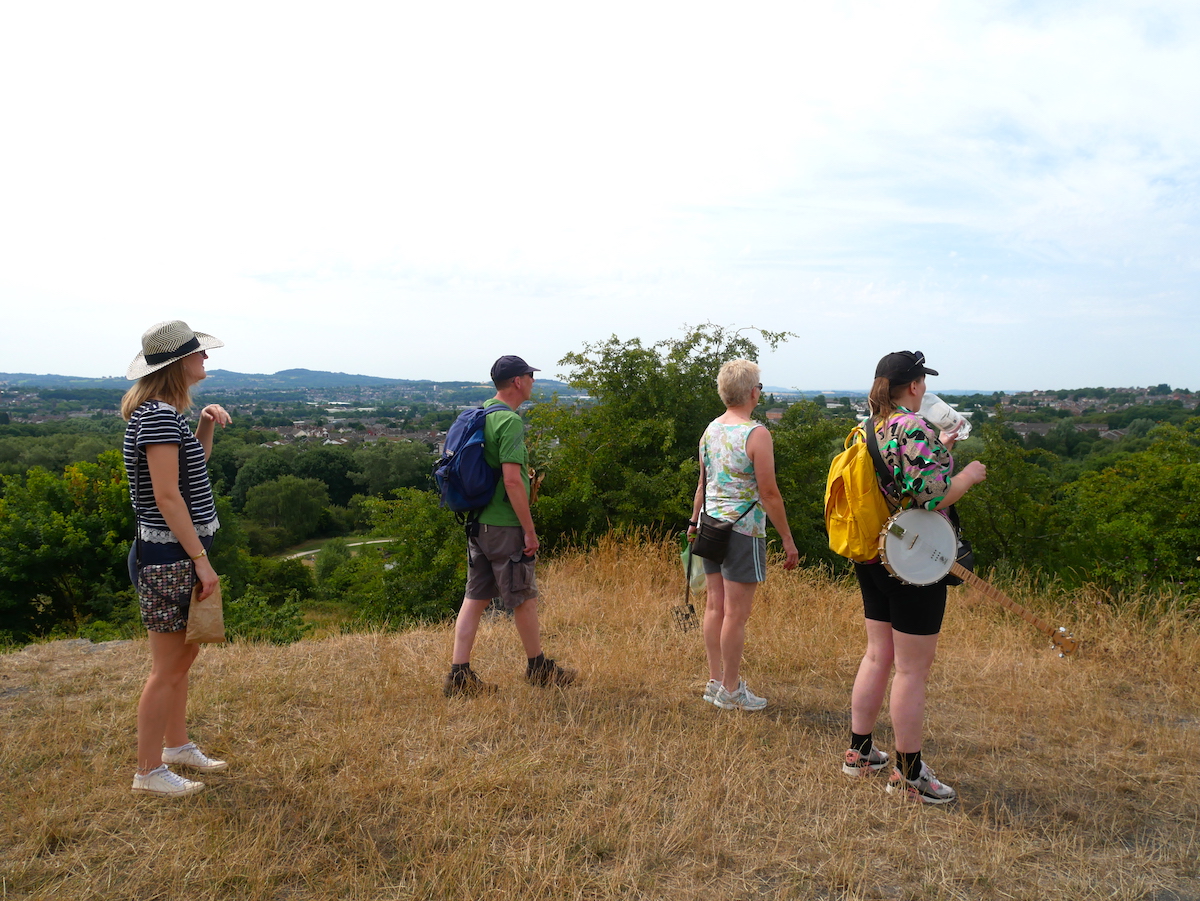
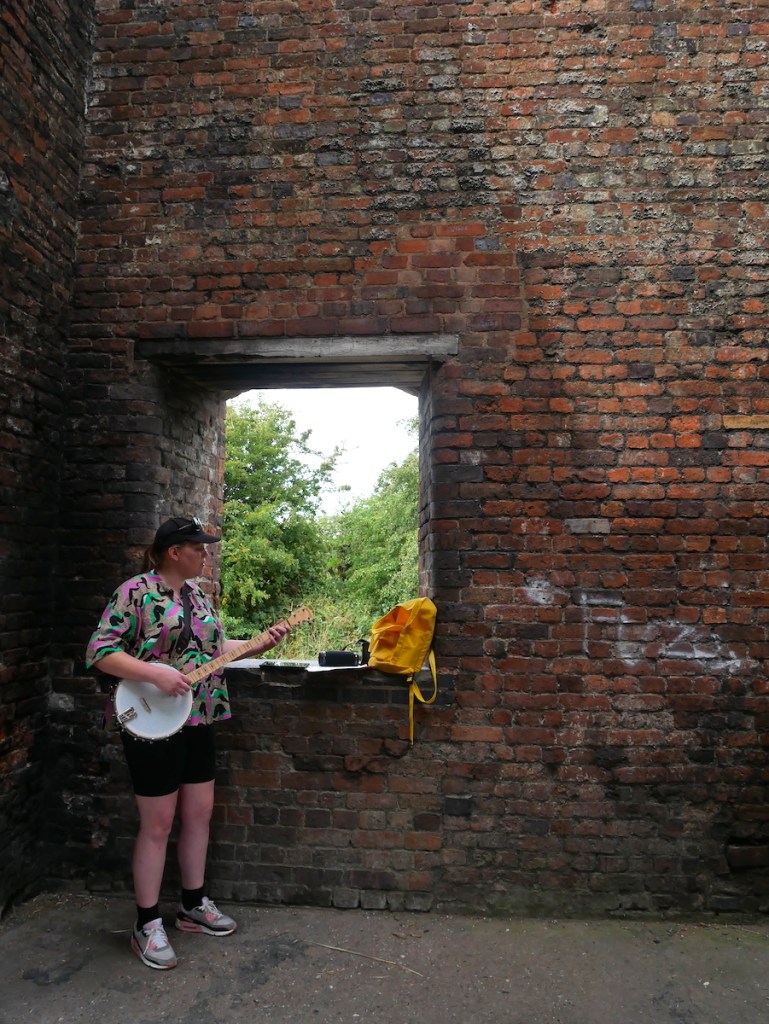
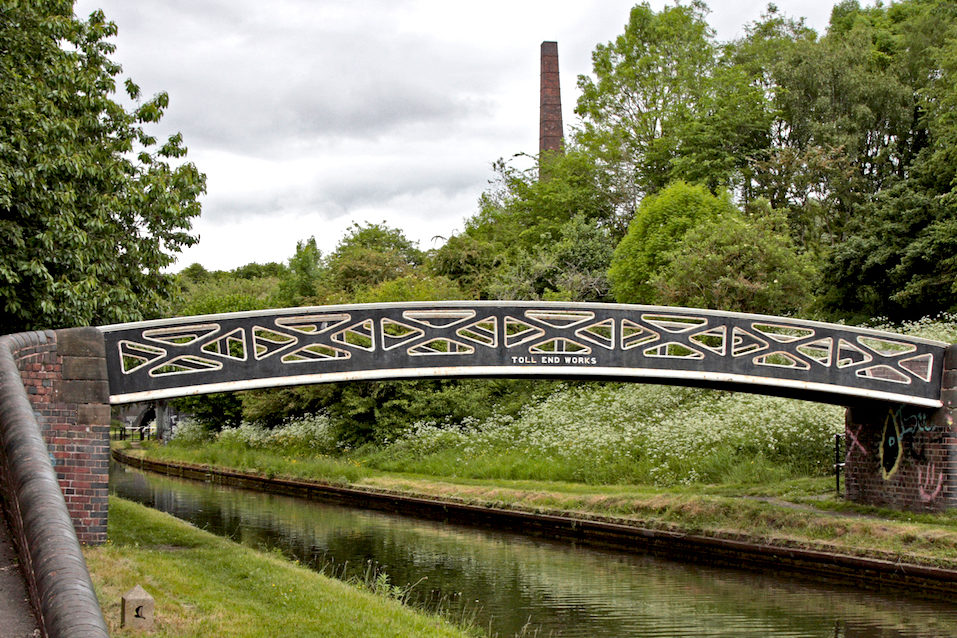
The procession of the flags will take us on a tour of many of the reserve’s finest features including winding canals, shady woodland, hilltop vistas, an industrial ruin and into the mouth of a pitch-black tunnel. Musical accompaniment will be provided by Beth Hopkins who will lead sing-a-long renditions of original and traditional folk songs drawn directly from the soil in which the flags will stand.

Inspired by Tibetan Prayer Flags, there are five different colours of flag, each representing a different element: blue for the sky, white for the air, red for fire, green for water and yellow for earth. Our procession will focus on each of these elements in turn and at different points on the route the flags will be fixed into the ground and strung across the waterways in spectacular displays.

Meet at 12pm outside the Bumble Hole Nature Reserve Visitor Centre, Windmill End, Dudley DY2 9HS. No need to book. Suitable for all ages. The event will last no more than two hours and will finish up back where it started. Refreshments and toilet facilities are available at the visitor centre but you may also wish to bring a packed lunch. For other queries please contact Andy.

This project is supported by Creative Black Country as part of Arts Council England’s Creative People and Places National Portfolio programme, Dudley Metropolitan Borough Council (DMBC) and support from CoLab Dudley. 

Categories
Posts Projects

The Roaming Flags of Bumble Hole

We are happy to announce that we’ve been commissioned by Creative Black Country to run two events celebrating the natural abundance, waterways and rich history of Bumble Hole nature reserve in Dudley.

The Roaming Flags of Bumble Hole will take place across the summer and will involve a sensory guided walk, a flag making workshop and a celebratory musical procession. The project is part of the Dudley Creates Summer of Creativity which will see art, colour and fun opportunities popping up in spaces and places across the Borough from June to September.

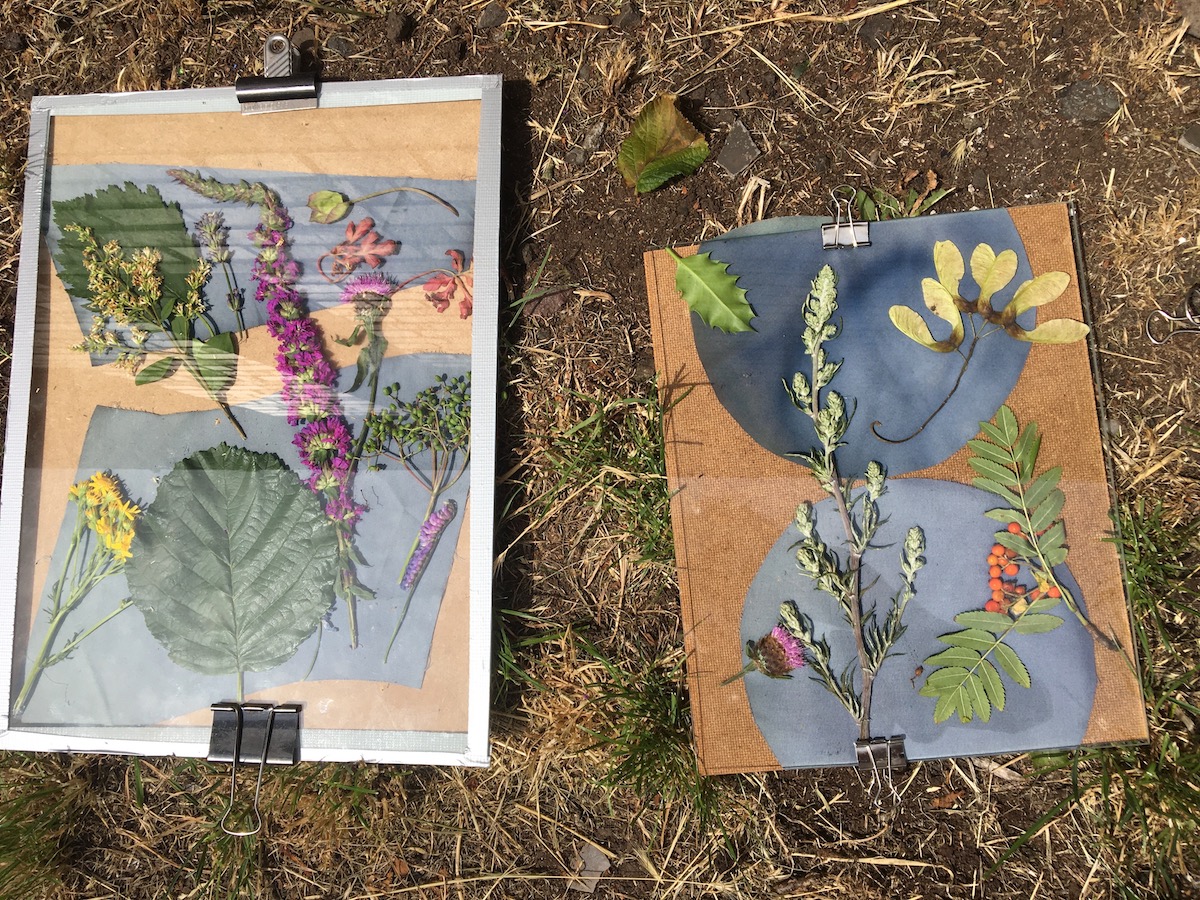
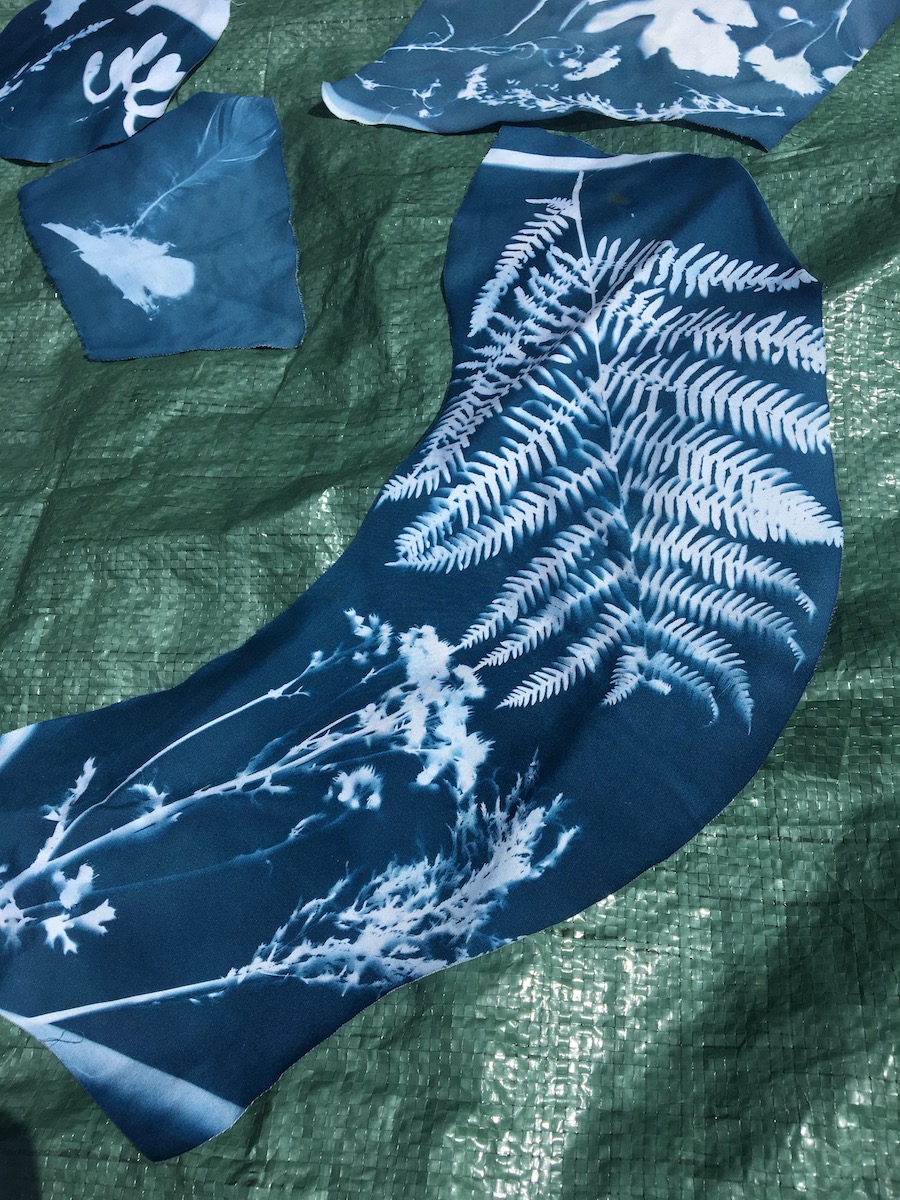
Our flags will be coloured with natural dyes made with plants found locally and the designs will be informed by participants’ responses to the sensory guided walk. Inspired by Tibetan prayer flags, we shall be using five different colours: blue, white, red, green and yellow to represent the five elements of sky, air, fire, water and earth. Rather than being an exercise in patriotic territory claiming, the flags will represent nature asserting its own stake in the land.

The project will culminate in August with The Earth Parade: a public ceremonial procession of the flags around the reserve in which participants will be able to show off their designs and celebrate their collective stake in nature’s abundance. The flags will be fixed into temporary installations around the reserve and strung across the waterways in a spectacular display. The parade will be accompanied by sing-a-long renditions of original and traditional folk songs drawn directly from the soil in which the flags will stand.

The Roaming Flags project is headed up by three members of the Walkspace collective: Andy Howlett, Beth Hopkins and Andrew Howe. Together they shall draw on their varied backgrounds in painting, printmaking, songwriting and the walking arts to create a truly participatory celebration of this magical area.

Key Dates

  • Sun 17th July, 10am – Sensory guided walk and onsite flag making workshop. Free but booking essential. Book here. No art skills or experience necessary. Ages 8+
  • Sat 13th August, 12pmThe Earth Parade: a celebratory Procession of the flags with musical and singing accompaniment. Free, no booking required. Suitable for all ages.

This project is supported by Creative Black Country as part of Arts Council England’s Creative People and Places National Portfolio programme, Dudley Metropolitan Borough Council (DMBC) and support from CoLab Dudley. 

Categories
Posts Projects Upcoming Events

Mapping Wolverhampton with Daniella Turbin

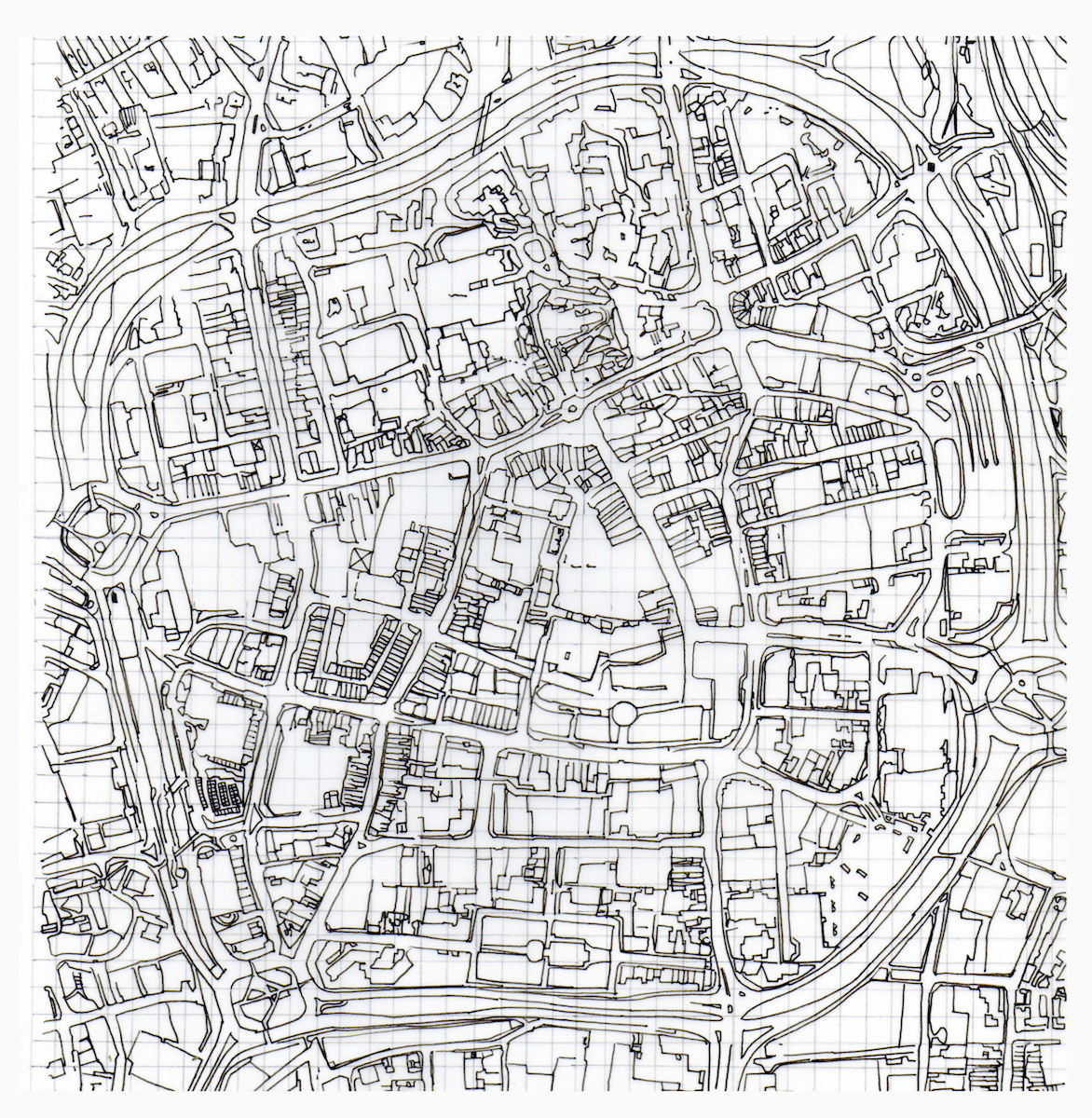
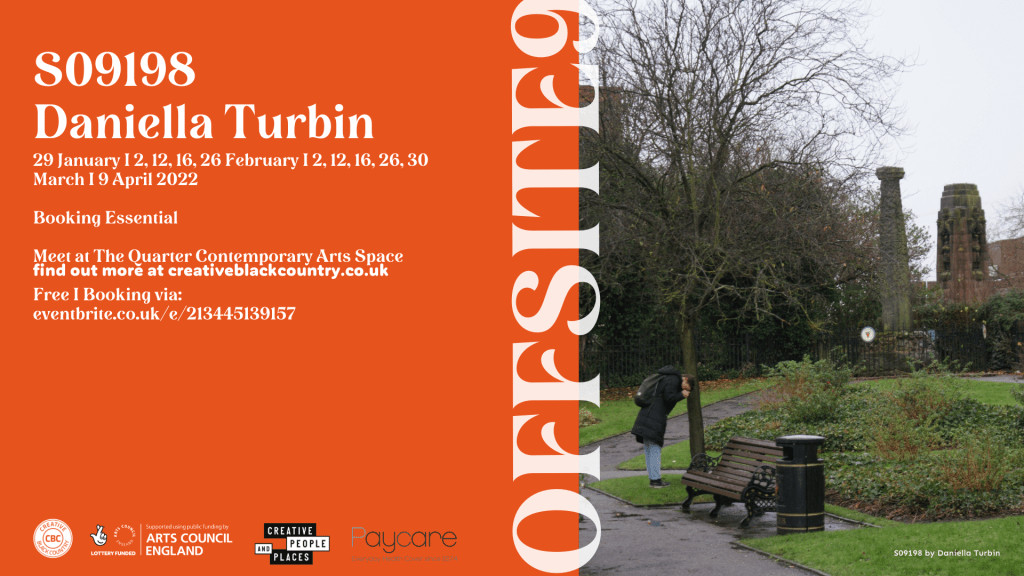
Join local artist Daniella Turbin for a walk around the City of Wolverhampton. S09198 is the unique grid reference for the centre of the City of Wolverhampton, and throughout the duration of British Art Show 9 you are invited to explore every underpass, street, and building within this one kilometre square.

Sign up to take a walk with the artist and together map and record the city through photography and walking. This project will take place throughout the duration of British Art Show 9, and will finish with the creation of a public map of the city on the scale of 1:100.

The remaining dates are: March 2nd, 12th, 16th, 26th, 30th, and April 9th. Walks are scheduled between 9.30 to 17.30 and last approximately 90 mins, they start and finish at The Quarter Contemporary Arts Space. The walks are free but booking is essential.

This OffSite9 project has been commissioned by Creative Black Country as part of Arts Council England’s Creative People and Places scheme, and supported by Paycare.

Categories
Posts Projects

Parallel Walking between Birmingham and Yogyakarta

Walkspace is happy to announce our first funded project – an international walking arts collaboration with Jalan Gembira in Indonesia. 

Jalan Gembira is a female-led walking practitioners group based in Yogyakarta, Java. The name translates as ‘happy road’ and reflects the enjoyment they have recently discovered from walking and exploring their city. 

Back in August, they invited us to partner in their application to the British Council’s Connections Through Culture programme, which fosters international collaborations through arts and culture. (Thankyou to Louise at BOM for the introduction.) In September, we were delighted to hear that we had been awarded funding for our proposed project. 

The full project title is ‘Parallel Walking: Between Here and There, Between the Seen and the Unseen’. Like Birmingham, Yogyakarta is a ‘motor city’ where walking is secondary to the car/motorbike/moped, where public space has been eroded by private interests, and where the infrastructure of the city can make walking feel unsafe for pedestrians. These were just a few shared themes we identified in our initial talks.

Over the next three months, we will be working and walking in parallel, gaining insights and developing our practices through showing each other our streets. We want to hold up a mirror to each other’s cities as part of our cultural exchange.

British Council banner with photos of JG and WS people

The ‘Parallel Walking’ project will run from November until the end of February. It will involve three UK artists (Beth Hopkins, Andy Howlett and Fiona Cullinan) and three Indonesian artists (Deidre Mesayu, Kurnia Yaumil Fajar and Riksa Afiaty). The mix of participants includes musicians, illustrators, collagists and walking artists. Together they will explore the identified themes through their own practices, perspectives and while walking in parallel in their cities. 

We will be producing a joint zine of material from the walks and hold a simultaneous parallel exhibition – ours will be at Artefact in Stirchley, Jalan Gembira’s will be on ‘pos kamling’ – community watch posts in the neighbourhoods where they walk. 

The exhibition/zine is scheduled for early February.

#BritishCouncilCTC #CultureConnectsUs

Supported by British Council logo
Categories
Films Projects

The Severn Way – animation by Daniella Turbin

New Walkspace member Daniella Turbin has set herself the ambitious target of walking every square of the UK Ordnance Survey Maps. This sixty second animation documents her journey along the course of the River Severn and comprises sixty hand-drawn frames created from photographs taken on a 35mm film camera.

“The River Severn runs right the way from North to South Worcestershire, joining the village of Upper Arley with the town of Tewkesbury. As a walking artist I decided to take this journey by foot and create a video in response to this journey.”

This film was a commission for Severn Arts as part of the It Gets Lighter From Here campaign.

Categories
Projects Walk Reports

A Figure Walks – the grand old face of the plateau

Transcript of a talk given by Megan Henebury about her walking project, A Figure Walks, on November 24th 2020.


A Figure Walks: the Rea, and other rivers you can’t see, is an ongoing project applying my walking practice to a psychogeographical investigation of Birmingham’s River Rea. The expected results are an essay, a short film, and an archive – together forming a body of work that will define my BA in Fine Art.

Over the summer, I was inspired by the thinking of Donna Haraway in her 2016 book, Staying With The Trouble: Making Kin in the Chthulucene. I’d been told she wrote about pigeons – this was enough to make me seek her out. But her ideas about a new ecology concerned with interspecies kinship, making space to acknowledge intimate relationships between more than just other human beings, led me to reflect more consciously on the way I communicate with other bodies, other things, how I feel for them, gather them, accumulate them.

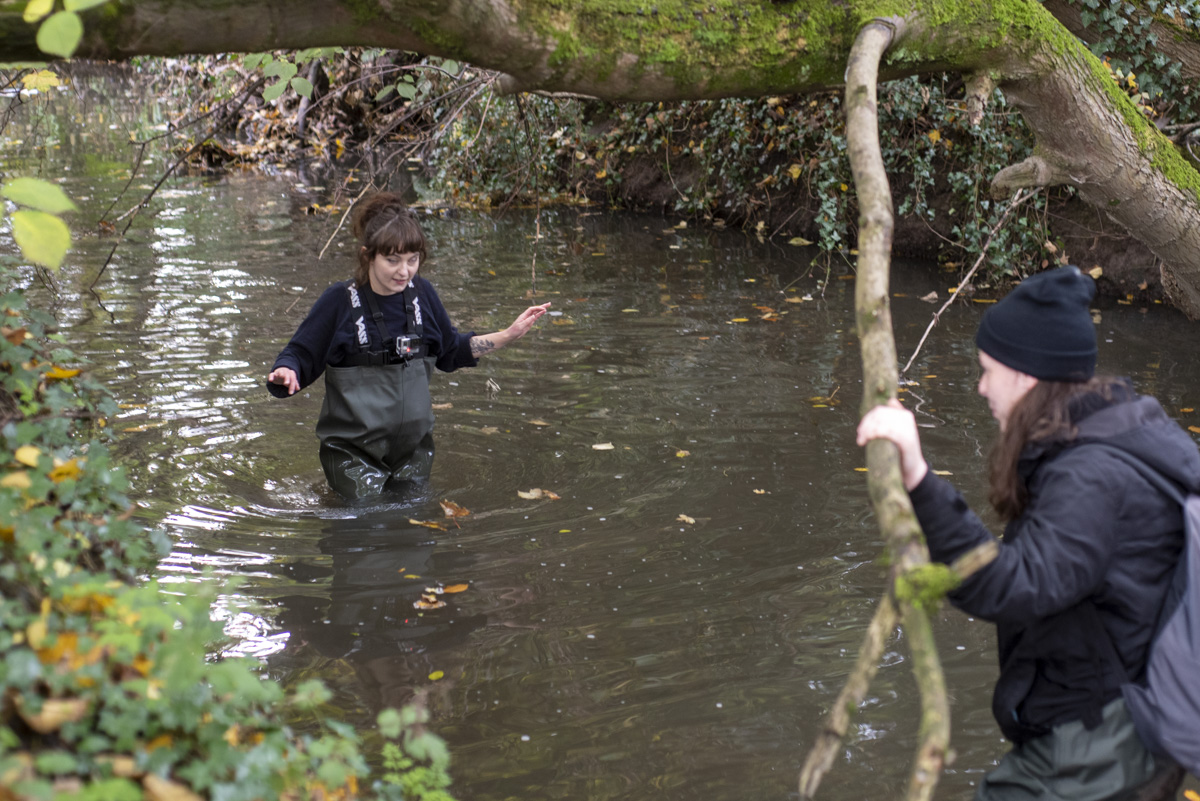
My walking practice is a performance, but recording it is instinctive. I have filled pockets, taken photographs, made field notes and sketches. If I don’t, I can’t say with certainty that I’ve done anything at all. Stones, birds, fungi, litter, scum accumulated in polluted corners, moss, broken birdhouses, clouds of midges, used stericups, condom wrappers, bramble, snails: these are all soggy extensions of my own unclean presence in the river’s cut, and I need to acknowledge them. I anticipated a personal reaction to the walks, to the things I have met, but I falsely believed I would be in control. The reality is different.


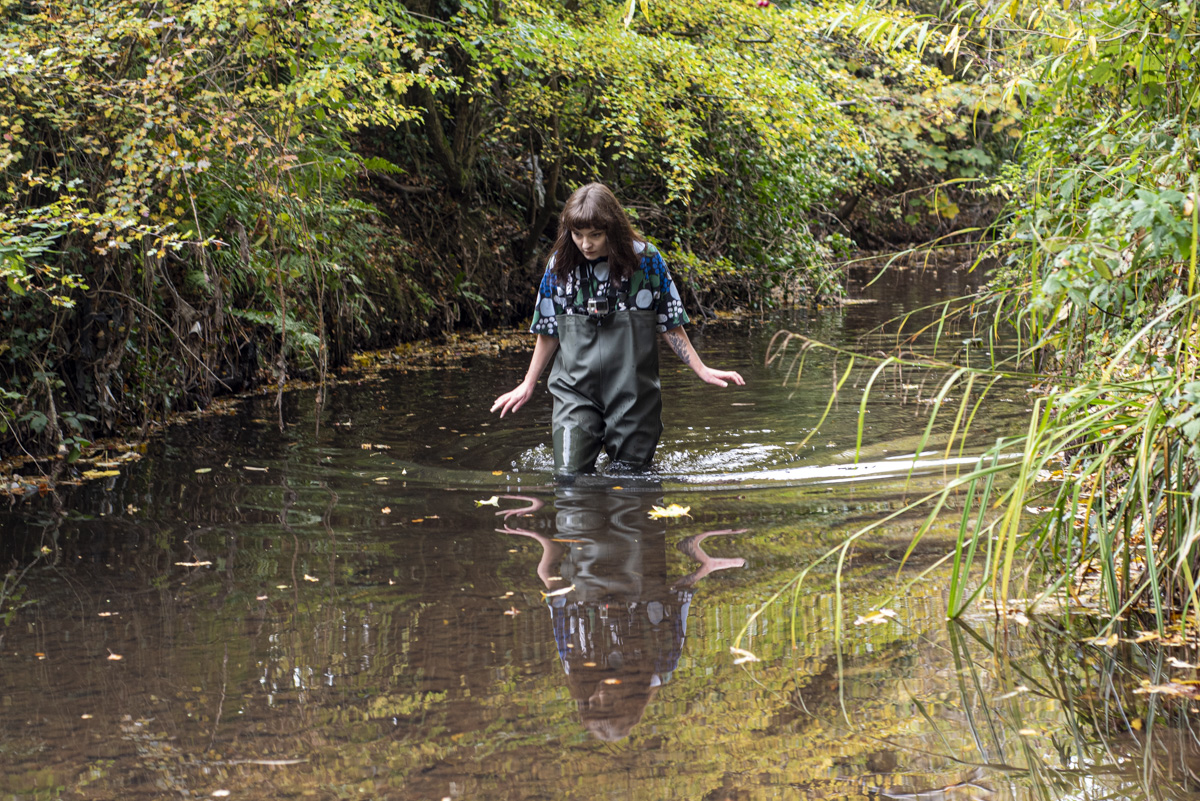
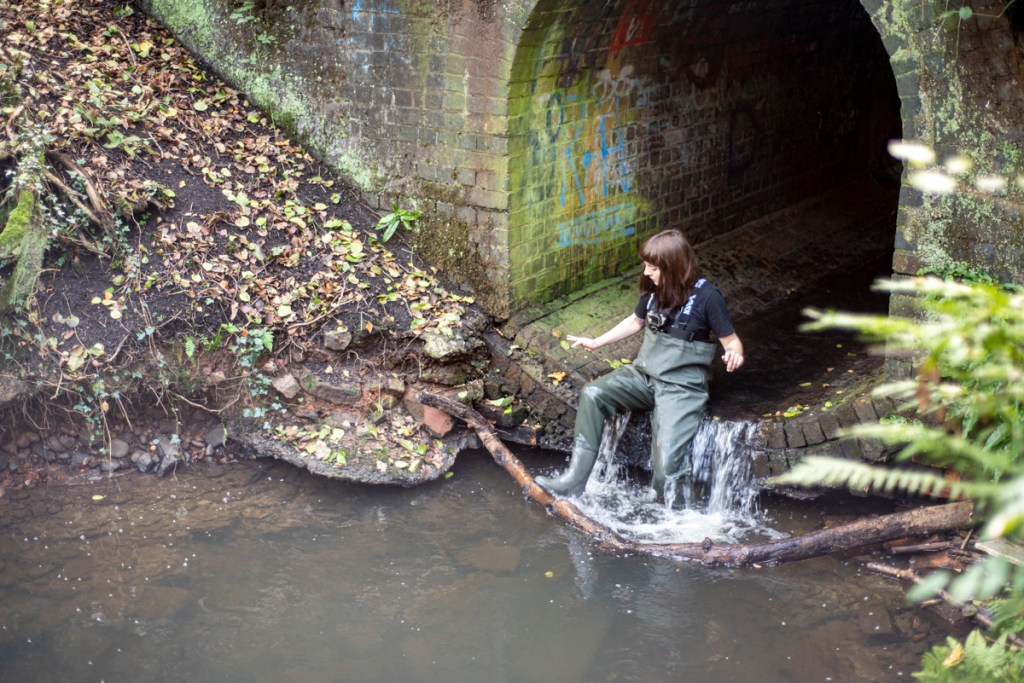
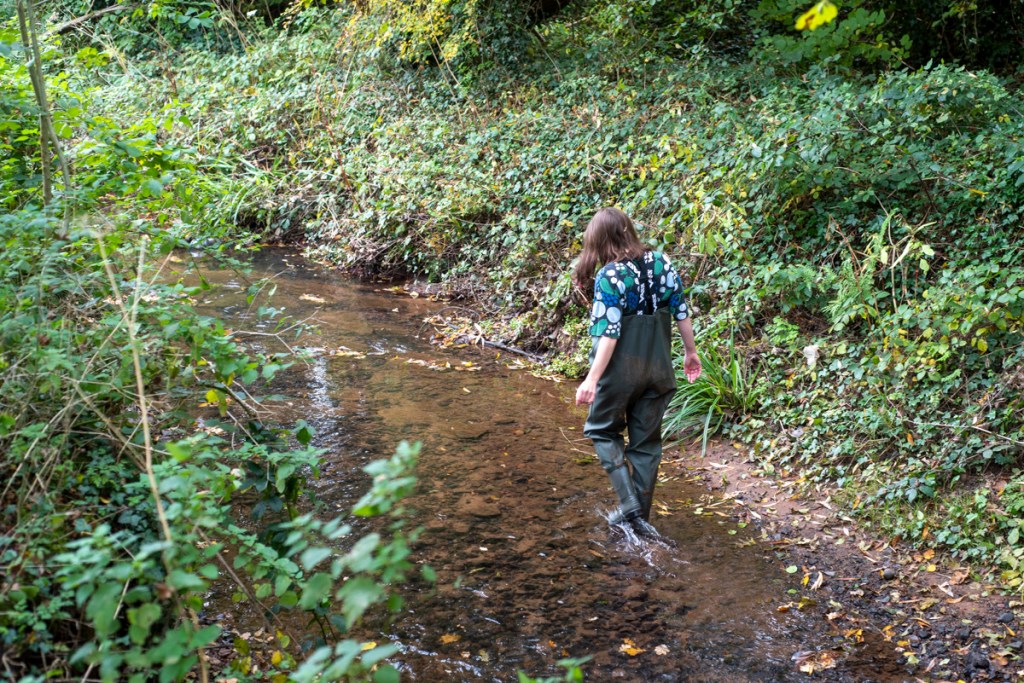
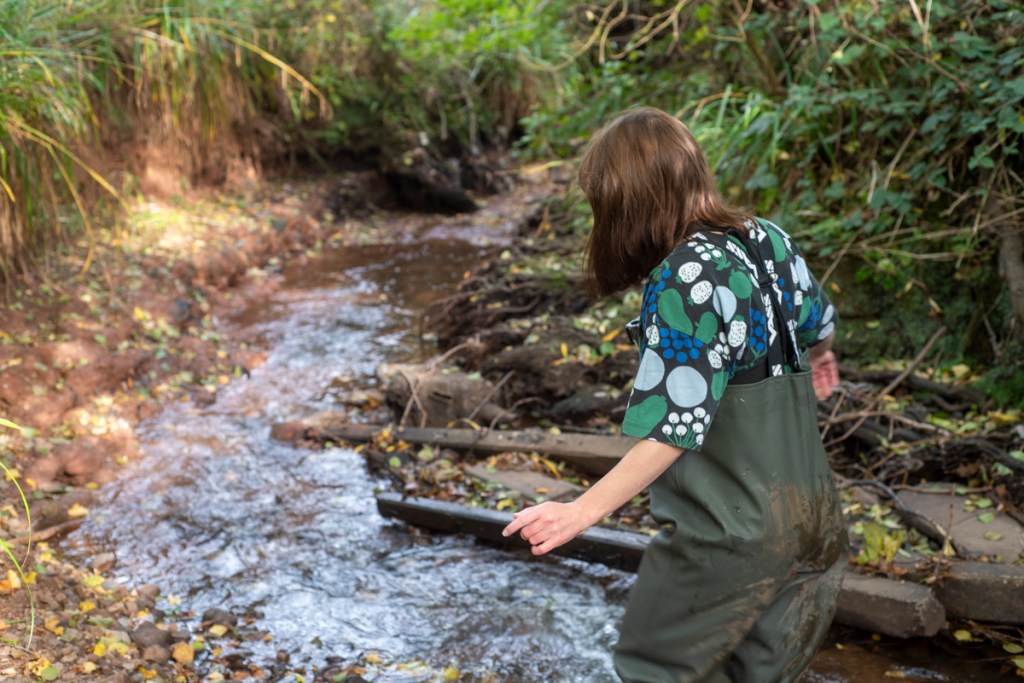
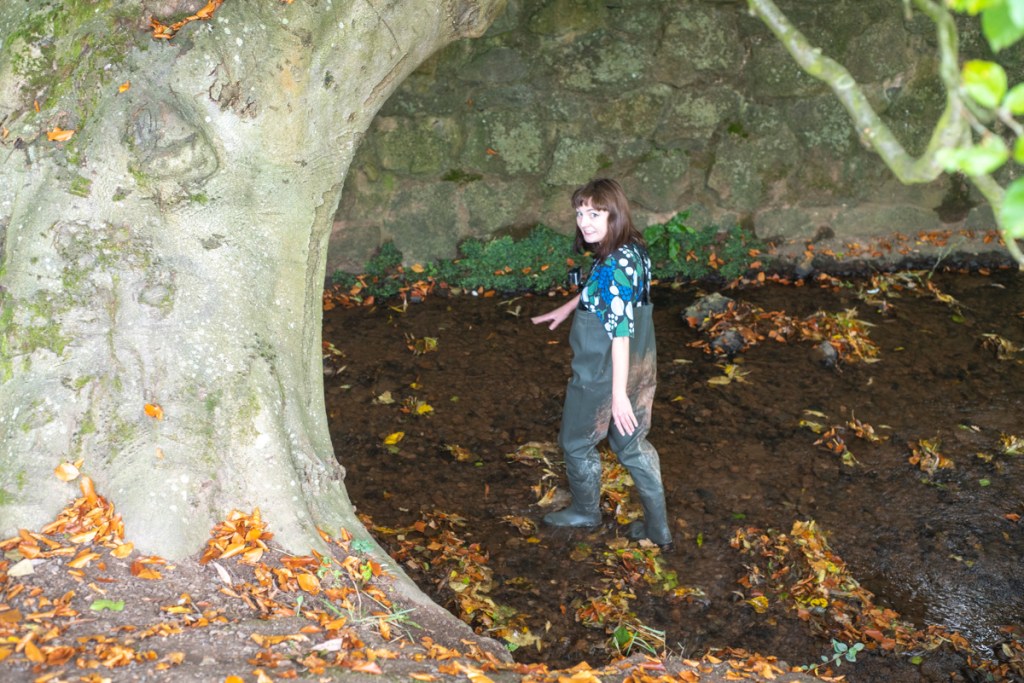
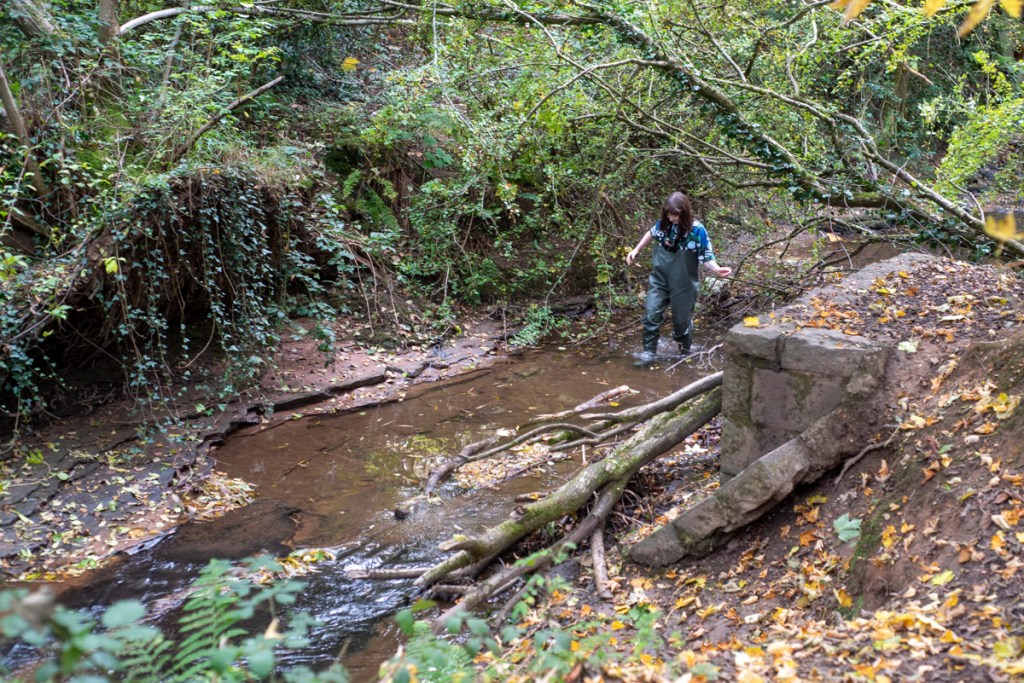
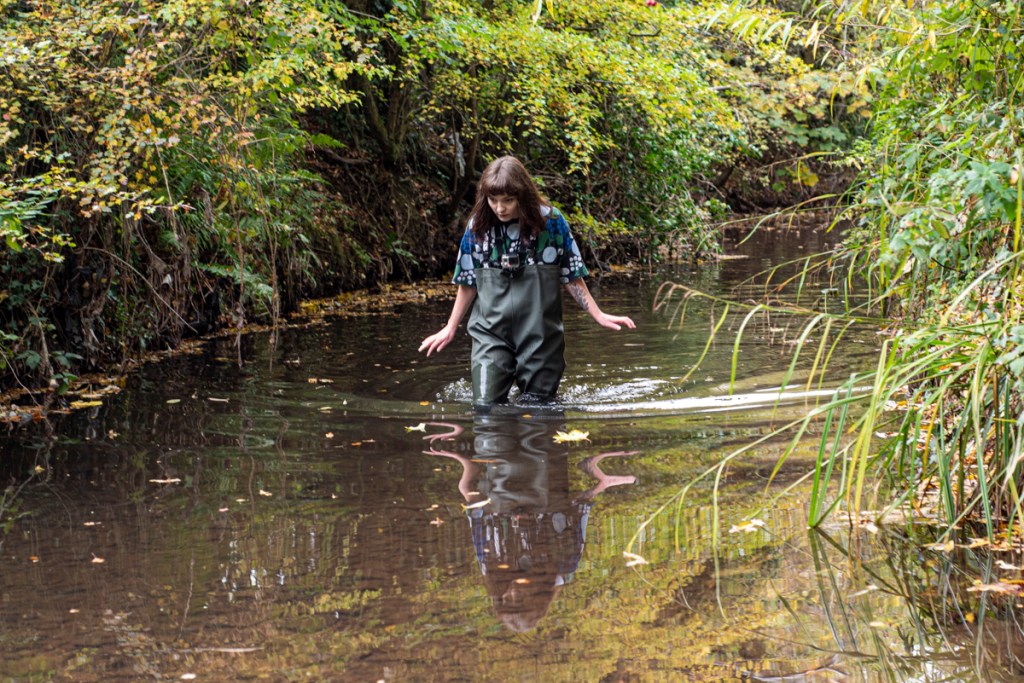
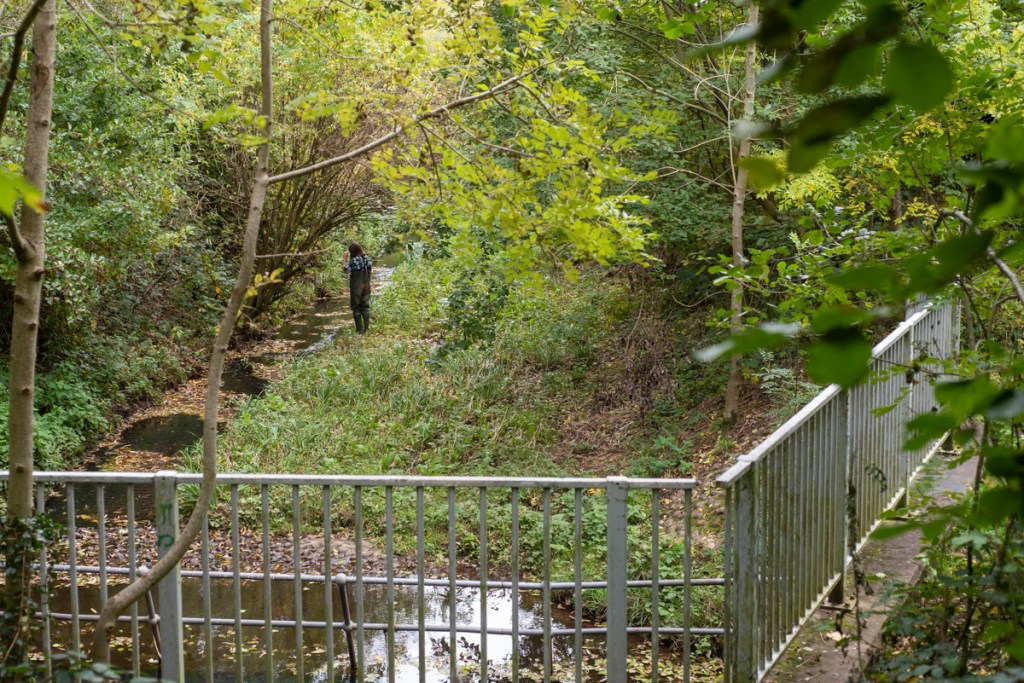
At the beginning of October – bringing in autumn, my favourite season – piercing boggy soil in my wading boots and clearing pathways through gnarls of bramble was a joyful escape: the honeymoon period of a new relationship between me and this wet, secret place that was both a stranger and home. But here now, in late November, I’m only halfway through. I last stepped out of the Rea as it passes under Cartland Road at the edge of Stirchley. And now that my walk has brought me closer to those long, hostile culverts that hide the river beneath the industrial grind of the inner city, the truth is that I don’t really want to go back in.

I allow heavy rains to delay walks, feigning disappointment. I injured my back on the last walk and, wrapped up warm in the glow of tramadol, I felt relieved that this too would keep me out of the water a little longer. Lockdowns under other names have prevented friends from accompanying me, and my own chronically despondent way of being means I’m reluctant to push ahead.


Forward is not my natural state. I prefer to linger in familiar spaces, long after all light and life has passed through them. I realise, to my horror, that this plateau in the project is a garish analogy for every other relationship I’ve sabotaged via refusal to work, to change, to go Forward. It may be more comfortable to hang around old, familiar shadows, but they’re cold and long dead and have nothing new to tell me.

The Rea is a river you often can’t see. It begins as a messy, chaotic network of puddles, streams and bogs before it approaches Longbridge and becomes remotely recognisable as a rivery thing. Those early streams are flowing somewhere – but on that first walk, I couldn’t find them, or couldn’t get into them, or lost patience entirely and retreated to footpaths. I can only imagine how the Rea must feel, having no other choice. So, following its lead, I cut other routes, make new mess, let the work change, listen to other bodies, and take different walks.

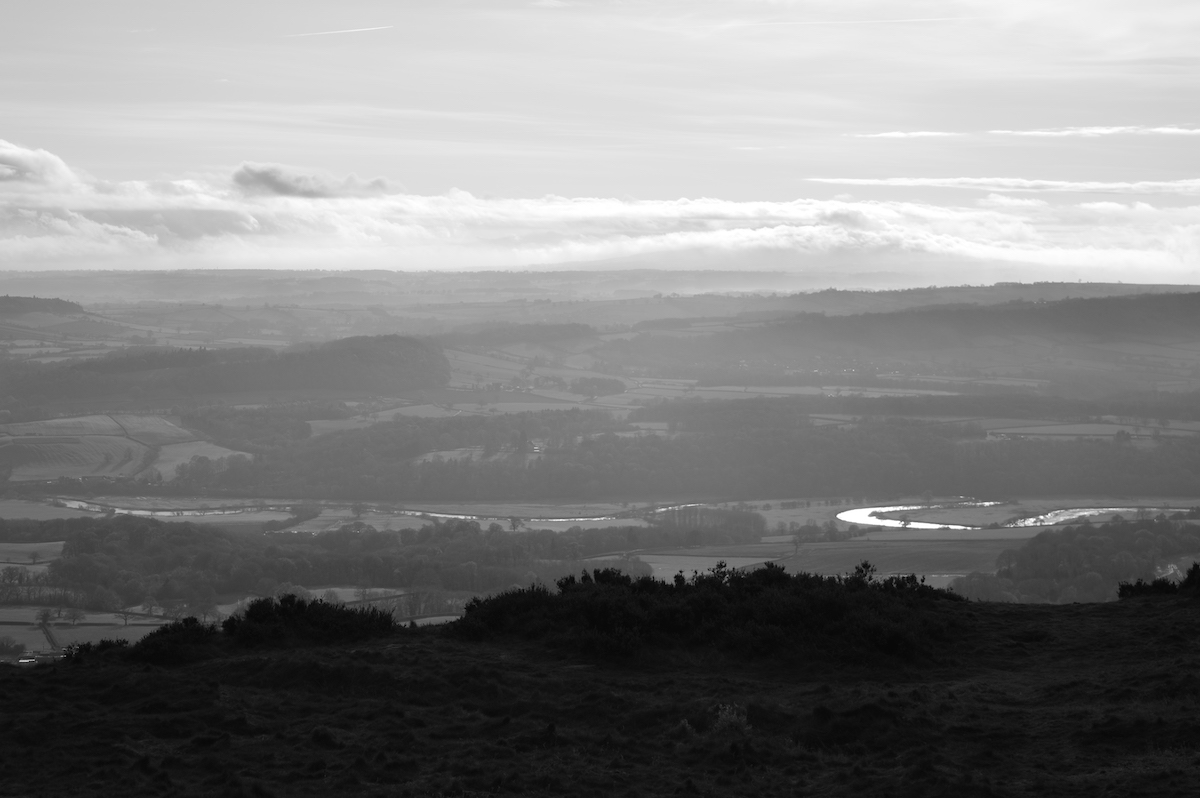
From the top of the Wrekin, the hill that keeps watch over much of the West Midlands, the sparkle of the River Severn a few miles south west catches my eye. It’s the longest river on this island, and a source of our tap water. I watch the late autumn sunlight shatter over its snaking course – from this distance, it looks deceptively still. I realise I am still working after all. There is an old regional saying about going all around the Wrekin. It’s a lovely, lyrical way to tell you, usually in exasperation – you are taking the long way around.

All Walkspace posts on this project are here.

Categories
Projects Walk Reports

A Figure Walks – day 4

During October we’re documenting Megan Henebury’s walk along the route of the River Rea, walking in the river itself as much as possible. Pete is following her with a camera and Megan will be producing a film in the new year. All Walkspace posts on this project are here.

For the fourth stretch along the Rea, Megan was joined by another wader, her friend Lin, whose effect on Megan’s mood was dramatic. They started in Kings Norton Park and by the time I joined them with my camera at Lifford Reservoir, a serious artist doing serious work had transformed into a grinning loon (doing serious work).

As Stirchley residents this was home turf, but it was still novel for me to be walking this area at such a slow pace, waiting for Megan and Lin to make their steady way through the frequently deep waters. I found myself contemplating the many paths that had been beaten through the undergrowth from the footpath to the river, seemingly with no purpose. Then it struck me – they were desire lines carved by dogs desperate to get in the water.

Dusk called the day to an end on Cartland Road. Three days later the November lockdown was announced, putting the walk on hold. Stay tuned for developments…

Categories
Projects Walk Reports

A Figure Walks – days 2 and 3

During October we’re documenting Megan Henebury’s walk along the route of the River Rea, walking in the river itself as much as possible. Pete is following her with a camera and Megan will be producing a film in the new year. All Walkspace posts on this project are here.

Day two of Megan’s intra-river walk started well, working through Balaam’s Wood in Rubery ending at this delightful bridge, water-falling into a surprisingly deep pool.

But then it all went a bit wrong. Megan went through a tunnel which took the river away from any and all public paths and Pete was not able to join her again. Phone battery issues multiplied the problems and we decided to call it a day around Bournville college.


For day three we were a lot more prepared, and confident that the footpath would follow the river nicely from Longbridge to Kings Norton.

The river along this section seemed more managed yet still fairly wild. We came across a number of remains of mills and places where the river had been co-opted by early industry, a history that was almost invisible from the footpaths.

We also started to see the current river management infrastructure – mysterious looking flood-prevention overflows and pumping stations around the Wychall reservoir.

And we also saw a lot of people. These paths are a beaten track, and not just by dog walkers and cyclings. The river still connects the city up.

We made it to Kings Norton Park, nearly at our home bases in Stirchley. Now we’re just waiting for a dry day that doesn’t follow heavy rain (which swells the river above Megan’s waders), something that’s become less common as we move into British Winter Time.