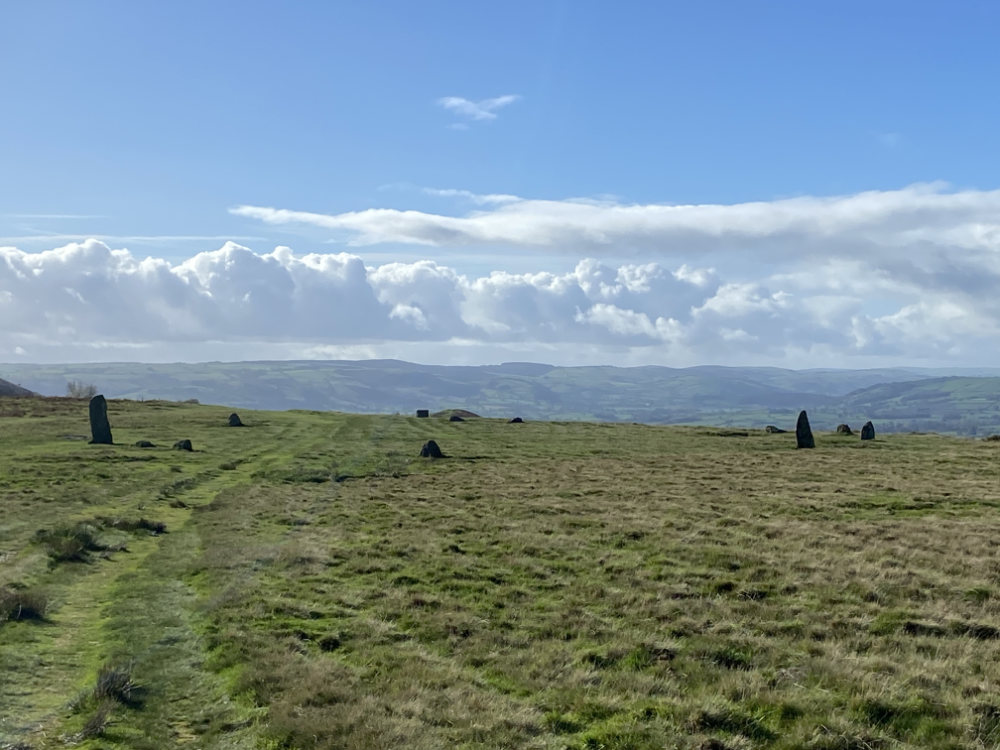
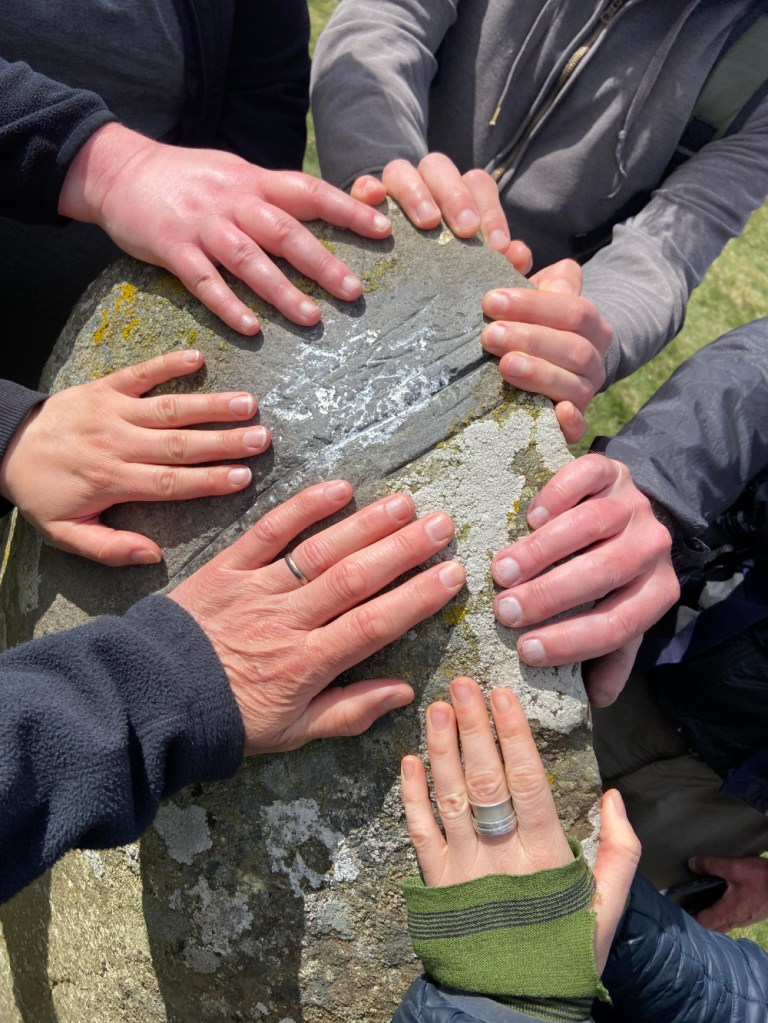
On 3 May 2025, a bright but windy spring day, several Walkspace members undertook a walk around Stapeley Hill and Corndon Hill in Southwest Shropshire, close to the Welsh border near the village of Priest Weston.
The walk centred on Mitchell’s Fold stone circle and the myths that gather around this ancient monument. Conceived as a members-only event, it was also structured so that it could be repeated as a guided walk open to the public.
I designed the walk as a manoeuvre: a form of guided walk devised in the 1990s by the artist Tim Brennan, with whom I have collaborated on several projects. Brennan describes a manoeuvre as “a walk built out of quotations which are recited to the group at stations along a predesigned route” (Brennan, 2017).
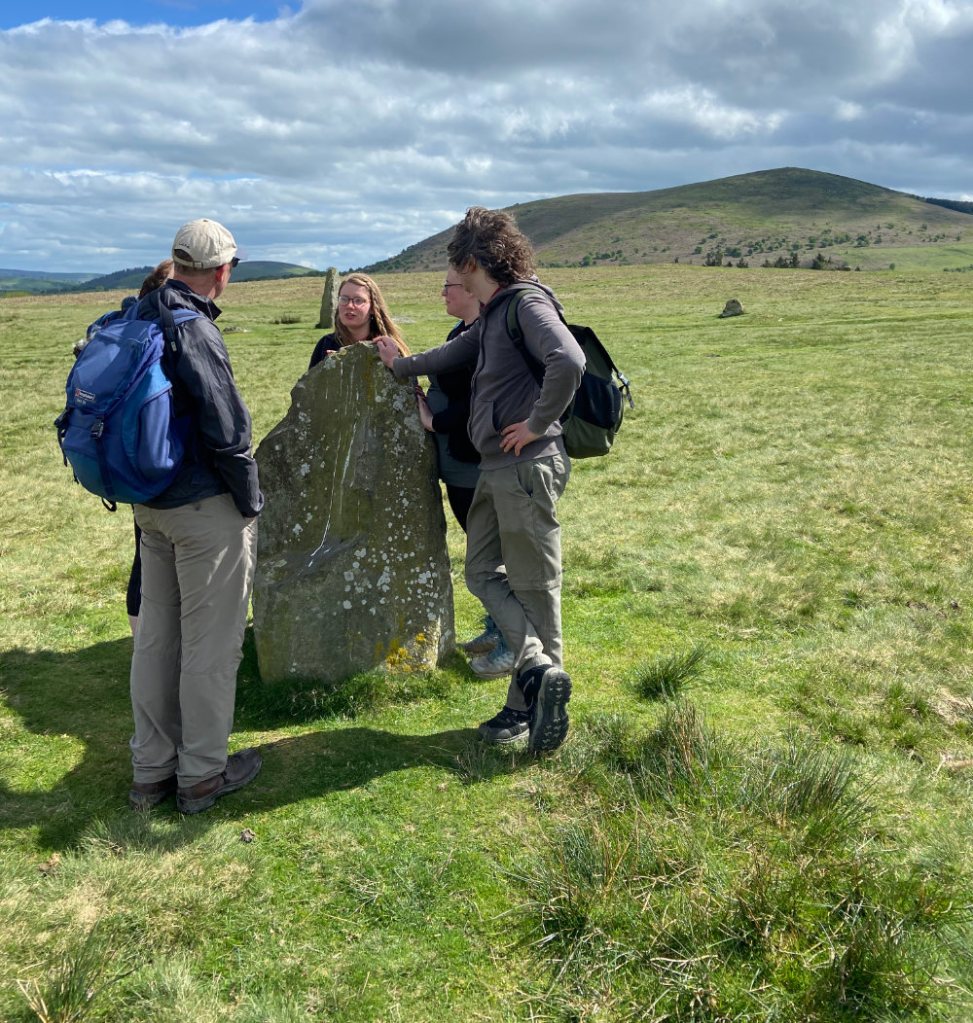
Alongside documented folklore and historical sources, I introduced a series of invented quotations – what I think of as neo-myths. These were attributed to fictional authors through what I call pseudo-references. The intention was not to deceive, but to mirror the ways authority, myth, and landscape are often braided together in accounts of ancient sites, where scholarship, oral tradition, and imaginative speculation coexist and overlap.
The Mitchell’s Fold manoeuvre followed a predefined route, with readings delivered at specific locations. These combined well-known folklore, historical commentary, and the neo-myths written for the walk.
From the car park, we headed north, directly into a stiff north-westerly wind, much as others might have done before us. The route across Stapeley Common runs alongside a holloway: a sunken lane formed by centuries of traffic, scoured out by drovers moving livestock between pastures or on towards market.
Mitchell’s Fold
The first station reached was the Bronze Age stone circle of Mitchell’s Fold (also referred to as Medgel’s Fold and Medgeley’s Fold). The name may derive from the Old English micel or mycel, meaning ‘big’. Fifteen stones remain, though it is thought that there may originally have been around 30.
“The peasantry of the neighbourhood tells us that this district, without being more fertile, was once more populous than it is at present, and that the population was kept from starvation by a benevolent being which came nightly, in the shape of a white cow, and abundantly supplied the inhabitants with milk. A condition, however, was attached to the comparative happiness of the people, and this was, that if the cow were milked dry, which it appears could not happen so long as each person took only a pailful at a time, she would disappear for ever, and the people would be reduced to extreme misery.
Now, there lived at the same time a malevolent old witch, who was envious of the flourishing condition of the people of this neighbourhood, and meditated continually on the means of overthrowing it. Her name was Mitchel. One night she went with the others, apparently one of the peasantry of the neighbourhood, but carried a pail with a sieve for the bottom. The milk, of course, passed through this, and the cow, who always allowed herself to be milked by each person until the pail was full, let Mitchel go on milking until at last she became dry. The condition was immediately fulfilled, and the population of this now solitary district all died miserably for the want of their usual food; but Divine vengeance fell upon the wicked hag, who was turned to a stone on this lofty hill, and the circle of stones was raised to imprison her. Hence it is called Mitchel’s Fold.’”(Wright, 1862).
Cow Stone
Continuing northeast along the ancient route, the next station reached was the Cow Stone, also known as the Dead Cow. The name derives from its resemblance to a reclining cow and is clearly linked to the legend of Mitchell’s Fold (Burnham and Pearson, 2018, p.133).
“They say the Cow Stone was once a living beast – gentle, broad-backed, and endless in her giving. Each morning she wandered the slopes of Stapeley Hill, offering milk to any who were hungry. But a witch, greedy for more, tricked her with a cursed pail. Realising the betrayal, the cow bellowed once and fled, her hooves cracking stone, her body stiffening mid-stride. She stands there still, turned to rock by sorrow. The wind, on certain days, moves around her like breath.” (Ellis, 2014).
The Hoarstones
From here we headed towards the Hoarstones, the second stone circle on the walk. This part of the route carried an element of uncertainty. During a reconnaissance walk, I had attempted to follow directions from an old printed guide, Stapeley Hills Historic Sites. On the ground, however, the described paths no longer aligned with fencing or access points, and after some effort I abandoned the search.
My intention on the day had been to stop at a particular point and tell a story about a missing stone circle. In the event, one of the participants knew the route, and we crossed a fence marked ‘Private – Keep Out’ to reach a circle of 37 small stones.
“The Hoarstones are marked clearly in the old guide – precise in distance, confident in direction. But on the ground, nothing held. Paths faded, landmarks changed, and the stones themselves seemed to withdraw. Some say they sink deeper with each decade, tired of being sought. Others suggest the map was never right to begin with. Older still is the tale of six fairesses who danced there on moonlit nights, their footsteps circling into the ground until stone rose to meet them. Now, the ring hides itself. In this landscape, absence is not an error, but a kind of message.” (Darnley, 1958).
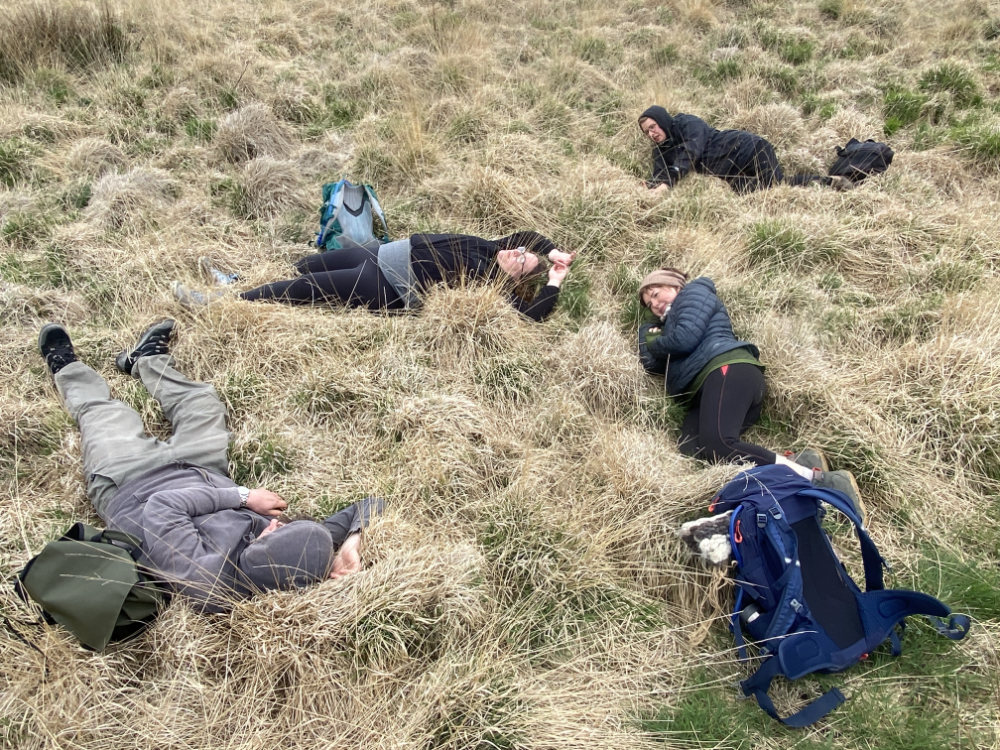
Stapeley Hill Cairn
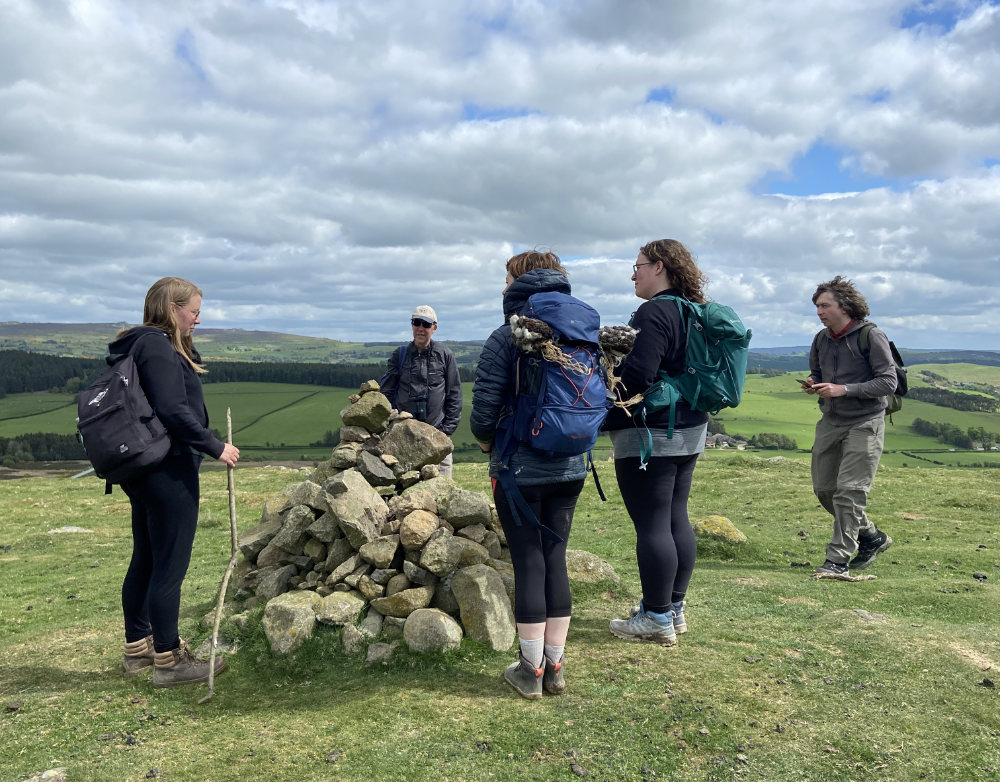
From the Hoarstones we began the ascent of Stapeley Hill, a saddle-backed rise with expansive views across Shropshire and into Wales. At its summit lies a ring cairn.
“The cairn on Stapeley Hill rests like a spine beneath the sky. Some say it marks a place where the world thinned – where the old ones stepped between sky and soil. Walking here feels like entering a sentence left unfinished. The cairn does not offer answers, only presence.” (Hallet, 2001).
Cromwell’s Trench
Walking south from the cairn, we approached Cromwell’s Trench: a series of scooped hollows dug as test pits in the search for minerals, a reminder of the lead-mining heritage of south-west Shropshire (Shropshire’s Great Outdoors, 2013).
“Cromwell’s Trench lies folded into the side of Stapeley Hill – an interrupted rhythm of hollows and scoops, dug by hands chasing minerals through shale and silence. The ground here feels restless, worked over, as if thought itself had been quarried. It’s a place of absences: ore not found, labour long vanished, names forgotten. And yet the trenches remain – cuts in the skin of the hill that still hold weather, lichen, and the slow return of stillness.” (Carver 1994).
Re-storying the landscape
Continuing south, we passed further cairns, stone rings, a Bronze Age ring barrow, and a network of linear earthworks before beginning the steep ascent of Corndon Hill. From the summit, the landscape opened out into a wide, circling view – fields, ridges and borders unfolding in every direction.
By this point, the quotations had accumulated. Voices – some historical, some imagined – had been laid into the land, not to explain it, but to thicken it. The manoeuvre did not resolve the myths of Mitchell’s Fold so much as redistribute them, allowing them to cling to stones, paths, absences and weather.
In future iterations, the quotations and their attributions may shift, disappear, or be replaced – treated as materials rather than fixed texts, responsive to route, weather and the particular group walking them.
If the walk achieved anything, it was to suggest that these landscapes are not fixed by archaeology or story alone. They are continually re-made through movement, speech, and attention: each step a small act of re-inscription, each pause a moment where the ground might speak back.
References
Burnham, A. and Pearson, M. P. (2018) The Old Stones: A Field Guide to the Megalithic Sites of Britain and Ireland. Watkins.
Brennan, T. (2017) Manoeuvre: Discursive Performance. Available at: https://www.timbrennanartist.co.uk/projects-fieldworks-performances/the-manoeuvre/manoeuvre-discursive-performance (Accessed: 26 December 2025).
Carver, I. (1994). Steps to the Sky: Notes on Walking and Vertical Mythology. Oswestry.
Ellis, R. T. (2014). Beasts that Became Stone, in Where the Hills Speak: Oral Tradition and Living Myth along the Anglo-Welsh Border. Hereford.
Darnley, I. (1958). Standing Stones and Straying Paths: A Rambler’s Guide to Forgotten Circles. Oswestry.
Hallet, M. (2001). Margins of Stone: Landscape, Memory, and the Mythic Borderlands. Ludlow.
Wright, T. (1862). Shropshire’s Great Outdoors (2013) Stapeley Hill’s Historic Trails. Leaflet. ‘On the Local Legends of Shropshire’, Collectanea Archaeologica, 1(1), pp. 50–66.
 Walkspace