Categories
Guest Posts Inspiration Posts

Art and walking – a book extract

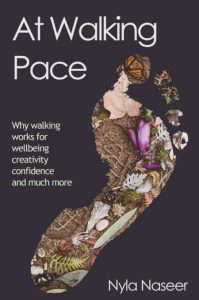
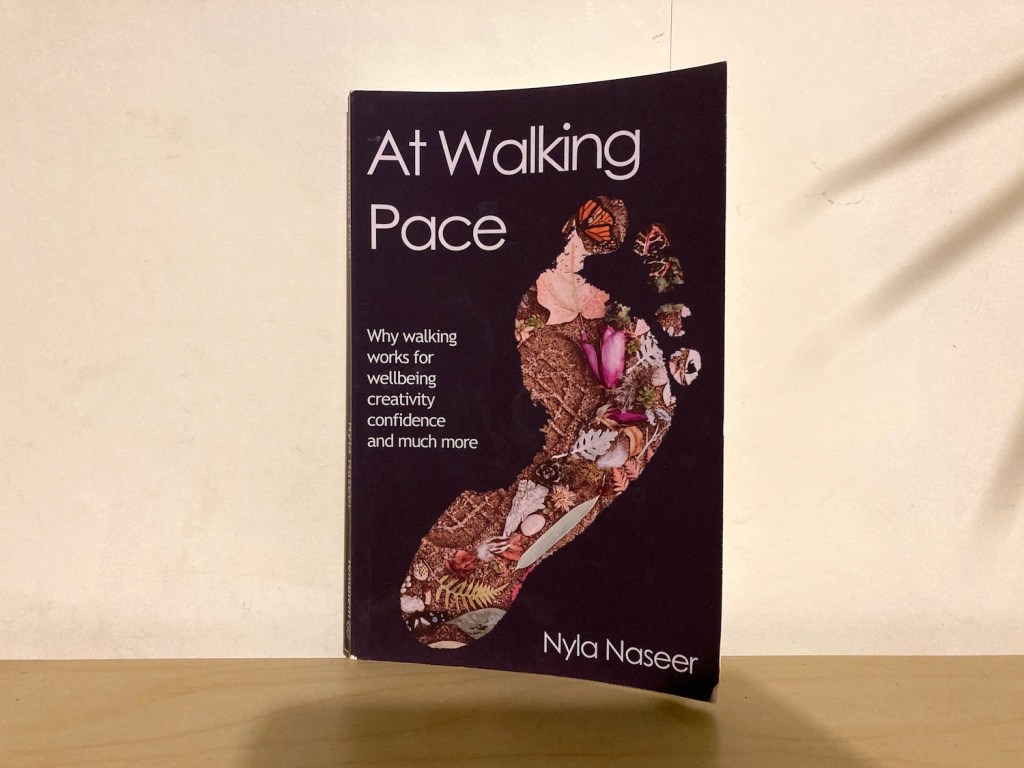
Nyla Naseer is an author and walker based in King’s Heath, Birmingham. During lockdown she wrote a book to celebrate walking. ‘At Walking Pace‘ was published last month, is easy to read, well researched and has one of the most pleasing book covers of all the walking books!

Nyla’s book is all about how walking can be used in different ways – for wellbeing, enjoyment, thinking and resilience.

Obviously we got in touch straight away to suggest going for a walk and to chat about walking in the process (because we are nothing if not meta here at Walkspace).

We also cheekily asked if we could republish an extract from the book. So thank you Nyla for the opportunity to support a local author. Here is the chapter on art and creativity that first lured us into buying the book.

Please do scroll to the end for links to buy At Walking Pace, to be a part of the accompanying podcast and to find out more about Nyla’s work.

There is no universal definition of creativity, but a common definition outlines a creative idea as being novel or original as well as useful, adaptive, or functional. It is the first criteria that applies to the ‘arts’ and the second criteria that applies more to problem-solving and work (more of which later). Taken together, the two dimensions of creativity play an enormous part in shaping personal and societal development. 

Earlier in this book I described how writers and philosophers though the ages have used walking to generate their ideas. For example, Aristotle, used to give lectures while walking around his school in Athens, followed by his pupils who became known as ‘peripatetics’ (meaning moving around). Charles Dickens was an avid daily walker who regularly walked twenty to thirty miles a day! Other groups of creatives, including musicians and visual artists have turned to walking to inspire them. Beethoven, for example, relied on daily walking forays for inspiration; during his walks he would continue to write music, scribbled on sheets of music paper that he carried with him.

Visual artists have long been inspired by the landscapes they walked within. Think of any painting by a landscape artist such as Turner and you will instantly feel aware of the walk that they took, ending up at the point that they decided to capture for us. Not only have artists used walking as a way of replenishing their energy and wellbeing, they have actively incorporated the walk as a way to record the world around them, stamping the identity of other walkers within their work. This, to me, is homage to walking itself.

Walking as an integral element of art has a long history. As walkers, artists gain the experience of more fully immersing themselves in their subject matter, or of considering elements such as the political, social or environmental relevance of their work. Walking is now present in art in many different ways: from collective art groups who go on walks, to the long history of political or protest walks that incorporate art forms such as music and banners. Walking and art are intertwined. Indeed walking is a legitimate form of expression in itself. Walking is an ‘attitude’.

Members of the Dada art movement in 1920s Paris organised a series of excursions to ‘places that have no reason to exist.’  Although only one of their nihilistic walks eventually took place, it sounds quite an event: the walk was accompanied by poetry recitals and was performed as a parody of a tour guide, making the walk a piece of performance art itself.  A few decades later, artist and philosopher Guy Debord created walking maps highlighting ‘psychogeographic contours’ through the city, drawing attention to the ‘ambience’ elicited by different surroundings. His notion of ‘derive’ saw the city as a living organism, where a walk became a creative experience that generated feelings that could be put to use in any number of ways: from the political to the artistic (Hermon Bashiron Mendolicchio 2020). Thus, walking has long been part of a daringly avant-garde and counter-culture scene.

Some contemporary artists centre their work on walking. They make art where walking is the subject matter: Richard Long’s ‘A Line made by Walking’ photograph, showing a straight line of trampled grass receding towards tall bushes or trees at the far side of what appears to be a field, is a good example. Another is ‘walking artist” Hamish Fulton. Since 1973 Fulton has only made works based on the practice of walking, dispensing with what he feels are the materialistic shackles we live with and concentrating on the freedom that walking gives us to think and create. The walk as a symbol of simplicity and an escape from conformity is a well used artistic trope.

Another popular example of ‘walking as art’ is ‘The Lovers’,  Artists’ Marina Abramović and Ulay’s 1988 performance, in which they stood 5,995 kilometres apart on the ruins of the Great Wall of China and began walking towards each other. They started from opposite ends: Abramović began from the mountainous provinces of The Yellow Sea while Ulay walked from the Gobi desert.  The walk was intended as a metaphor for their love and longing, however it turned into something very different (especially since Ulay had an affair with his translator during the journey) but nevertheless interesting, dramatic and thought-provoking. 

This association of walking and journeys with discovery and drama is very well exemplified in books and films, indeed there are too many to mention but I’ll pick out a couple. The classic ‘Wizard of Oz’ tells the allegorical story of Dorothy going through Oz ‘following the yellow brick road’ on a walk with her companions, whilst Cormack McCarthy’s ‘The Road’ offers a disturbing tale of a walk by a father and son though a dystopian post-nuclear destruction America. These two very different stories tap into our deep-seated identification with journeying on foot. The idea of a walk as a means of discovery is deeply embedded within written and visual culture.

Walking then is not a stranger to creative people. Historically, it has been appreciated as a thought and idea-provoking mechanism; walking therefore seems inextricably linked with the creative process. Does research reveal any rationale for walking promoting ideas creation? If indeed walking is a creative force then this opens the door for walking to become a tool, not just for artists but for work that needs people to think of ideas. So, does walking really have a positive effect on creative thinking and, if it does, what could be its greater impact at work?

[To find the answers, you’ll have to read the book! – Ed.]

Extract from At Walking Pace © Nyla Naseer, 2020.

At Walking Pace is available through the various book retailers, including Amazon and Waterstones. There is also an At Walking Pace podcast – details below.

About Nyla
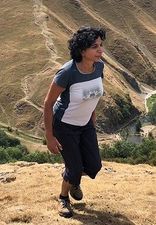
Nyla Naseer lives in Kings Heath. She is a writer, podcaster and vlogger. Her tough and totally un-stereotypical background brings alternative perspectives to her work.

She has a lifelong interest in people and ways of life, building a repertoire of knowledge for her writing and work on resilience, wellbeing and behaviour in general.

The outdoors, and walking in particular, has been central to her life and is a thread through her research and writing.

Nyla has two masters degrees and a BSc but describes herself as a ‘street-hustler type’ and ‘an interesting person with potential’.

Podcast opportunity

Nyla is interested in interviewing fellow walkers for the At Walking Pace podcast, which broadcasts on Spotify, Apple, Google and more.

In it, she talks to guests about walking, taking them on random walks and sharing views and ideas about living in a more human-paced way. The podcast encourages walking, lo-fi living, and taking things a bit less seriously.

If you’re interested, please get in touch via her website: At Walking Pace. You can also listen to the latest podcast and read more about Nyla’s work there, too.
Categories
Inspiration Posts

Walk with Craig across Japan

Are you up for a vicarious walk across Japan starting tonight?

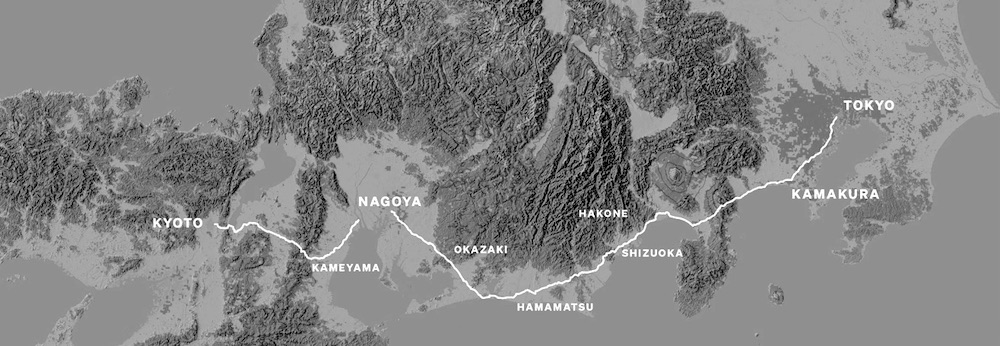
Craig Mod – writer of Roden and Ridgeline newsletters – is inviting people to join him on his durational walk 500km from Tokyo to Kyoto. It starts when he turns 40 at midnight tonight and he will walk daily until the end of November.

He is asking people to sign up and respond to daily walk newsletters with some kind of action that will be turned into a book of the walk.

To explain:

Each day I’ll send out one photograph and a 200-words-or-fewer missive. It’s meant to be visual, short and punchy. A Low Impact™ email. Something you’ll be happy to peek at.

It’s going to be weird! We’ll meet strange folks! Eat pizza toast! Walk along highways! Play some pachinko! Smoke disconcertingly cheap, unfiltered cigarettes! (OK, maybe not that last one.)

Roden 047

Craig Mod has form doing this so it should be enjoyable and an interesting journey to a part of the world that I’d love to visit.

Here is his essay on the project containing many more details and how to subscribe.

Categories
Inspiration Posts

People we found at 4WCOP

Last month we “went” to the 4th World Congress of Psychogeography. We’ve already posted about our own contribution to this virtual gathering but here we want to give a mention to some of the other West Midlanders we came across while “there”.

Helen Garbett and Bill Laybourne

One of the highlights of the Friday film night was Helen Garbett and Bill Laybourne’s psychedelic Black Country amble Albion: Care Don’t Care.

After three months of lockdown Helen and Bill returned to Albion Street in Brierley Hill. At first they noticed, with a heightened sensibility a street full of caring organisations such as a local food bank and Samaritans incongruously set within an environment that is utterly uncared for and decaying. Subsequent visits revealed unexpected associations and a melancholic beauty.

Helen, a visual artist and Bill, a sound artist co-founded Workshop 24 in 2018 where they work collaboratively as social art and walking practitioners. More about their projects and recent work can be found here. And here’s their panel discussion at the Congress.

Emily Inglis and Rachel Owens

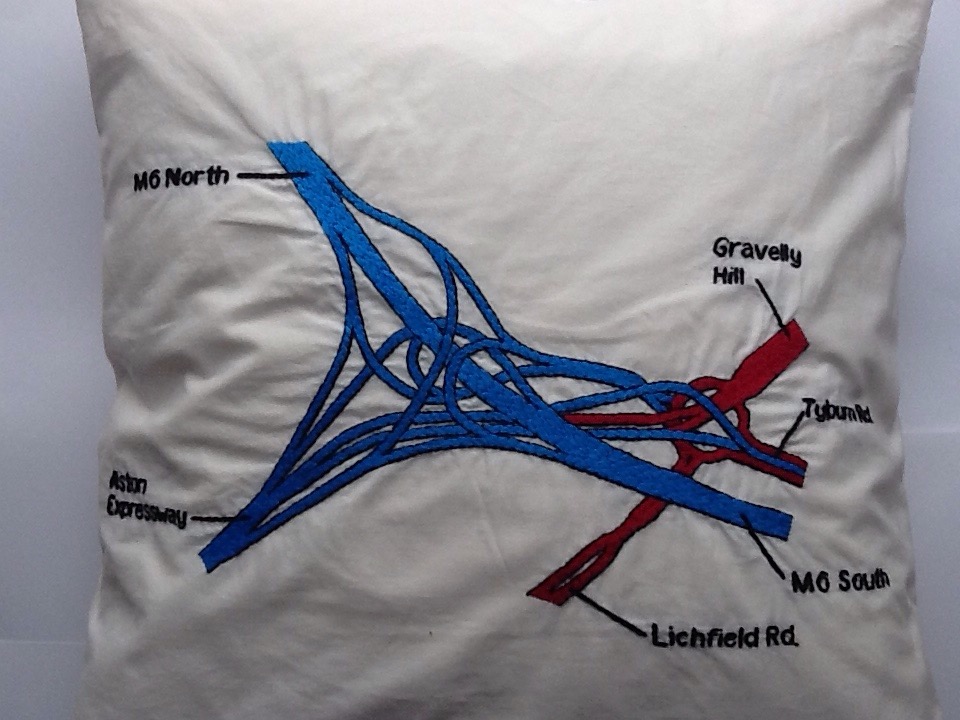
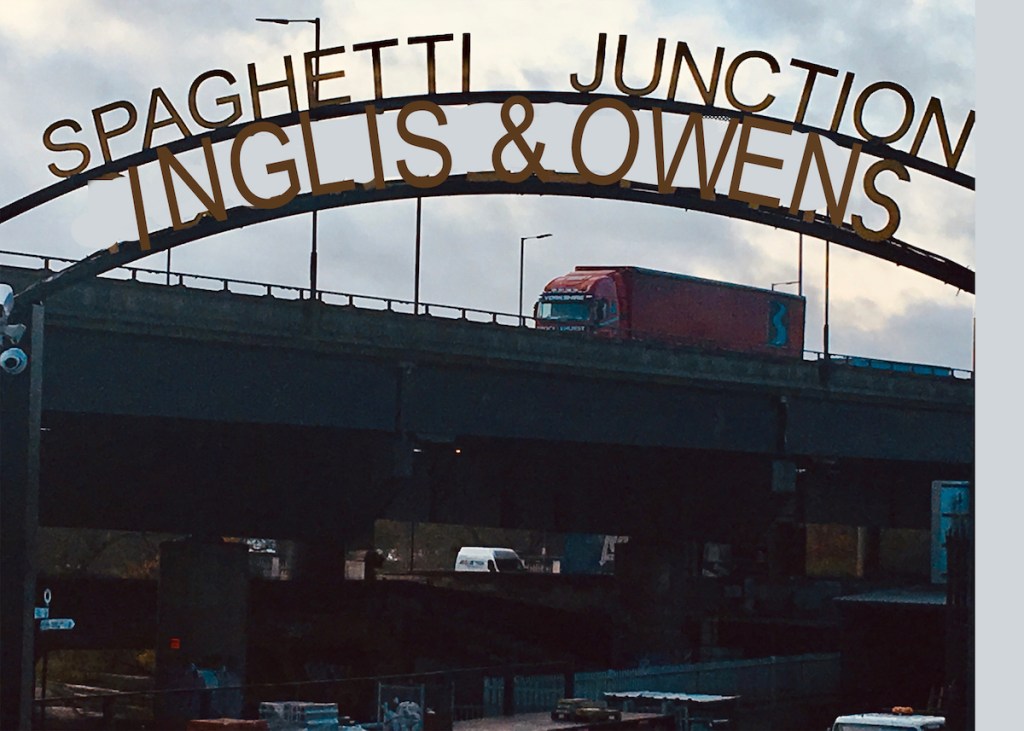
The mighty Gravelly Hill Interchange, AKA Spaghetti Junction has long been a favourite haunt of ours here at Walkspace so we were delighted to find a pair of artists who share our love of this concrete colossus.

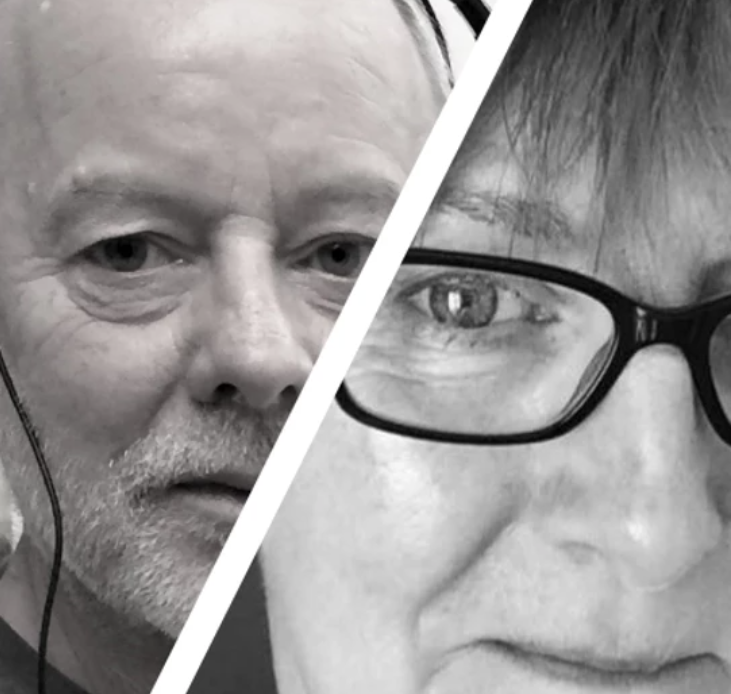
Emily Inglis and Rachel Owens go on walks and make art; their creative collaboration is based on a thirty year friendship and the interplay of tensions and class differences contained within it.

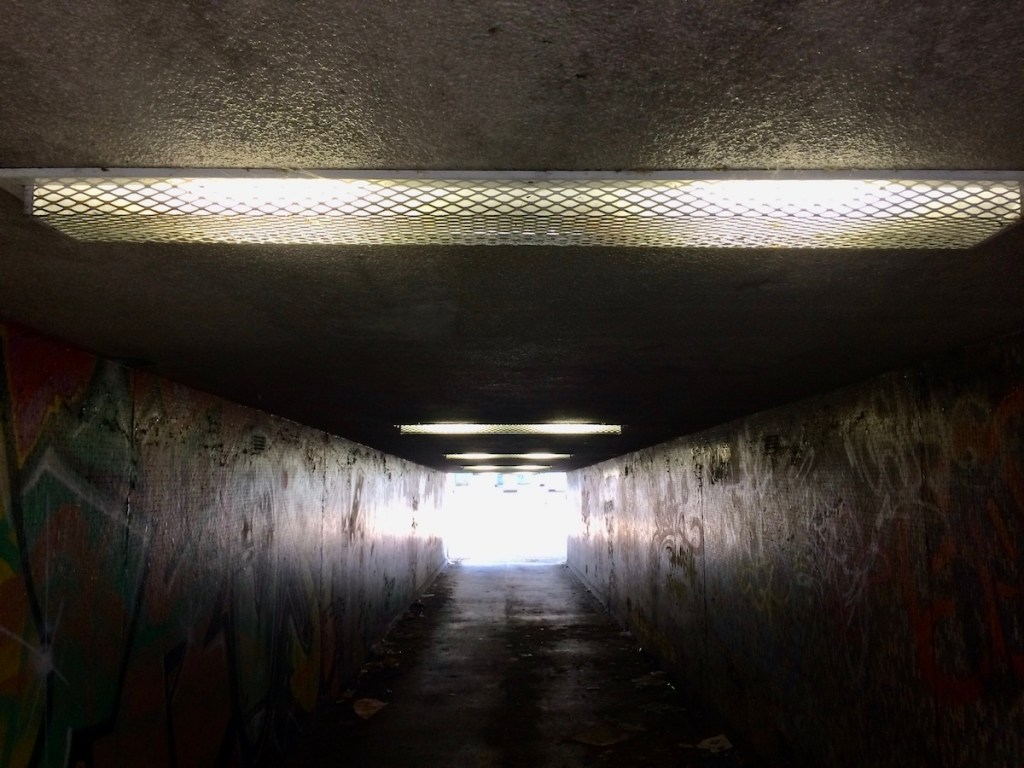
They both grew up in the Midlands: Leamington Spa and Nottingham. Now they live 400 miles apart and walking trips are the thing. The Spaghetti Junction walk was a way back into art for them. Travelling up from Sussex and down from Edinburgh they chose to explore the footpaths, tunnels, underpasses, towpaths and the ‘no-man’s land’ parts of the junction; signposting this an English landmark to be celebrated.

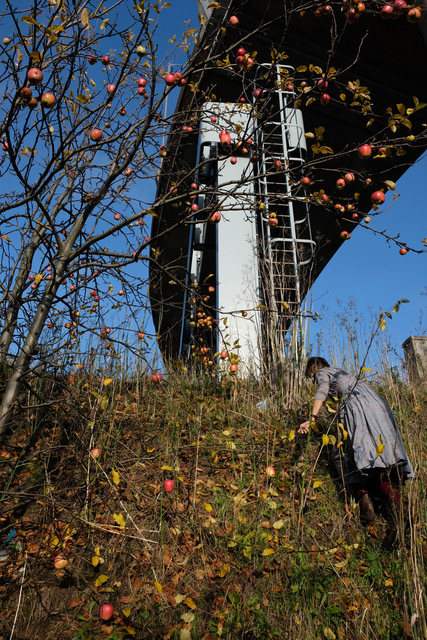
This is part of a wider project investigating overlooked sites that say something different about England. They visited the Junction in all seasons finding recurring themes that drew them back: the strange, the scary, the funny, the getting lost, the countless arguments and the unexpected glorious hidden sanctuaries. They came across an apple tree at the heart of the Spaghetti Junction laden with fruit. Was this discarded by a fractious kid stuck in a traffic jam sometime in the 70s? 

Emily and Rachel are currently working on a film born out of their explorations of the Junction. We eagerly await it and shall share it here when complete.

We hope to return to 4WCOP next year, ideally in person this time!

Categories
Inspiration Interviews

Q&A with durational walker Paul Taylor

Why do we walk and what do individuals get out of walking? In our first interview, Paul Taylor from Burntwood talks about his durational walking challenges in the Midlands and beyond.

Hello! Who are you?

Hi, I’m Paul Taylor and in February 2020 I walked one million steps as part of The Prince’s Trust’s Future Steps challenge. This was the latest in a series of walking and other challenges I’ve set myself over the last few years, ostensibly to improve my fitness.

The Covid-19 restrictions have obviously affected my ability to take extended walks, and this has possibly had a related impact on my mental and physical health. But, as we enter August, I’m once again starting to walk for walking’s sake. And I’m hoping it won’t take as long to improve my health is it did the first time round…

Why do you walk?

In 2017 I changed job and started working from home four days a week. Cue a rapid drop in my fitness levels. My wife bought me a Fitbit to track my exercise and the step counter caught my attention. I found myself ‘gamifying’ the step count, going from 10k daily steps, to 15k, to two-week stretches of 20k steps a day.

But then I also started to enjoy exploring local footpaths, walking routes and public footpaths. The Beacon Way passes close to my home and that led to other long-distance walking routes.

You connect your walking activity with sponsorship of a cause and also record the walks publicly? Why is that?

I find the motivation to complete harder physical challenges from telling people I’m going to do it, mostly on social media, and then talking about it as I prepare and undertake it. It feels like it would be a missed opportunity not to raise money or awareness. Now people suggest charity-organised challenges for me to undertake.

My 93-mile Two Saints Way walk, from Lichfield to Chester, took four days and was possibly the most physically difficult. But it also the most rewarding for what it achieved – helping a CrowdFunder campaign by some good friends reach their target for a Climate Change and biodiversity project on Scotland’s Western Isles. That really helped push me through those points when I didn’t think I could complete it.

What is your relationship with walking? What do you get from it?

My main outcome and goal is still the fitness. I’m fitter now than I possibly ever have been. Walking seems to be the one form of exercise that I can actually keep up.

But I have also really enjoyed exploring my local area. I live in Burntwood and have done for 40 years. But I’ve walked through parts of it in the last two years that I’ve never been to before, followed footpaths I never knew existed just to see where they go. It’s taught me a lot about my home town and, in part, led to an interest in local politics that I hope to explore.

Finally, I get a certain peace of mind from walking that comes from the simple act of putting one foot in front of another. It can calm my thoughts and give me space to think things through. I suffer, on and off, from depression and walking helps to relieve that, particularly on pleasant days and in attractive and/or interesting surroundings. I’ve found the longer challenges can have dark and difficult moments of their own, however. Any difficult endurance challenge does, and you have to keep telling yourself that if it wasn’t difficult it wouldn’t be a challenge and it wouldn’t be worth doing.

Where do you walk?

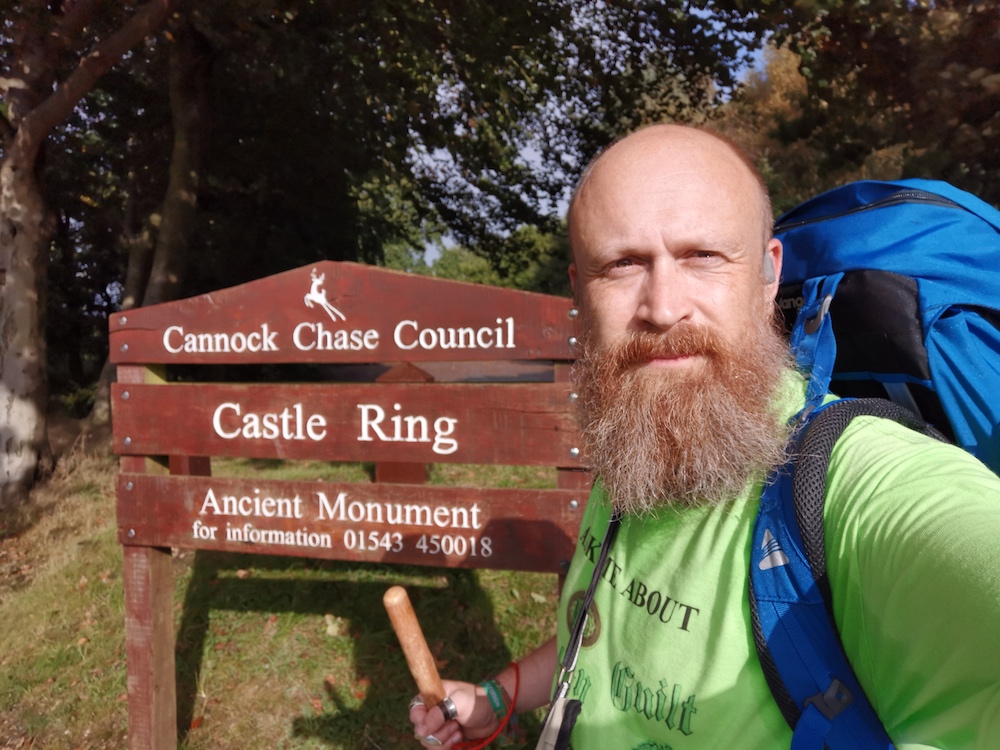
I mainly walk around Burntwood. Gentleshaw Common, Cannock Chase and Chasewater are all within 10 to 30-minutes walk from my house. We also have urban routes like the Anglesey Branch Canal and the newly opened McClean Way in Brownhills.

If I’m walking simply for the step count I often walk to and from the train in Lichfield and Rugby to go to the office. Or, when I’m having to make up those last few thousand steps for the day’s target, the preferred destination is a pub for a ‘hydration break’ (a running joke in my FB posts – it’s a pint of cider). I know all of the pubs in Burntwood based on how many steps it takes to walk there and back. I’ve considered setting up a ‘Drunk Hiking’ group at times. Part hike, part pub crawl, part exercise in pushing H&S concerns to breaking point.

Do you prefer to walk alone?

I usually walk alone, out of circumstance rather than choice. There aren’t many other people I know who want to walk as far or as often as I do. I listen to a lot of music and audiobooks. I do a weekly internet live stream music show [check out Paul’s excellent radio shows – Ed.] focusing on new music and long walks give me plenty of time to listen to new material.

How do you record your walks?

I have been documenting my walks on social media using hashtags such as #MillionStepFeb and #AardvarkSaintsWalk. I started a blog but it’s not compatible with an activity that leaves you totally worn out at the end of the day.

Vlogging has given me a way to show my often beautiful surroundings and get across some longer thoughts that would have been difficult to type out. I also do shorter video pieces for posting on Instagram and FB stories. If feels like a way of sharing not just the facts of the walk but also the emotion of it. Particularly on a cold, dark, wet morning when I really wasn’t happy about being out there to get an early three-hour walk in before work.

It came as something of a surprise after each of the first few challenges when people told me they found my posts inspiring. It hadn’t occurred to me that my mad escapades could do that. A few friends and followers have taken up or increased the walking they do after seeing my posts and vlogs and I find that incredible. It encourages me on further.

What do you think about on long-distance walks?

Everything. Nothing. I find the repetitive, but not totally unthinking, nature of walking soothing. It frees me up to reflect on things, to allow my mind to roam or to focus on a specific issue as I wish.

I like to find out about my surroundings. I am one of those people who spends as much time staring at his phone screen as at the surroundings. And that’s often because I’m looking up things of interest that I’ve seen around me… landmarks, businesses, things that pique my interest, random questions I’ve had while my mind has wandered.

Has your walking become a bit of an addiction?

I can stop anytime I want. Honest… I don’t think it’s an addiction. Yet. But I do find in the period after a long challenge I get a mental and physical crash, almost a withdrawal, while I adjust back to normal levels of activity.

And there’s always a desire to do something else. To walk somewhere else. I definitely miss it when I’m not doing it. It has some of the features of addiction, particularly when I’m rearranging my day or heading out late at night just to hit an arbitrary step target. But that’s largely because my ultimate goal is the improved and maintained fitness.

What will be your next walking-based challenge or idea?

I want to do the Coventry Canal in a day, which is 38 miles from Fradley to Coventry. And to do the rest of the Heart of England Way once the weather improves.

I’m also interested in linking up with some local historians to find new walking routes with history to them or to keep old public footpaths alive. And I’d love to plan and then walk the route of Queen Elizabeth’s 1574 progression from London to Bristol as part of a project for a friend who’s obsessed with that event.

Ultimately, before age prevents it, I’m tempted to try an LDWA (Long Distance Walkers Association) 100 Mile event : 100 miles in less than 48 hours. However, I think that might be a step (or tens of thousands of steps) too far.

Do you have any suggestions or recommendations based on your personal walking practice, or just generally about walking or walking in the West Mids?

The West Midlands has some fantastic planned walks. I’d strongly recommend picking up a guide book to some local ones and trying them out. And then just get out there and walk.

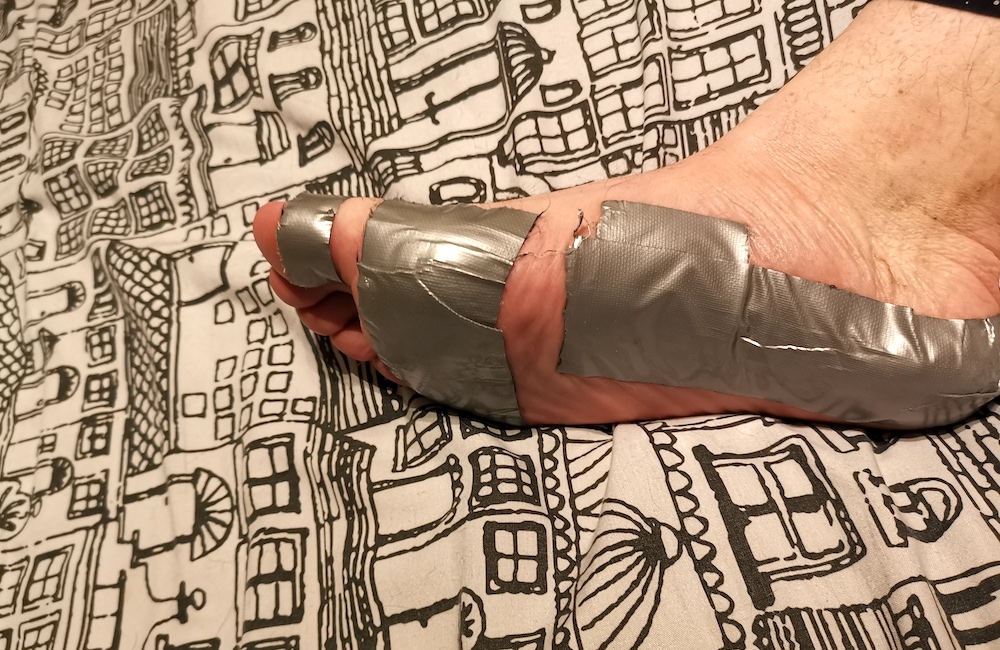
Start small if you’re not a walker. Don’t buy expensive kit until you need it. When you start reaching distances where you’re suffering from wear and tear, then invest in decent hiking socks and shoes. And gaffer tape is the absolute best prevention method for blisters. Gaffer tape on your feet and micropore on your toes.

Thanks Paul!

If you’d like to be questioned about your walking, drop us a line and we’ll subject you to a light interrogation.

Categories
Inspiration

Robson on… Marvellous maps

I can’t really write about walking without writing about maps. Hand drawn, Ordnance Survey, road, tube, physical, nautical, political, climatic, thematic, ancient, fictional maps, if you can think of it there is probably a map for it. A note before we proceed, everyone can learn to read maps, don’t believe any nonsense that some people just can’t, they just can.

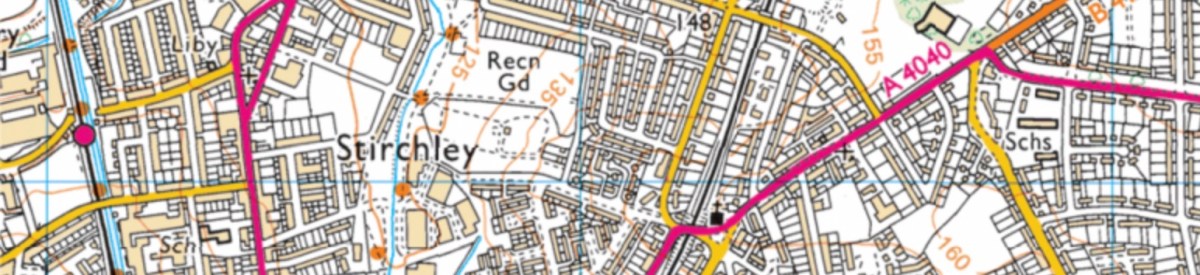
Ordnance Survey (OS) Explorer maps are the best maps you can purchase of these islands. If anyone ever tries to persuade you differently, politely correct them and clarify that they should never raise the matter again. There are currently 403 available and you can spot them by their orange cover. They are 1:25000 scale, meaning what ever the distance on the map multiply it by 25000 to get the actual distance across the land. I encourage you to buy the explorer map of the area you wish to explore, open it on the table or the floor and pore to your hearts content. (Bing maps has a useful OS layer but is not available on mobiles devices and it’s not the same as studying a paper map.)

Maps are political even when they are physical. They have been used for 100’s of years to show borders, denote ownership of land and, often, imply the exclusion of one people in preference of another. (Ordnance means artillery, the original remit of OS was to map Scotland after the Jacobite uprising of 1745.) To be ‘put on the map’ suggests recognition. A map can explain why a border is in a particular place and they are often situated where there is already a natural boundary. A river, a range of hills or sometimes a change in flora have all indicated a change of ‘ownership’. When you live on an island, as we do in the UK, you have a big wet natural boundary, usually called the sea, but when you sail out of UK coastal waters there is no bobbing line of buoys on the ocean to inform you. Similarly when you cross the Welsh Marches on foot from England into Wales there is not a painted line on the fields or hillsides.

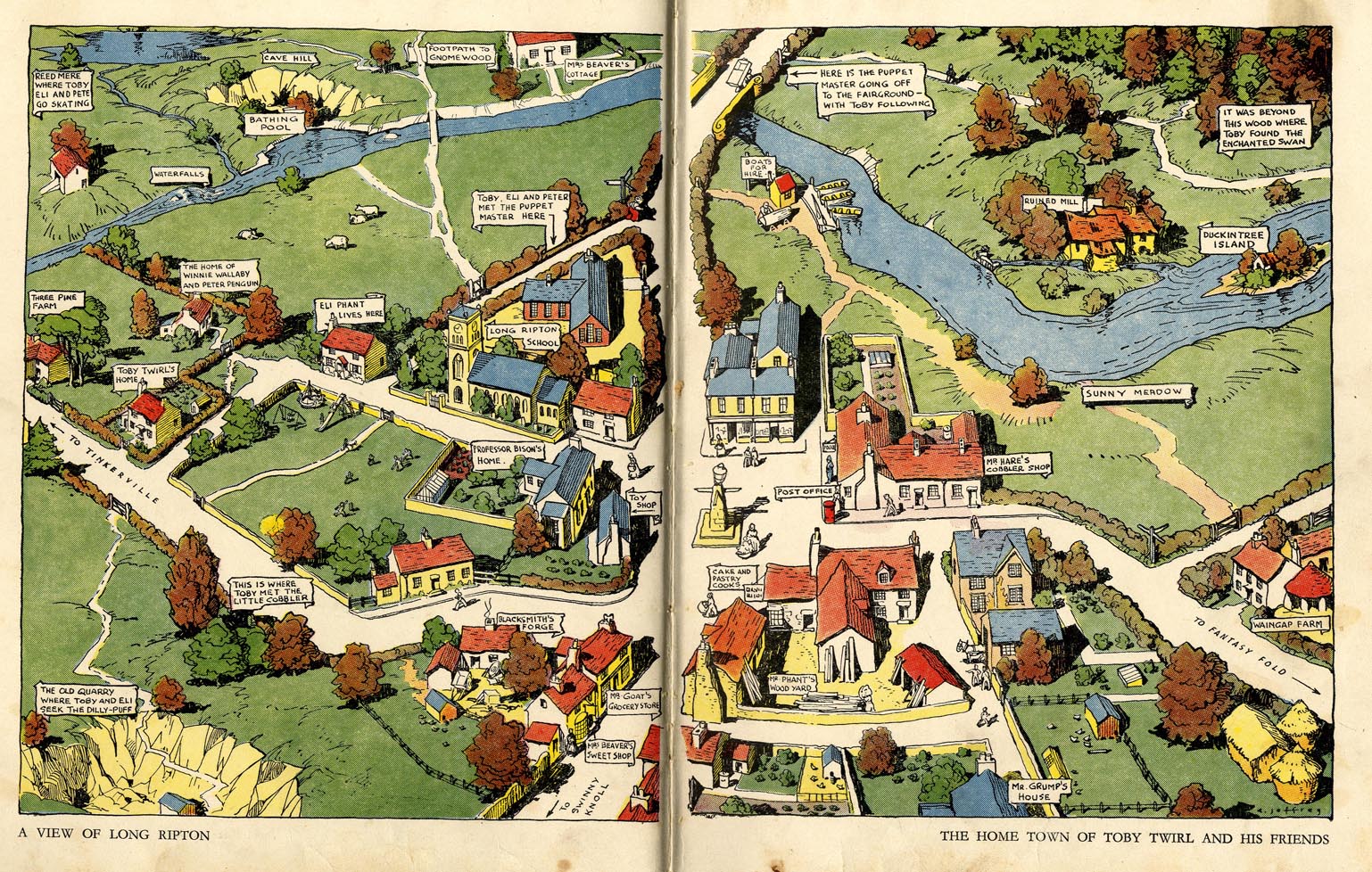
Maps are show us a version of what is really there but, in a sense, they are all fictional. Many fantastic books start with a fictional map. A map helps immerse the reader in the world that is being created. Treasure Island, Winnie the Pooh, The Hobbit, The Wind in the Willows, Toby Twirl, all these books have maps, often picture maps, that have become as cherished by readers as the stories themselves and the way we read those maps is the same as we would for real locations.

There are too many wonderful ‘real’ maps to do justice here but the Mappa Mundi in Hereford Cathedral is worth a mention and a visit. It’s a 700 year old map of what was then the ‘known’ world, from a European perspective, painted on vellum. Amongst many accuracies it includes several species of dubious provenance including the Sciapods, who used their one giant foot to shield them from rain and the cynocephalus who had a human body and the head of a dog.

Draw your own map or map a route for friends to follow. Remember though, as famous explorer Jon Bon Jovi said, ‘Map out your future – but do it in pencil.’ He really did. A good map can be trusted but they are rarely 100% accurate. By the time a map goes to print a row of shops might have been knocked down or a road layout might have changed. Generally, what you can see in front of you with your actual eyes is probably actually there. If the map you’re reading says there is a small stream at the bottom of the valley but when you get there it’s a raging torrent at the bottom of a gorge, no matter what the map suggests, the raging torrent is really there.

Investigate a map of a distant district, one you may never even visit, and you will start to be able to read the terrain, the vales and valleys, roads and rivers, schools and scree. Study an OS map of your own neighbourhood and look for the features you have not noticed before. Learn where the stream flows under the railway or where the high ground is. Studying old maps of your manor can inform you why a street has a particular name or where a farm used to sit. This will enrich your understanding and your enjoyment of you local environment.

So go and buy a map and explore the area in your head, then buy a map of your local area and go for a walk.

Categories
Inspiration

Six lockdown walks with Alys and John

There’s much to enjoy in this correspondence between writer Alys Fowler (who you may know from her memoir Hidden Nature kayaking Birmingham’s canals) and artist John Newling (whose exhibition Dear Nature was on at Ikon before lockdown). It takes the form of six letters with photographs over April and May.

You can read them on Ikon’s website or download a PDF.

As a taste, in the second letter Alys talks about finding a lost pigeon, which her dog scares away before she can persuade it to live with her.

For a good hour, I mourn not having that pigeon as a friend. I look for her the next day, but she is nowhere. I hope that, refuelled on my chicken corn, she has gone home. That or she met another pigeon and now is living a wild life along the rail tracks.

I’m very interested in pigeons. I am fascinated in how they transcend so many different spaces for us. They are feral and domesticated, prized, fattened (a fancy pigeon eats a very refined diet) and despised. They have raced, travelled over boundaries as spies carrying messages, won medals at fairs for their plumage, been food for working families, a source of manure, psychological test subjects and even taught to recognise breast cancer. They can apparently spot it as accurately as any oncologist.   

Meeting the pigeon sent me back to reread the multispecies feminist writer Donna Haraway’s Staying with the Trouble, Making Kin in the Chthulucene (2016). Do you know it? It is about how we must find new way ways to reconfigure our relationship to the earth and its inhabitants in the midst of spiralling ecological devastation. She writes of pigeons;

“Everywhere they go, these cosmopolitical pigeons occupy cities with gusto, where they incite human love and hatred in equal measures. Called ‘rats with wings’ feral pigeons are subject of vituperation and extermination, but they also become cherished opportunistic companions who are fed and watched avidly the world over.”

Haraway is interested in species that are boundary crossers for us: occupying more than one place in our minds and thus are able to cross over and create threads of stories of how we, as multispecies, as kin, might get on better together.

Alys Fowler. Letter 2/6 Monday 9 April.

I picked this out because one of the walks we were hoping to run before lockdown scotched them all was a guide to Stirchley’s pigeon communities with Megan Henebury. When I first discovered Megan’s obsession with the noble pigeon it seemed odd, in a good way. Now it appears I’ve been living a sheltered life. We must run that pigeon walk and soon.

I could have excerpted any number of bits from these letters though. Wonderful stuff. Thanks Ikon!

Photo at top by Alys Fowler.

Categories
Inspiration

Marching against racism in Birmingham

I’ve seen some comparisons of the Black Lives Matter protests with the tumultuous events of 1968, some wondering if we’re witnessing the start of something similarly historic. While comparisons can threaten to diminish rather than strengthen, it might be empowering for those marching to make some connections and know history has their back.

Andy went on the Birmingham protest on Thursday and posted some footage from within the crowd.

https://youtu.be/-jg0UUzNES0

Andy writes:

Amazing scenes at the #BlackLivesMatter rally yesterday. When it began the last thing I expected was to end up marching over the Hockley Flyover but there you go. Incredibly all that was planned was a stationary protest so this wild procession somehow came about spontaneously. Huge energy, overwhelming solidarity from car drivers and onlookers and not a single police officer in sight. An unforgettable experience. Let’s hope it never happens again.

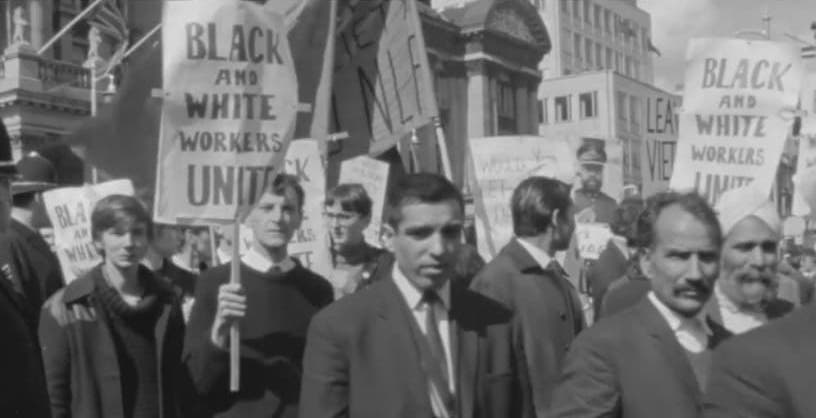
A frame from ATV footage of the 1968 march in Birmingham. via

I found myself reminded of footage filmed by an ATV news cameraman on 5 May, 1968 of protests in Victoria Square. Ian Francis of the Flatpack festival showed it last year when talking about his new book, This Way To The Revolution, a look at art and activism in Birmingham in 1968. The footage isn’t online but he has published an excerpt of the book covering that moment on the Flatpack blog.

It’s a crisp, warm Sunday afternoon in central Birmingham. Demonstrators are filing into Victoria Square in anticipation of a visit from Prime Minister Harold Wilson, due to give a speech in the Town Hall at 3pm. There’s an eclectic array of placards on display: students in donkey-jackets proclaim ‘Yankee Aggressors Out of Vietnam’ and ‘Wilson is an Optical Illusion’; smarter and more orderly, a large group of Indian and Pakistani workers carry signs reading ‘Black and White Unite and Fight’ and ‘Prosecute Fascist Powell’; bringing up the rear, a group of dancing, singing African protestors attack the ‘Nigerian genocide’ in Biafra. There’s a large crowd of curious onlookers, from school-kids to old ladies, and on Galloways Corner at the top of the square a pocket of fascists is chanting “Send ’em back!” Among them is Colin Jordan, a former Coventry school teacher and prominent British nationalist. 

Black and White Unite and Fight – Flatpack blog

He goes on to outline the people and organisations that were active then and what they were fighting for. It’s sobering to see what has and hasn’t changed.

I also found myself thinking of this photograph from Vanley Burke‘s excellent photo book By The Rivers of Birminam published by the MAC for his exhibition there and available from their shop when it re-opens.

Vanley Burke – “A demonstration organised by the Asian community in protest against racist immigration laws and deportation – 1978”

I love its sense of place, that these people are clearly marching in a residential Birmingham street, identified by the skyline, and that they belong there.

Vanley has been documenting the lives and experiences of the Afro-Caribbean community in Birmingham since 1967 which has of course involved protests, demonstrations and riots. By The Rivers of Birminam juxtaposes them with portraits and candid shots of people just being people, lending a depth and humanity to a community that has been wildly misrepresented over the years.

A 20 minute documentary about Vanley’s life and work

Walking together is often a radical act with a long history. I hope these two examples from Birmingham’s past are of use to the current generation.

Categories
Inspiration

Walking the Pipe with Kate Green

Following an arbitrary line is a tried and tested technique for the curious walker. The landscape and its contents will reveal themselves in a sequence determined by your line. Pick a start, an end and draw line between them. Follow that line and keep you eyes and ears open.

Kate Green spent the last year walking a line that was drawn from the Welsh mountains to south Birmingham by Victorian engineers when they were trying to figure out how to bring water to the rapidly growing city. Birmingham’s waterways are a bit puny due to it being one of the highest points on the British isles and in the 19th century it was festering with disease in dire need of sanitation.

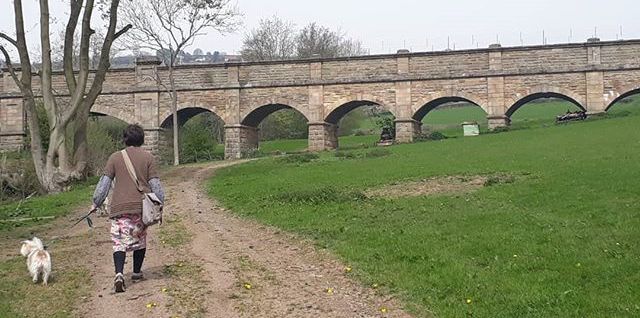
Kate and her dog by the aqueduct.
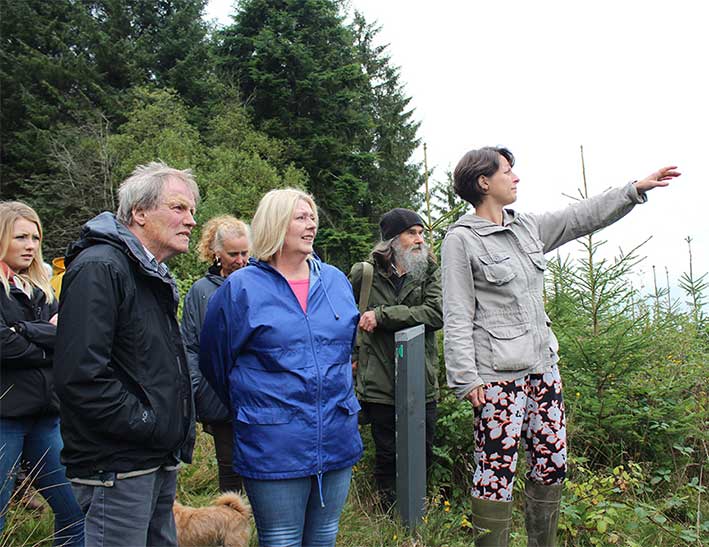
Kate employing the walking-artist’s trope of pointing at things.

Thankfully the Elan Valley is 52 metres higher than Birmingham. A pipe angled at a gradient of 1:2300 will transport water over a day and half using gravity alone from the waterlogged mountains of mid-Wales. Building started in 1896 lasting a decade, and that’s why we rarely have a hosepipe ban in Birmingham!

But I digress. Kate, who describes herself as a short interdisciplinary artist with dark hair, decided to walk the Elan aqueduct primarily to gather and share stories. She does this by writing and performing songs in a style that would have been popular during the build, drawing parallels between its creation and the present day. For example the navvies that built it were itinerant workers, moving their families from one job to the next. A century later the workers repairing and maintaining the pipe are predominantly migrants from Europe.

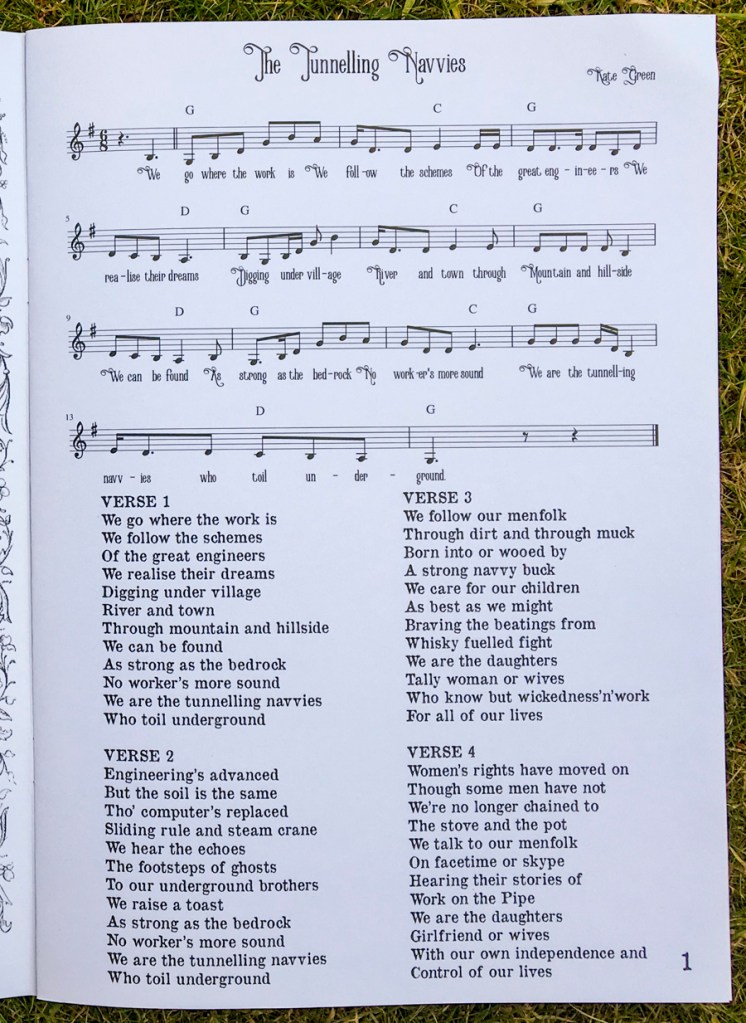
The Tunnelling Navies from the Walking the Pipe Song Book

Her project has seen her run workshops, coffee mornings, exhibitions and performances along the towns and villages near the pipe, all fed by a steady walk eastwards. They’re documented in The Pipe Chronicle, a cod-Victorian newsheet.

We got to meet Kate and her infectious personality when she presented Walking The Pipe at the Plymouth walking conference in November last year. Rather than a lecture, is was wisely run as a singalong performance in the evening when beers had been consumed. We’ve been singing “This is the damn, this is the damn, that feeds the thirst of Birmingham” ever since.

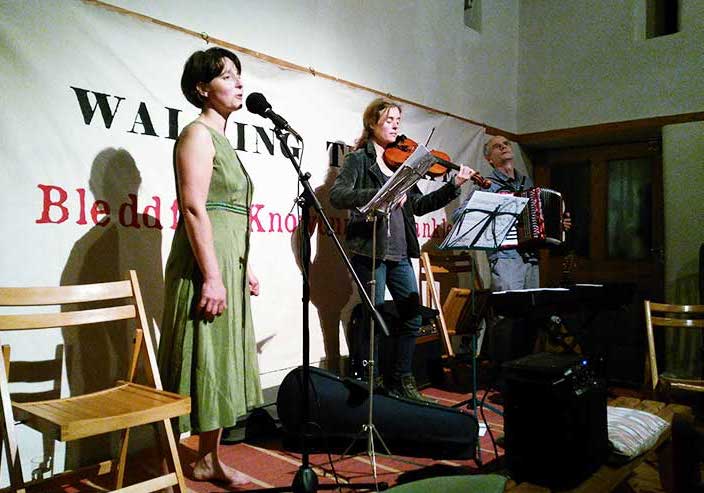
Kate performing at an event along the pipe.
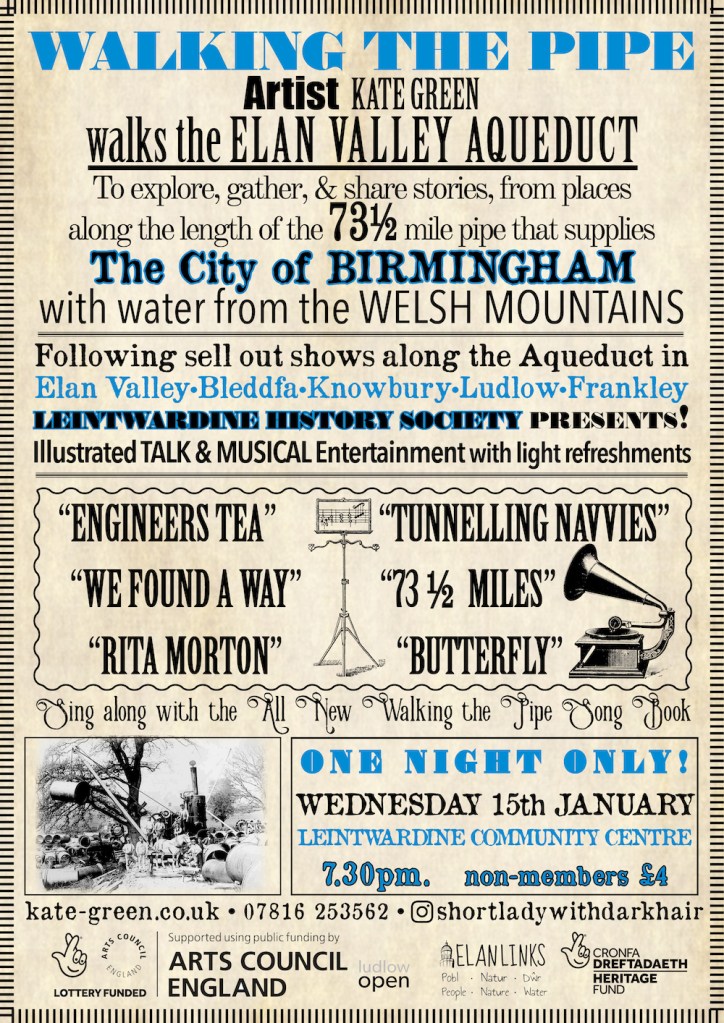
A poster for an event.

It’s rare to find art that is both high-concept and high-nerdery while also being fun and accessible. Walking the pipe is a gem.

Kate has produced a songbook and zine-style collection of her newsletters. A formal Walking The Pipe book is in production. Contact her for details.

Categories
Inspiration

Robson on… Arboreal beauty

Trees are our companions, man. That said they do not generally walk with us, unless you have been lucky enough to take a stroll with an Ent in your local Fangorn Forest. They do however live where we live and ‘breathe’ the air we breathe.

Some of the first to signal the arrival of spring are cherry trees. They burst into flower, like the earth venting clouds of pink and white blossom, billowing from between buildings, from behind houses and in parkland. A few weeks later horse chestnut flowers look like the gleaming spires of a city in the branches.

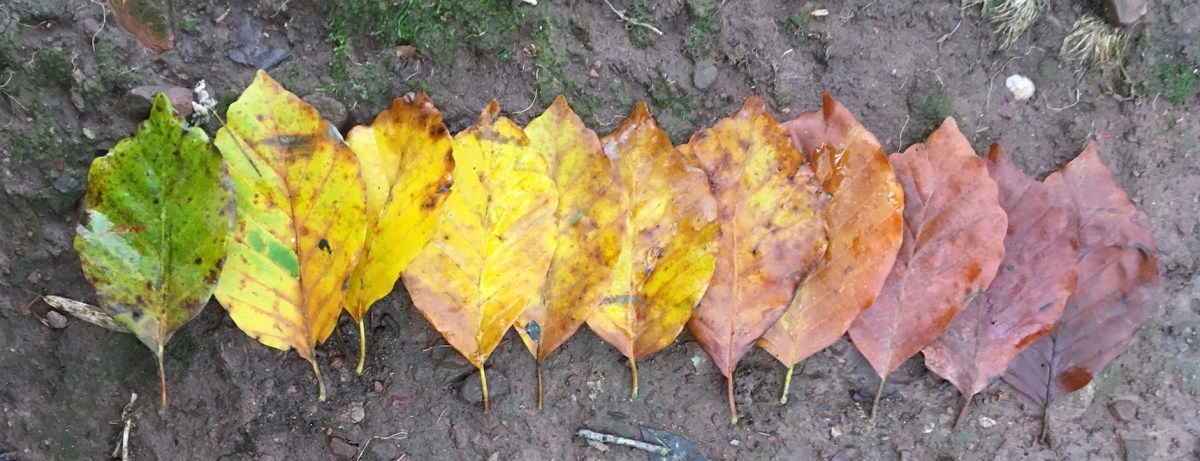
Trees change quickly at this time of year. Four weeks ago most trees were still quite bare, now they are in leaf or at least in bud. As they do so they soften the landscape in which they grow. The dark silhouettes of winter blurred by new growth. When you can get farther afield go to see trees on hills, where the weather is naturally a bit harsher. These trees are often two or three weeks ‘behind’ their cousins in the relatively protected valleys and cities.

If you look a a patch of woodland from a short distance you will run out of words to describe the different verdant greens of each species of tree. Adam Nicolson, in his brilliant book The Making of Poetry, describes spring as having ‘rhapsodic freshness in every molecule’. Some leaves are not even green, there are bright yellows and deep reds as well. Visit a local tree once a week from the start of April to the end of May, throughout the year in fact, and you will see it transform. The effort the tree exerts in spring is worth pondering. A mature oak is thought have around a quarter of a million leaves, all of which it replaces every year!

Charles Simic sensuously describes leaves in his poem, called Leaves,

… Watching leaves,

The way they quiver
At the slightest breath of wind,
The way they thrill,
And shudder almost individually,
One of them beginning to shake
While the others are quiet, …


and later, in the same poem,

On this oak tree casting
Such deep shade,
And my lids closing sleepily
With that one leaf twittering
Now darkly, now luminously.


The dappled shade of spring leaves, now darkly, now luminously, enable carpets of bluebells, wood sorrel and wild garlic to flourish.

When summer arrives you can almost watch as trees wilt on long hot days. All the effort of Spring replaced by a staid endurance in the dusty summer air. Trees provide their own shade. Stand under a big tree on a hot day and the cooler air is lovely, don’t fall asleep though, you might wake up in Faerie.

In autumn the colours of the leaves seem to compliment the lowering sun, it’s like someone planned it. They didn’t. Autumn colours are the result of the trees no longer photosynthesising. The leaves lose their greenness and, as decay sets in, change to yellows oranges, reds and browns. The shorter, cooler days make the trees realise it’s time to start hunkering down. Walking through still autumn woodland is one of the delights of the season.

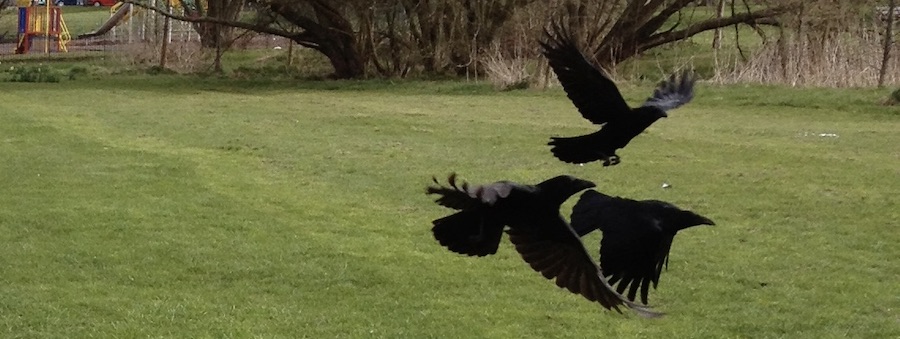
Winter trees stand stoic against the cold, their dark branches punctuated by crows. The view through woodland is no longer ‘hindered’ by leaves so you can often see views unavailable the rest of the year. Many of the original map makers of these islands did their best work in winter when they could see further from trig points. Trees are basically hibernating in winter although it’s called dormancy. By not maintaining their leaves they are saving energy for when it’s needed.

And so back to spring. All the recent evidence suggests that humans, that’s most of us reading this, get tangible mental and physical benefits from spending time in woodland. So spend some time amongst trees. Watch them ebb and flow across the year and go for a walk.

Categories
Inspiration

Robson on… Avian activity

Since the start of lockdown I have been walking for an hour, around sunset, almost every day. This is great time of day to watch wildlife and the unseasonably mild spring has made it a daily delight. Animals are of course, entirely unaware that the world is a bit more unsettled than usual just now. I find that somehow reassuring. In these uncertain times a feeling of ‘kinship’ with non-human earthlings can help, even if the feeling is not mutual.

Some of those earthlings, the avian ones, are quite easy to see. Birds often gather together as this slightly improves their odds if we, or any other animals, decide to hunt them. If you’re missing crowds go and watch gathered water-fowl, pigeons, gulls, sparrows and crows all go about their work. More solitary are blackbirds, grebes, jays, woodpeckers, robins, wrens and herons, the latter can often be seen on the canal. 

I have seen a falcon, a Peregrine I think, hover over it’s prey in one of the less built-up suburbs. Birds of prey are still rare in cities but can be seen quite often in the edge-lands, where the distinction between urban and countryside blur. Watching one hunt is a mesmerising.

Ted Hughes brilliantly describes a hunting hawk in the first poem of his first collection, with the same title, The Hawk in the Rain.

… but the hawk

Effortlessly at height hangs his still eye.
His wings hold all creation in a weightless quiet,
Steady as a hallucination in the streaming air.

I encourage you to read Hughes’s bird poems, he usually writes with a directness that is accessible and conjures tangible images of many different creatures. 

Less direct is Hughes’s collection Crow which tells tales of the mythic trickster crow of many cultures. Look for the deep iridescent blue on the backs of crows and ravens. You can spend the rest of the day trying to decide if it was indeed blue or a colour as yet unknown to science. Watching crows along the canal squabbling over a discarded chicken takeaway is one of natures true wonders.

Waterfowl, ducks, geese, swans and moorhens, seem to like a good old-fashioned punch up at dusk so it’s a good time to observe them. There is no doubt a good evolutionary reason for this boisterousness but, to my unknowledgeable eye, they appear to simply enjoy a row. They settle down again as night creeps in.

Gulls are ubiquitous in town and country and, of course, by the sea. That said you can leave the ‘sea’ part out of their name, most gulls have never seen the it and, apparently, they think it’s a myth. Read Landfill by Tim Dee, it’s a lovely look into their lives and how those lives are linked to ours. Wood pigeons and their tough inner city cousins, with their often mangled feet, make interesting viewing. When startled, you may have noticed, pigeons ‘batter’ almost straight upward to evade a threat. This is thought to be because they used to live on mainly on rocky ground in the ‘olden days’ and this was a way of evading lizards and wild cats that stalked that terrain. 

In Birmingham there is a growing population of starlings in the city centre. Their seemingly anarchic ways and punk feather-styles make them a good lunchtime distraction.

Farther off red kites glide over Wycombe and the Chiltern Hills and can be seen easily from the train to London. Kites are often a bit scraggy looking but are still majestic and they are slowly moving to new grounds so keep your eyes to the skies. 

I haven’t even mentioned the dawn chorus! Get up really early and listen.

During the current time we, perhaps, feel less connected to our fellow humans. We might also be less at the behest of our usual daily timetable. Take advantage of that time, if you can, and connect with the feathered fauna that live near you. Feel part of something, no matter how passively, and go for a walk.

Partly inspired by our Fiona’s piece on great tits.