This piece by Andy Howlett was originally written in April 2021 and appeared in Back to the Future, “a forward looking journal about past-futures, modernism, architecture, and town-planning in Birmingham.” Upon learning of the death of the pop-artist sculptor Nicholas Monro it seemed fitting to repost it here in tribute. Every word of it is true and like all great stories it started with a walk…
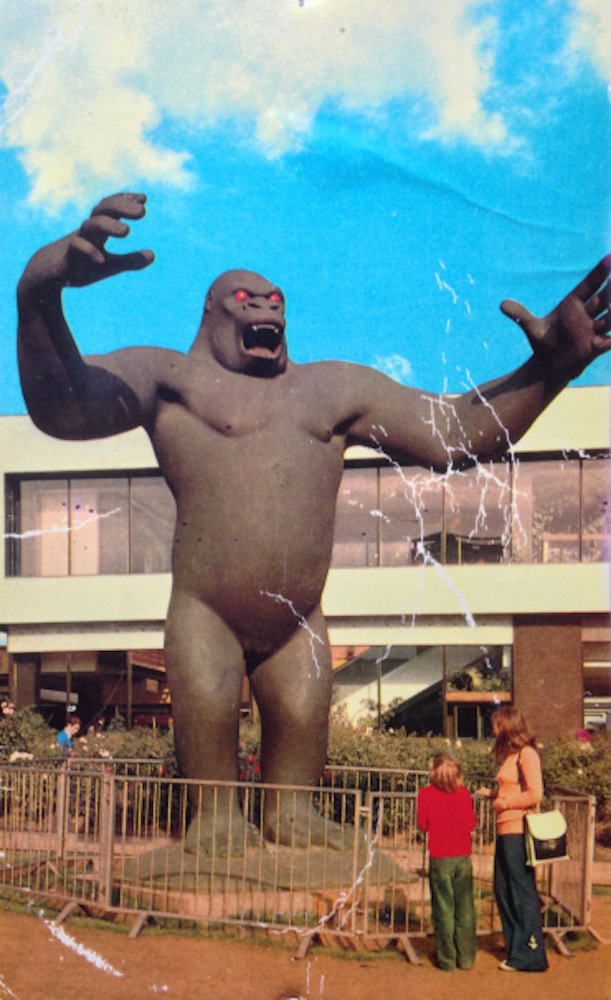
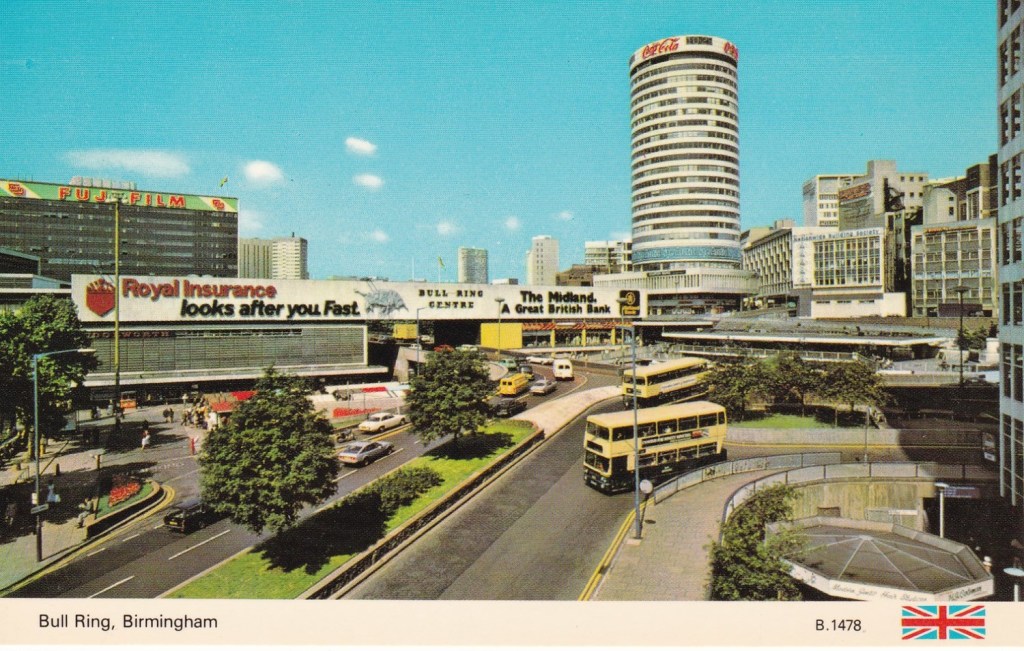
Anyone who’s seen the film King Rocker will know that for a brief time in the early ‘70s, a giant fibreglass gorilla lorded it over the grounds of the Bull Ring shopping centre in central Birmingham. The previous two decades had seen the city rebuilt from the rubble of World War Two in the image of what was then considered the future: soaring flyovers, concrete monoliths, traffic island beauty spots, heroic multi-storey car parks.
“What Birmingham does today, the world does tomorrow”
King Kong watched over this futurescape from the shadow of the Rotunda, encircled by the rumbling flow of the gyratory new road system.
Guardian Spirit
City (dis)oriented
Eighth Wonder of the World
The mighty Kong’s reign however was short-lived. After six months Birmingham City Council sold him off to a second-hand car dealer down the road at Camp Hill. The “City of the Future” swiftly degenerated into a concrete wilderness: the once radiant surfaces became sullied by petrol fumes, pedestrians came to resent their second-class status, and the much vaunted inner ring-road earned itself the nickname “The Concrete Collar”.
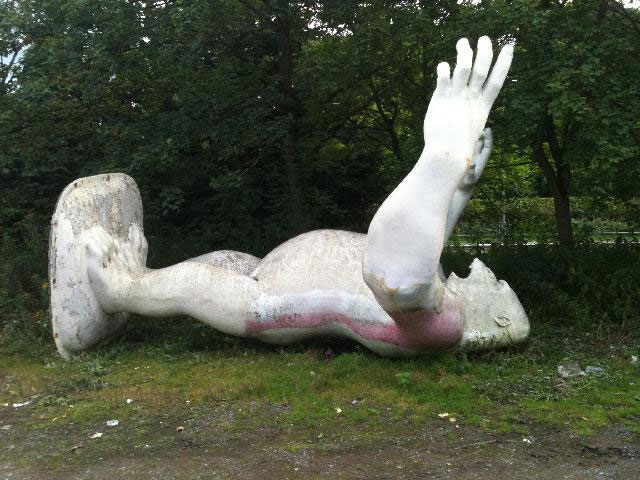
After his stint in second-hand car dealership, King Kong found his way to Scotland, was painted bright pink and displayed in a market, only to be later left abandoned and vandalised in a car park in Penrith.
Fast-forward half a century. It’s a sunny May afternoon in suburban Birmingham, the country is in the grips of a deadly pandemic, and I receive a text from my mum:
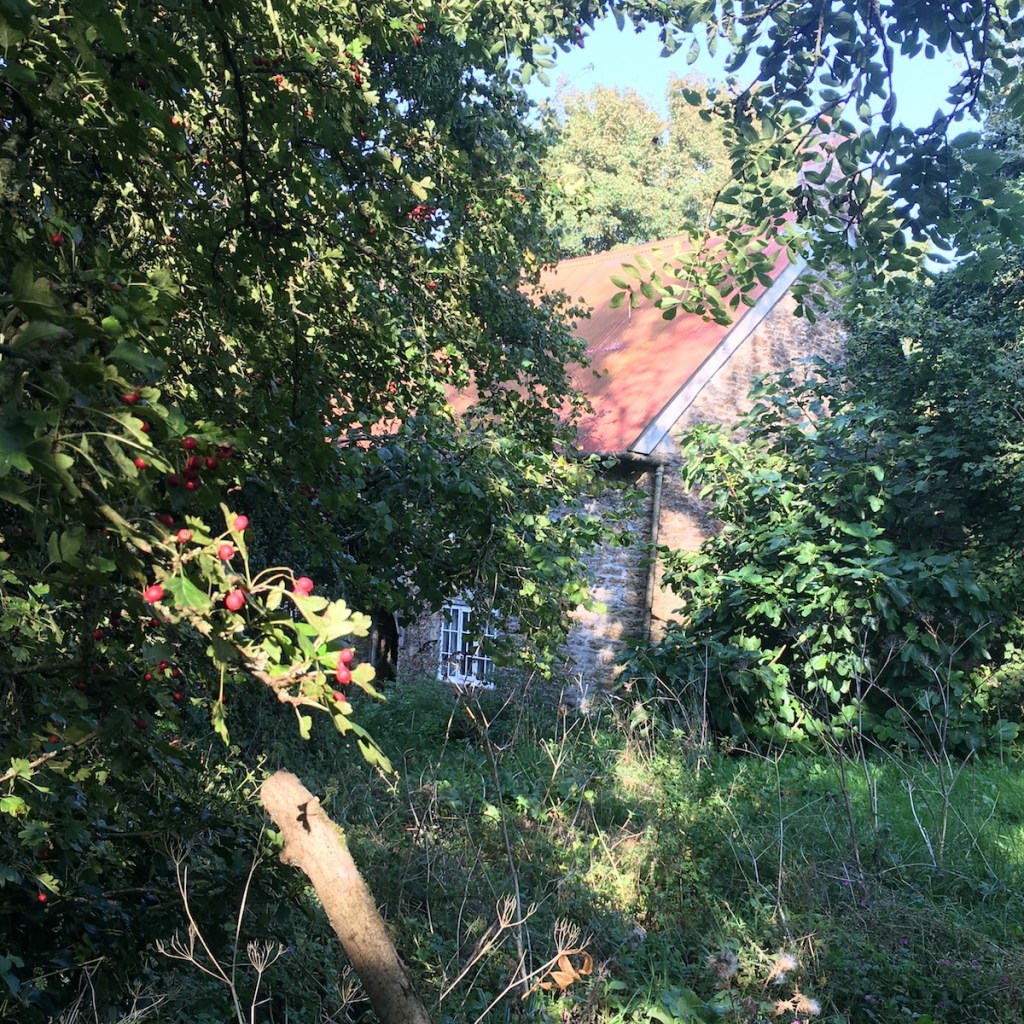
“You’ll never believe this but I think I met the sculptor of King Kong on a walk in the Dorset countryside this afternoon!!! Tony and I were out walking and we came across this remote cottage and we couldn’t tell if it was inhabited or derelict. Then we walked round and saw this elderly man working on a strange object in a half covered shed. He said his name was Nicholas and talked a while with Tony about his invention. Then we came across the local farm shop and they said he had been a sculptor. We looked him up when we got back and are pretty sure he is Nicholas Monro and that one of his creations was King Kong!! How amazing is that.”
I look up from my phone and regard the King Rocker poster on my wardrobe door. The great ape returns my gaze through a pair of fiery red orbs.
Fast-forward four months. We are walking along a dusty track through the lush Dorset countryside, the site of a lost medieval village. We don’t know if he’ll be home but I have a printed picture of the Kong statue and a sharpie pen, just in case. Anticipation grows as we descend the gentle valley and proceed through a corridor of foliage. Various farm buildings loom up either side of the path, the immense steel and wooden structures swallowed by ivy.
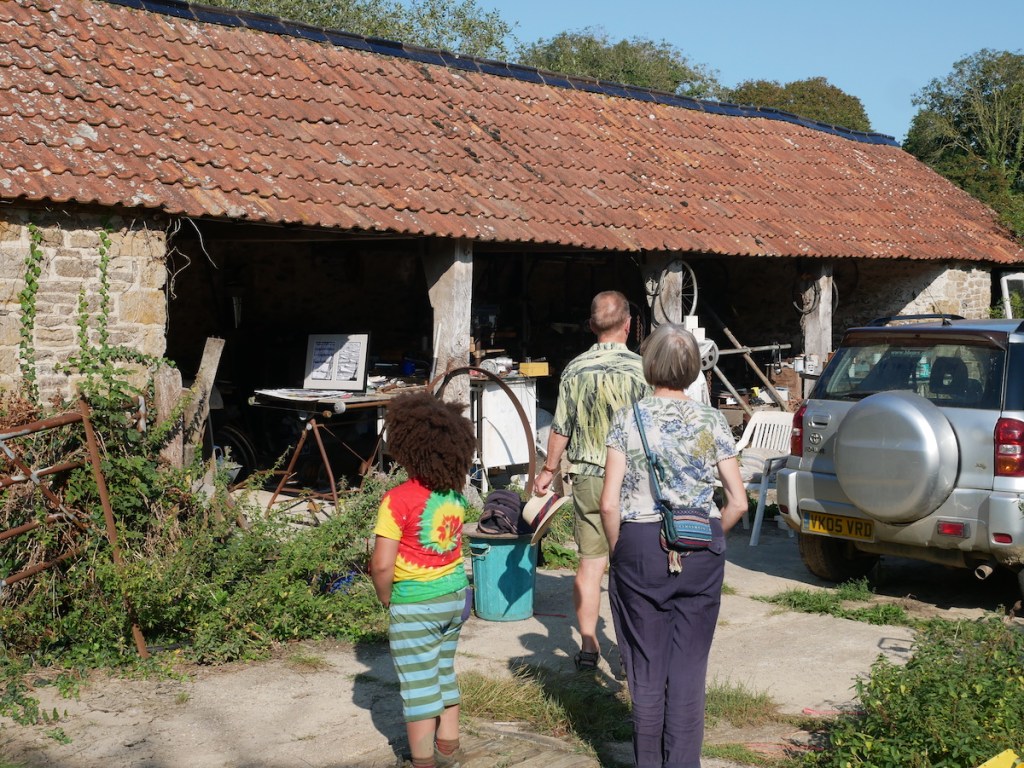
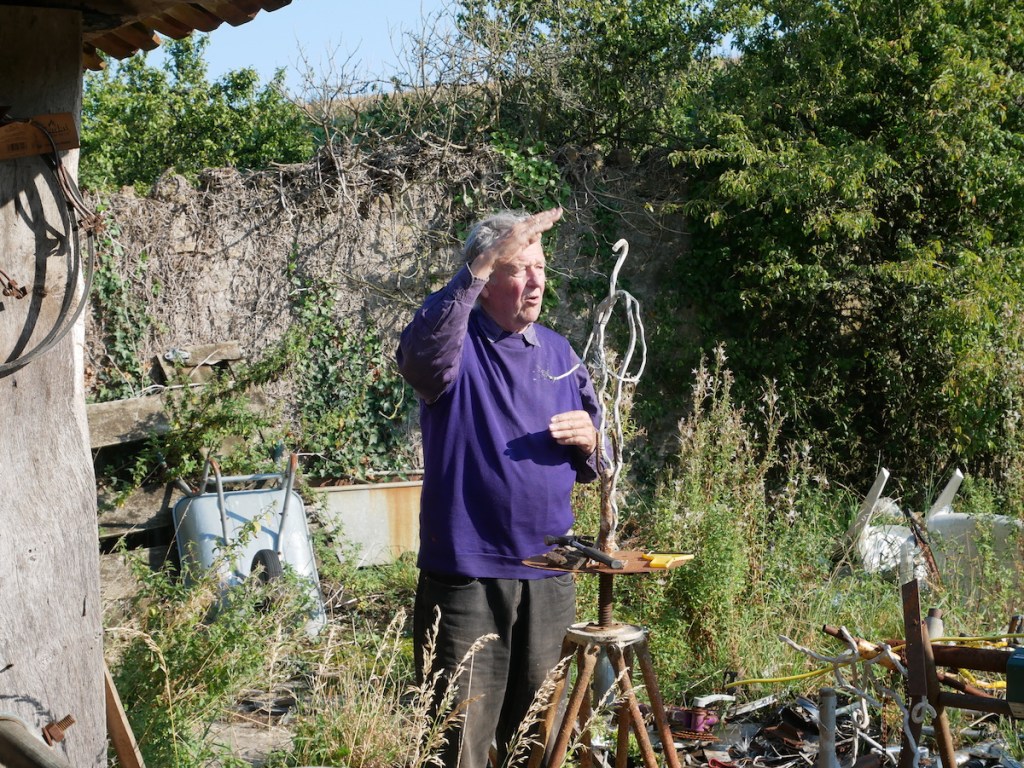
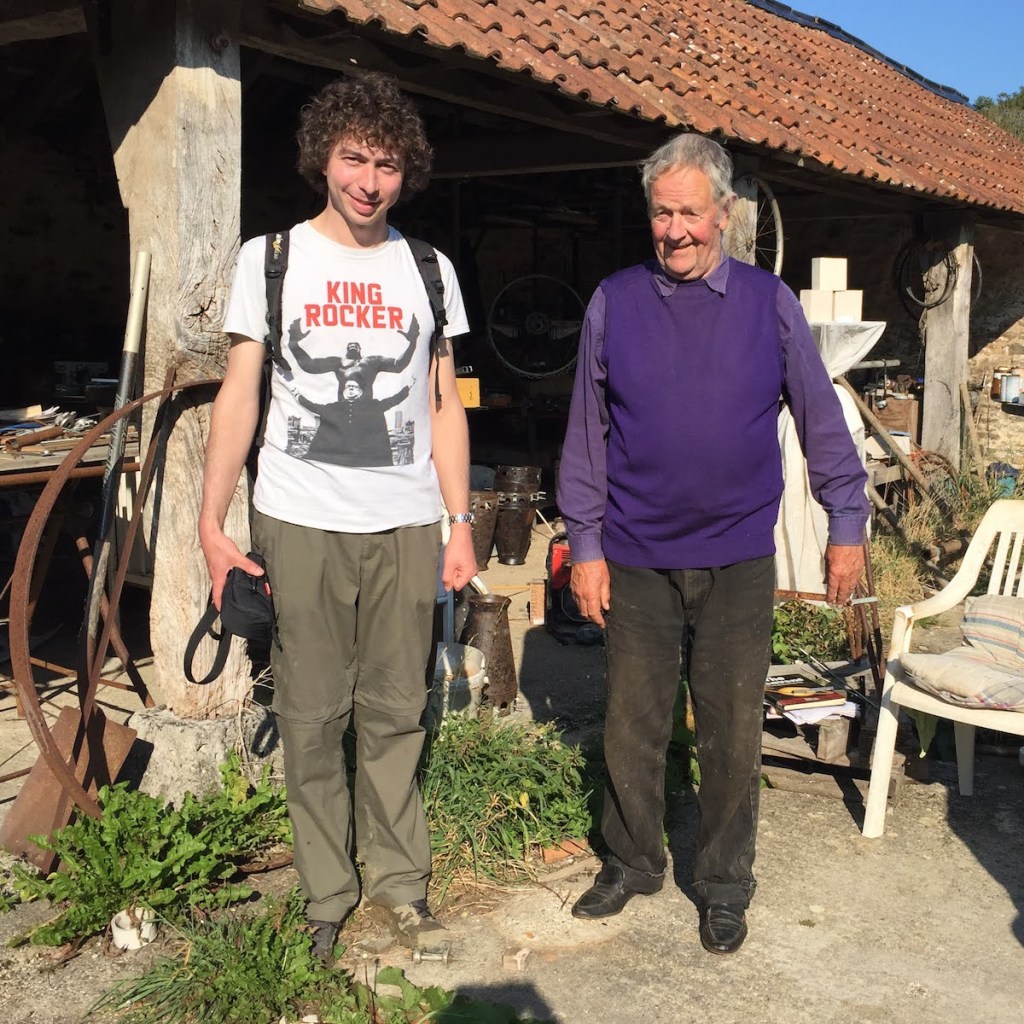
Then we reach the shed; a sturdy structure of stone and wood with a wavy red-tiled roof. One side is open to the world and the contents spill out onto the weed-ridden yard. The vibe is somewhere between a junkyard and a workshop: upturned wheelbarrows, assemblages of rusted machinery, tripod-mounted sculptures including a spindly figure of wire and bone. Other than a lolling tabby, there’s no one here.
We wait with bated breath, the cottage just visible beyond a sprawling garden. We consider knocking but then he emerges from a track beside the shed in a striking purple jumper and matching long sleeve shirt. We’ve interrupted his afternoon glass of wine but we’re a welcome interruption. He remembers Tony and my mum and is delighted to see that this time they’ve brought company: a ragtag audience. He’s even more delighted and not a little astonished to learn that we know who he is. He sees my King Rocker T-shirt and his eyes light up in recognition of his famous simian creation.
The makers of the film had looked into contacting Monro for an interview but couldn’t get an address and were told he lived off-grid, reachable only by payphone. He tells us about the Kong statue’s critical reappraisal in recent years, how it was rescued from the car park, restored to its original condition and displayed in the Henry Moore Institute in Leeds, star attraction of the City Sculpture Projects 1972 exhibition. He says he wishes he’d known that we were interested because then he could’ve told us about the show.
I take the printout from my pocket and ask if he could sign it for me. This clearly isn’t a situation he’s familiar with – how should he address it? “Dear” sounds too personal.
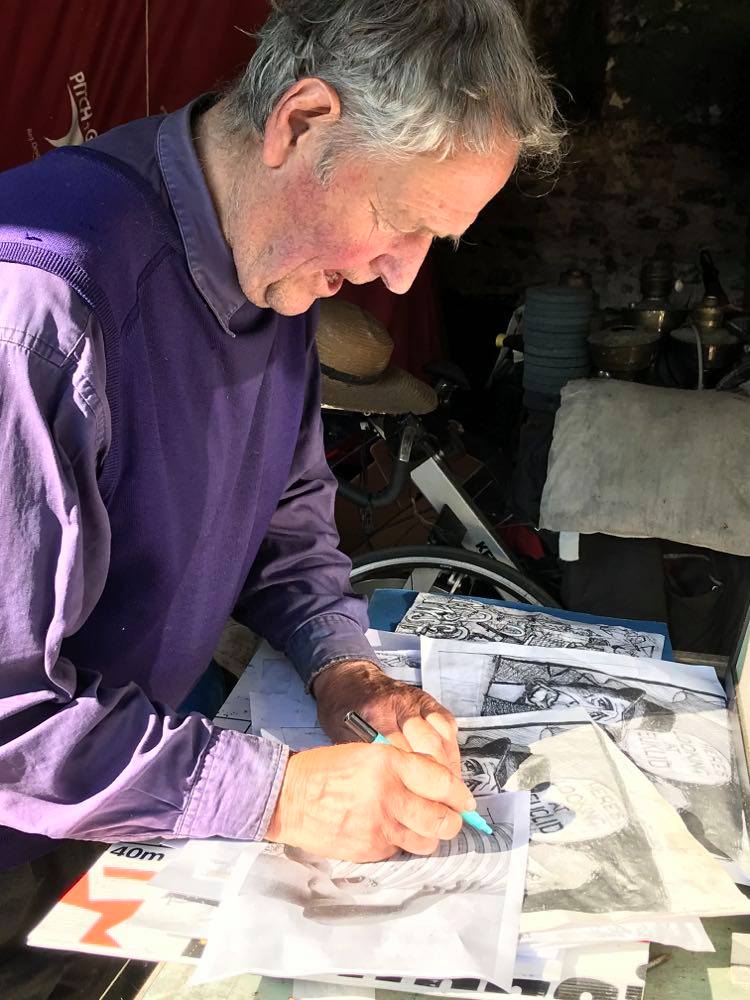
He takes us into the studio-shed and shows us some of his latest ink drawings: a series of comic-book style scenes based on puns of his own invention: “Here’s looking at Euclid”, “Vermeer to Eternity”. He’s considered approaching the art shop in the nearby market town but hasn’t mustered the courage yet.
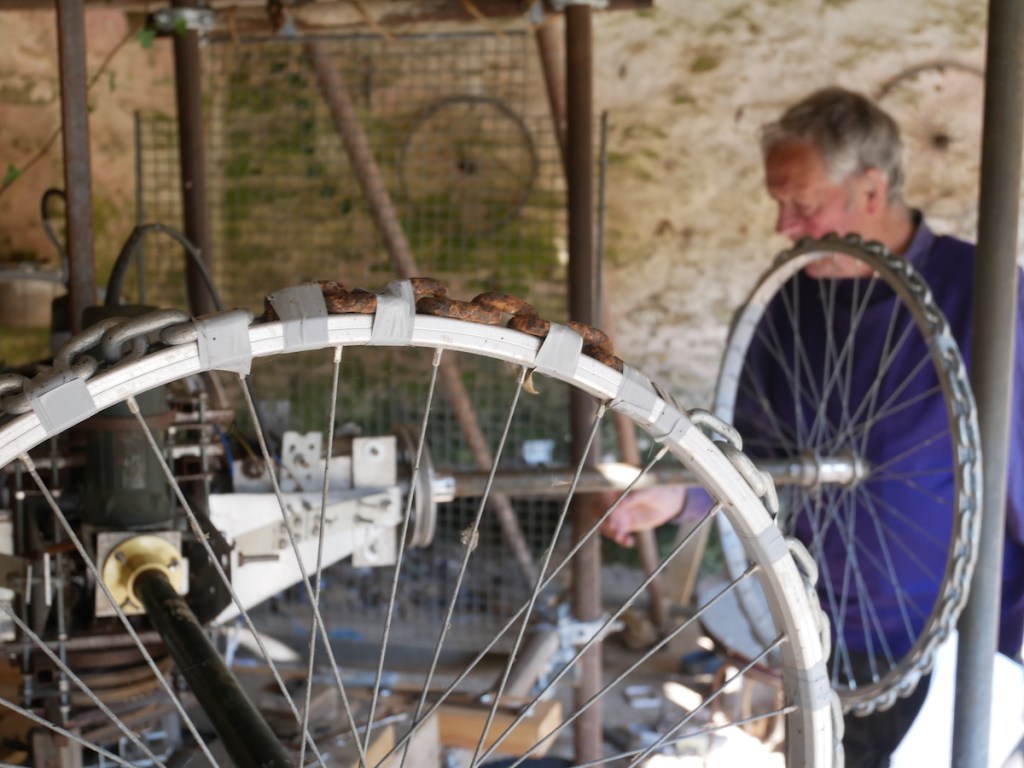
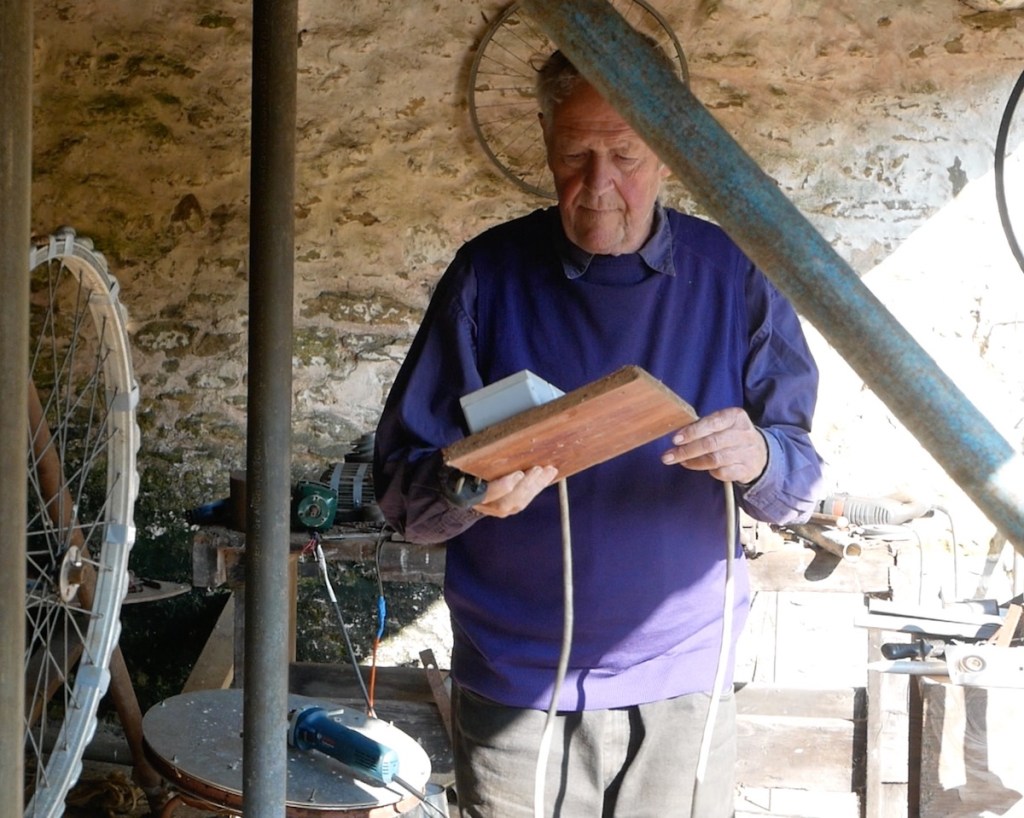
He leads us away from the work-desk towards the grand centrepiece: a work-in-progress he refers to as “The Contraption”. A curious apparatus of scaffolding, breezeblocks and bicycle parts, assembled in a radial configuration with a motor at the centre. It’s immediately clear that this is his true passion project, as he excitedly offers to give us a demonstration.
The generator is located in a small outhouse adjacent to the workshop. He disappears behind the door, starts it up and re-emerges with a makeshift control pad. He turns a dial and The Contraption jumps into life, the bicycle wheels rotating around a central axle in a centrifugal motion, gradually picking up speed. We all take a step back.
He’s at pains to stress that this isn’t the finished thing but more like a prototype. He points to a pile of physics textbooks and explains how when he’s got it just right, the component parts will rotate in such a way and at such a velocity that the known laws of physics will break down and The Contraption will defy gravity. Yes, Nicholas Monro is building a flying machine. Once the basic principle has been demonstrated he’s confident that it will revolutionise the aviation industry, put an end to our fossil fuel dependence, and make flying cars a reality.
He says that while he’s done his best with the skills he has, what he really needs is an engineer and some decent kit. He’s contacted the physics departments of different universities to tell of his innovation but none have been willing to take him seriously. “They think I’m a charlatan,” he tells me, “I don’t mind really but given the choice I’d rather be thought of as a fool than a charlatan.”
By now The Contraption has picked up quite a bit of speed and the youngest member of our group asks excitedly, “is it going to fly?” to which Nicholas replies with a chuckle, “no it won’t now but it will someday… because I say it will.” Following the demonstration he bids us farewell and tells us we can come and visit any time we like. We promise we will and continue our walk in the scorching late summer sun.
It’s 2021 now; King Rocker has premiered on Sky Arts to great acclaim and Birmingham tentatively looks ahead to a post-pandemic reality. In a time of such uncertainty, when so much has been lost and so much may never return, it’s comforting to know that somewhere in deepest rural Dorset, a kindly elder is keeping the future alive.
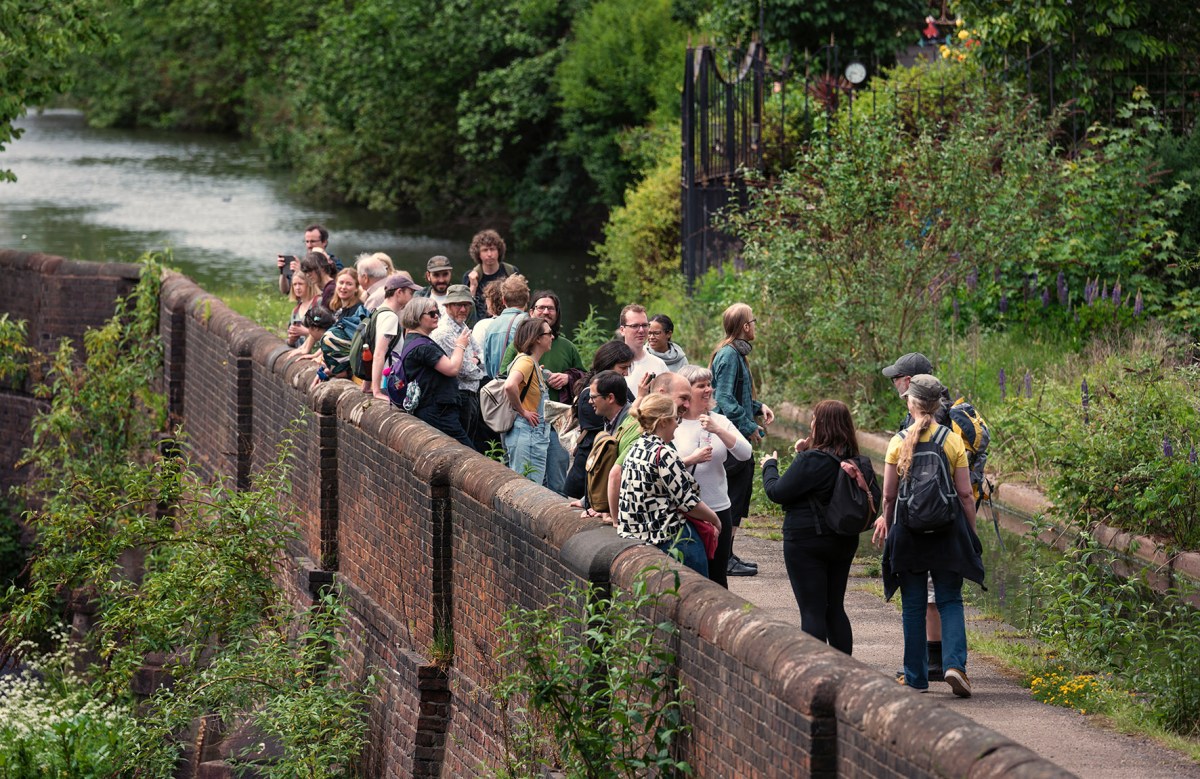
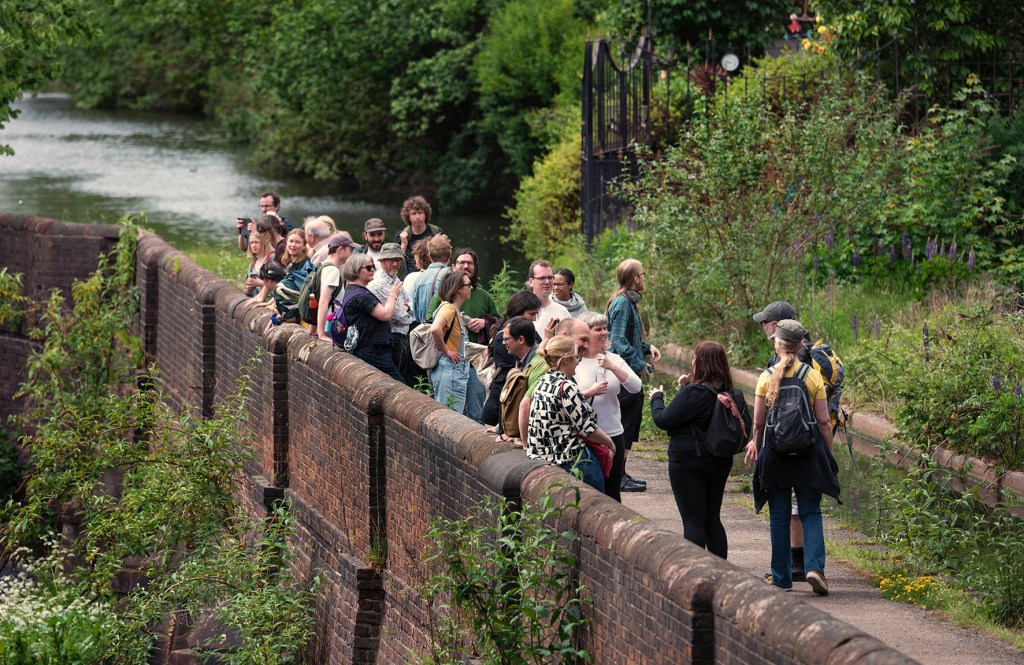
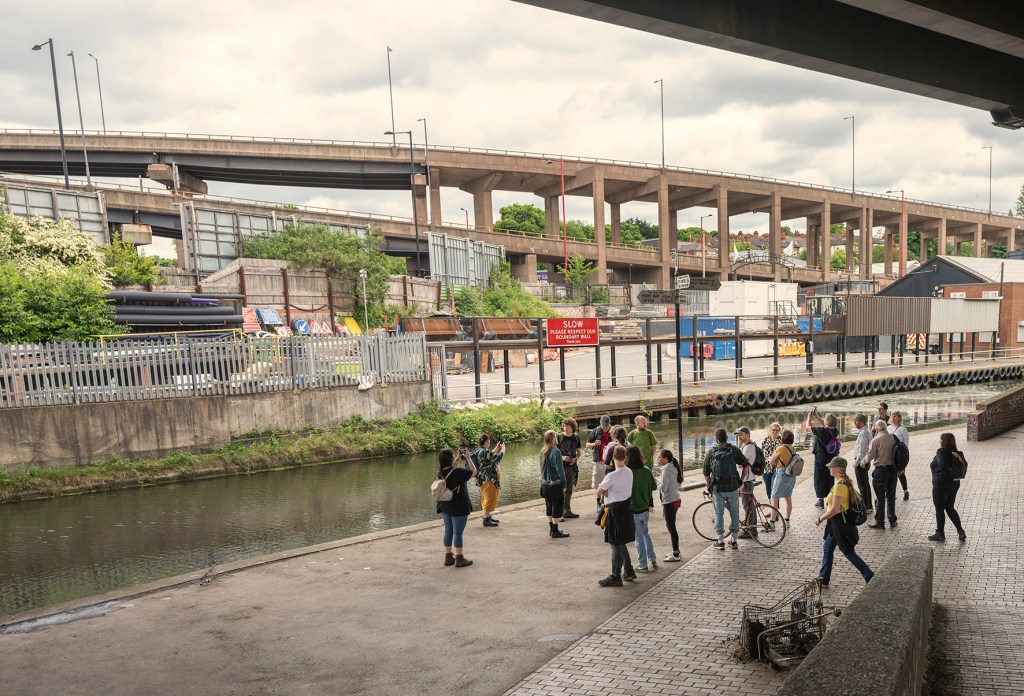
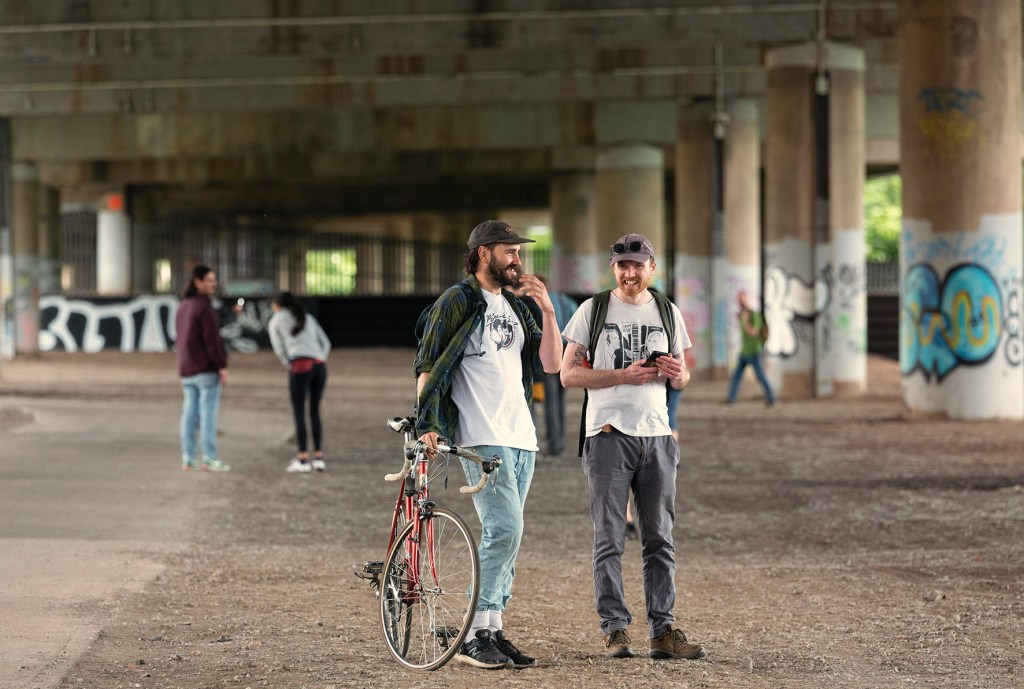
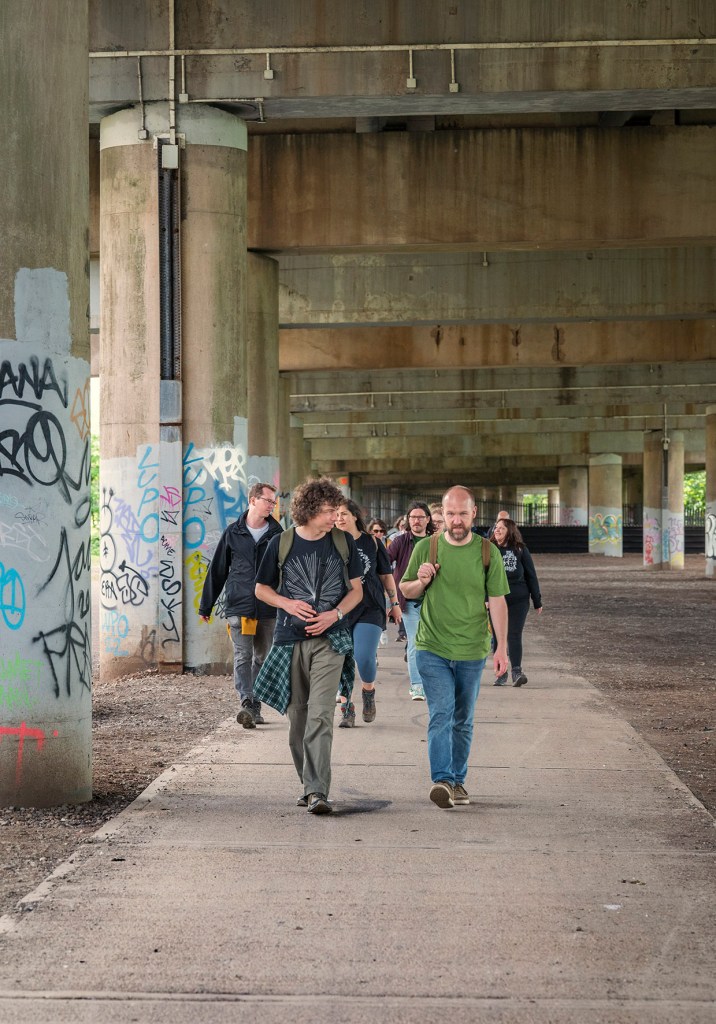
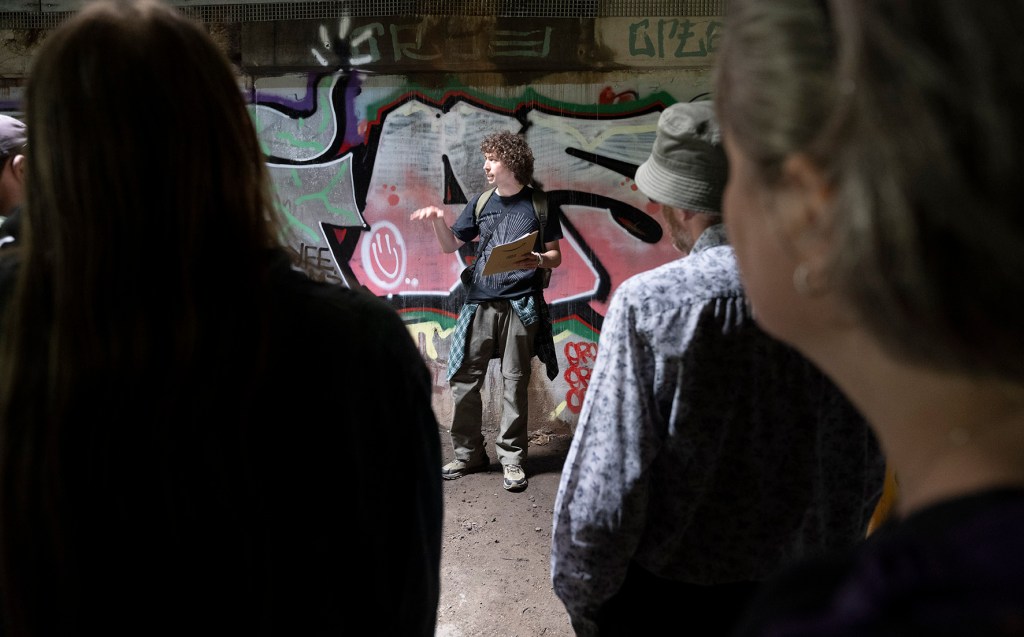
For May’s Erratic we teamed up with Flatpack Festival for a pilgrimage to Spaghetti Junction to celebrate its 50th birthday. We had a great turn out of 25+ people and the weather was kind, which all made for a delightful and profound day.
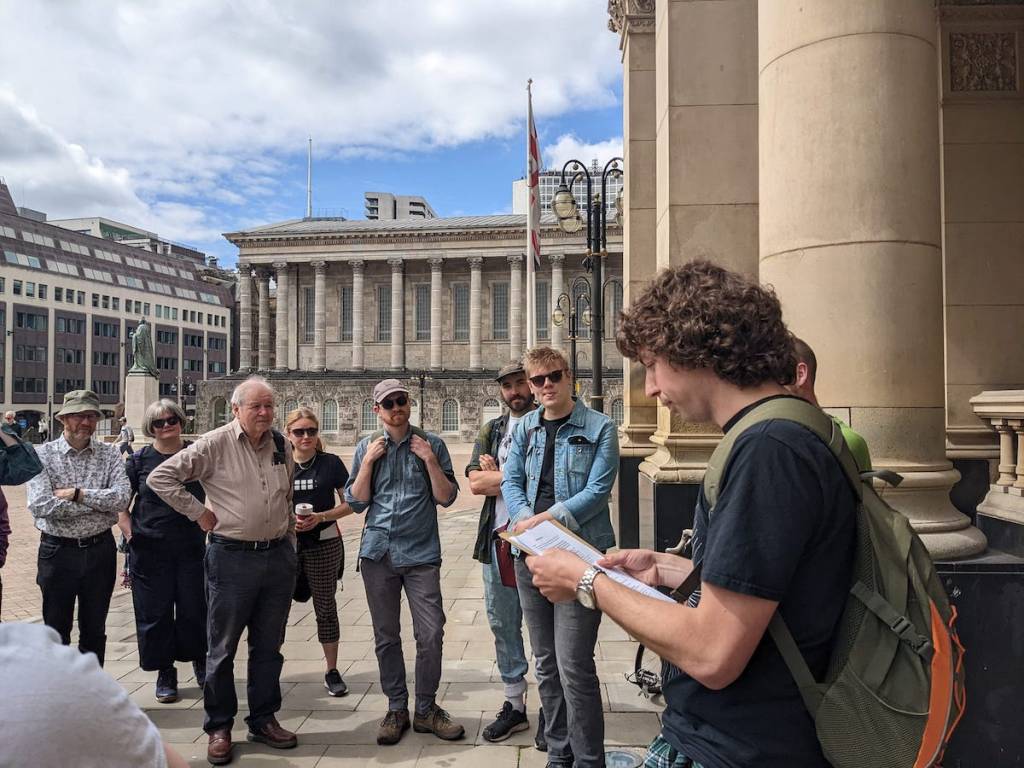
The walk began in Victoria Square and from there we made our way down to the Birmingham and Fazeley Canal which we then followed the rest of the way to Spaghetti Junction; a total distance of 3.5 miles. We took in the sights, basked in the sun and considered the significance of Spaghetti Junction as a “confluence of confluences”: a meeting point for two motorways, multiple trunk roads, three canals, two rivers and a brook.
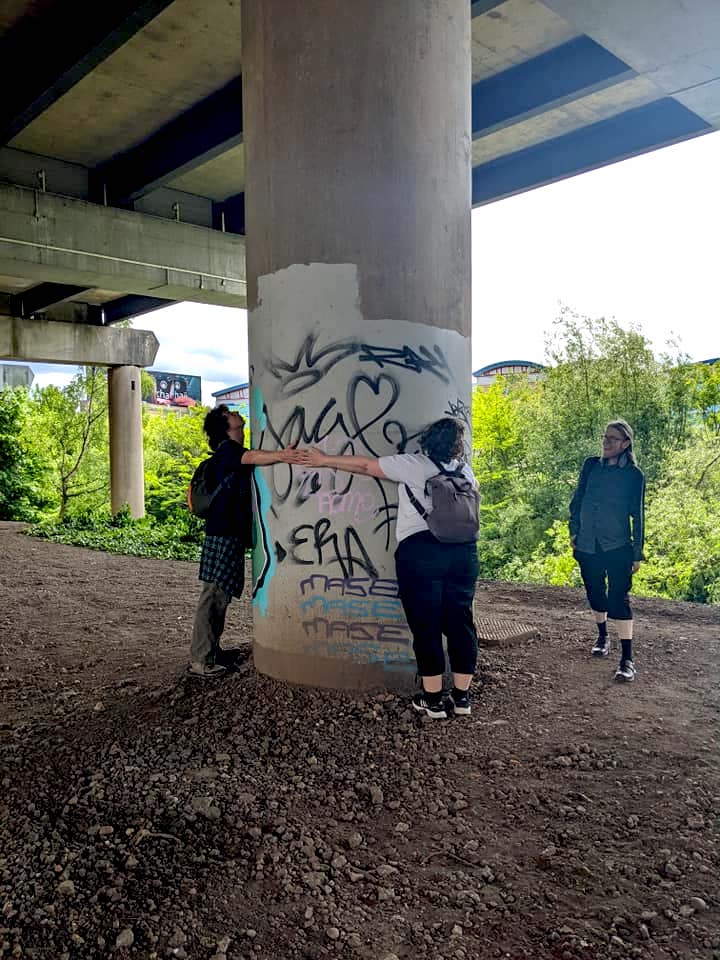
Upon arrival we performed a sacred rite involving the music of Black Sabbath and water from the Grand Union Canal. This was in tribute to the artist Bill Drummond who witnessed a miracle here in 1973 and who chose this site to begin and end his ongoing twelve year world tour The 25 Paintings.
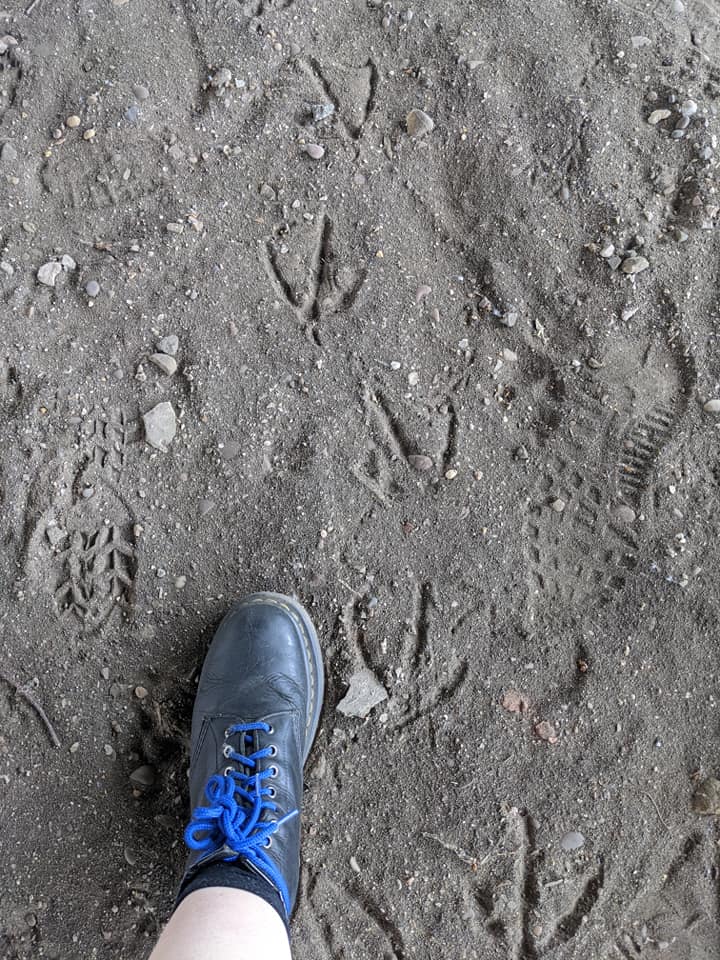
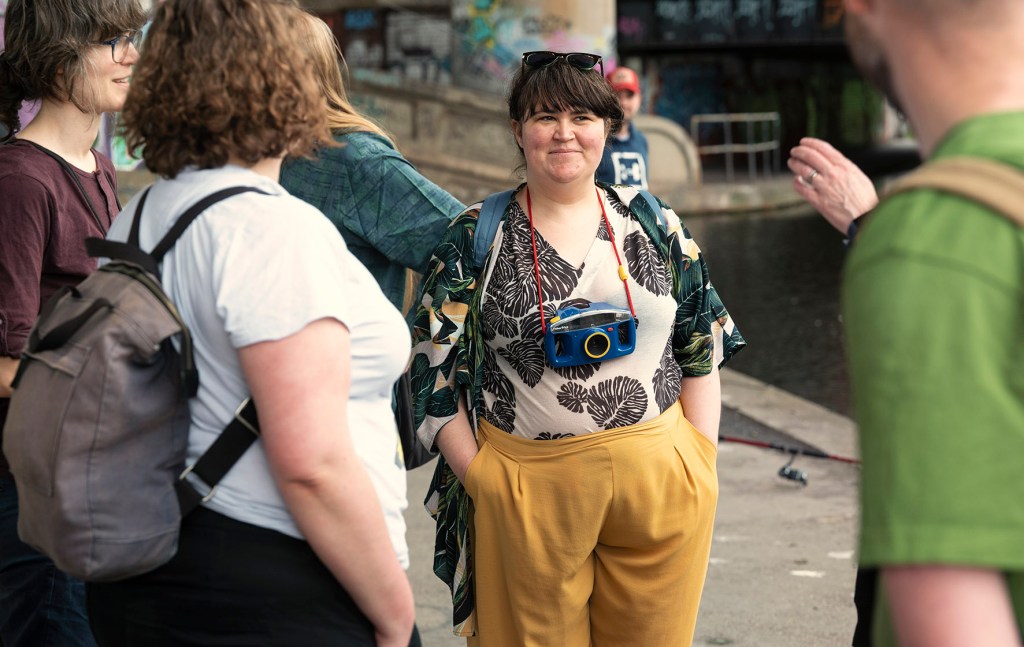
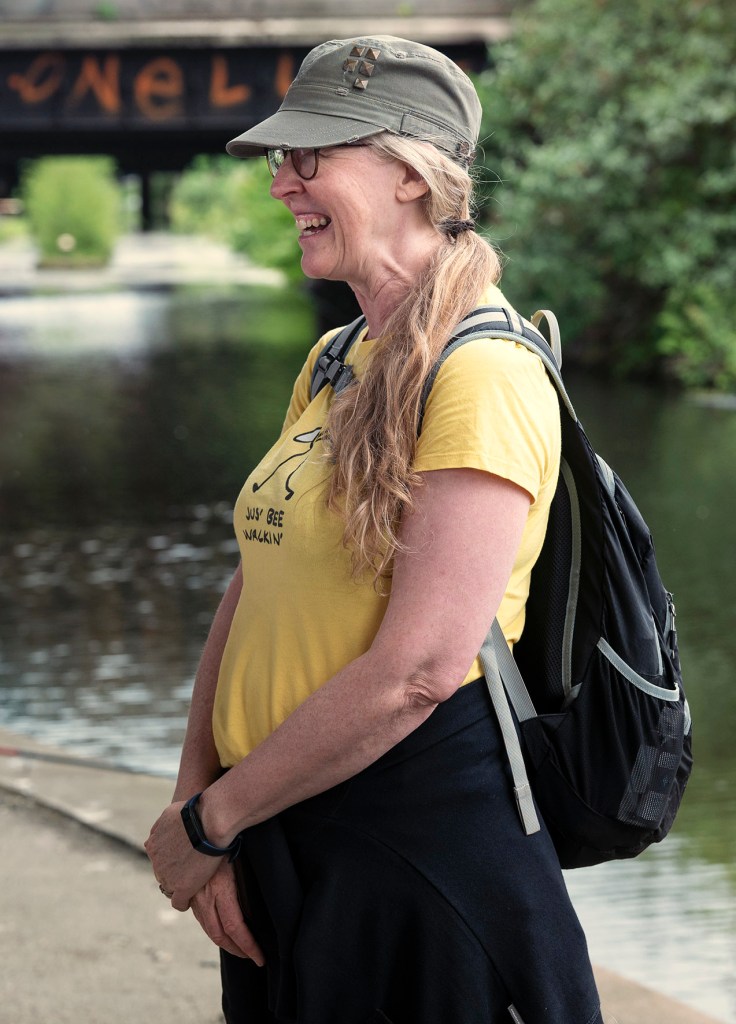
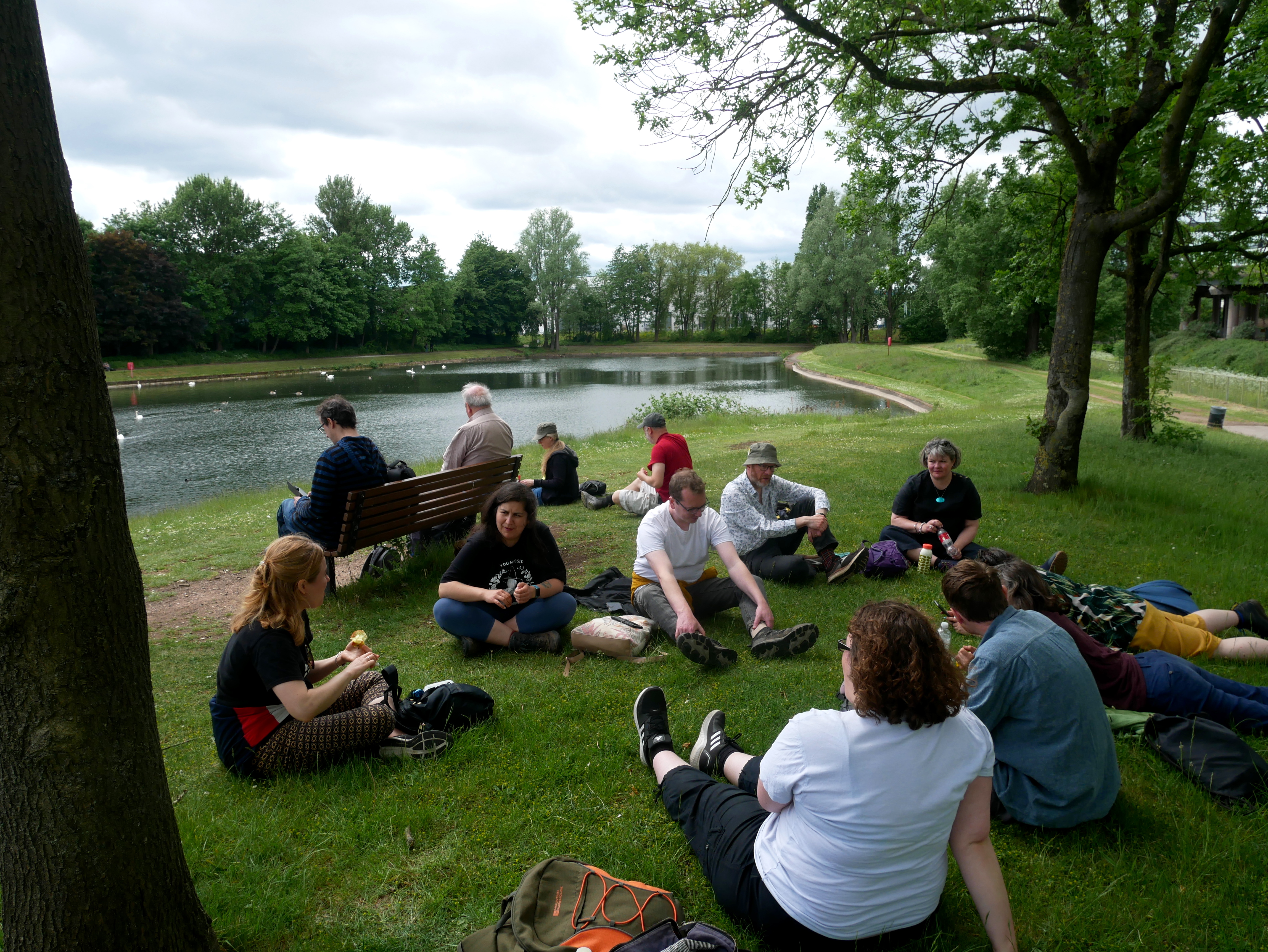
We finished with a picnic on the banks of Aston Reservoir before making our way back into town (by train this time) for the final night of the festival. We were fortunate enough to have the event documented by a professional photographer, the hugely talented Katja Ogrin and so we include some of her pictures below, alongside others taken on the walk. Thanks to all who came! Details of next month’s Erratic up soon.
Walkspace has a strong cohort of flaneurs, the “connoisseurs of the street;” urban roamers who stroll the streets and parks of the city. Who delve with delight into canalside tunnels and under brutalist bridges, who wander through suburban estates and industrial sites, who walk the concrete and tarmac ways in a quest for urban stories and strange erratics. Walkers who revel in the expression of human doing and being that a city is.
But there is a (very) tiny cohort of Walkspace members for whom urban roaming is trial rather than a joy. These are folks who delve into nettle infested woods, wander down rutted muddy tracks or stagger breathlessly up high tussocky hills. I am firmly in the second group. Having escaped 14 years of suburban and city living almost nothing could tempt me to walk its grey streets again, not even the pleasure of a Walkspace walk, with lovely Walkspace people.
(I really need to invent a name for rural flaneuring – considering all the livestock we encounter maneuring comes to mind)
So when Andy and Robson decided to host another Walkspace Erratic, I thought it would be fun to accompany the group, but at a significant distance. Herefordshire, where I live, has quite a few erratics of its own as ancient glaciers carved swathes across this landscape. I reached out to Kate Green, who I suspected is a fellow maneur and we hatched a plan to hunt down the Whetstone, a large erratic situated somewhere atop Hergest Ridge. We’d start our walk the same day and time as the Birmingham erratic walk and share pictures live on the Walkspace WhatsApp.
Hergest Ridge is the name of Mike Oldfield’s difficult second album and also a large hill, rising above the small town of Kington. It’s right on the border between Wales and England with Offa’s Dyke LDP traversing straight across its top. From the summit of the hill several barrows and hillforts can be seen on the neighbouring hills. Hergest Ridge has an elevation of 426m and if you ever fancy doing a spot of Marilyn bagging, Hergest Ridge should be on your list.
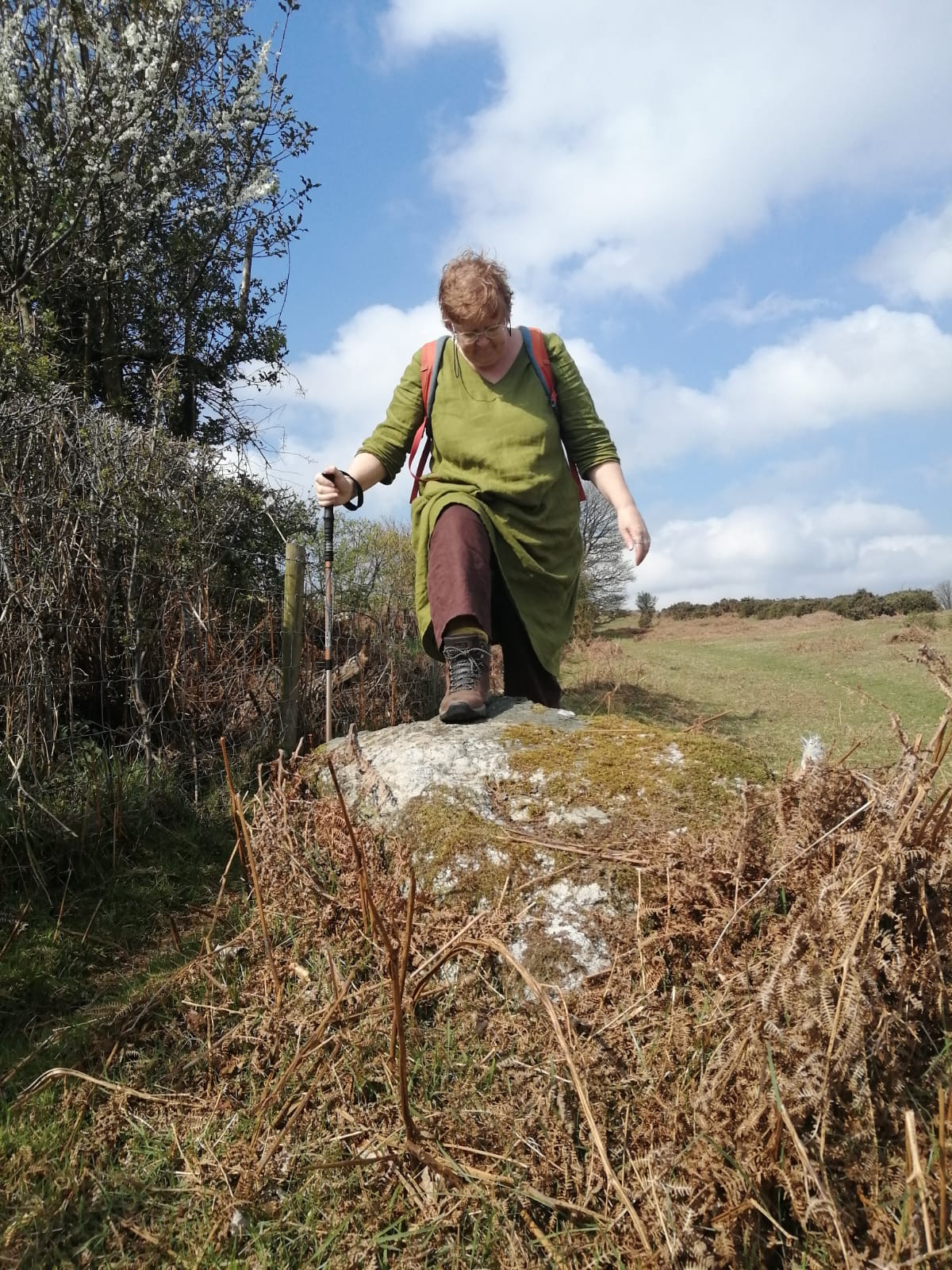
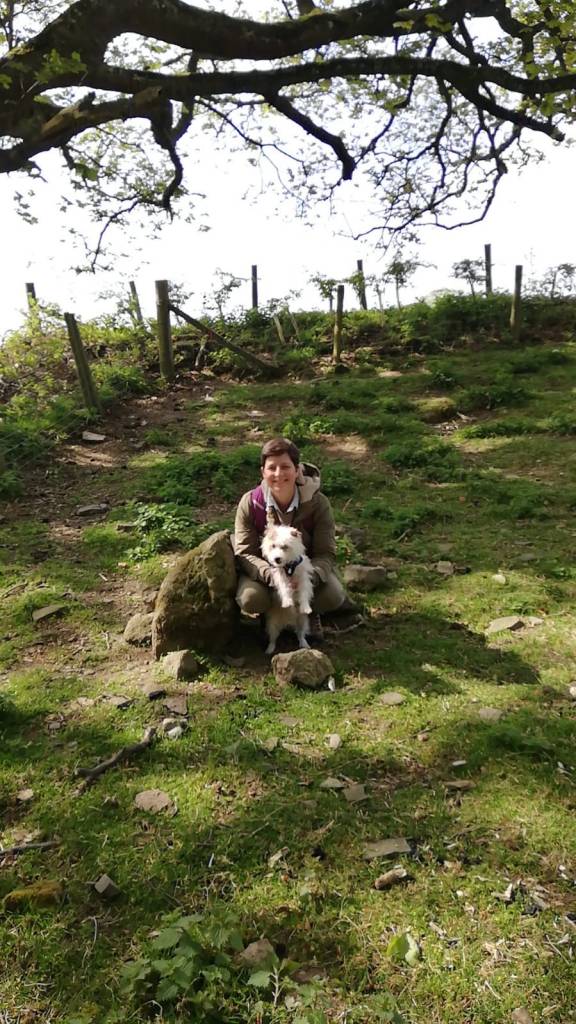
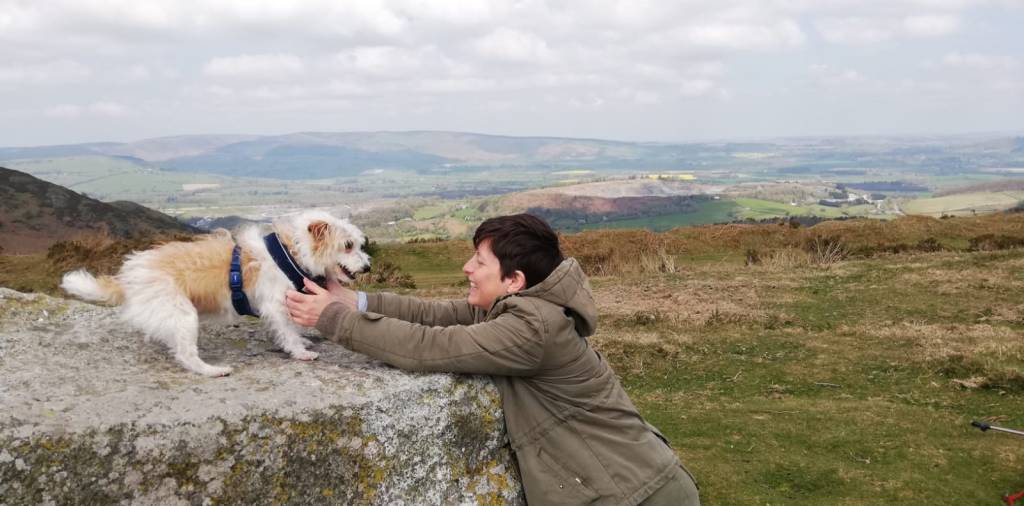
Kate drove us to Kington as I am still rather nervous of all the one-car-wide roads around here and we were joined on our quest by Dot, a small shaggy-haired bundle of irrepressible canine enthusiasm and joy. It was a steep trek from the carpark to the top of the ridge and while I laboured my arthritic joints up the slope, Kate went slightly mad and began spotting potential erratics left, right and centre. We knew the approximate location of the Whetsone (ie, it was on the hill) but we hadn’t really done any homework and just wandered erratically (ahem) over the landscape, enjoying the wind and space and the song of skylarks.
Kate and Dot…kruse
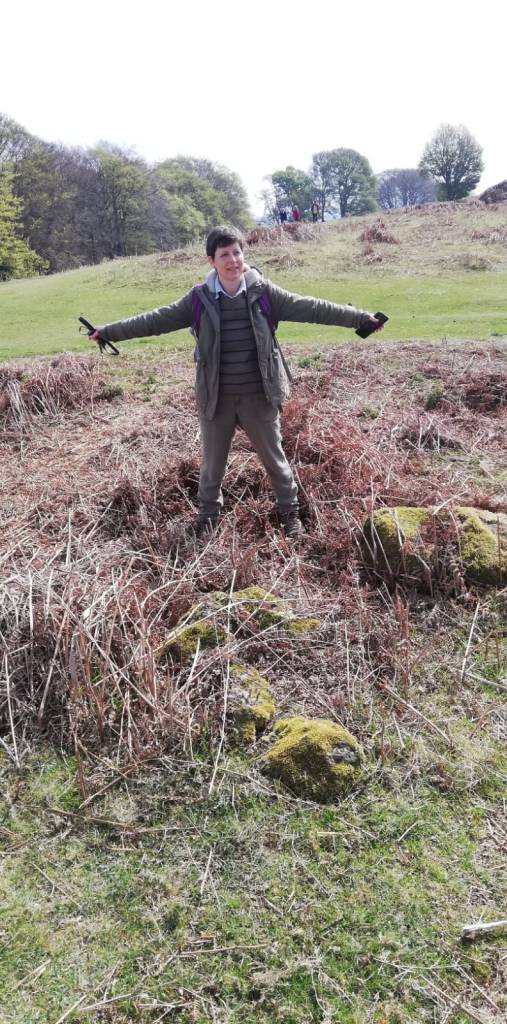
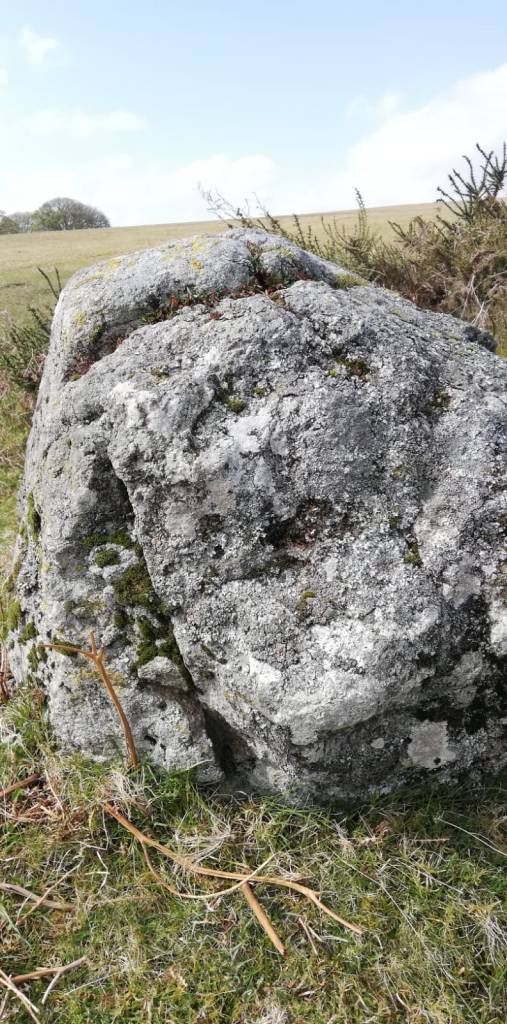
Soon Kate spotted more stones and we both began to flex our maneur muscles, tuning into the landscape of The Ancestors and divining a potential layout of tracks and stones that could be the remnants of an ancient stone circle. It actually got genuinely exciting as we discussed how the ancestors might have used the hill, imagining rituals and burials and ourselves following in the footsteps of those long dead, mysterious people who dotted the hills all around the Ridge with barrows, standing stones and hillforts.
All the while Dot bounded around, cheerfully sniffing and leaping onto the smaller stones, rushing everywhere with cheerful gusto. Despite only having six inch long legs I’m sure Dot covered more than twice the distance we did.
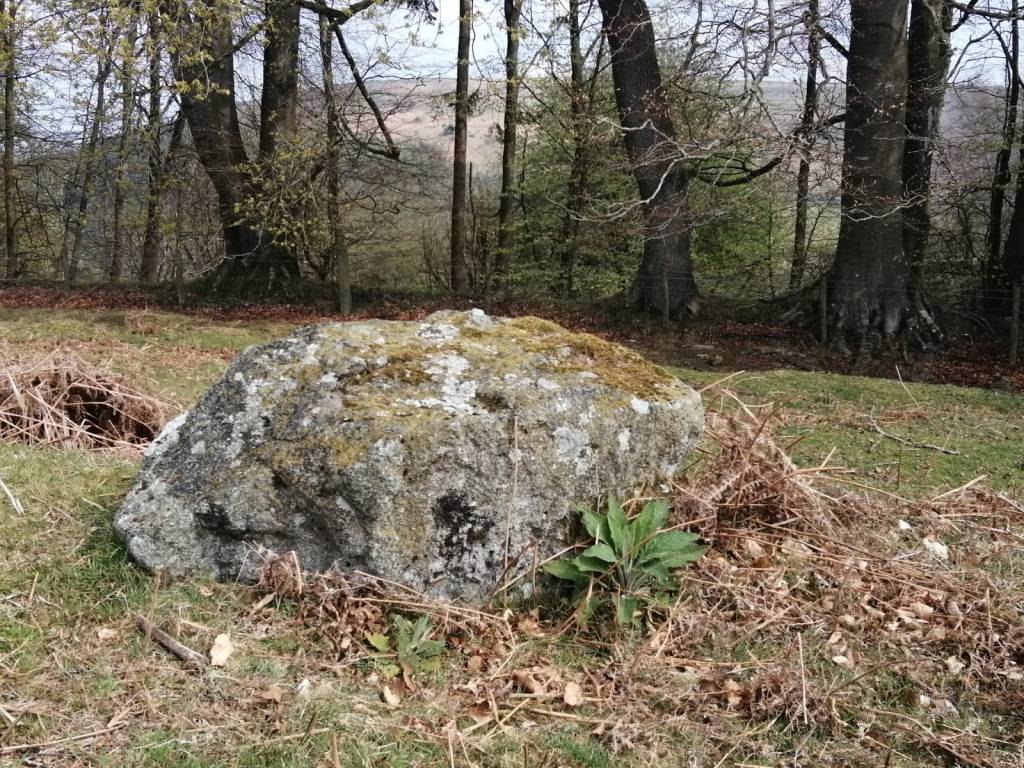
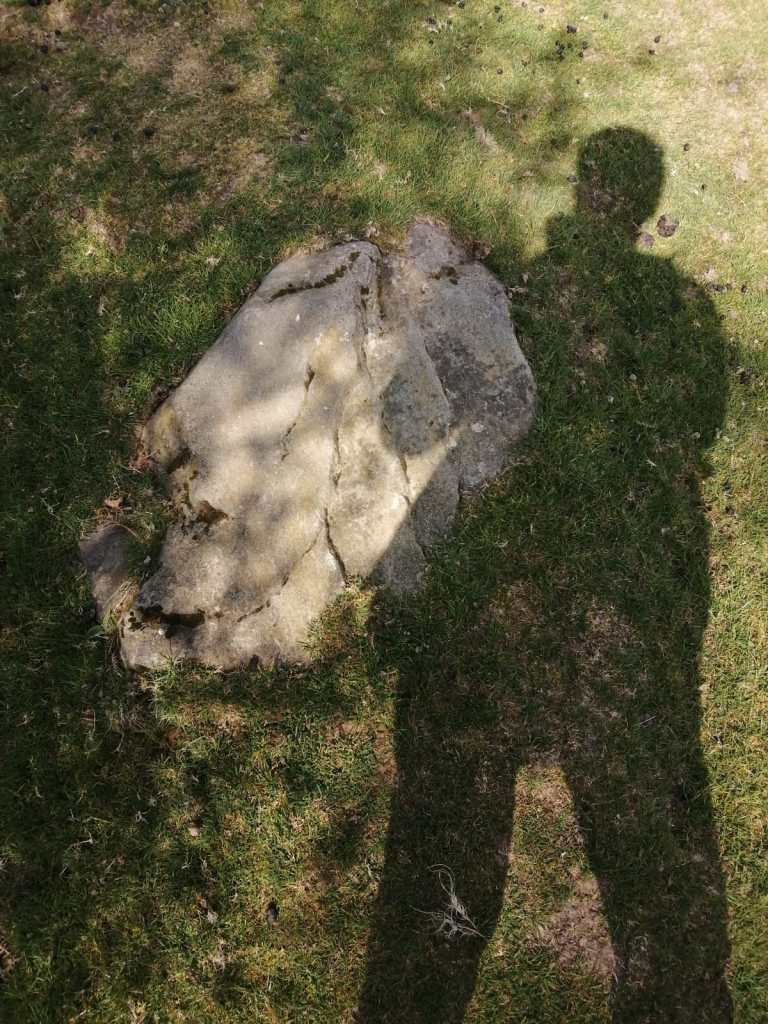
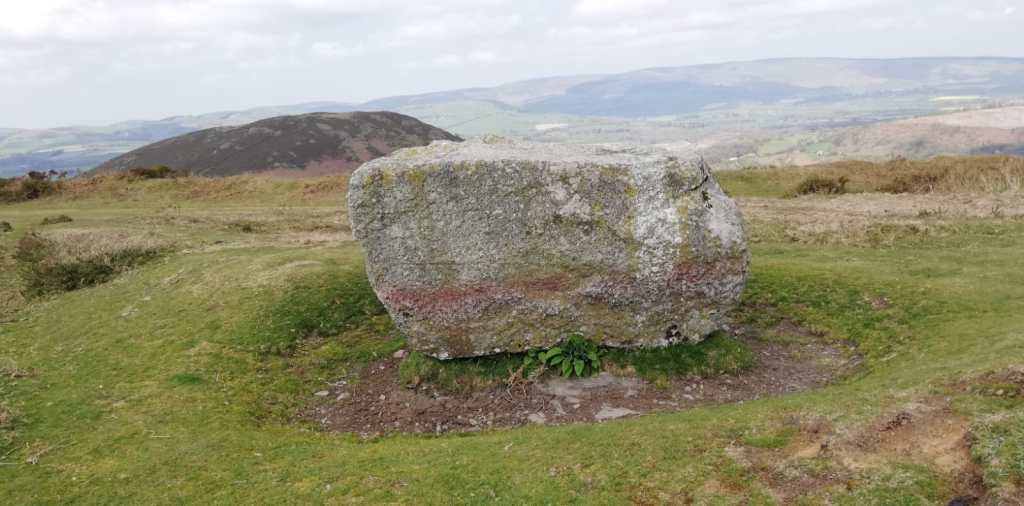
When we finally found the Whetstone itself I was astonished by how big it was. We wondered if it was completely natural, or if it had been carved in any way. Kate found a portion of the stone that seemed to form a perfect and comfortable seat. Maybe it had been a King’s Seat once? We knew the stone had played a significant role in the history of the local people and had once been a place where food had been distributed to lepers, which seemed rather hard on the lepers, considering its elevation.
It was really nice to be walking at the same time and on the same quest as the Birmingham based cohort and I for one would really like to do something like this again. Perhaps a canal versus river walk or a rural v urban industrial walk. Although quite honestly, any walk that includes Dot (and Kate!) would be a walk worth doing.
…kruse is a neurodivergent, experimental artist and writer, whose practice includes drawing, writing, storytelling and phenomenological research.She is interested in the connections between landscape, mythmaking, magic and story.For more of her writing see her excellent Wayfaring blog.
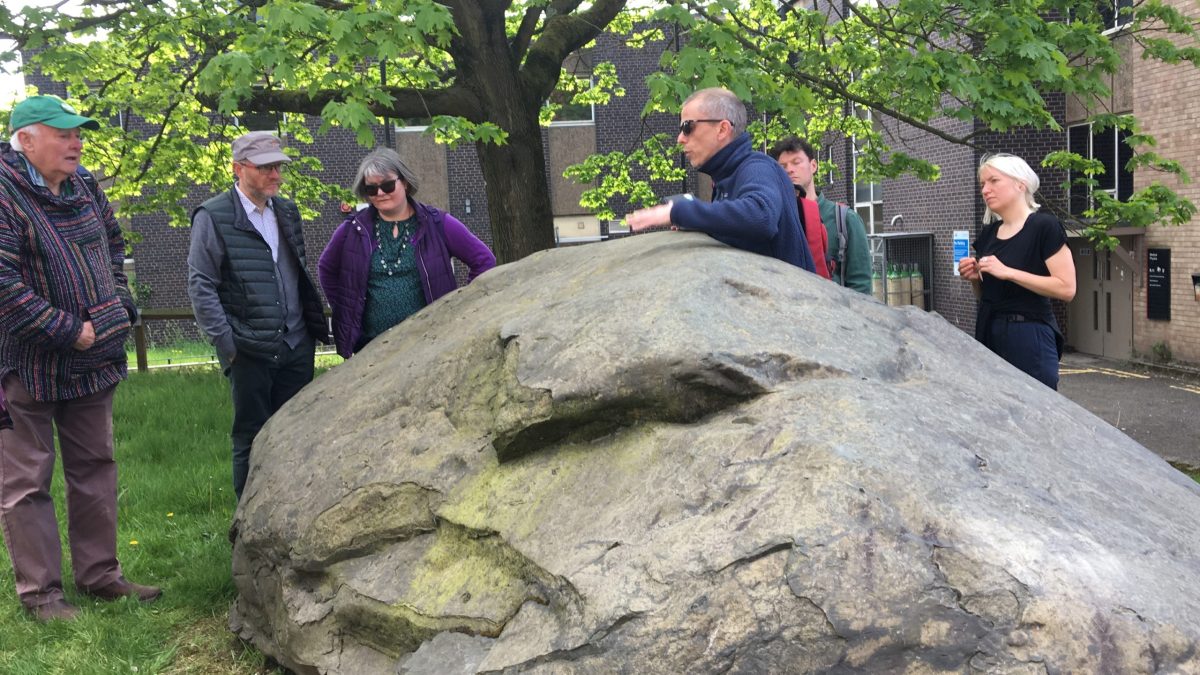
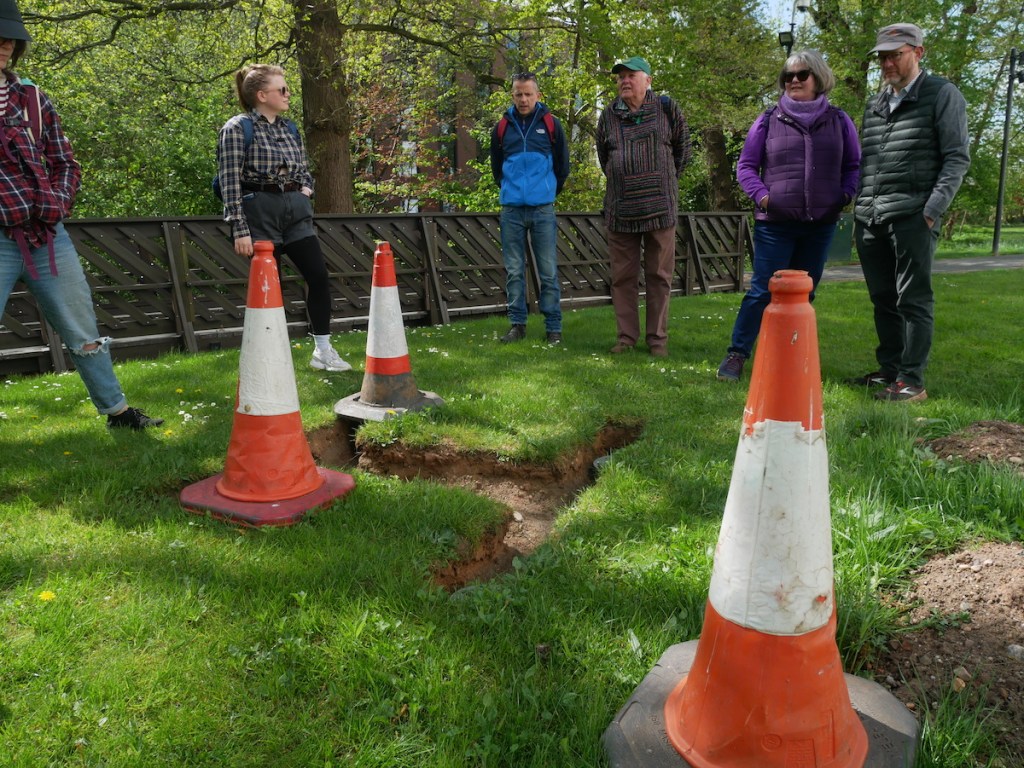
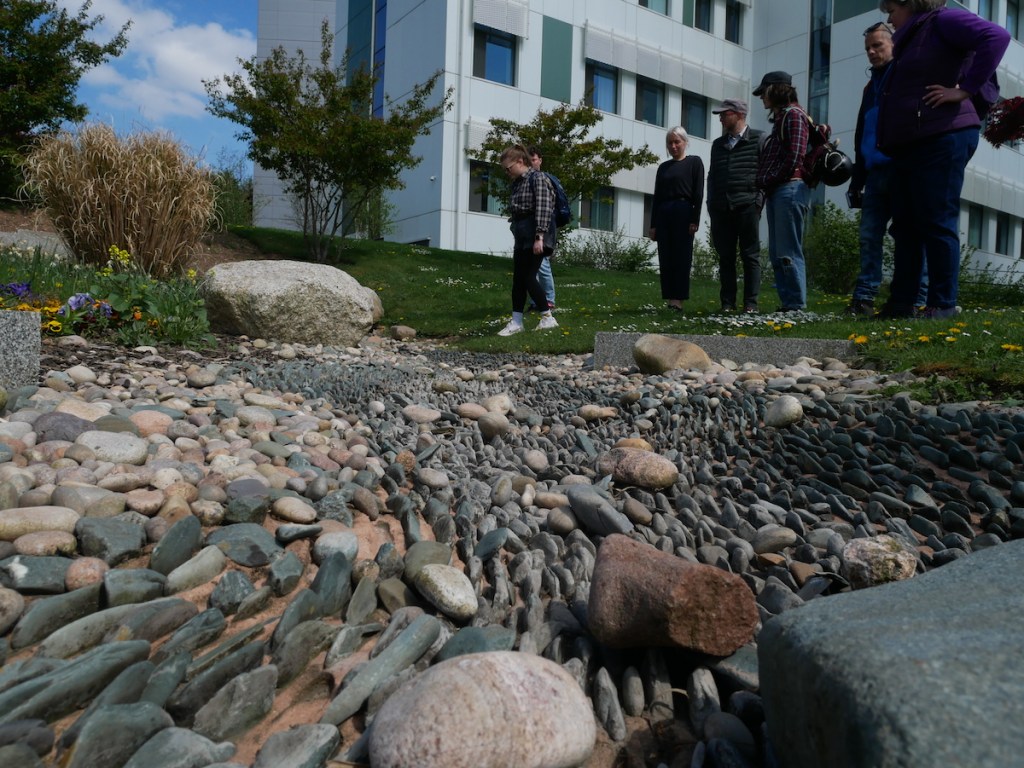
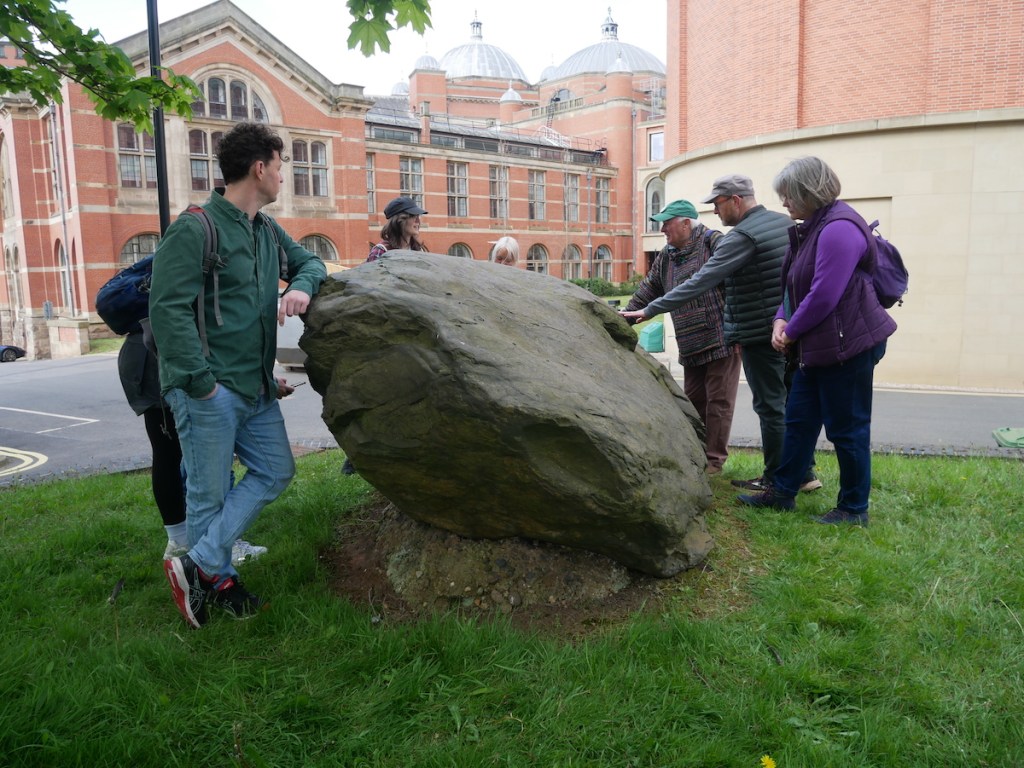
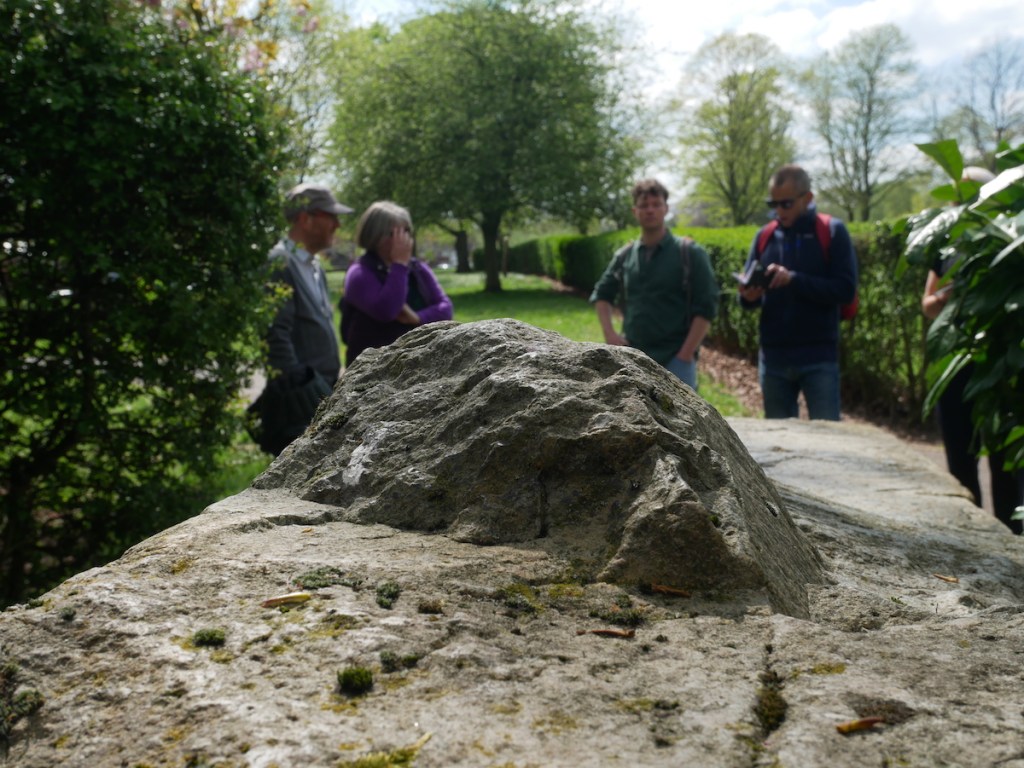
We relaunched The Walkspace Erratics last Sunday with a delightful springtime boulder hunt. We took the name “Erratic” from the glacial erratic boulders which were deposited across the region in an ice age 450,000 years ago. Robson and Andy felt it was time to pay tribute and so devised a walk from Cannon Hill Park to Selly Oak Park via The University of Birmingham.
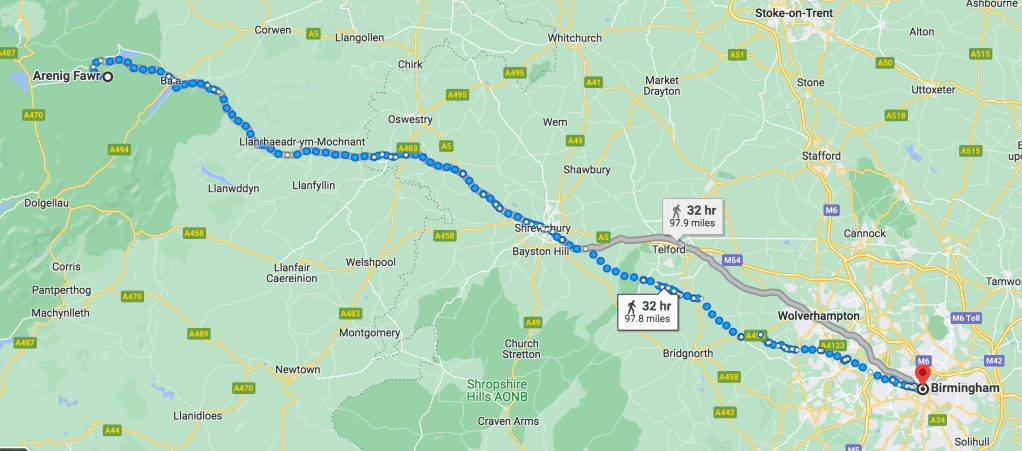
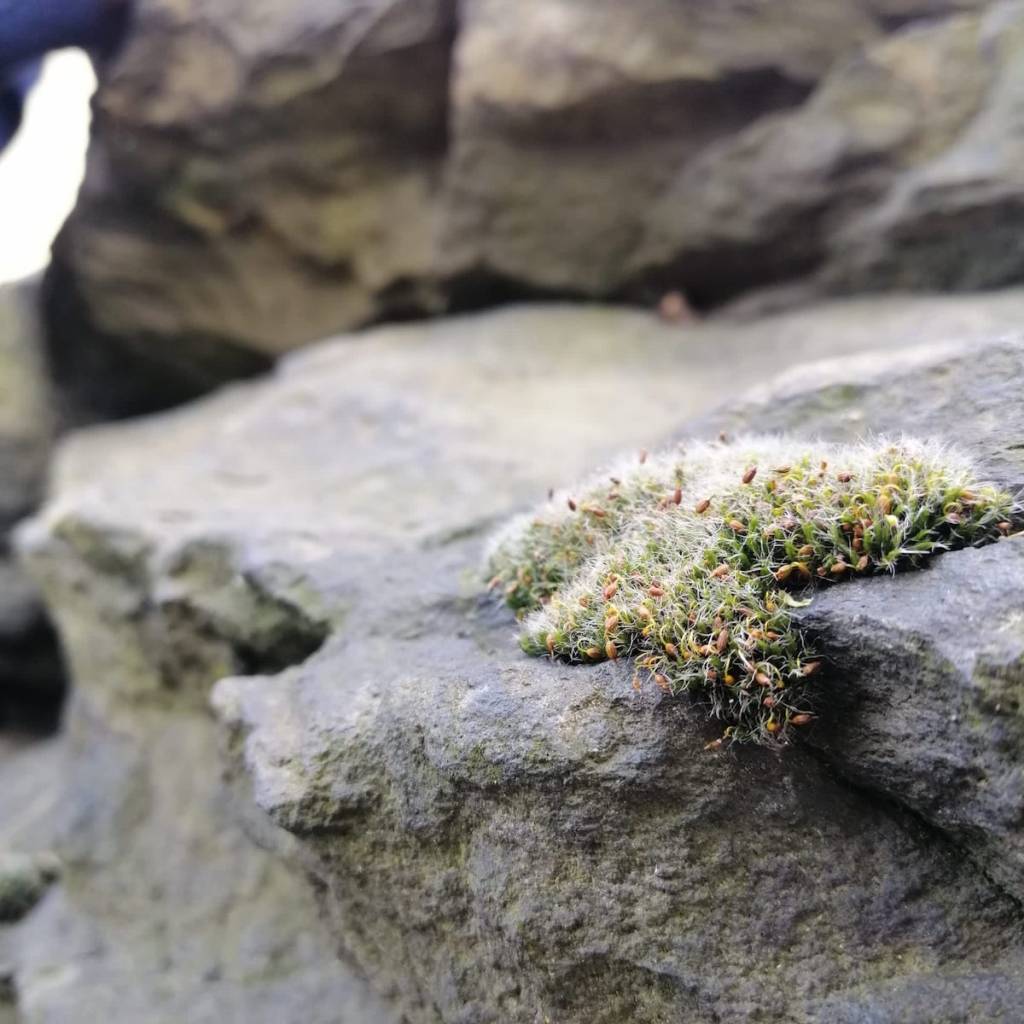
The boulders were formed in a volcanic eruption 450-460 million years ago and later travelled from the Arenig mountains in Wales to the West Midlands on an ice sheet. Eons passed, the ice retreated and the boulders now litter the alien shores of 21st Century suburbia. They can be found lurking in parks, graveyards, roadside verges, beer gardens and hidden in walls and buildings.
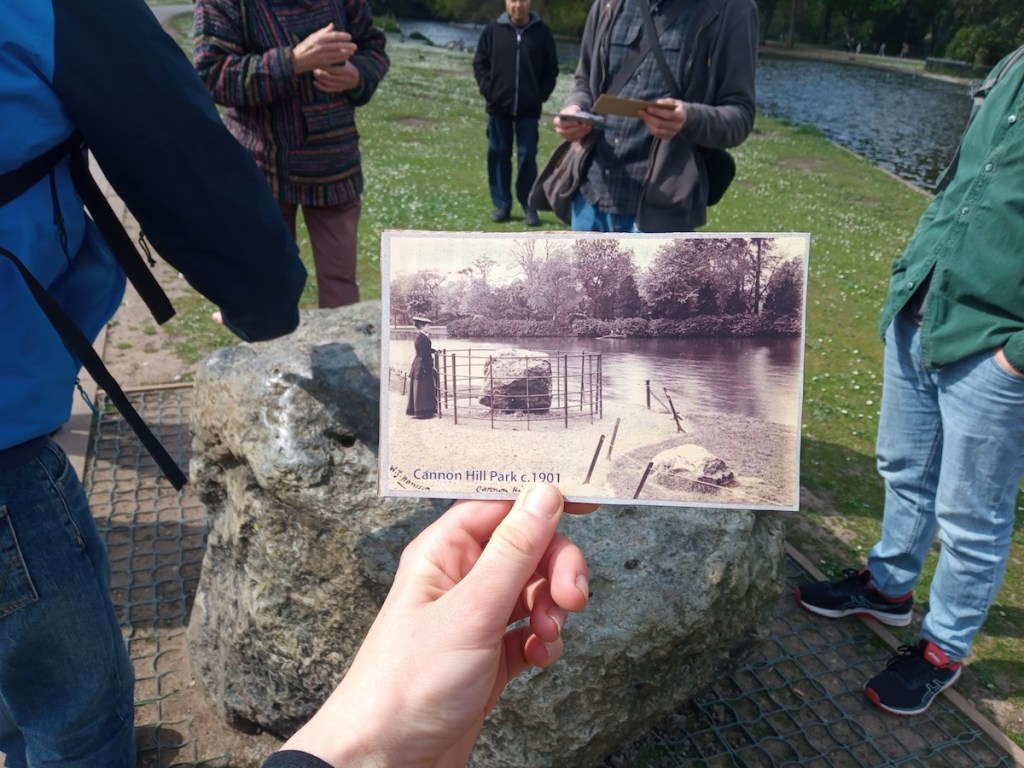
The word “erratic” comes from the Latin errare meaning to wander, roam or stray. The restless rocks are still on the move: many have disappeared since the great age of discovery in the 19th Century. The picture below shows the Cannon Hill Park boulder in 1901 and beside it is another, smaller boulder. The main boulder remains but its little cousin has upped and left. Forget Paris, the original flâneurs are here (for now).
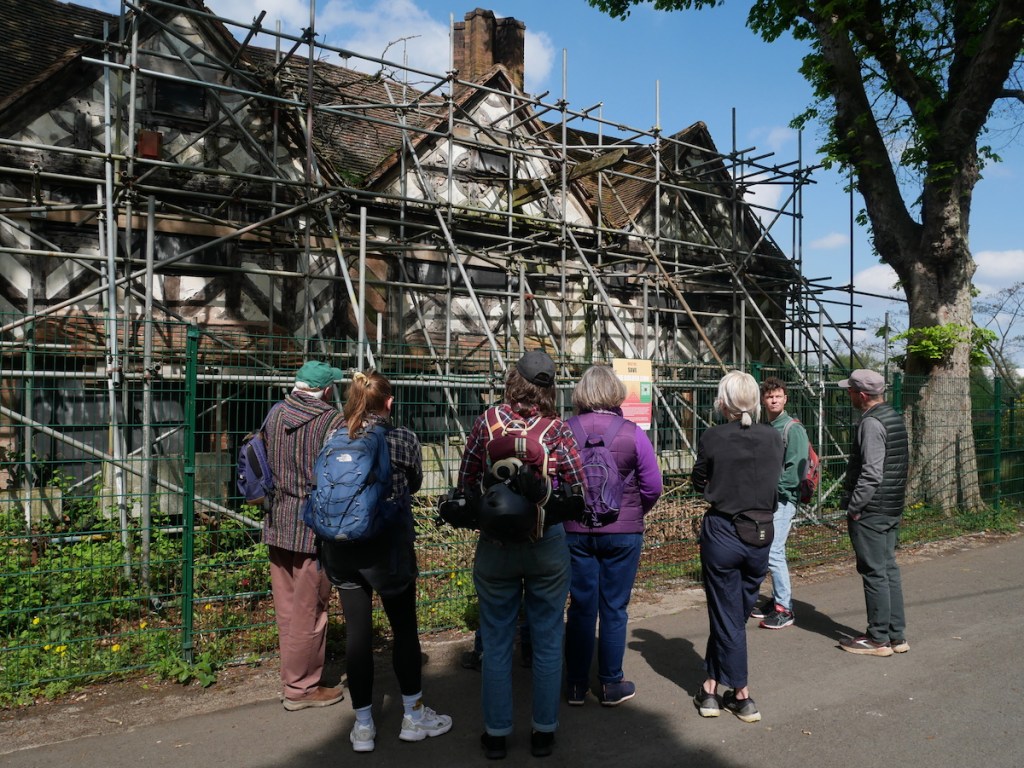
The concept of “roaming heritage” doesn’t just apply to boulders though; Cannon Hill Park also contains erratics of a very different kind. The Golden Lion Inn hasn’t travelled quite as far as the boulders but it has moved further than most buildings are likely to. A rare 16th Century survivor, it originally stood on Deritend High street, two miles away. In 1910 it was dismantled and removed to make way for a road-widening scheme and then re-erected in its current location and used as cricket pavillion. It was listed in 1952 and then left to fall to ruin. The support scaffolding is now as much a part of the building’s heritage as the C16 timbers.
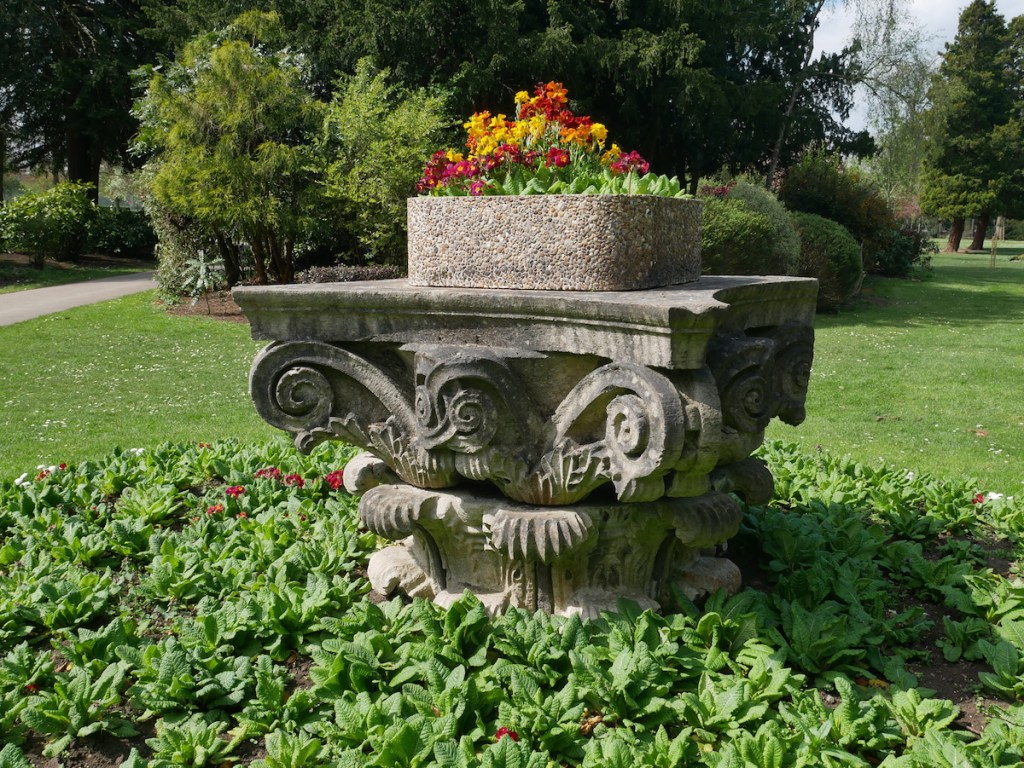
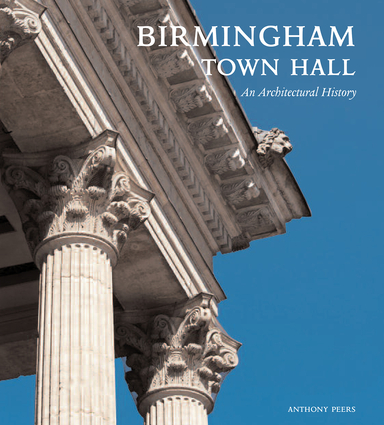
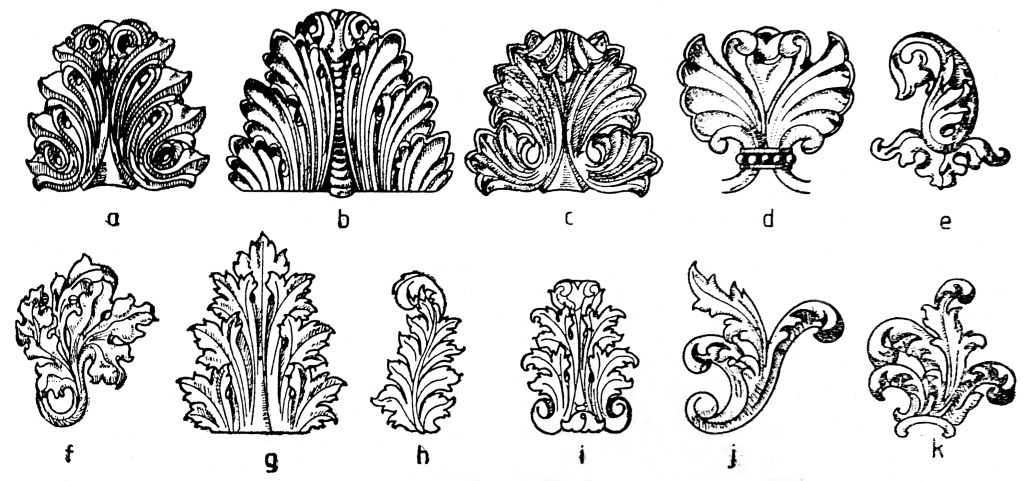
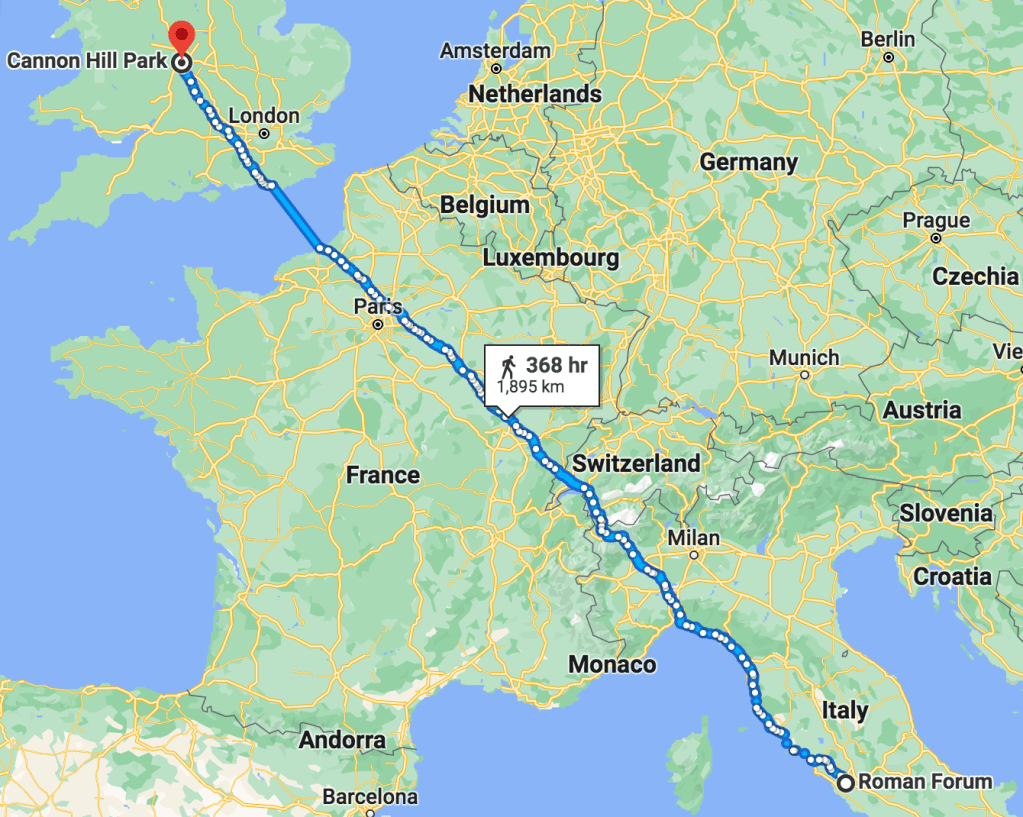
A few hundred yards away, beyond the crazy golf course, you’ll find two more “erratics” hiding out as flowerbed ornaments. These ornate stone structures are in fact spare parts from the Town Hall in the city centre. They’re called capitals, ie. the bits at the tops of columns, as seen here on the cover of Anthony Peers’ book.
The capitals may have only travelled a couple of miles but the Town Hall itself is a copy of the Temple of Castor and Pollux of ancient Rome. The leaves in the design are acanthus, a genus native to the Mediterranean and one of the most commonly occurring motifs in classical architecture.
To quote Crab Man: “Once you become sensitive to these ‘erratics’ you will begin to navigate a landscape from which such anomalies, large and small, repeatedly pop up.” (Counter-Tourism: The Handbook, 2012, pg 137)
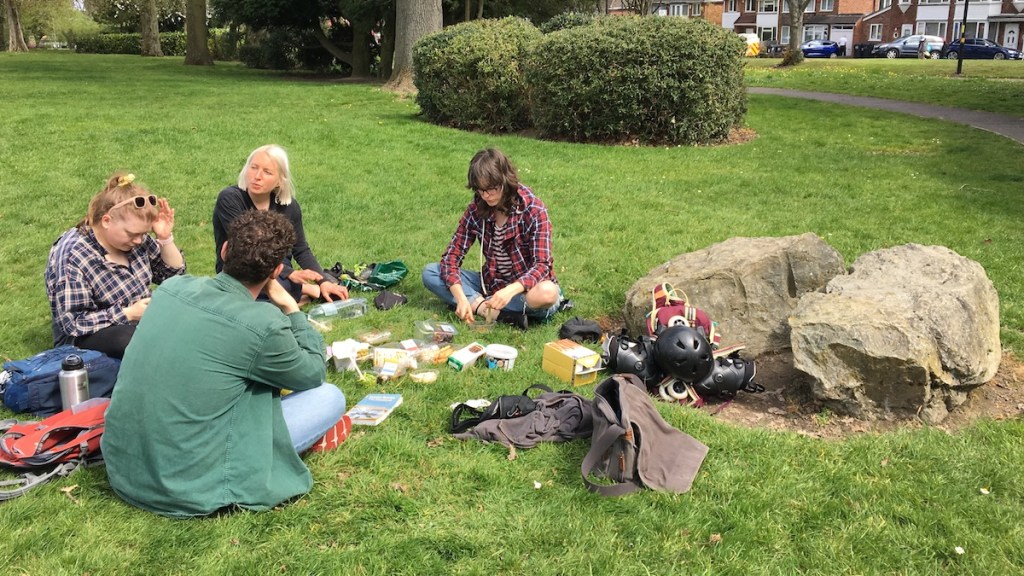
The boulders cover far more ground than we were able to in a single day so there are plenty left for future walks. Stay tuned for more boulder action but in the meantime we hope you can join us for our next Erratic, a pilgrimage to Spaghetti Junction with Flatpack Festival on May 22nd.
This year we invited members of the public along to join in our annual Stirchley skull walk. I say annual… the first one only took place last year under rule-of-six lockdown restrictions but someone on the walk said we should do this every year and so an ethereal manifesto has started to form. Check out the inaugural skull walk to get a skull overlay for your own local streets.
Of course, an unwelcoming storm of horizontal rain and icy winds blew through just before the walk but eight people still turned up to follow an invisible skull outline around the streets of Stirchley in south Birmingham on a wet Sunday night.
Andy Howlett baked the soul cakes and led the 90-minute walk which criss-crossed between this world and the next. And despite fewer houses decorating the front yards this year, there were still plenty of real signs that the spirits were at large.
Messages in the landscape
No! Keep out! Danger of death! Stay safe! Too late! Ends! RIP! Emortal! Warnings of graves being dug. All the signs were there that this was no ordinary walk.
Sounds of the spirit world
At the top of the skull, the spirit sounds came to us in the rustling of tree leaves and whistling of the wind through the back alleys of Stirchley East. We paused at the top of Hazelwell Park and a bat flapped out of the tree line. A flagpole screeched by Selco. And a broken streetlamp flapped overhead against its pole like something out of Twin Peaks. Naming no names, some started saying the words on street signs out loud in monstrous or ghoulish or hissing tones: “Schoooool!” “Caaaaution!” “Travisssss Perkinssss”
Faces in strange places
From van doors to grit bins to cloud formations viewed from the darkness of Wickes’ car park, the other side communicated its presence through pareidolia. Witches on broomsticks in the sky. Shadows demons lurking in the corners. Beaked hooded figures in the River Rea of blood. Screaming faces etched into Bournville Lane’s Victorian housing.
Portals to the underworld
On Halloween, the portals between worlds open up everywhere. From drain covers in grass verges with moss embossed runes to the gateposts of hell to people frozen into stone bollards guarding entrances and exits. And then there are the snickets, ginnels and alleyways where time itself seems to shiver and ripple as humans pass through to the other side.
The End
After the walk, the participants looked visibly relieved to have made it back. A few went to the pub to sate their thirst. Others peeled away to trains or home. For us, we walked home all alone, past graves and tombstones. Where the bunny rabbits were waiting for us…
Stay safe, everyone. See you next year for Skullwalk 3: Rise of the Walking Dead?
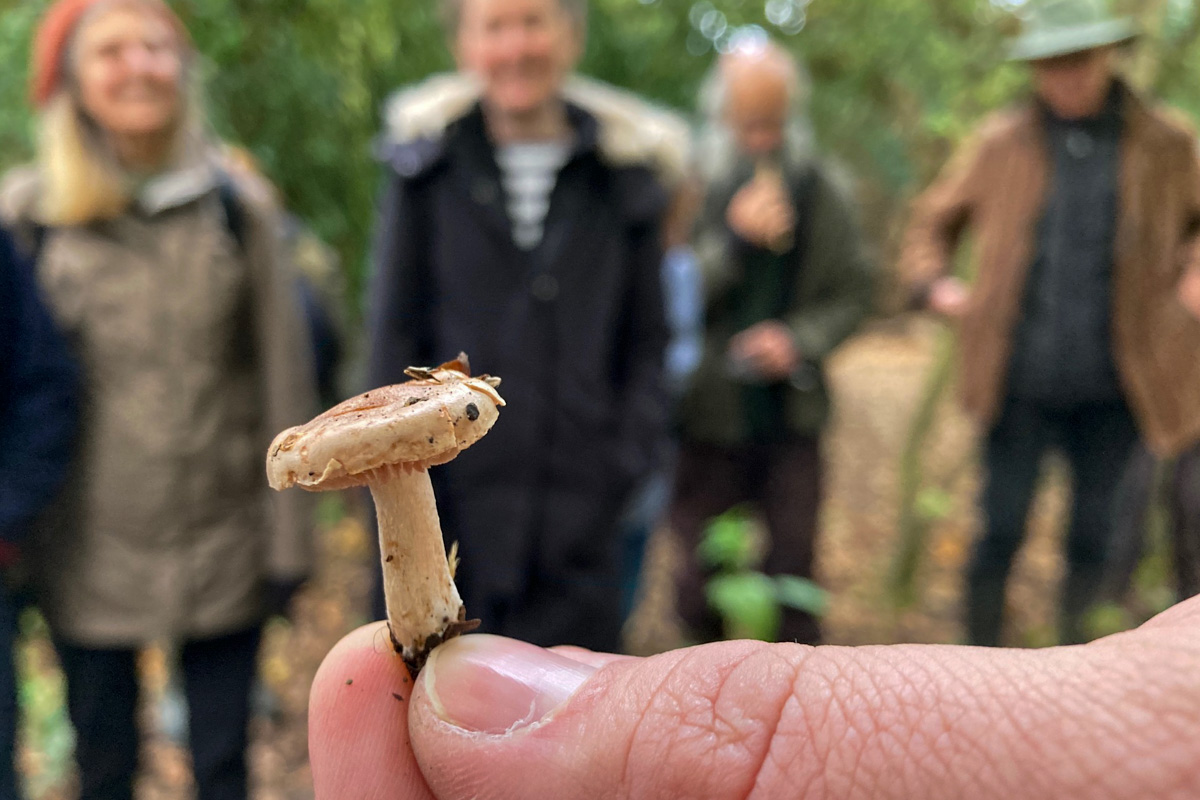
To be fair, I could have picked any of the names to headline today’s two-hour, ‘sold out’ Lukas Large fungi walk around Moseley Bog. But Dead Man’s Fingers were one of my favourite’s with their pointy black protuberances that look nothing like what anyone would imagine a mushroom to be.
There was also:
The amethyst deceiver, which changes colour, almost like camouflage.
The white saddle or elfin saddle, a convoluted spore shooter that looks a bit like a biology book diagram.
Clustered brittlestem – which grows in clusters with er brittle stems.
Brown roll-rim – the only fungus known to have killed a mycologist (someone who studies fungi). Julius Schaeffer died after eating it. Apparently it can cause an allergic reaction which leads the body to kill own blood cells. “Eating one is a bit like Russian roulette,” says Lukas.
Trooping funnel – which grows in troop lines or rings.
Birch brackets – which grow on birches and have lots of medicinal properties.
Apricot clubs – a lovely yellow coral fungus.
Sheathed woodtufts – shiny!
Inkcaps – I think these were the ones that were highly poisonous if alcohol is consumed a few days before or after.
I think the photo below is of the red cracked bolete – which drops spores out of pores instead of gills on the underside…
Candlesnuff – because that’s what it looks like.
Hairy curtain crust which commonly grows on oaks.
Shaggy inkcap aka lawyer’s or judge’s wig.
Green elf cups – although some walkers thought it was blue. Maybe teal? Anyway, this vivid coloured small mushroom also discolours the decomposing wood it grows on.
From what I can gather, the 2021 ‘mushroom season’ (Sept-Nov or until the first severe frost) is a good one. Certainly once we started looking in the Moseley Bog nature reserve they were everywhere, popping their heads above ground, on trees, in mud in order to spread their spores.
There are 15,000 species in the UK, all running on a limited number of describable characteristics – shape, size, colour, texture, gills, tubes, webbing, caps, cups, smell, sap, relationship with nearby trees. Even Ray Mears doesn’t fully trust his fungus ID skills when eating in the wild.
Or as someone said at the start: “All mushrooms can be eaten once, not all can be eaten twice…”
Thanks again to Lukas Large, Natural Sciences Curator at Birmingham Museums, who led the walk. You can check out his Flickr stream for some great photos.
We found out about him from fellow Walkspace member Jacob Williams, who led one of our members walk on a journey to the Centre of the Earth and urged us to look out for Lukas Large’s next walk. Follow him on Twitter @lukaslarge.
Or just get out there and look. But as Lukas says: “If you want to go foraging for fungi, please do it ethically. Many of our nature reserves and country parks are the last fragments of nature in a sea of people and agriculture, so the fungi there are precious and should be left for wildlife and other people to enjoy.”
All photos: Pete Ashton (except for amethyst deceiver and white saddle by Fiona Cullinan)
On Sunday 22nd August we launched our new series of public walks with In Search of the Brumphalos, a journey to find the heart of Birmingham. The walk was devised and lead by Walkspace members Andy Howlett and Robson and was inspired by an article in The Guardian which revealed the precise geometric centres of the UK’s 10 largest cities.
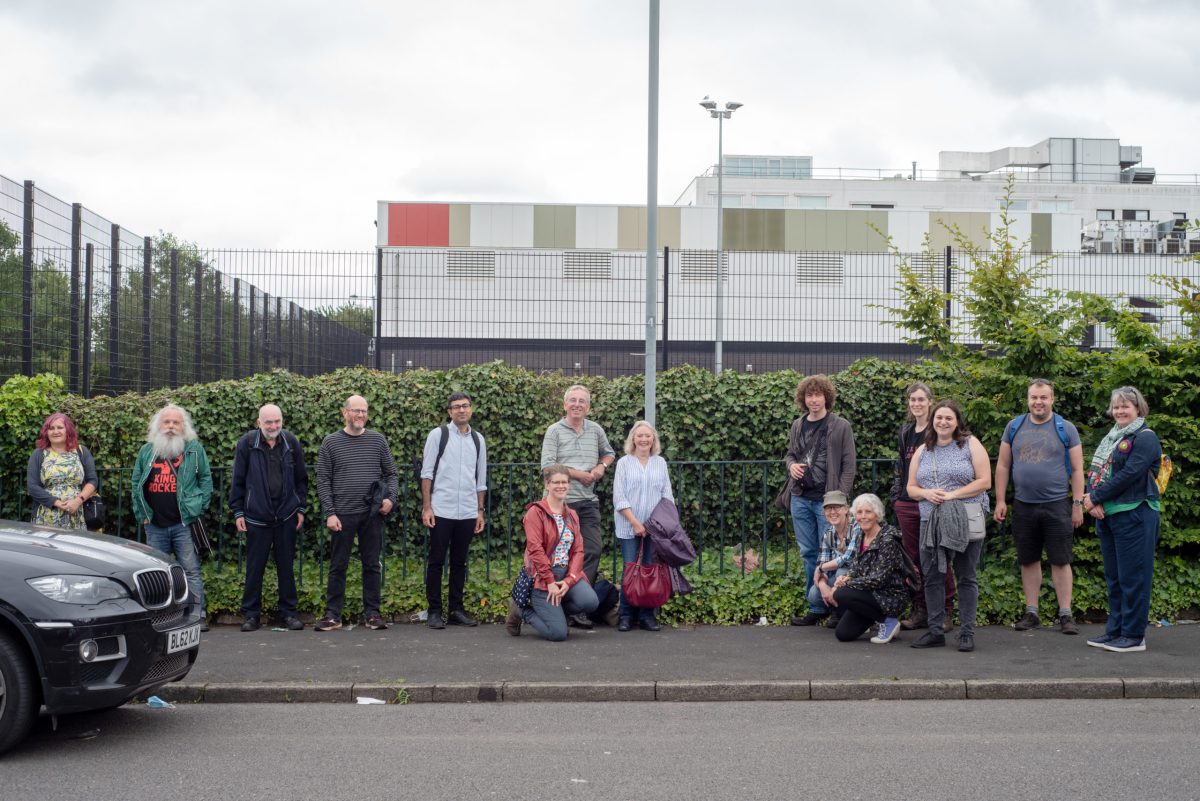
There were seventeen of us on the day and we visited various sites that might be considered the centre of the city, some obvious, some a bit more esoteric, before finishing at the mathematically calculated “real” centre which turned out to be on a residential street in Duddeston.
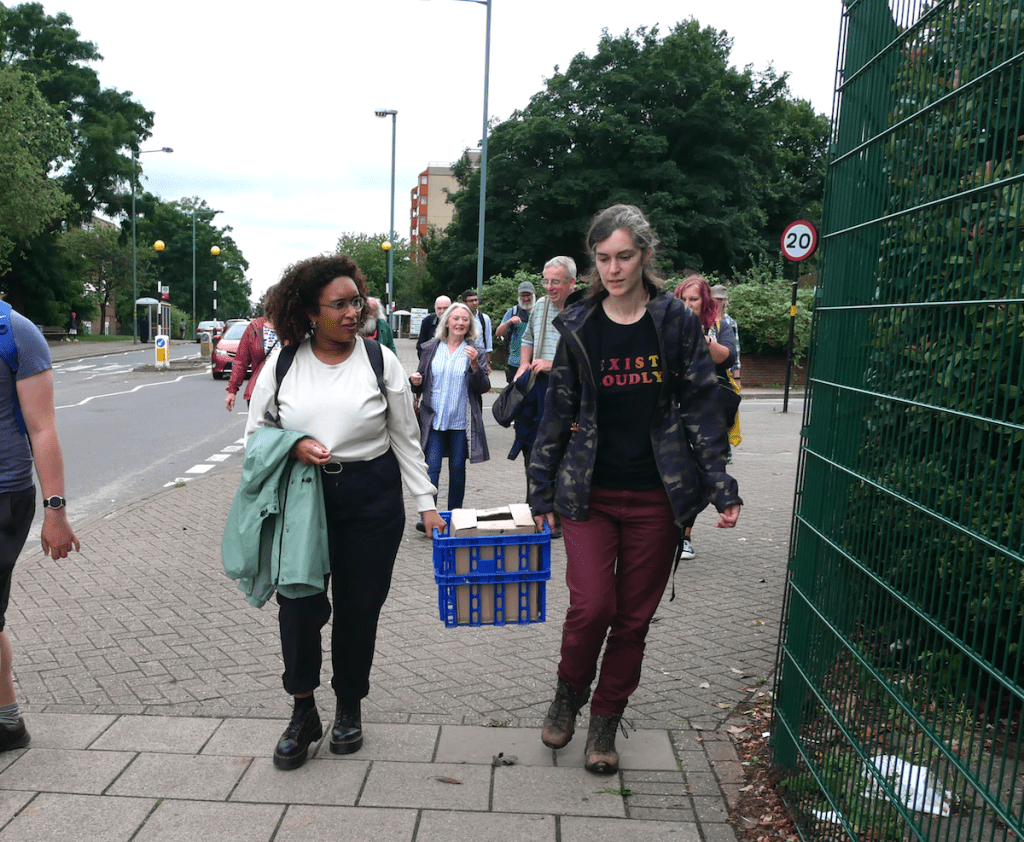
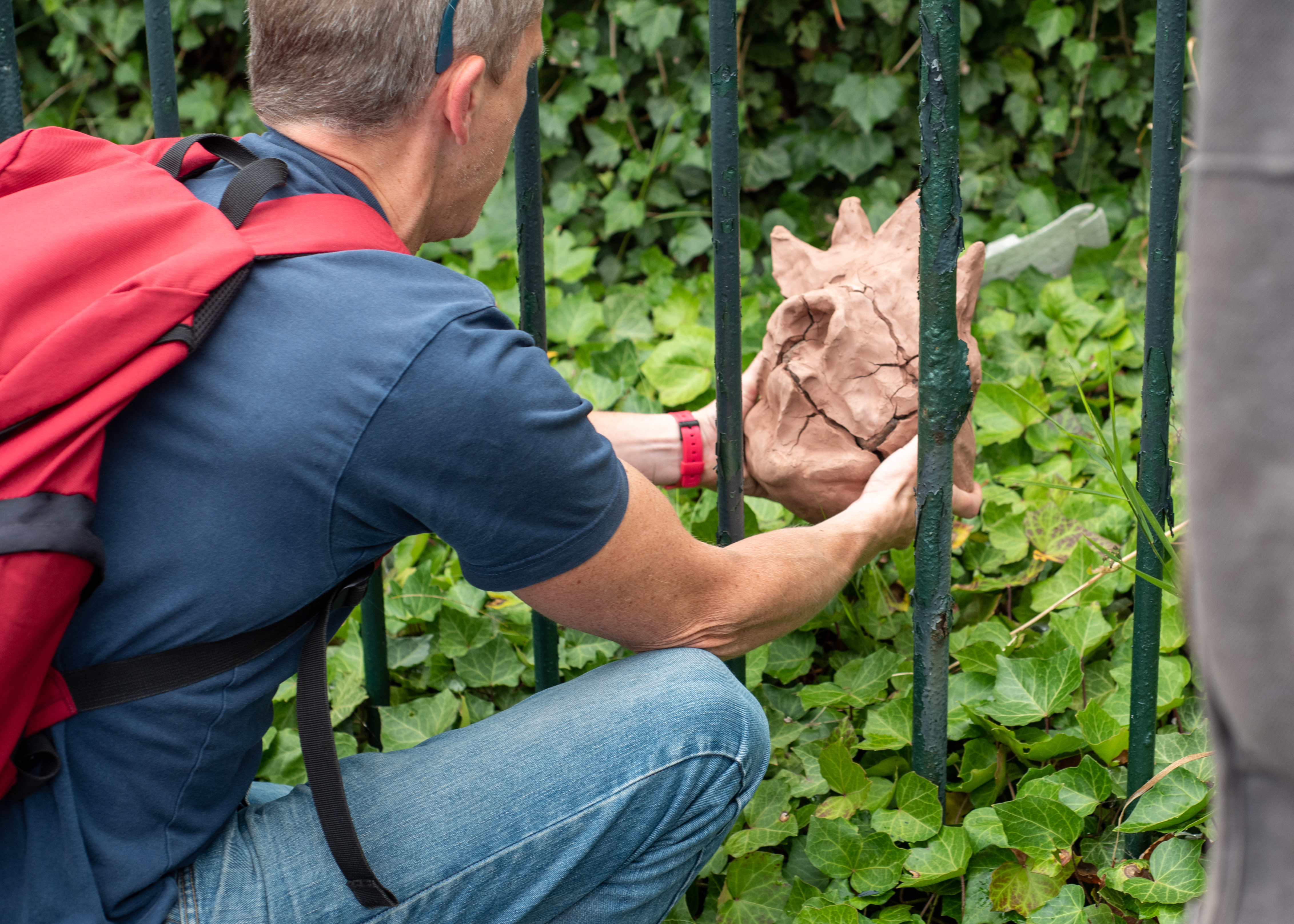
Inspired by Greek mythology we carried a specially made “Brumphalos” stone with us to mark the spot. The original Omphalos (meaning “navel”) is a sacred stone in Delphi, believed to have been placed there by Zeus to mark the centre of the ancient world. Our Brumphalos was created by visual arts duo Hipkiss and Graney and participants on the walk took it in turns to carry it in pairs in a concealed crate. The stone was only revealed once we reached our destination, at which point we carefully placed it on a bed of ivy behind a railing where it shall remain until it is reclaimed by the earth.
Liz pauses us as we emerge onto the terrace above the canal. All around is a social throng of teens, twenty-, thirty- and fortysomethings. They line the floors of the Mailbox, drinking, dining, flirting, peacocking and people-watching. After months of restrictions, the UK’s third lockdown is easing and it’s a beautiful sunny Saturday evening in central Birmingham. The mood is celebratory. The olds are mostly vaccinated, the young at least partly so, and everything feels just a little bit more hopeful for the future. Humanity is in its brightest colours.
This is either going to be the most triumphant or the most uncomfortable part of our attempt to ‘crone the city’.
==
Croning the City
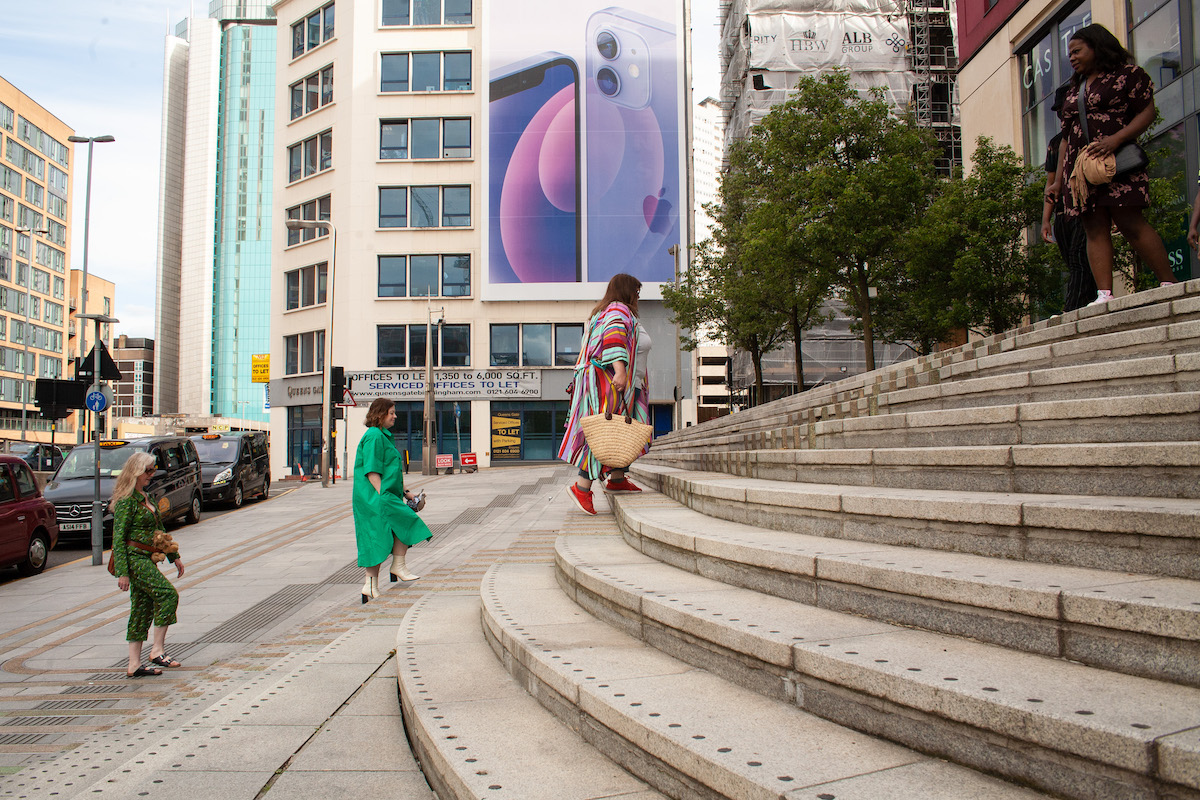
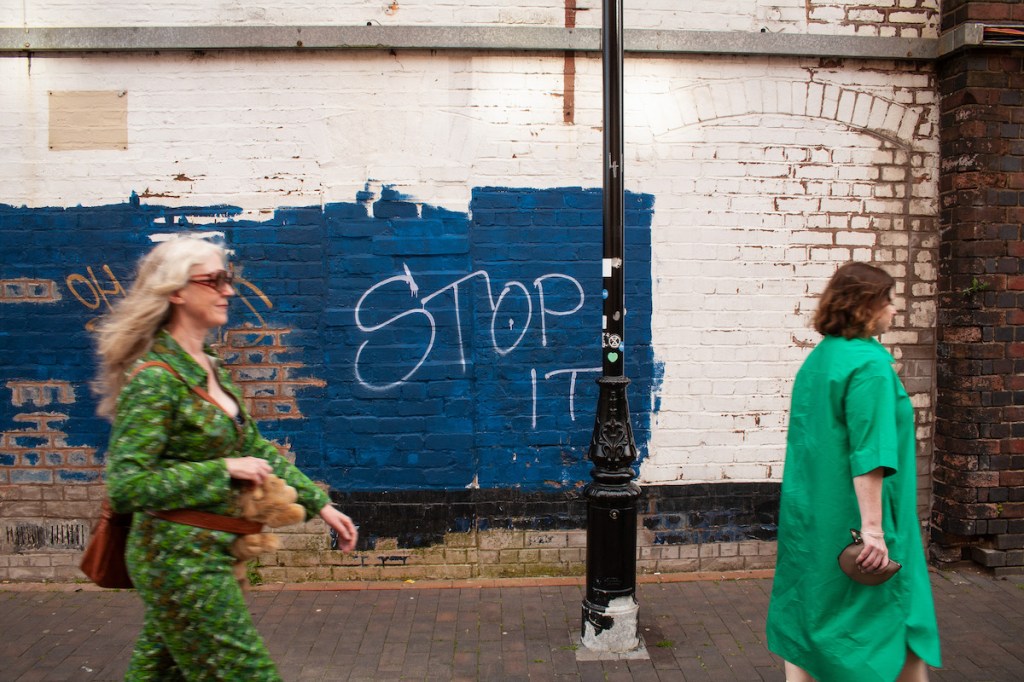
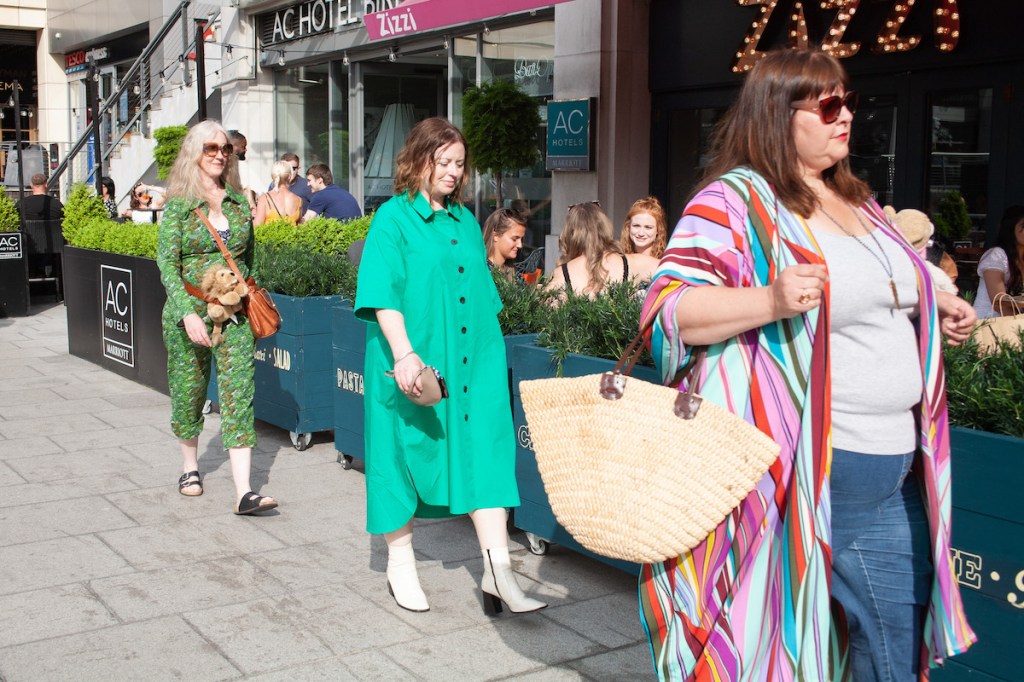
Who are these women? Are they important in some way? Why are they carrying stuffed toys? Why are they walking in a line? Why is a photographer snapping them? Where did the middle one get that dress? What is the story here?
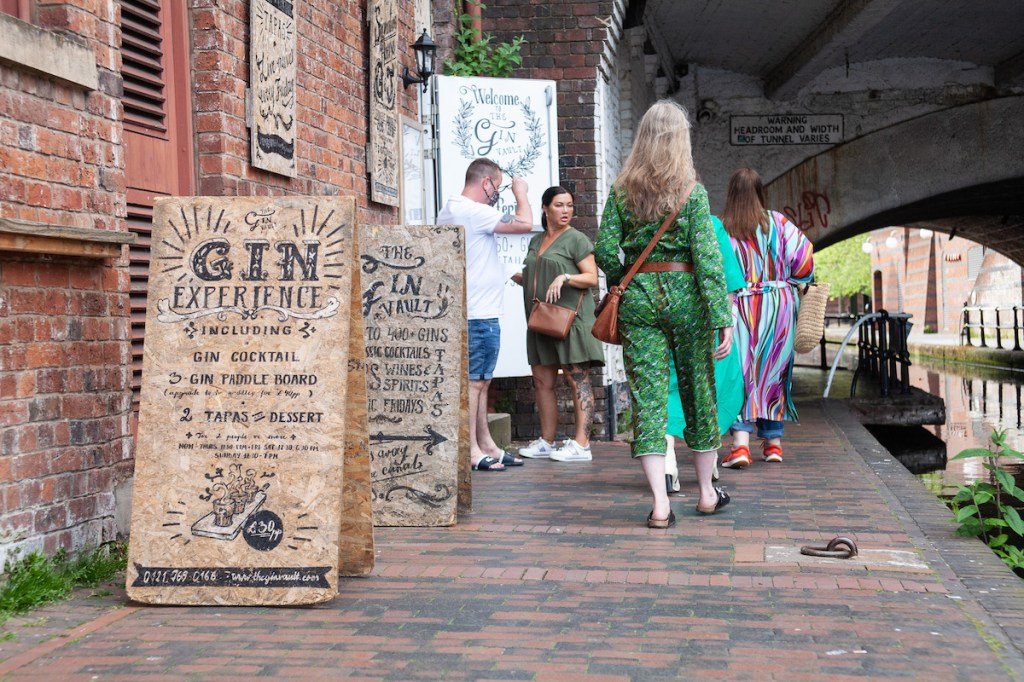
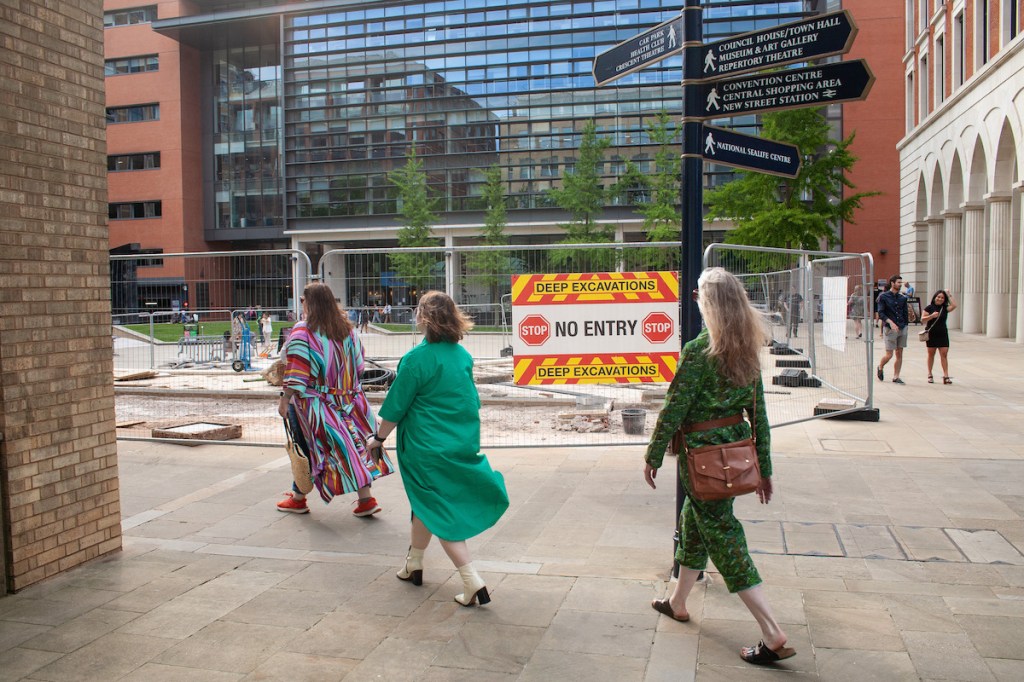
Three crones walk in silent, single file.
The crones walk through city infrastructure that can feel forbidding to all women – underpasses, canal towpaths and tunnels.
The crones walk where women of their age wouldn’t ordinarily be present – past strip-club streets to the party zone on a Saturday night.
The crones walk where they are most visible – across sweeping bridges and staircases, through a train station, a high-end mall, past tables of people-watchers.
The crones are dressed in bright colours. Two carry props of toy animals. They walk in a resolute but unhurried fashion.
A photographer trails them, running ahead, to the side, crouching into position to frame the women against the city.
The crones are glanced at, stared at and the subject of both whispered comments and open exclamations… They are also frequently not noticed at all.
The crones appear briefly on a hot Saturday night in the city and just as quickly fade away, leaving only small, temporary traces in the lives of others.
==
Can we do a watched walk?
“I was thinking about [how women walk] and wondered if we could do a watched walk? How could we encourage the most people to have a memory of us walking through a city?”
– Liz
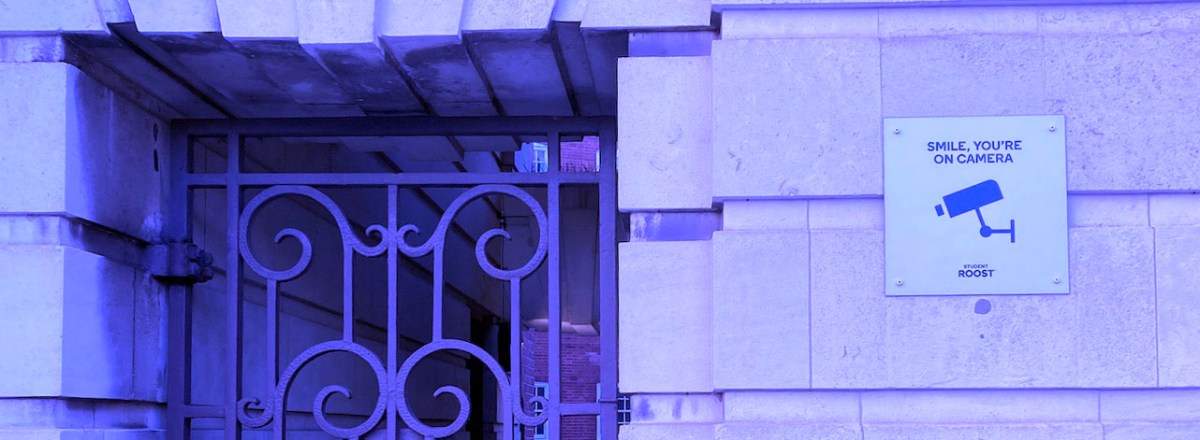
Six weeks before the Crone Walk, I posted a photo from my second all-female Dazzle Walk – a walk designed to make us digitally invisible to the city’s prevalent surveillance cameras. The murder of Sarah Everard was causing widespread outrage and factoring into post-Dazzle Walk discussions about how women walk. How did being invisible in the city make us feel. Safe? Threatened? Subversive? If cameras didn’t protect us, what would? More female pedestrians? Walking with others?
I invited female friends to join me on a series of walks together in the city, perhaps alternating on the themes of visibility/invisibility. Those who volunteered were 40 and 50-year-olds, the age when women tend to become invisible and less valued within a society that favours youth and patriarchy. Age, gender and visibility quickly became a factor in this next walk.
Having spent a year thinking about walking invisibly – on Dazzle Walks, Dark Moon Walks and Night Hikes – walking with the sole purpose of being seen seemed an interesting counterpoint. What might the opposite of an invisibility walk look like? How could we as deprioritised older women become visible again?
==
At New Street Station, the photographer (Matt Murtagh) is documenting the walk at our request. He takes some pre-walk photos as a warmup and we present ourselves one by one for the camera.
Our self-generated poses mimic those of fashion models, cougars and various other female stances selling desirability. As a middle-aged woman who is none of those things, they nevertheless rise up in my mind. I want to look attractive – this is how I perceive that to happen. It’s what we see everywhere in advertising and women’s media – women bent into weird accentuating shapes. These images are culturally embedded and inescapable. And so at home, we drop a hip, or stick out a foot, or position our bodies in some way that is deemed to be more attractive than simply standing still. It’s what we know.
We submit to our close-ups but it feels awkward, perhaps because it foregrounds our struggle with the desire to look good for the camera. We trust Matt and yet we are fighting a culture that says we must look younger, thinner, happier, prettier, sexier. I feel tension between this and my crone-aged self. I want to be authentic yet here I am posing and breathing in the middle-aged spread.
==
On ageing in a patriarchy
“… I feel at my most confident now … I am more myself … more powerful now that society has decided I’m less useful … No one says thanks or recognises us … At the mercy of my hormones … I’m angrier now the oestrogen has gone … We are all knackered … I’m worried about losing my desire/desirability … I’m happy to be less visible …”
– Snippets from pre-walk discussions
The experience of ageing is different for men and women. For women, the menopause draws a distinct line based on our reproductive organs shutting down. With it comes a hormonal rollercoaster with 30-40 recognised symptoms that may go on for a decade. At 53, I’m two years in and there is no ignoring the pile up of symptoms, which can be mild or debilitating from one day to the next.
The traditional maiden, mother, crone archetype provides a neo-pagan view of the different life stages of women. I’ll be honest, it isn’t an area I’m familiar with, unless the archetype can also mean tomboy–careerwoman-other. I viewed ‘crone’ with as much suspicion as all the other labels and cultural stereotypes that afflict women throughout their lives – as yet another put-down.
Crone feels like the most loaded word of the archetype. Images of witchy Baba Yaga, fairy godmothers and old hags in rags immediately spring to mind. But crone archetypes also symbolise ‘wise women’, finally able to take a step back from the concerns of maidenhood and motherhood and enjoy a potentially very different, transformative ‘third act’. My own mother is an example here, transformed from shy Irish maiden to immigrant mother-of-three to founder of the Acorns Children’s Hospice shops (From Little Acorns…).
With age can come wisdom and growth. This is a theme of our pre-walk chats. The crones discuss how much more confident we are in many ways now that we are older. Our knowledge and experience makes us more powerful in our work, more confident in our sexuality, and more articulate in our voice and expressions.
Yet in a youth-oriented patriarchy, we are also now more likely to be overlooked, less likely to be listened to, passed over for work or jobs, and seen as less desirable or less valuable somehow due to age. The unspoken biological question surfaces: what do we have to contribute to society now that our reproductive work is done?
==
People are giving us plenty of side-eye as we pass them on the pavements near New St Station. We are not walking ‘normally’. We are in single file and slow but purposeful. At the Hill St crossroads, we stand juxtaposed next to three maidens, waiting for the green light. All of us are dressed up but our older bodies are more lived in, our middles way less defined, our outfits less figure-hugging. We are the same but 30 years in the future. I try to think of somewhere our generations interact without the power relationships of age: parent and child, teacher and student, line manager and employee. Nothing comes to mind.
We reach The Mailbox. A huge former Royal Mail sorting office, now a destination for high end goods and services. There is a sense of us rising up. We emerge from a concrete underpass up a sweeping stone staircase, then escalators, then lifts. The situation also feels heightened – we are about to enter the entertainment district.
A couple of expensively-dressed young women look up briefly from their drinks. I feel assessed. I don’t think we look old so much as out of place. Not thwarting expectations of ageing so much as thwarting expectations of what we should be doing in that space. “What are we doing here if not shopping?” asks Liz in her route prompts.
==
How do you perform ageing?
“He said: ‘Ah you know a woman’s middle-aged when she’s wearing leopard.’ The casual sexism and ageism of that comment has stayed with me for 12 years”
– Jenny
“… [Ageing] is a multiple, ambiguous and contradictory process which provides us – continuously and simultaneously – with images of our past, present, lost, embodied and imagined selves”
– Helene Moglen, Aging and Trans-aging, Bodies in the Making
The Crone Walk had a sense of occasion, a ‘happening’. Pre-walk, it felt as if we were preparing for any night on the town. We discussed dress codes for greater visibility but instead of little black dresses and heels, the talk was of robes that made us look like cult leaders, or functional boiler suits, or “something with a leopard-esque print” that plays into the everyday sexism and ageism of cougar/MILF/GILF sexual stereotypes.
We talked of challenging these stereotypes but also of lost or alternate or potential selves. Dressing up for the walk could be part of the process of ‘becoming’ this other self.
Accessories included comfortable walking shoes and props such as stuffed toys (hinting at eccentric cat lady and megalomaniac villain stereotypes, roles we were over-associated with or that were associated with men).
The female ritual of ‘getting ready’ felt familiar to our younger selves. The fun, the anticipation, the mirror checks – perfectly lampooned in Rachel Bloom’s The Sexy Getting Ready Song from the TV show Crazy Ex-Girlfriend – but more loaded with meaning. We were getting ready to perform ageing; we were dressing up for the city and for how we wanted to write our older selves into its landscapes.
How do you feel as you walk through the different spaces? (comfortable/uncomfortable, accepted/imposter, safe/scared, included/excluded, anonymous/watched?)
What can you see? Who is seeing you? Who is missing?
==
Liz pauses us on the packed terrace above the canal. She later admits she has disliked walking all her life until lockdown equated it with freedom. Here, she is a majestic walk guide, a female crone cult leader in a billowing robe of many colours, stroking her beloved toy cat, and surveying new kingdoms to conquer. Jenny aligns herself next to Liz; she looks serene and confident in the most vivid green dress. I follow in a dinosaur-camouflage boilersuit, with a toy lion stuffed in my belt. I’m wearing a bikini underneath because it’s hot and as a reference to GraceGraceGrace – three gen-age artists who partly inspired this work.
Before us, people are everywhere, enjoying their first freedom in months amid a summer heatwave. Matt runs ahead and crouches down to snap us. This draws attention. The act of photography literally makes us visible – people see him and then look at us. I feel self-conscious but also part of the scene. We may be costumed crones but everyone else is dressed up for high visibility, too. “I love your lion!” shouts a young woman to me as we pass the people-watchers.
On a high metal walkway over the canal junction to Gas St Basin, Liz pauses again. Two women dining at a restaurant beneath are staring up. To give them a better view, we lean on the railings. They look at us, we look at them. They whisper conspiratorially. It doesn’t really matter what they are saying. We are here, we are seen, we are discussed. I’m enjoying this. I almost wave at our whispering younger sisters to let them know we are benevolent but that might break the spell so I resist.
As we approach the canal tunnel to Broad Street and Brindleyplace, a woman now exclaims at Jenny. “OMG I love your dress, I love that green, I could never carry it off!” Seen.
We end the walk at the Ikon art gallery, chosen by Liz as “somewhere all of us will feel safe thanks to our interests and somewhere where it’s entirely acceptable to be dressed unconventionally”. We’ve made it. We are elated. We can’t wait to talk about how it went.
==
Snapshots
How did it feel? Who did you see? Who is seeing you? Who was missing?
“Like we were gliding through the city, the slow pace, the single file, the deliberate nature of the walk. No one got in our way until the tunnel. It flowed, we flowed.”
“Felt invisible at times – people were busy in their own worlds but it was nice. We could look around and enjoy the city. Our purpose wasn’t rushed.”
“The silence was important.”
“There was an urge to smile.”
“Felt quite processionary.”
“Felt benevolent towards my younger self.”
“The standouts were homeless people – wearing black or grey clothes and sitting still.”
“The over-65s, children and normally dressed people were missing from the scene.”
“We blended in – we were in context of everyone else and everyone was dressed up. What would it be like if we went out on a Tuesday or on a morning commute?”
“Did we get into different characters in our minds?” “Not so much. I think it was enough to dress up with intent – as heightened versions of ourselves.”
“I felt a peace from our walk I really did not anticipate.”
“It was a lot of fun! I think there’s something very interesting in an event existing to be photographed and how meaning is created through that process.”
“It felt authentic. That embodied experience once it shifted from sweaty awkwardness to being a part of something was so grounding and liberating.”
==
The power of a walk
“I have long been fascinated by how people understand themselves using landscape, by the topographies of self we carry within us and by the maps we make with which to navigate these interior terrains”
– Robert MacFarlane, The Old Ways
“To be a crone is about inner development, not outer appearance”
– Jean Shinoda Bolen, MD and author of ‘Goddesses in Everywoman’
Afterwards it occurs to me that we were mostly seen and acknowledged by women. This fits with losing the male gaze, which was firmly on the maidens of Brindleyplace, but also reflects a lack of older female role models in society. If we could speak to that lack by being more present, it sends a signal that female life doesn’t end when your ovaries switch off.
Our aim was a ‘watched walk’ – to be seen in the city and to claim some space for older women where we had little or no presence. It was a journey that was by degrees self-conscious, eloquent, colourful, conspicuous, fun, celebratory, defiant and bonding. The experience of ‘croning the city’ was more vivid for the participants than the watchers.
Walking as a crone enabled us to think about our own interior worlds of wants and anxieties around gender and ageing. It gave us space to explore where we are at with ageing, what being menopausal means, and how we might see ourselves now and in future.
Taking a stance against encroaching invisibility let us respond to it both individually and as a group. It let us play with cultural stereotypes but also feel the feminine power of coming together after a year of not having such gatherings. And it was fun. The dressing up. The conversation. The chance to get know some funny, smart and intelligent women better.
One surprising factor in the Crone Walk was the photographer. It quickly became clear that the act of photography was not just about documenting the walk but was integral to the work. It facilitated us being seen time and time again.
The photos, when they came, were almost superfluous. Matt’s final selection of 100 photos offered a perfect broad scope of shots from all angles and across all the environments we walked through. But they only provided a singular view – that of the photographer. ‘Croning the City’ was a more intense experience than the photographs could ever show. Walkspace mentor and artist Pete Ashton raised the point that we should be careful not to confuse the art and the documentation. To avoid the photos being seen as the work, the crones decided to publish only one image from the walk (since extended to five images.)
Another surprise… I had thought the Crone Walk would need a leader to make it happen but leadership was also superfluous. In that way that women excel at when they come together, the walk immediately became a collaboration with decisions made by all. It felt good to be part of a group where everyone had an equal voice.
For the record, the collaboration consisted of:
several pre-walk discussions of what we wanted to do and why, walk practicalities and ‘what is art?’
an immediate formal post-walk discussion
an informal post-walk dinner sharing more general experiences around growing older
a week later, an artist briefing and a group crit of the photos.
There is so often much benefit in how women come together; and in how we walk together too. Walking in a group provided us with a safe space to act. It gave us a sense of solidarity with the changes we are facing as a result of the menopause and a sense of solidarity with others who may also struggle to be heard or seen in society. Through the idea and act of crone walking together, we were able to explore female ageing and take some positive action over it.
==
What next?
‘Croning the City’ turned out to be more than I had hoped for. I hope it won’t be the only crone walk. Perhaps next time we will appear in a different context from a Saturday night out in the city. Perhaps a morning commute or a protest march or walking in other places where crones need to be seen or where our maiden/mother/allies exist.
We could adopt entirely new crone characters or re-invent ourselves for the camera, taking cues from Cindy Sherman’s photographic work. Or maybe it will develop in a completely different way. Into a womanifesto. Or a game. Or a script for a play perhaps.
It doesn’t really matter. Ultimately, the crone age is all about potential and change. Crones go through the change. We have the ability to become agents of change.
Every journey starts with a single step. In 2016 mine was finally getting around to sorting out my crappy online passwords. I took a short cybersecurity course and decided to pay it forward by offering help sessions in a local café. This grew into The Interrogang – a monthly reading group for data issues. In 2017 I became an ‘Ingenius’ at The Glass Room London, an interactive exhibition into data privacy visited by 20,000 people. I wanted to bring this home to Birmingham so I started a newsletter called Observed City which ran for a year. Together with Open Rights Group Birmingham, we set up a mini version of the Glass Room exhibition at my local library.
Now this series of steps has moved from activism to art in the form of a walk commission by The Dazzle Club – a research collaboration which explores surveillance in public space. For the Birmingham Dazzle Walk, I proposed using age-related camouflage as counter-surveillance measures to walk silently and invisibly across the city.
In the style of a surveillance report, here is the walk log.
++
Birmingham city centre, 18 March 2021
6.15pm the Electric Cinema, Station St
I meet my walk guest – the neurodivergent, experimental artist and writer, Kruse – to lead her through a city that was once the UK’s CCTV capital, with an estimated 100,000 CCTV security cameras in 2020. I am only allowed one walk invitation due to lockdown restrictions. The city is empty. I find this perturbing, threatening; Kruse finds it bliss.
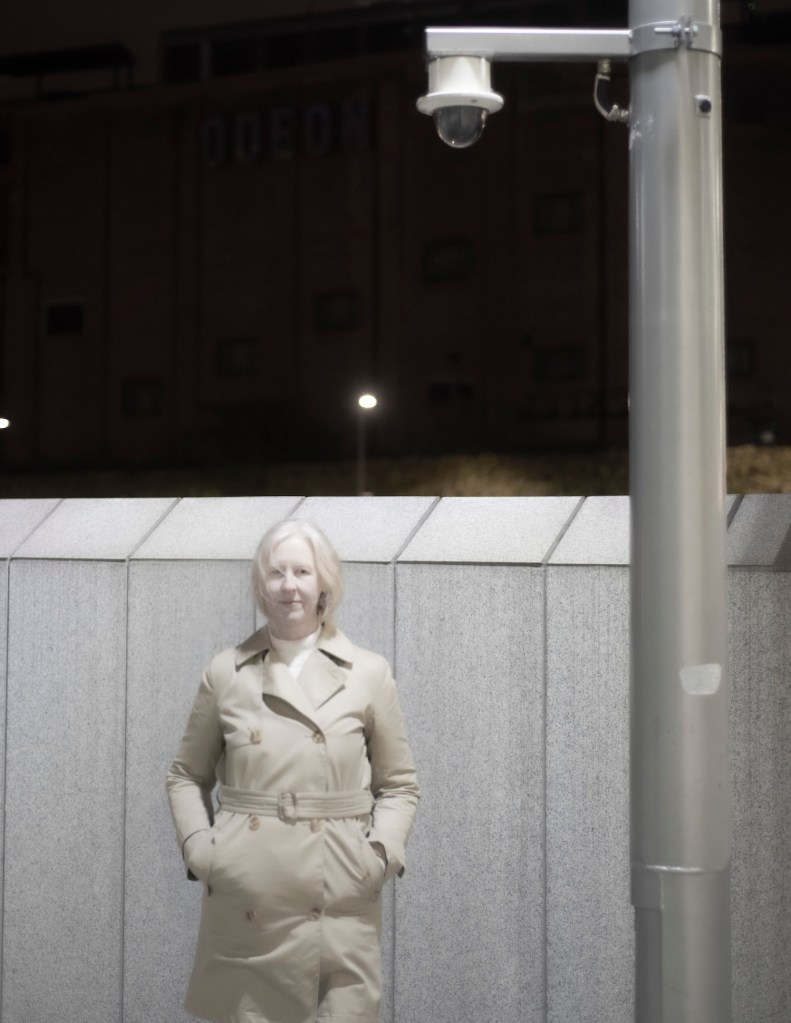
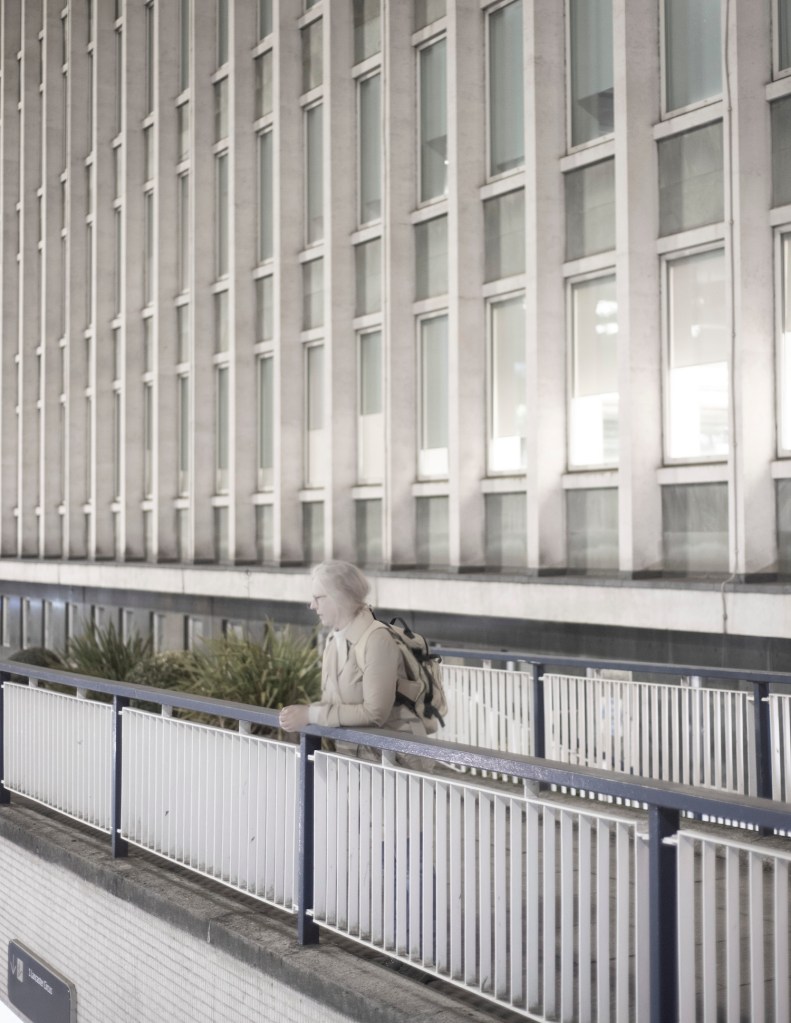
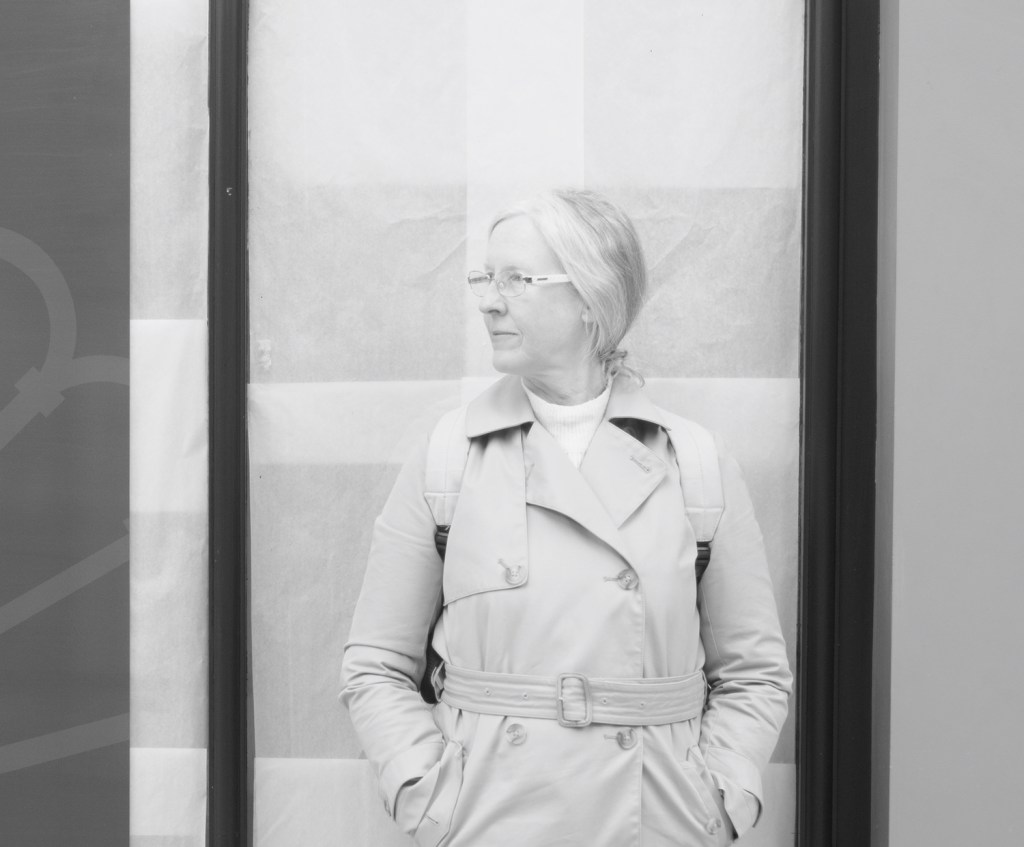
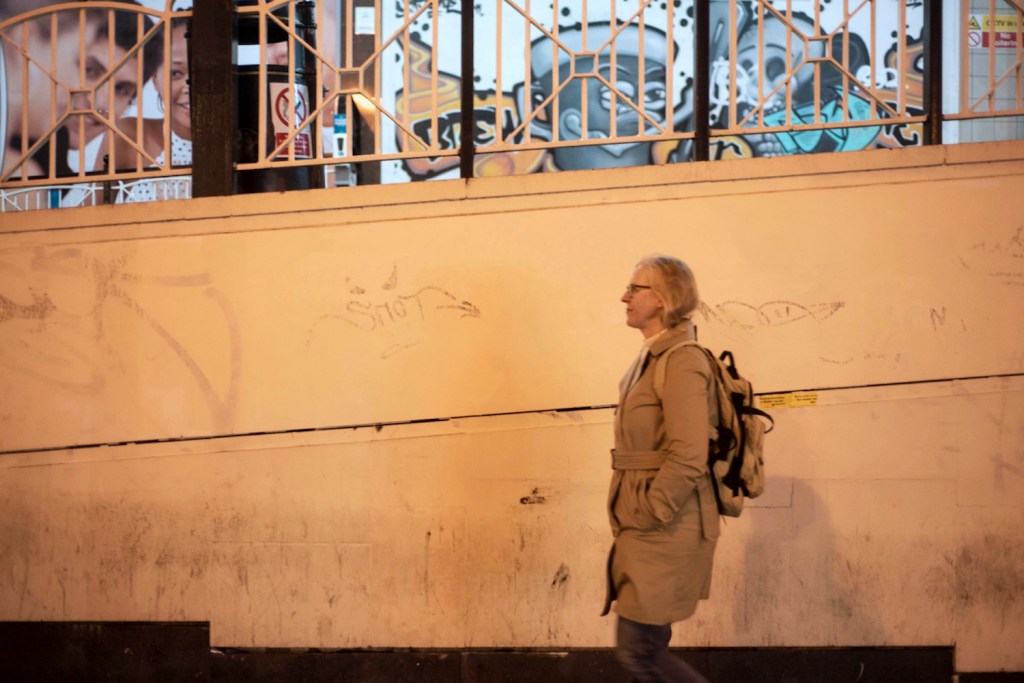
In my bag is make-up to help erase the shadows and features that demark my face. Kruse applies a white foundation. We look like blank ghosts. As women over 50, we are already invisible in society. We enhance that with low-contrast clothing – a beige mac, a light hat, jumper, skirt and gloves.
We take a single photo of our beigeness, blending against the station wall, and turn off our phones so we won’t be digitally tracked by the data emitted from our devices.
We are now silent.
We start to walk.
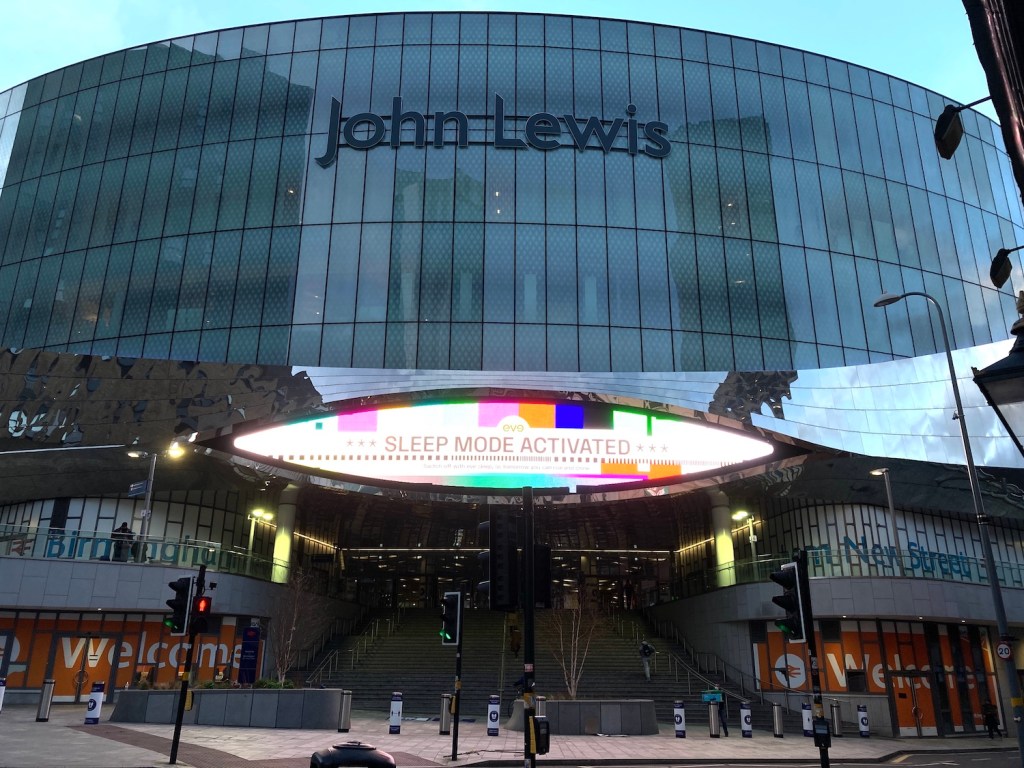
6.30pm Birmingham Media Eye 1, Grand Central / New St Station
The walk begins in twilight under one of three huge ‘Media Eyes’ staring out from Grand Central shopping centre above Birmingham’s main New Street train station. Each eye targets and scans humans for demographic and emotions-based data in order to serve ads. These Orwellian Big Brother eye-shaped screens look down on public space, profiling us for its own commercial profit. The largest screen is 28.80m wide x 5.28m high. Somehow they have passed the city’s planning process. My references for these are not benign or benevolent: they represent dystopia, control and a removal of freedoms.
How is it ok that they face out from the shopping centre into public space? How is it ok to profile the public for profit without public consent?
6.30pm New St Station
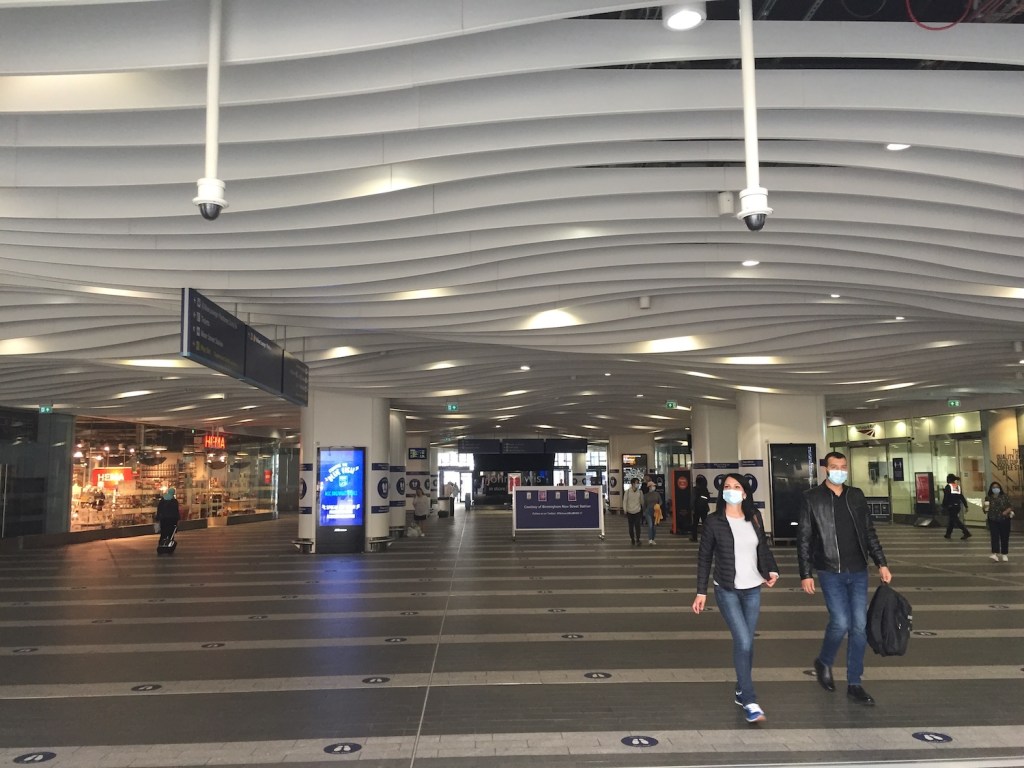
We walk through the station, which drips dome-shaped cameras from the ceiling. They blend in surreptitiously, looking like lights that aren’t on. Last summer I took a photo of them – it seemed a fair exchange as they took images of me. An official challenged me and said she’d have to report me. Apparently I needed a permit to take their photos but they don’t need a permit to take footage of me. I explained what I was doing to two police officers, who were unconcerned. This is where being a white woman over 50 offers privilege.
6.35pm Birmingham Media Eye 2, Stephenson St
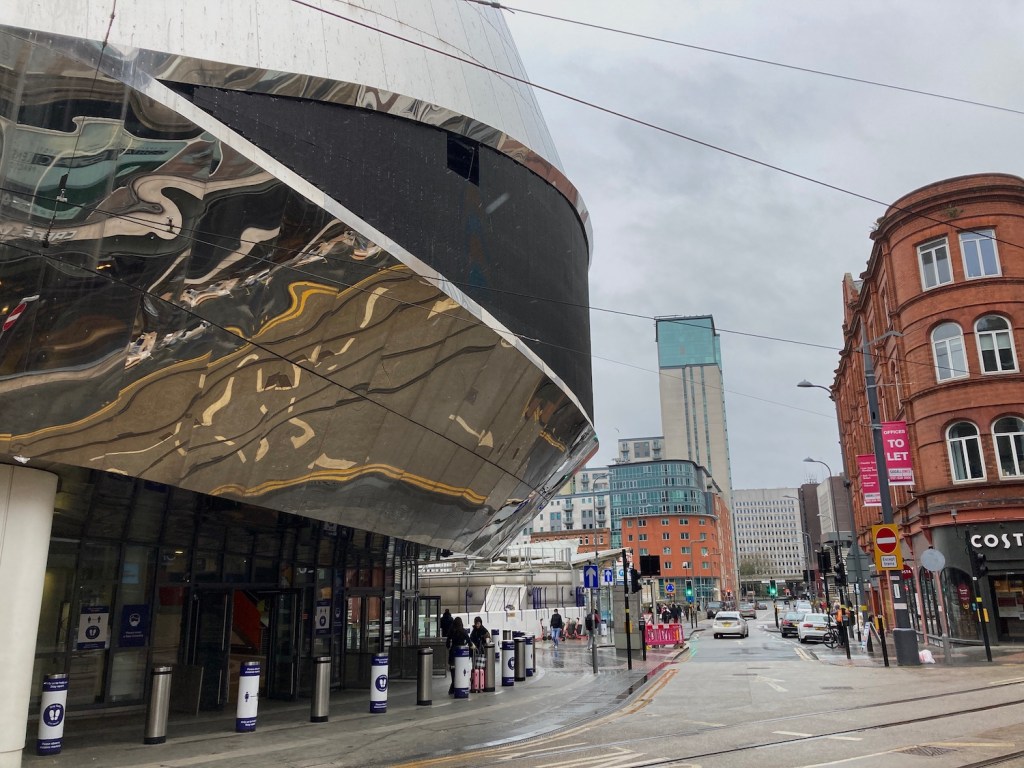
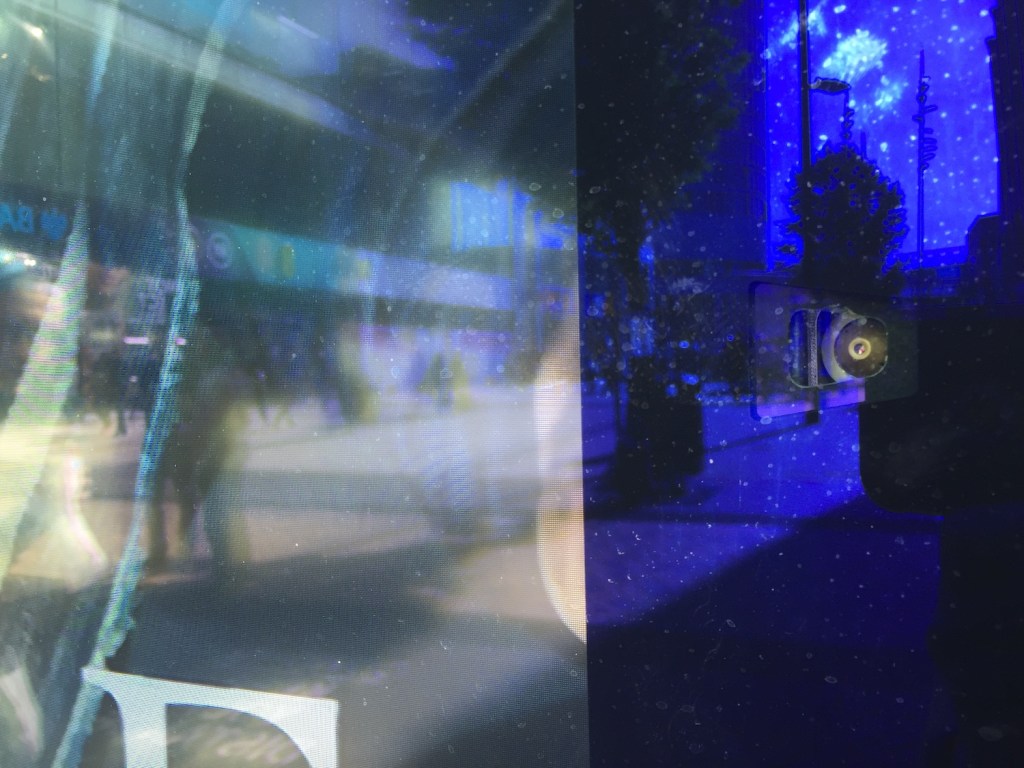
We emerge under the largest ‘eye’, which is off or just not displaying ads. A soft-lit emptiness lets us see behind the black screen. There is a single green light – it is on. We watch the watchers for a short time then we remove our masks and head into the city’s main shopping streets.
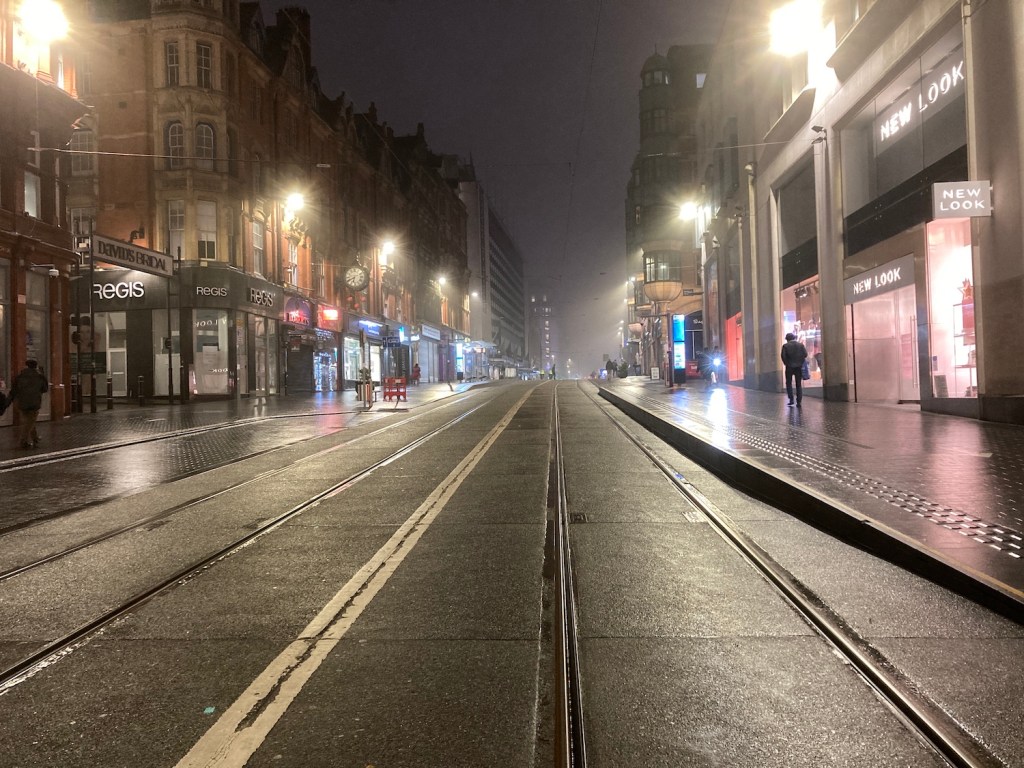
6.40pm New St to Corporation St
It is eerily quiet except for the occasional screaming of the trams and some gulls far overhead. A man further ahead claps a beat to fill the silence. The auditory soundtrack of an empty city is intense. We blend into the walls and pavements but in the darker areas feel exposed and vulnerable in our beigeness.
I lead but we walk side by side. This is the ‘grey man’ theory of invisibility – don’t act unusually, blend in with the crowd. The ability to remain unseen can be a powerful protection, particularly to women walking at night. The case of Sarah Everard has raised the hackles of every woman. I am glad to be walking with Kruse in the empty streets. The last time I came to town in November I was followed briefly – on a Saturday at 5.30pm in Brindleyplace, a highly surveilled and patrolled area. Cameras do not protect and they are not always a deterrent.
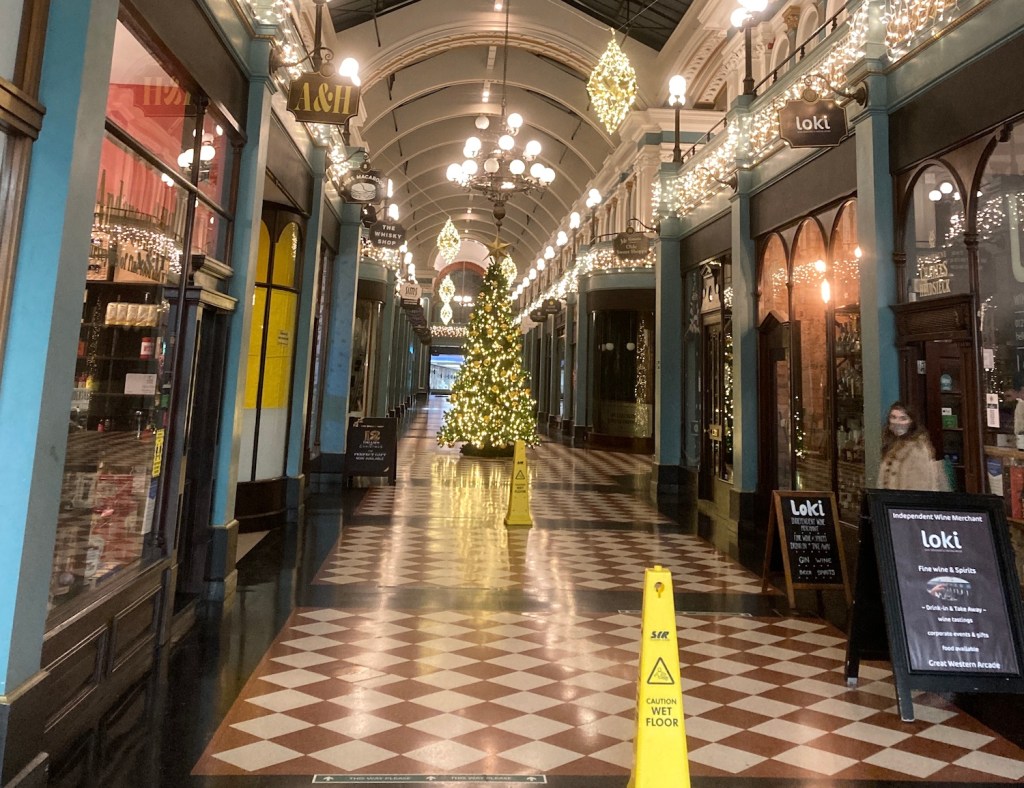
6.45pm Great Western Arcade
At night the cameras are less visible but they are still there in trees, on buildings, integrated into street furniture, behind digital billboard screens, on strategic street corners. It’s harder to spot the cameras as the walk progresses but I am becoming attuned.
In the Great Western Arcade, the tech is there at the start and end of the 545m-long Victorian walkway. It is deserted. I can hear our soft heels tapping on the tiles and our ghostly images reflect in the closed shop windows.
6.50pm Colmore Circus Queensway to Priory Queensway
The Gaumont Cinema used to be here. I saw The Sound of Music there as a child, six times, and remember standing in the long queues. It was full of life and people. Now it is empty office blocks and paved walkways. I spy a Victorian-style lamppost but with domes where there should be lights. Like us, are the cameras trying to remain unseen?
Town used to be a place to come to escape and enjoy the pleasures on offer. Now we are watched and recorded and followed everywhere we go. How does this change how we act and how we feel about coming here? Does it feel safer or oppressive? What has been lost? What has been gained?
In our youth, my generation had the freedom to walk without relentless surveillance and tracking, and this freedom has been lost – a loss normalised and embraced first with CCTV and now with digitalisation and smart city initiatives. There is no choice in this.
Town used to be about people, now it is all about technology. Is it in service of its citizens or other interests?
6.55pm Corporation St
It is almost fully dark now. As night falls, invisibility brings power in remaining unseen but also powerlessness in having to hide from potential predators. Being a woman, the night often feels shut off, but this walk feels good as we reclaim the space. Often I clock eyes with people when I walk because I am hypervigilant and always on alert. But now we weave unseen like ectoplasm through groups of people at bus stops and outside takeaways who don’t seem to register us at all.
7pm Birmingham Control Centre, Lancaster Circus
The turning point of the walk is the Birmingham Control Centre, one of the leading CCTV control centres in Europe with commercial clients across the city and also direct links to West Midlands Police.
Its Google profile images are straight out of a Hollywood movie. Four watchers (men?) monitor several hundred screens and the scene is bathed in electric blue. Another stylised purple has a single man walking (stalking?), casting an ominous shadow with his footsteps. A third in red has someone typing in a code to enable (disable?) an alarm. In reality, 1 Lancaster Circus is brutalist Birmingham 1970s concrete. On every corner, top and bottom, a camera points.
We cross underneath the Aston Expressway and look up, watching them knowing they are watching us. Then we turn and stand with our backs to it, instead overlooking the subways that subjugate pedestrians to walk below the city.
I imagine myself appearing on their screens, visible but indefinable. I feel subversive, a citizen spy in a beige mac. A female Bourne. Maybe a Hollywood response is how data privacy becomes a more sexy topic to engage with rather than one that is always at the bottom of the to-do list.
Akiko Busch, in ‘How to Disappear: Notes on Invisibility in a Time of Transparency’, says: “Invisibility can be corporeal or ethereal. It can be chosen or conferred. it can be power or powerlessness. It can be desired or despised. It can be ambiguous and full of intrigue, or straightforward and even banal.”
This walk also walks this line.
7.05pm Aston University campus
We enter the campus, another highly surveilled area. It is well lit. They are well versed in privacy and offer degrees in cybersecurity. I once came to a cybersecurity conference here. There are countless cameras.
We follow behind three young female black students who are dressed head to toe in black. They are our mirror opposite and seemingly in perfect disguise against the night. But they are more at risk of biases in facial recognition algorithms than any other demographic. Facial recognition systems consistently show the poorest accuracy in subjects who are female, black and 18-30 years old. I want to invite them to walk with me.
As an older women I am becoming increasingly invisible as my value to society declines. I am also discovering age-related biases that manifest digitally and ultimately exclude. Last year, my UK passport application failed the automated check saying ‘we can’t find the outline of your head’. My slowly whitening hair against the white photobooth background had confused the system – not for the first time. At the data privacy exhibition The Glass Room London in 2017, Adam Harvey’s facial recognition exhibit MegaPixels often failed to register my face at all – or, if it did, it produced matches that were only 60% accurate.
A middle-aged white women misidentified in a white space is not a big deal, but…
7.10pm Wattilisk, Birmingham Crown Court, Newton St/Dalton St
This gift of age-related camouflage – greying hair, pale features and low-contrast clothing – offers a natural ability for non-detection against my home city’s well-known prevalence of cameras.
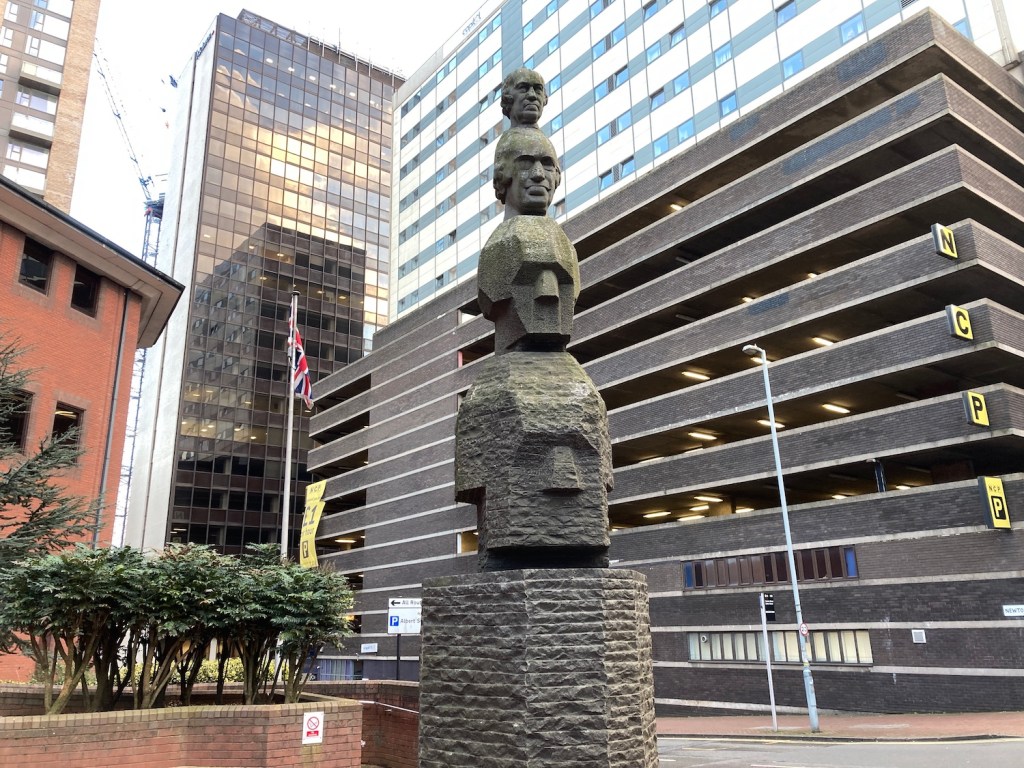
If cameras struggle to find either the outline of a head or facial recognition markers from my blonde facial features then perhaps I am free. I am a human female ‘Wattilisk’ – a city sculpture that abstracts the head of city engineer James Watt until it is becomes unrecognisable as an individual. Or, working in the opposite direction, I can decide to become visible and identifiable once more.
The Wattilisk embodies the simultaneously empowering and disempowering nature of invisibility. As a symbolic totem pole of facial recognition, it also offers an interesting discussion point.
7.15pm Dale End
Dale End is a road valley that dips between the law courts and the main high street shops. It is less well lit and one of Birmingham’s crime spots. It is also the busiest section so far with small groups gathering outside McDonald’s and cycle couriers collecting takeway food. Here is life and a glimpse of the city as it was. For middle-aged women needing to pee, it is also the only place we find that offers a comfort break.
As we enter the high street, the digital advertising infrastructure increases in volume – two tiny cameras on either side of each.
7.20pm Birmingham Media Eye 3, front of New St Station.
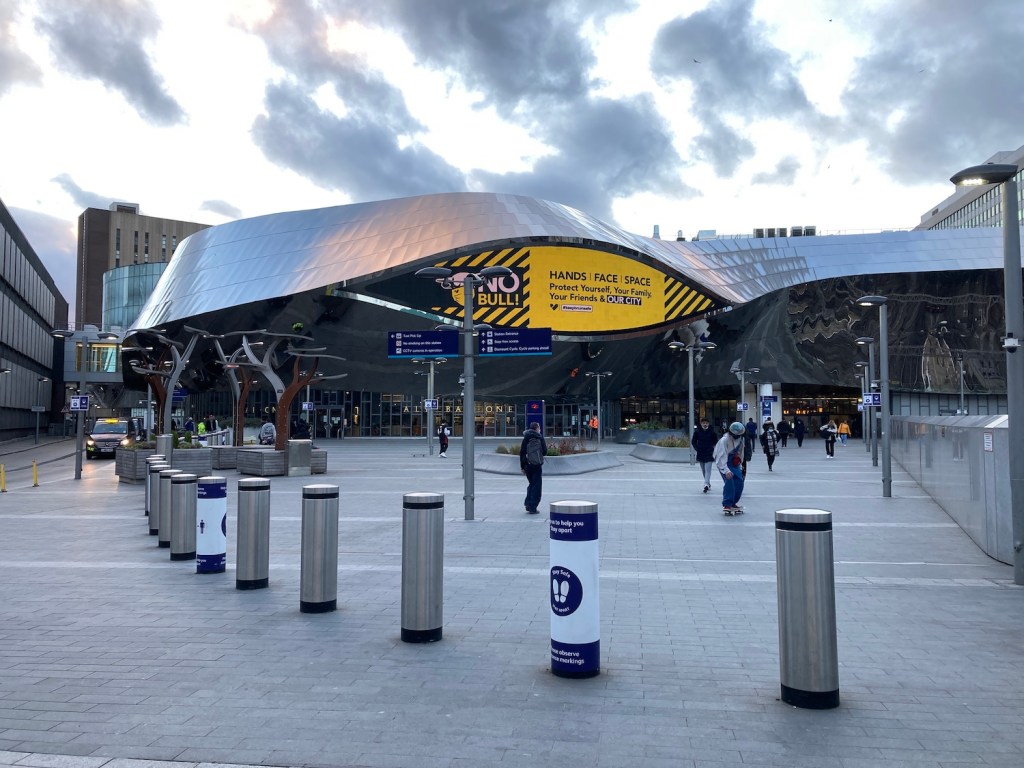
The walk ends at the third and final Media Eye. It posts government Covid-19 messages about ‘Hands, Face, Space’ then advertises a mattress then goes black. The system is broken. Perhaps we can build back better. Insert your own LOL, according to your opinion on this.
The station plaza has street lamps and tree sculptures with a dozen or so dome-cameras hanging from them. I stand underneath and blend.
Kruse is incredulous: “There are so many cameras.”
…but hardly any people for them to watch.
It is night and it is lockdown but I am filled with the strongest vision that this is our future – a city devoid of citizens – because who wants to go somewhere to be profiled, predicted and exploited? All that remains are orange or turquoise-branded delivery cyclists dropping food supplies at speed to the outskirts where there are fewer cameras endlessly watching and to where Birmingham’s citizens have retreated.
I turn my phone back on and on multiple apps my ID pops up.
I am back in the digital matrix.
I am logged.
Fiona Cullinan is a writer, editor and a co-founder of Walkspace, with an art practice exploring themes of infrastructure, privacy, diaries, memory, feminism and ageing. Further writing can be found at: fionacullinan.com.
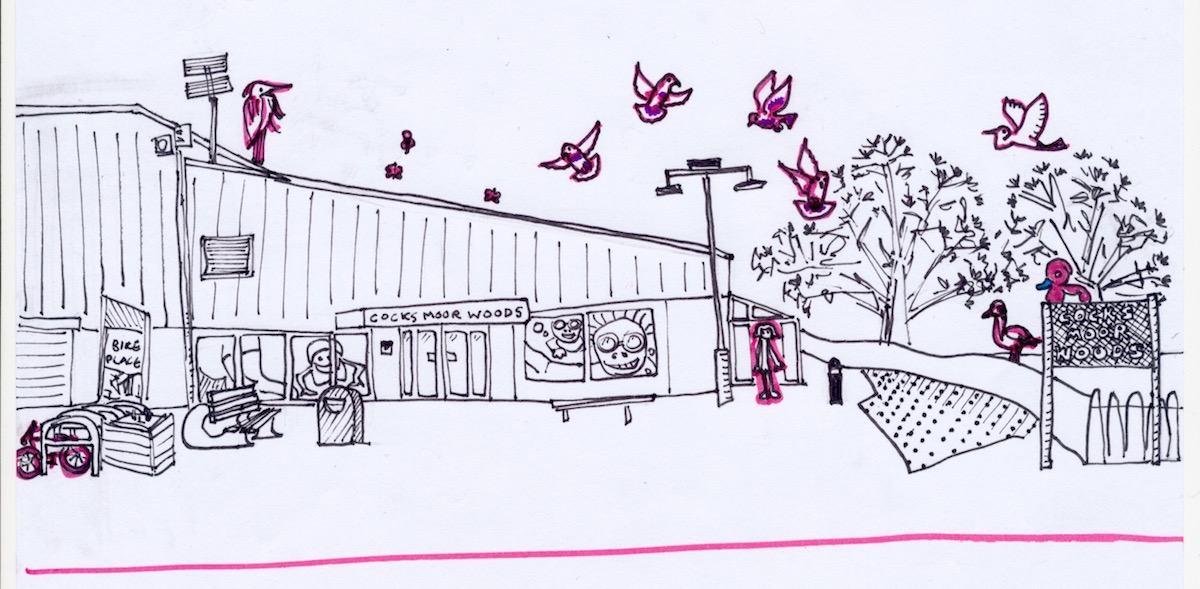
I arrive to see Andy walking from the side of Cocks Moors Woods Leisure centre. I know he is nostalgic for this place after visiting as a child.
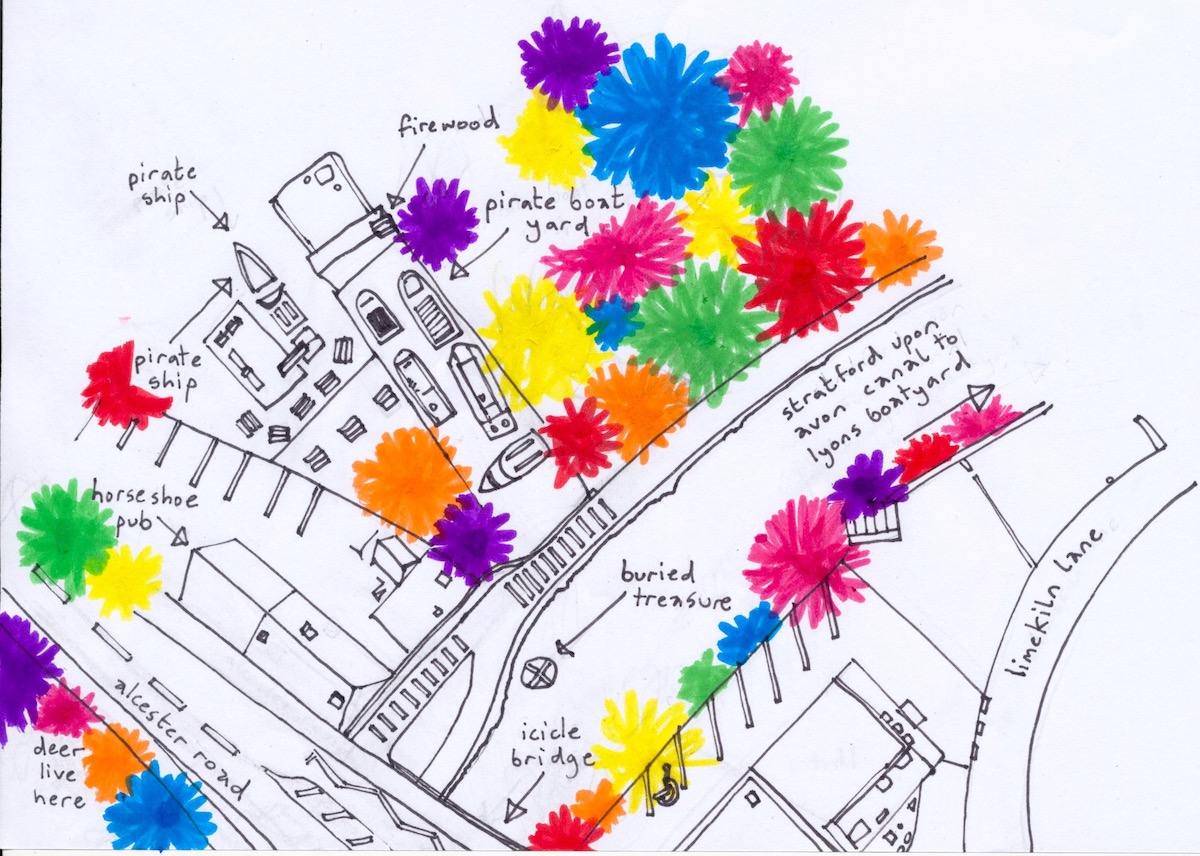
Along the Alcester Road, over the bridge, past the Horseshoe pub and left onto the canal.
Andy comes this way on his bike but hasn’t looked at the boat yard before. Just as I mention that people live there, an inhabitant of the boat steps out and looks up. Perhaps the landlord of the Horseshoe pub that is being renovated? That or a pirate. Kids play on the piratical climbing frame in the pub’s play area and know more than their older counterparts of what lies beyond.
I interrogate Andy on where he has been cycling and it transpires that the other end of our walk is near where he grew up. Armed with this useful information I slide him down a muddy slope onto Cocks Moors Woods golf course. A stressful prospect for me as I am a nervous rule breaker.
I see my second butterfly of the day and am overjoyed. Brown with colourful spots – I think it is a painted lady showing off her freshly healed tatts. But later I learn it is probably too early for that sort of thing. Yesterday, I saw my first bumblebee of the year.
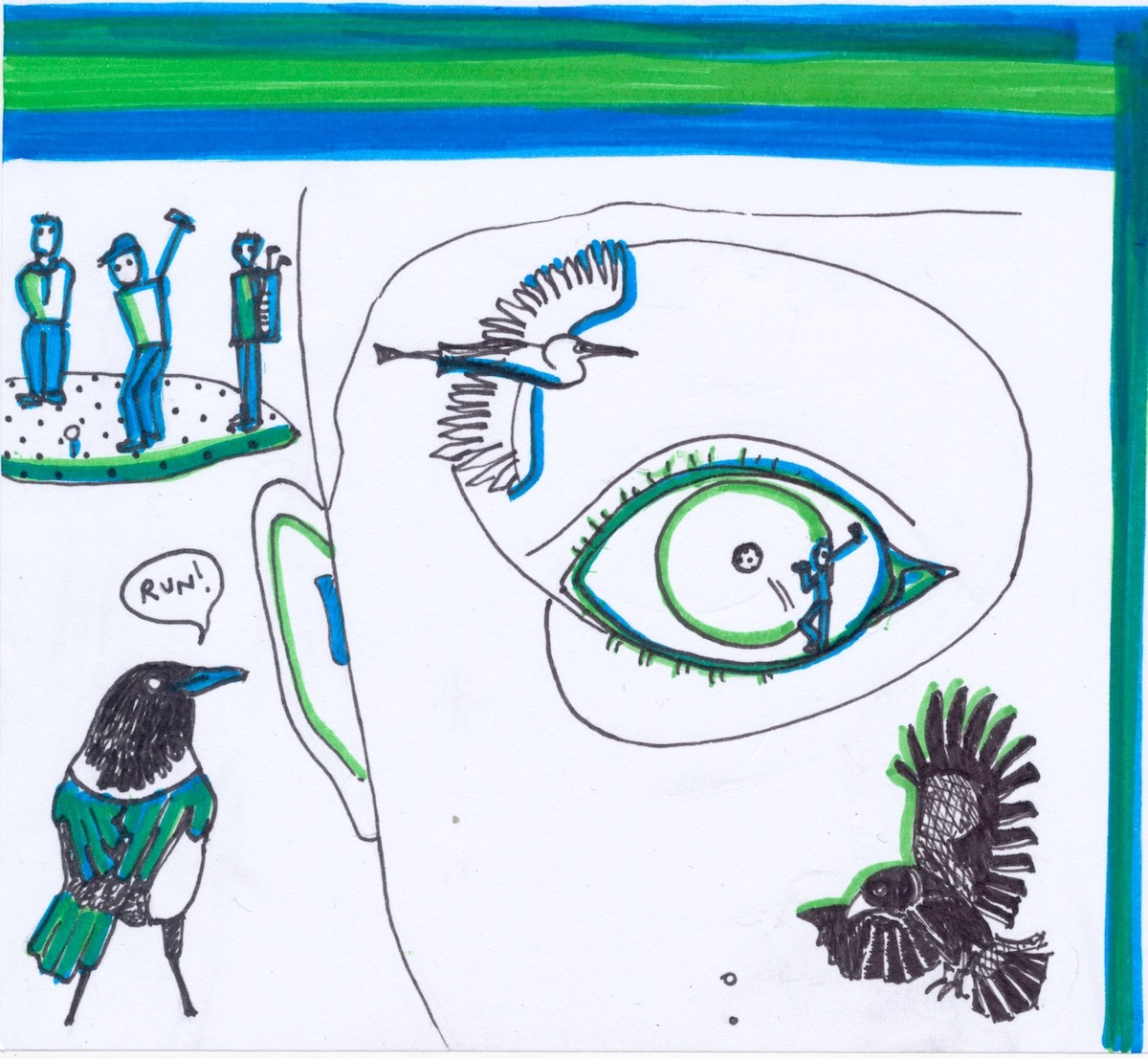
I hear a thwack! and eight… or maybe one and a half minutes later, a golf ball plonks down in front of us. I kick it absentmindedly before turning to see its owner. They are walking towards us – the golfers are attacking! How did that ball spend so long in the air? We barely make it out alive but there’s a bunch of club wielders on our opposite side. Flanked! I watch in dread as one of them hits the ball right in our direction…but then Andy points out a little egret.
The myth of the golf ball who transforms into an egret is a great one and sings praise to the resilience of the little bird. It mingles with some crows like ancient warrior monks and out of the tree pops a magpie! It finally dawns on me that a magpie is the lovechild of an egret and a crow. How naïve I’ve been all these years.
We come to what seems deceptively like a country road. As we slip through a hole in the metal fence (courtesy of a renegade angle grinder) I am wary of a dog walking family, but my hypervigilance is shattered as I say ‘Hello,’ and realise they are waiting to enter the golf course in a calm and seemingly well-rehearsed manner.
We cross the narrow brick bridge over the stream into Chinn Brook Nature Reserve. Two joggers go past, one struggling less than the other.
The sun is bright, bright, bright and the trees are budding.
Andy tells how his film about Birmingham’s lost concrete library is developing to be shown at this year’s Flatpack Festival and I’m excited to see it. This is where our existing nostalgia converges into a walking theme of nostalgia for things we’ve never known.
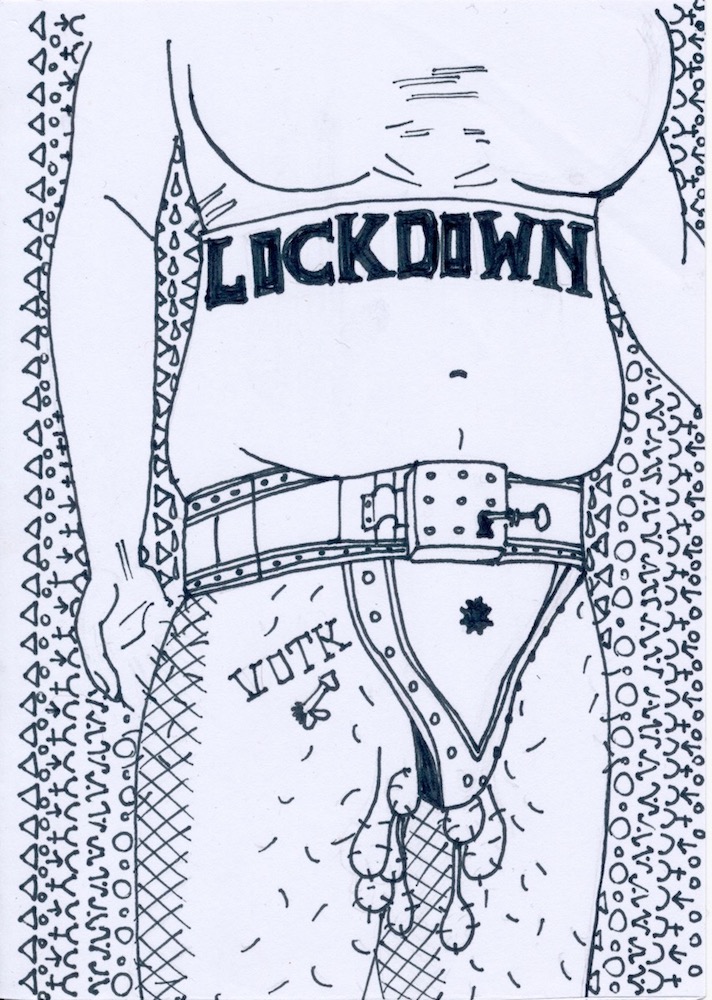
Andy asks if this brook has any link to Carl Chinn. I don’t think so, but I hate to assume. I mention the rap I’m writing which features Carl Chinn serving as a plot link between someone’s cuddly dick and Swingamajig festival via the Peaky Blinders. It’s for a drag act at ‘Valley of the Kings’, the informal night I run. Andy asks about it – little does he know I will later send him a poster featuring eight dangly testicles hanging out of a chastity belt – but what is life if not made up of these wondrous surprises.
We walk some more, through a green alleyway where a lady is wearing a full-on protective mask. It feels like we are in the Russian film ‘Stalker’ and she knows that we should be throwing a sheet tied to a stone before proceeding into unknown territory.
We duck into an overgrown pathway where two dogs are admiring the first flush of ramsons. I have previously seen something exciting and cooing in these parts and am hoping it wasn’t a mirage. We squelch towards the houses that back onto this park and discover a batch of brown and white pigeons in a cage! They must belong to neighbours of the birds I am taking Andy to see. It would appear that pigeon fanciers are abundant in these parts.
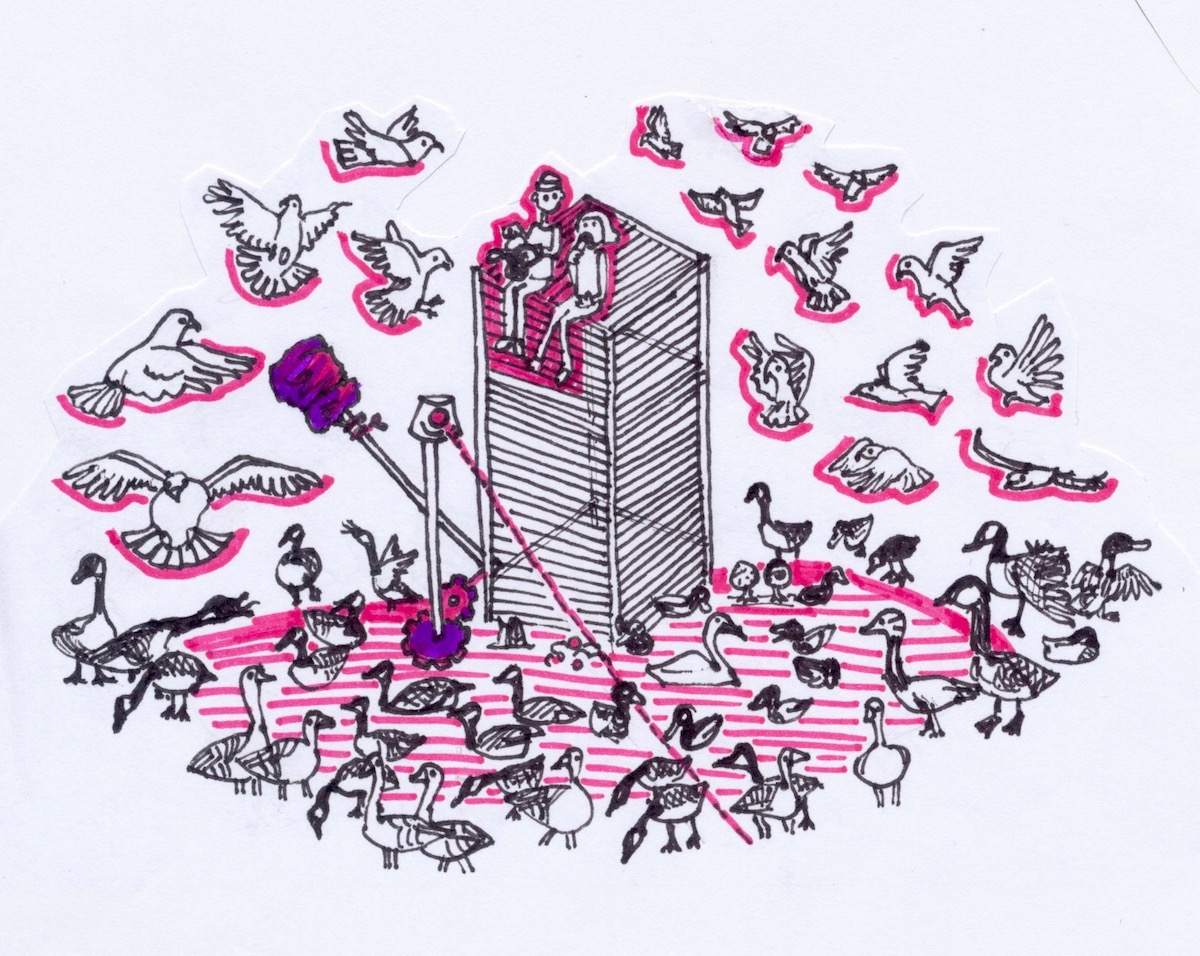
Squelching forwards, a cage towers above us and we hear the purring of white pigeons roosting behind barricades and barbed wire. As I point them out, a big stick with what looks like a bin bag, thrusts up and hits the lumbering cage. The birds erupt high into the bright, blue sky and we are in a cloud of neon purple and pink as the surprising flappers circle above us. Flashes of intense colour nestled under their wings. We realise the stick must be part of a giant automaton that whacks the coop whenever someone steps over a trigger beam or panel, we should probably start throwing a rock with a hanky ahead of us.
It’s not the first time today that we will look up to nature at its most bizarre.
We watch the pigeons for a long time. Eight… or maybe one and a half minutes later, we emerge into a large field, Andy points to a stream and says – that must be Chinn Brook. I am confused then say “Yes”.
This happens again at the end of the walk which, funnily enough, might be the moment Andy realises that I am perpetually perplexed by shifting memories. Andy marvels at what a funny part of the body it is for a brook to be named after. I miss the humour of this as I try to remember if the nearby Haunch Brook, that looks like a bent leg, is actually named after a leg or not.
Anyway, I take him over to Trittiford Mill Pool to see the lonely bar-headed goose and the tundra geese. I tell him my fantastic story about how that bar headed goose must be an escaped convict and is the world’s highest- flying animal reaching 7000m. I refer him to the video on the BBC website of someone slow clapping a goose in an oxygen mask as it flies into a wind tunnel. Quite miraculous.
We stand and look at the geese and the gothically-beautiful, tufted ducks with their blue bills and are profoundly and simultaneously moved to start snacking. Andy has a nature bar which I suppose helps him adapt to his environment whereas I have some rich tea biscuits in a plastic poo bag.
Now we enter the most exciting part of the walk – if this were a graph we would be soaring up to the top edge of the paper.
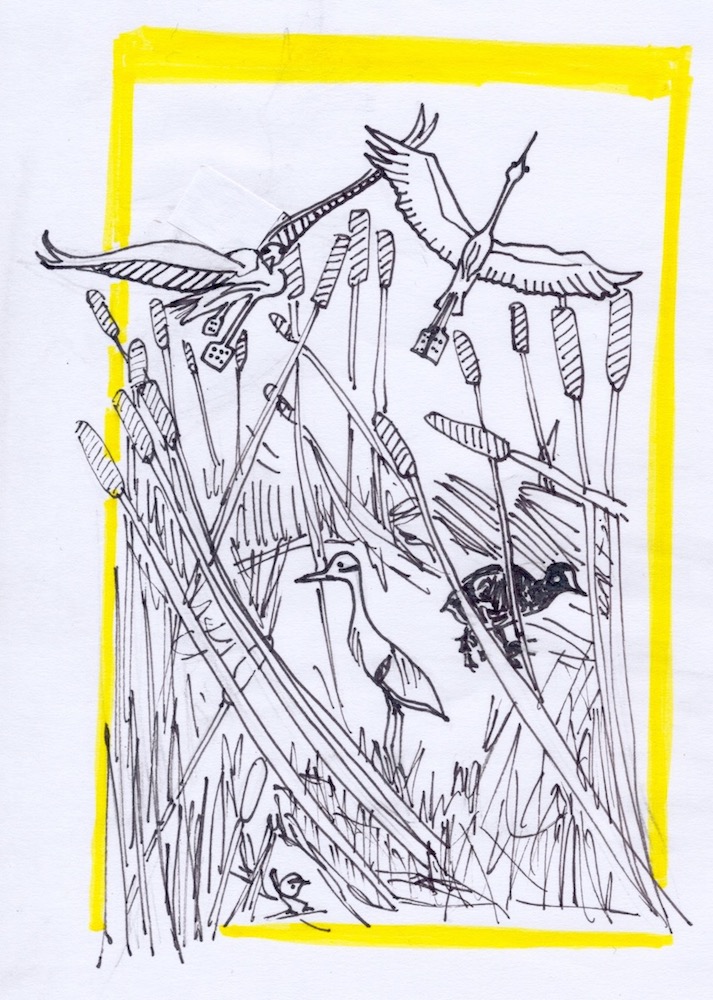
It is the marshy reed bed formed from what I think is the River Cole and I am excitedly looking for the heron and little egret I’ve seen hanging out together recently.
Only slight disappointment to see there is nothing…BUT WAIT – two hulking masses almost too slow to be flying, lurch overhead with dangly legs like spatulas. They are circling the reeds! Then behind us – another heron skulking on a tree branch!?! What is happening? Are the parents of a teenage heron coming to check up on it? Is it a grand day in the Birmingham heron calendar? How many herons are in Birmingham? Three in one place seems worryingly excessive if you ask me! If only I’d taken the nature bar when Andy offered – maybe I would take this all a bit more in my stride.
So, we carry on after the absolute mayhem that is lingering herons.
Now we go to a bit I have only visited once before. The underworld of Solihull Lodge, an unkempt mess of fallen tree trunks and river twisting together. It really is beautiful. Then we are in Solihull Lodge and we talk about the nightmarish memories we have of Shirley and Solihull.
I overshoot the moment to turn right for the canal, but Andy exclaims “I KNOW HERE!” He has recognised a bend in the road not at all from eleven metres but with intense clarity from ten metres away! It is a jubilation! We turn around and Andy leads us to the canal.
It is a great walk so far. I am in vaguely unknown territory and congratulating myself for coming this far away from my house and being such a reliable tour guide.
On the canal, Andy talks about Desmond Morris for some reason, and pulls out a notebook with the script from when he reconstructed Desmond’s destroyed surrealist film by reading out the scene overviews. It is fantastic to hear him recite it with dramatic, yet dulcet tones and I expect to trip over an elephant’s skull at any minute.
We dip into some mud on the right of the canal and emerge into a picturesque cemetery. We are nostalgic over the Victorians who would picnic in cemeteries and have a healthier attitude to death. We remember the Victorians with their healthy attitudes to death, taking photos with the corpses of their loved ones.
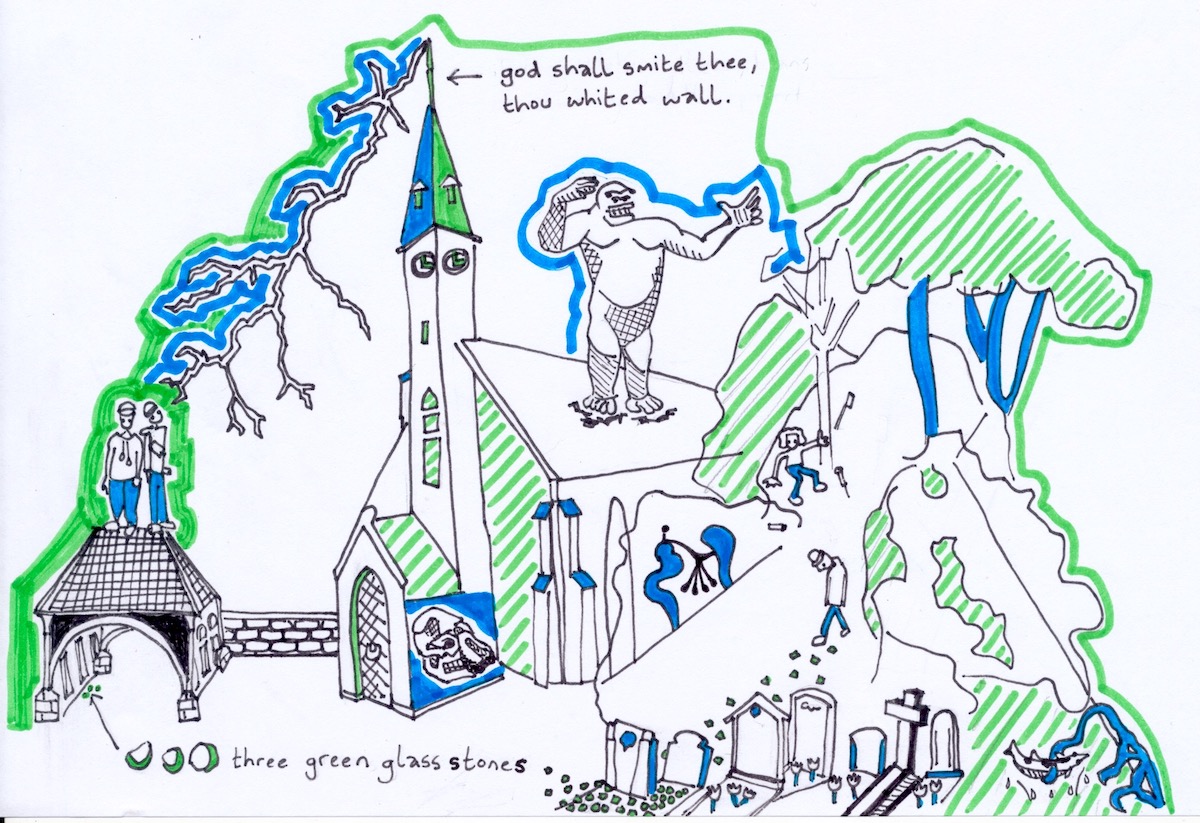
We loop the church seeing the typical titchy-witchy back door and read the brilliant carved tattoo-like messages in the arch entrance where the benches have been removed. I suppose to prevent anyone from sitting there for free and drinking (maybe this church is sponsored by the local pub). We make a guess that we are in Yardley Wood Cemetery (it turns out we were loitering around Christchurch, the parish church for Yardley Wood).
On leaving, we see a group of teenagers ignoring a sign that has asked anyone who isn’t a mourner or is in a group of friends to stay out of the cemetery. I smile and say, “Imagine growing up hanging out in a cemetery”. Andy supposes they will have a healthy relationship with death.
On that mildly threatening note we climb down a firework strewn slope back to the canal.
Andy tells me about a film called ‘King Rocker’ and I start listing the 1990’s rock pop scene that I know of second- hand. Referencing Club Katusi and the many gig posters from promoter Arthur Tapp and the Catapult Club gigs at the Jug of Ale pub. Andy hasn’t heard any of these bands, so I make a mumbled promise to email them over. A small-town Andy and a big city, gender queer, depressive letting their musical memories converge on the edge of a grimy canal which harbours quite gnarly tree roots, big puffs of moss and some really jumpy fish.
I become violently bored (or maybe overwhelmed with memories and nostalgia for things I haven’t known,) so Andy advises me to stare at the path until I get home.
All I see are pebbles for the rest of the walk. Sometimes we look at the tumbling gardens of the canal side houses as they struggle not to collapse into the canal.
He asks me what I am doing and is absurdified to discover that I followed his advice (I think he is a surrealist trickster).
When we get back, I am knackered because there were a lot of pebbles, but Andy is full of excitement to try and glimpse inside his childhood leisure centre. As we walk around the building, I am overjoyed at the second or third time I have heard the story of the boy who put sugar instead of salt on his chips … wait for the punchline…and then cried as he ate them! Andy spontaneously giggles as he tells it. Childhood mischief bubbling out of his eyes like that poor boy’s hilarious tears. It happened here!
Blacked out windows illuminate the mystery of the dog walkers on Cocks Moors Woods. The golfers I’ve been so afraid of are the local community just moseying onto the field. I didn’t need to be worried but am glad I avoided being clonked on the head at the beginning of our perilous escapade.
I hear a yelp of delight. Where I had seen a wall made of plain old bricks, Andy has spotted a HOLE IN ONE! Reaching up to the tiniest of chinks in the brickwork I see the looping of the water slide. It looks much better than from the inside. The pressure out here is a lot more open, not so moist and the sound is less like a thousand bullets ricocheting off tiny sheets of glass.
Completing the journey by hopping over a fence to look into more abandoned areas, Andy collects his bike. I embark on the remaining fifteen minutes of my walk – absolutely exhausted and trying not to limp. Once safely home, I take a page from Andy’s book, writing our journey down. Without it I wouldn’t have been able to sort what happened out of the crumpled-up mess of memories and anxiety swarming through my brain.
But luckily, I did! If our walk was a graph it would have ended with us flying into the sky with origami herons and pigeons made of neon pink post it notes.











 Walkspace