Categories
Uncategorized

Escaping suburbia – a walk from your sofa

This is an actual walk you can do if you print this post and follow the directions. It’s also a walk you can do from the comfort of your sofa, or if you live a long way away from Dorridge and are missing it and feeling nostalgic and just want to remember your favourite place (this might just be me).

Take the train to Dorridge. Leave the busy, tidy platform through the ticket office. Go ahead, past the car park, turn right. Past houses most folk would never be able to afford, not even renting, and go to the right down an alley between manicured gardens, through a cul-de-sac of starter homes and turn right.

Up a small slope roofed with the branches of scrawny sycamores and over the railway bridge, past six brick and slate houses facing each other in a gossipy circle, then left towards the trees.

Take a deep breath, feel suburbia drop off your shoulders, walk into the arboreal tunnel. A straight tarmac road one car wide, leads to an unknown destination. We do not go along it very far, that journey is not for us today.

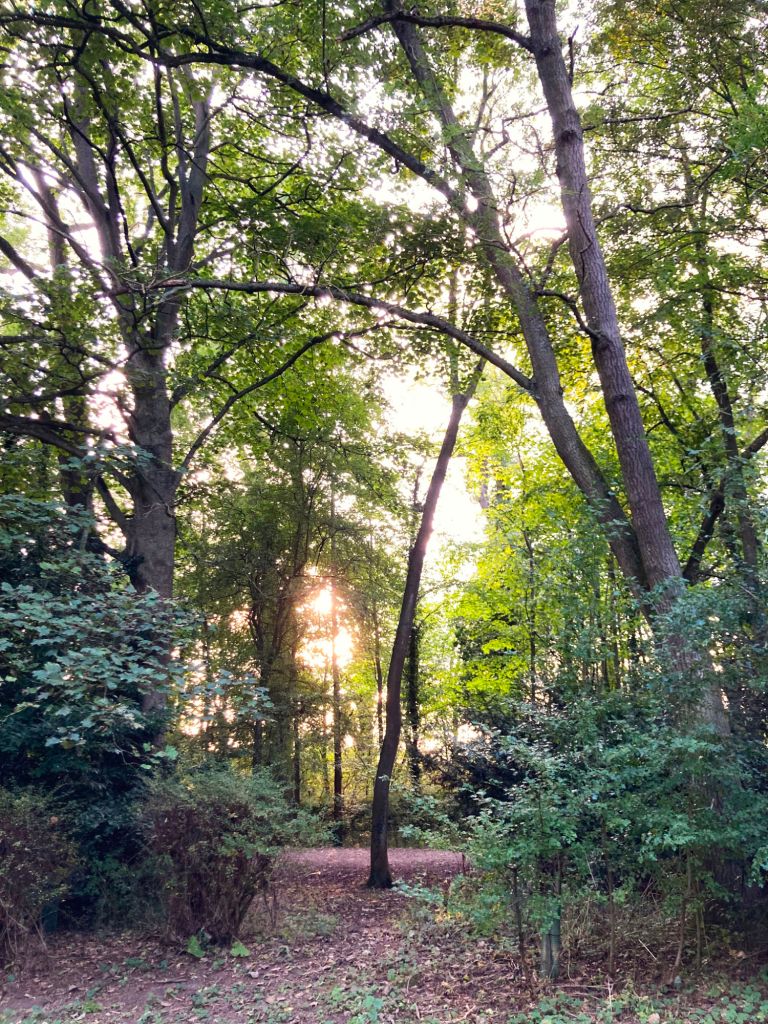
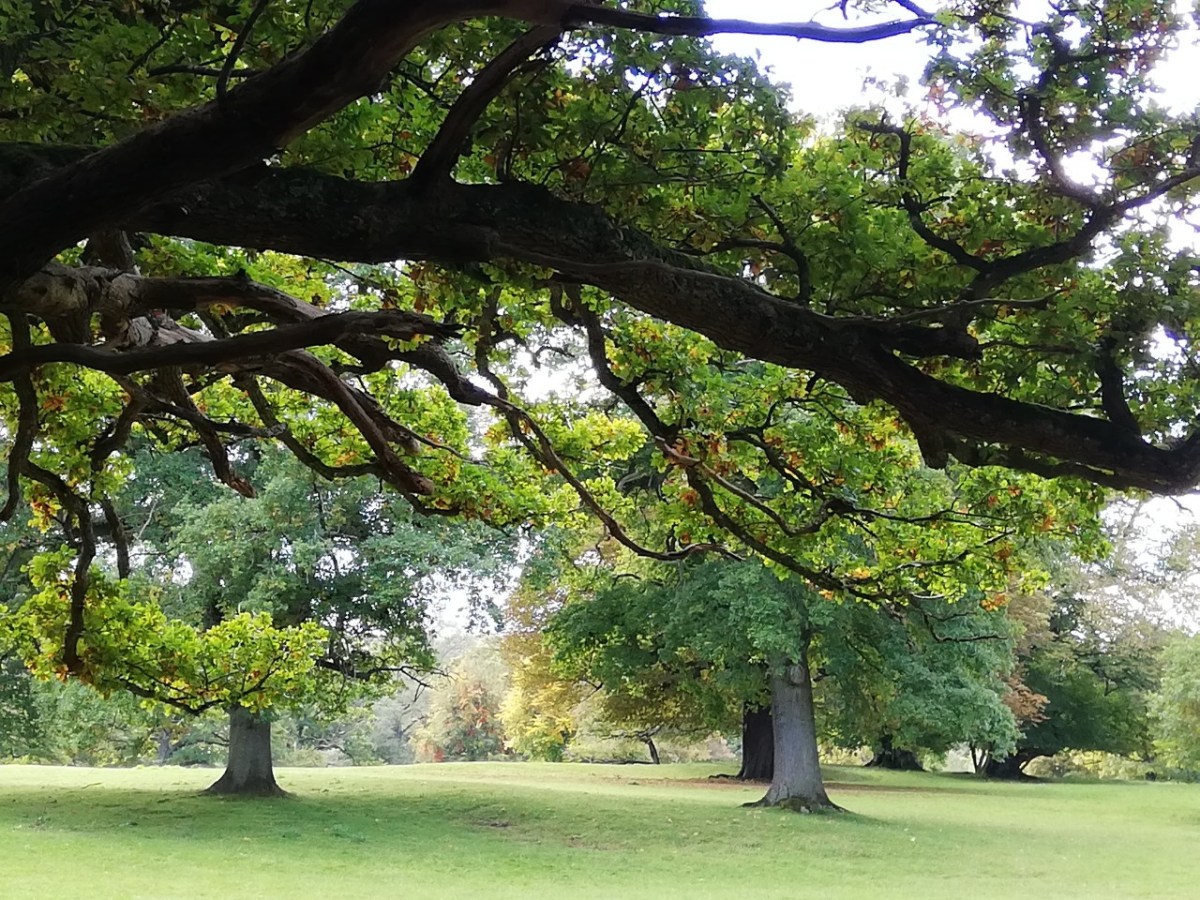
The road is lined with oak and beech and birch and roofed with fluttering leaves. It is always shadowed, even in winter. As soon as you are under the trees step to your right, away from the road, gingerly over the muddy verge and left into the wood proper.

Woodpeckers knock. Jays swoop silently overhead. Blackbirds, robins, chiffchaff and wrens trill and chatter and warble. A muddy path winds beneath orange barked pines, around dark hollies, between scrawny birches riddled with plates of fungi. In autumn toadstools burst from stumps and mossy logs; push through leafmould burnished by beech leaves.

Now you leave the wood, come out into the park, heading south west across shaved grass encountering happy dogs and cheerful owners. Go past the dead oak, pale and sculptural, down to the shallow stream burbling bright and clean under the bridge where there might be trolls, then step along a rising boardwalk to the narrow lane.
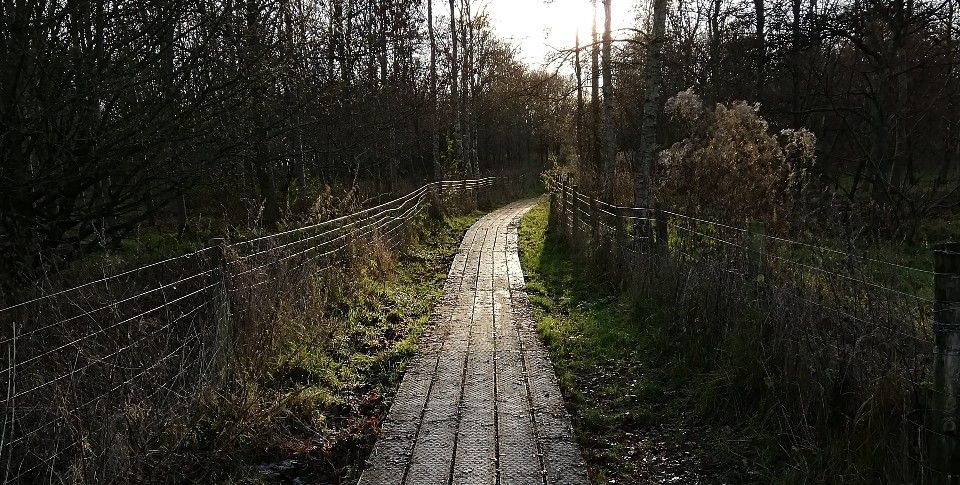
Image © …kruse

Cross the lane into a coppice of teenage oaks, deeply muddy at the wrong time of year. The path is pockmarked here with boot prints and paw prints and sometimes the half moons of a small pony’s shod hooves. Come out into fields, take a left skirting the crops, keeping to the hedge, and take another left after passing through an ungated gateway, past trees that began life when this was still Shakespeare’s Arden Forest.

A curved iron kissing gate is next, then we walk down a lane between mansions. Ten foot high yew and laurel hedges on each side of us hide a barking dog.

“Go away” say the high hedges, the fancy iron gates, the barking dog.

Imagine for a moment the stress of holding on to all that wealth, the work it requires. Maybe not hard work, like that which farmers, cleaners, nurses do, but effort; hiring staff to trim the hedges and walk the dog, making sure the alarms are on when you’re out, paying insurance and keeping up appearances. Take a deep breath and let any envy transform into the joy and freedom of the welcoming path and turn right onto a little country road.

A few hundred yards on, turn right at the triangle of grass, a rural roundabout serving only two tractors and seven cars the whole day, and go left over the wobbly wooden stile. It’s hard on the hips because it was made for tall men.

Walk across three fields, one, two, three. Sometimes there are sheep, sometimes flowers, once a startled detectorist. Fields one and two go down to a streamlet, over another troll bridge, one person wide and only five feet long. A small troll then.

Field three rises to a road. On your right a church, a manor, a moat, oddly melancholy, dark with ghosts. We turn left at another kissing gate, rusty and squeaking. We take a right along a road towards the big house, busy with day trippers. Beautiful gardens and a noisy cafe, and a good place for tea and scones.

You walk the straight road that cuts through the estate. On your left a field and a long straight track, centuries old, bordered with oaks and grazing sheep. To our right the big house, a lake, roses and flower beds, ancient yews, ravens and sparrowhawks, specimen trees of ravishing beauty.

Go on past this magical place, dense with stories of Puritans and ancient feuds, of a sad man long dead putting all his unrequited love into objet d’art and not the lad he really wanted. The house is a reliquary of loves and tragedies and agonies and joys untold. An archive of the edge folk; women, servants, the poor and queer. Only the stones know all, and they are not speaking.

Walk on past the house and on down a road straight as a Roman, to a dangerous corner as it joins a busier thoroughfare. A short, but tense walk beside this busy road, sharply noisy, picking your way along the rutted grass verge.

At another corner, dangerous with rushing SUV’s turn left onto a stony track. Only pedestrians and the owners of the farm at the end are allowed here. It’s quiet again. It looks like a place where there should be owls.

At the end of the track turn right to the canal, past the red brick lock-keepers cottage, busy with flowers in pots, and scattered buckets and timber, all the stuff of countryside living.

Follow the canal east. Seven locks. Ducks in the reeds. After the seventh, cross over the water and continue east. At the bridge take the steps up onto a narrow road and turn left over the ancient, humpback bridge.

Walk on a quiet country lane. More raven calls and jackdaw, robin, wren and goldfinch and the gunfire crack of startled pigeons bursting from the hedges. An Elizabethan house half hidden behind brick and wrought iron. The road rises a little and we lean in a little.

Half hidden among trees and the hedgerow, on the other side of the lane, another kissing gate, wooden, green with lichen. Three very beautiful very old oaks stand sentinel alongside the field boundary. Take the little path through this field and the next, both rich with flowers and wild grasses. Butterflies and horseflies, beauty and the beasts, dance here in summer. In winter the bottom of the field is sodden, in spring, bluebells paint the banks with sky.

Right at the stile, broken and rickety and suddenly, steps! Metal steps, a second railway bridge, postered with kind entreaties from a mental health charity. Step down onto the quiet platform. Take a bench and sit in peace among the songbirds, waiting for the train to fetch you back to the city.
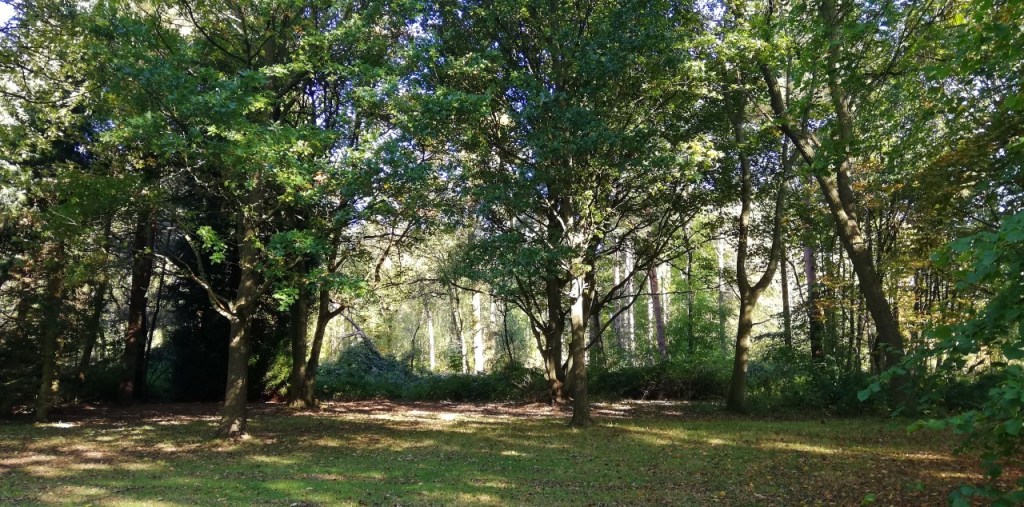
Image © …kruse

Find out more about …kruse and their work at https://www.krusework.info/
Categories
Posts Walk Reports

Mitchell’s Fold manoeuvre

On 3 May 2025, a bright but windy spring day, several Walkspace members undertook a walk around Stapeley Hill and Corndon Hill in Southwest Shropshire, close to the Welsh border near the village of Priest Weston.

The walk centred on Mitchell’s Fold stone circle and the myths that gather around this ancient monument. Conceived as a members-only event, it was also structured so that it could be repeated as a guided walk open to the public.

I designed the walk as a manoeuvre: a form of guided walk devised in the 1990s by the artist Tim Brennan, with whom I have collaborated on several projects. Brennan describes a manoeuvre as a walk built out of quotations which are recited to the group at stations along a predesigned route” (Brennan, 2017).

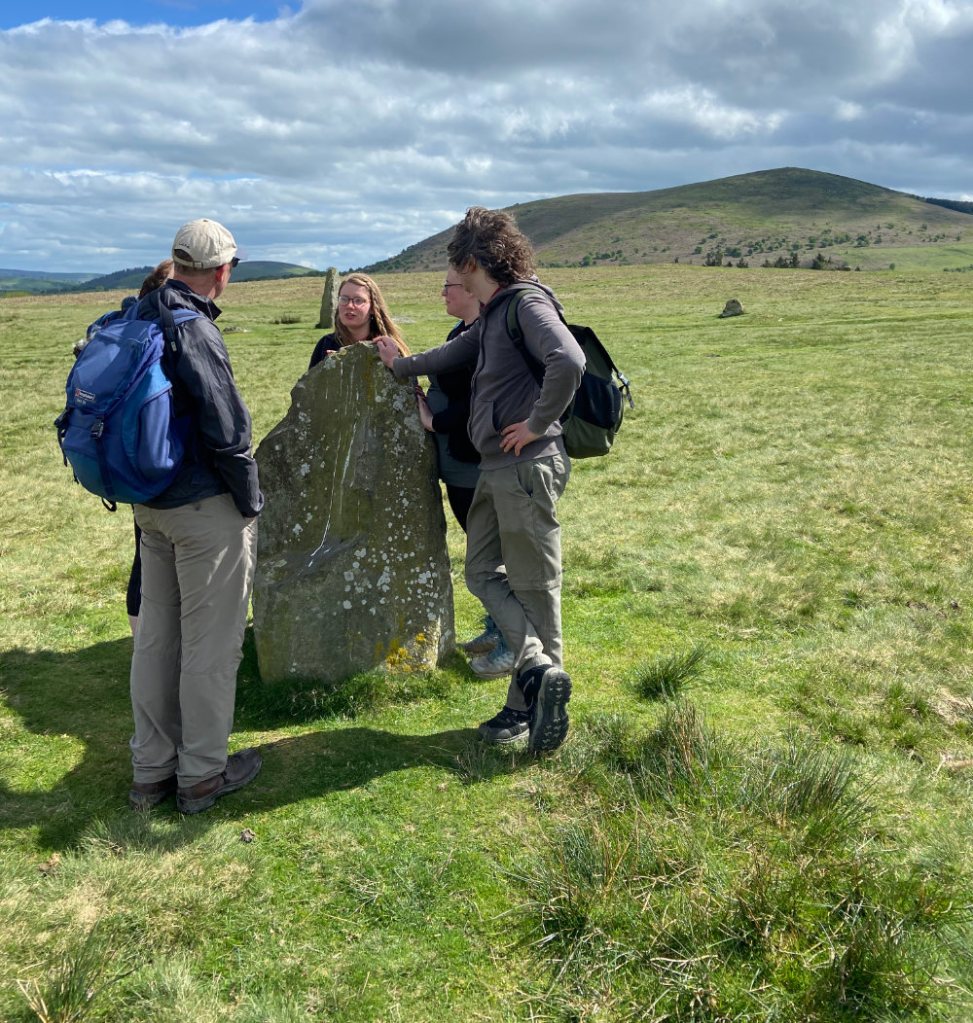
A group of walkers gather around a shoulder-height standing stone against a moorland backdrop
Photo © Paul Wakelam

Alongside documented folklore and historical sources, I introduced a series of invented quotations – what I think of as neo-myths. These were attributed to fictional authors through what I call pseudo-references. The intention was not to deceive, but to mirror the ways authority, myth, and landscape are often braided together in accounts of ancient sites, where scholarship, oral tradition, and imaginative speculation coexist and overlap.

The Mitchell’s Fold manoeuvre followed a predefined route, with readings delivered at specific locations. These combined well-known folklore, historical commentary, and the neo-myths written for the walk.

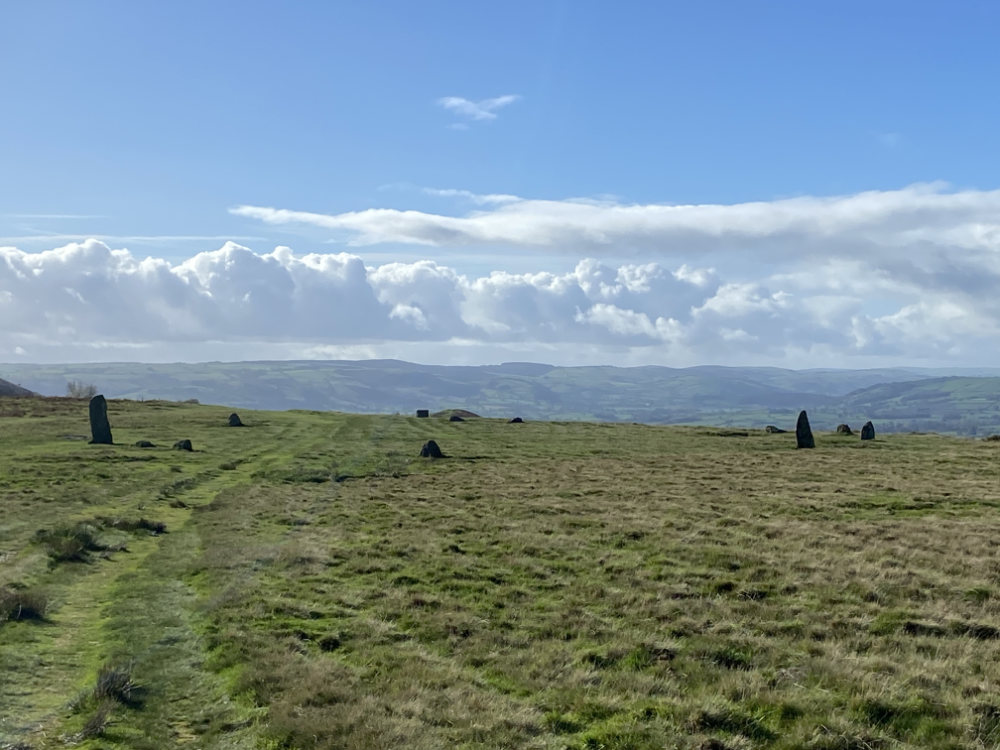
From the car park, we headed north, directly into a stiff north-westerly wind, much as others might have done before us. The route across Stapeley Common runs alongside a holloway: a sunken lane formed by centuries of traffic, scoured out by drovers moving livestock between pastures or on towards market.

Mitchell’s Fold

The first station reached was the Bronze Age stone circle of Mitchell’s Fold (also referred to as Medgel’s Fold and Medgeley’s Fold). The name may derive from the Old English micel or mycel, meaning ‘big’. Fifteen stones remain, though it is thought that there may originally have been around 30.

“The peasantry of the neighbourhood tells us that this district, without being more fertile, was once more populous than it is at present, and that the population was kept from starvation by a benevolent being which came nightly, in the shape of a white cow, and abundantly supplied the inhabitants with milk. A condition, however, was attached to the comparative happiness of the people, and this was, that if the cow were milked dry, which it appears could not happen so long as each person took only a pailful at a time, she would disappear for ever, and the people would be reduced to extreme misery.

Now, there lived at the same time a malevolent old witch, who was envious of the flourishing condition of the people of this neighbourhood, and meditated continually on the means of overthrowing it. Her name was Mitchel. One night she went with the others, apparently one of the peasantry of the neighbourhood, but carried a pail with a sieve for the bottom. The milk, of course, passed through this, and the cow, who always allowed herself to be milked by each person until the pail was full, let Mitchel go on milking until at last she became dry. The condition was immediately fulfilled, and the population of this now solitary district all died miserably for the want of their usual food; but Divine vengeance fell upon the wicked hag, who was turned to a stone on this lofty hill, and the circle of stones was raised to imprison her. Hence it is called Mitchel’s Fold.’”(Wright, 1862).

Cow Stone

Continuing northeast along the ancient route, the next station reached was the Cow Stone, also known as the Dead Cow. The name derives from its resemblance to a reclining cow and is clearly linked to the legend of Mitchell’s Fold (Burnham and Pearson, 2018, p.133).

“They say the Cow Stone was once a living beast – gentle, broad-backed, and endless in her giving. Each morning she wandered the slopes of Stapeley Hill, offering milk to any who were hungry. But a witch, greedy for more, tricked her with a cursed pail. Realising the betrayal, the cow bellowed once and fled, her hooves cracking stone, her body stiffening mid-stride. She stands there still, turned to rock by sorrow. The wind, on certain days, moves around her like breath.” (Ellis, 2014).

The Hoarstones

From here we headed towards the Hoarstones, the second stone circle on the walk. This part of the route carried an element of uncertainty. During a reconnaissance walk, I had attempted to follow directions from an old printed guide, Stapeley Hills Historic Sites. On the ground, however, the described paths no longer aligned with fencing or access points, and after some effort I abandoned the search.

My intention on the day had been to stop at a particular point and tell a story about a missing stone circle. In the event, one of the participants knew the route, and we crossed a fence marked ‘Private – Keep Out’ to reach a circle of 37 small stones.

“The Hoarstones are marked clearly in the old guide – precise in distance, confident in direction. But on the ground, nothing held. Paths faded, landmarks changed, and the stones themselves seemed to withdraw. Some say they sink deeper with each decade, tired of being sought. Others suggest the map was never right to begin with. Older still is the tale of six fairesses who danced there on moonlit nights, their footsteps circling into the ground until stone rose to meet them. Now, the ring hides itself. In this landscape, absence is not an error, but a kind of message.” (Darnley, 1958).

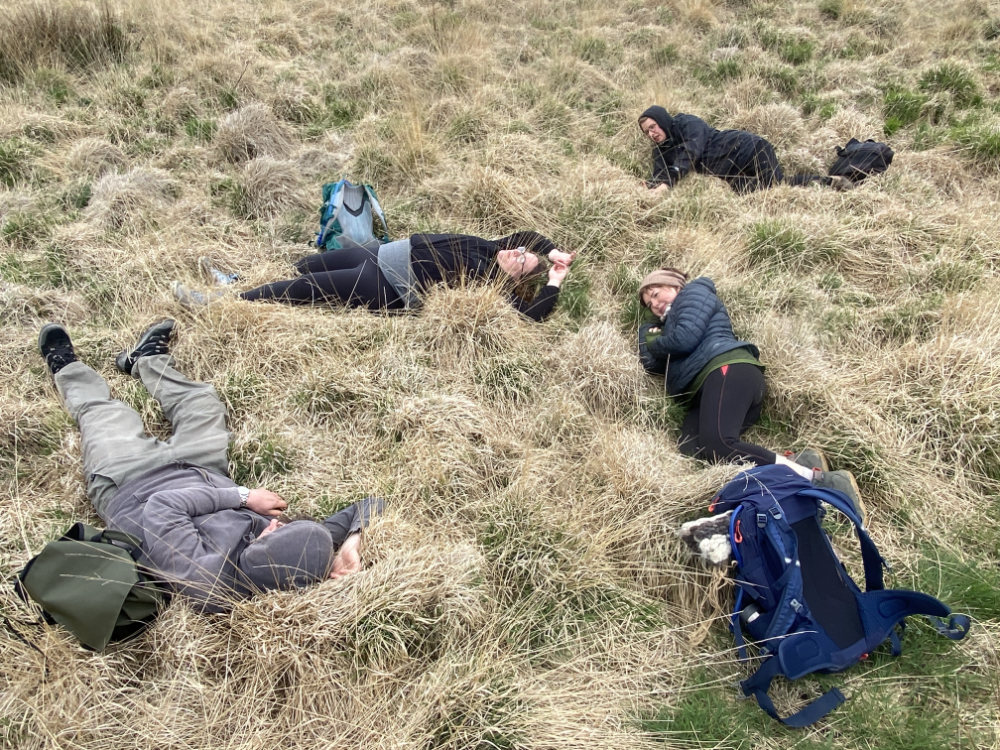
Four walkers rest on the ground in long grasses
Walkspacers resting amongst the Hoarstones. Photo © Paul Wakelam

Stapeley Hill Cairn

From the Hoarstones we began the ascent of Stapeley Hill, a saddle-backed rise with expansive views across Shropshire and into Wales. At its summit lies a ring cairn.

“The cairn on Stapeley Hill rests like a spine beneath the sky. Some say it marks a place where the world thinned – where the old ones stepped between sky and soil. Walking here feels like entering a sentence left unfinished. The cairn does not offer answers, only presence.” (Hallet, 2001).

Cromwell’s Trench

Walking south from the cairn, we approached Cromwell’s Trench: a series of scooped hollows dug as test pits in the search for minerals, a reminder of the lead-mining heritage of south-west Shropshire (Shropshire’s Great Outdoors, 2013).

“Cromwell’s Trench lies folded into the side of Stapeley Hill – an interrupted rhythm of hollows and scoops, dug by hands chasing minerals through shale and silence. The ground here feels restless, worked over, as if thought itself had been quarried. It’s a place of absences: ore not found, labour long vanished, names forgotten. And yet the trenches remain – cuts in the skin of the hill that still hold weather, lichen, and the slow return of stillness.” (Carver 1994).

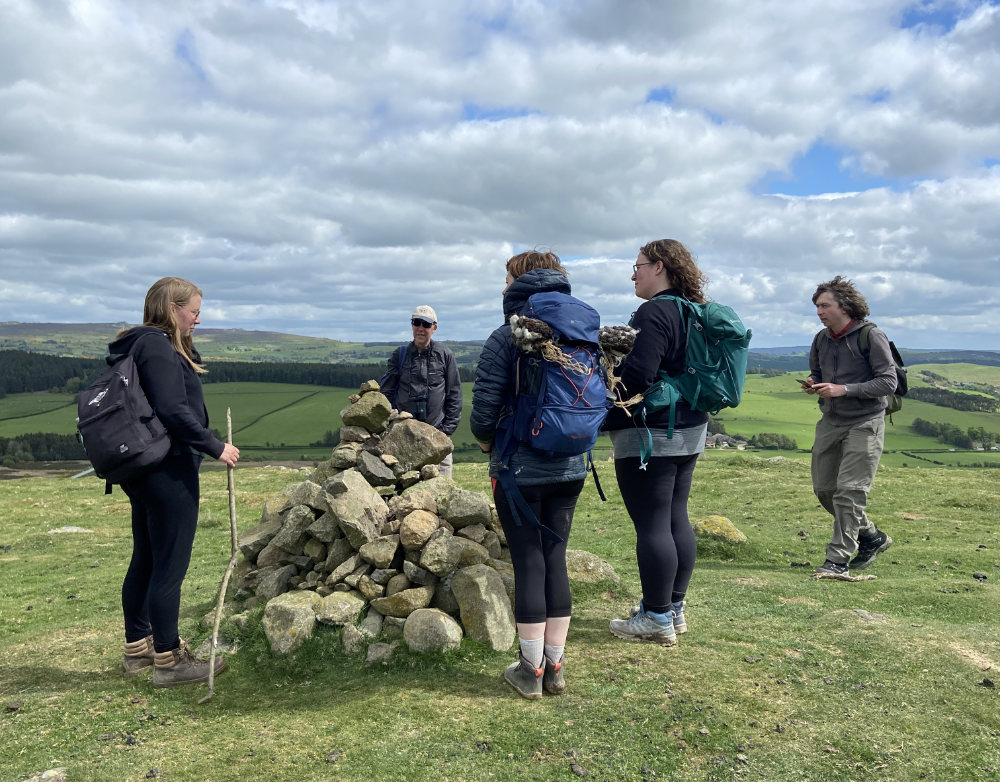
A group of walkers gather around a cairn in the Shropshire landscape
Photo © Paul Wakelam

Re-storying the landscape

Continuing south, we passed further cairns, stone rings, a Bronze Age ring barrow, and a network of linear earthworks before beginning the steep ascent of Corndon Hill. From the summit, the landscape opened out into a wide, circling view – fields, ridges and borders unfolding in every direction.

By this point, the quotations had accumulated. Voices – some historical, some imagined – had been laid into the land, not to explain it, but to thicken it. The manoeuvre did not resolve the myths of Mitchell’s Fold so much as redistribute them, allowing them to cling to stones, paths, absences and weather.

In future iterations, the quotations and their attributions may shift, disappear, or be replaced – treated as materials rather than fixed texts, responsive to route, weather and the particular group walking them.

If the walk achieved anything, it was to suggest that these landscapes are not fixed by archaeology or story alone. They are continually re-made through movement, speech, and attention: each step a small act of re-inscription, each pause a moment where the ground might speak back.

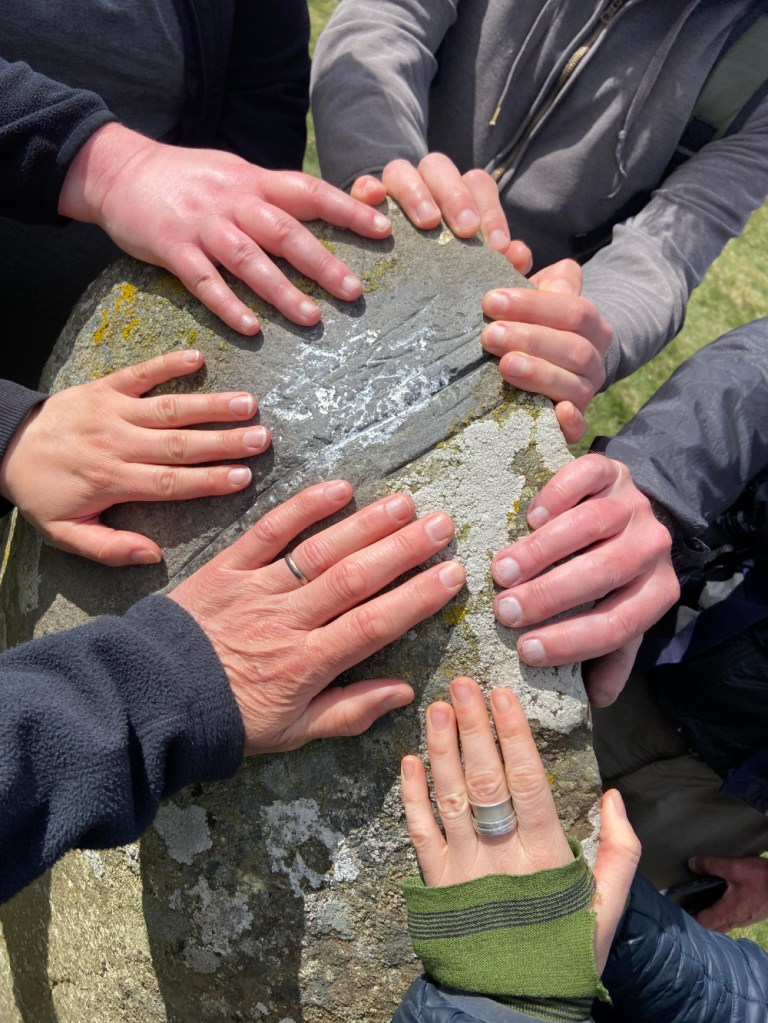
Close-up of six walkers' hands placed on a standing stone
Photo © Paul Wakelam
References

Burnham, A. and Pearson, M. P. (2018) The Old Stones: A Field Guide to the Megalithic Sites of Britain and Ireland. Watkins.

Brennan, T. (2017) Manoeuvre: Discursive Performance. Available at: https://www.timbrennanartist.co.uk/projects-fieldworks-performances/the-manoeuvre/manoeuvre-discursive-performance (Accessed: 26 December 2025).

Carver, I. (1994). Steps to the Sky: Notes on Walking and Vertical Mythology. Oswestry.

Ellis, R. T. (2014). Beasts that Became Stone, in Where the Hills Speak: Oral Tradition and Living Myth along the Anglo-Welsh Border. Hereford.

Darnley, I. (1958). Standing Stones and Straying Paths: A Rambler’s Guide to Forgotten Circles. Oswestry.

Hallet, M. (2001). Margins of Stone: Landscape, Memory, and the Mythic Borderlands. Ludlow.

Wright, T. (1862). Shropshire’s Great Outdoors (2013) Stapeley Hill’s Historic Trails. Leaflet. ‘On the Local Legends of Shropshire’, Collectanea Archaeologica, 1(1), pp. 50–66.

Categories
Upcoming Events

Wandering rocks for Terminalia

Suburban Birmingham might not be the first place that comes to mind for visiting ancient stones but maybe it should be.

450,000 years ago an ice sheet carried thousands of lumps of volcanic rock from the mountains of North Wales and deposited them in the English Midlands. These “erratic” boulders can now be found lurking in the parks, gardens, graveyards and roadside verges of 21st Century suburbia. The word “erratic” comes from the Latin errare meaning to wander, roam or stray.

Join Walkspace members Andy and Bharti for a short tour of the wandering rocks of Bournville and Cotteridge. We’ll be paying tribute to the boulders by pouring from water jars (Birmingham’s tap water also comes from Wales) and reading aloud from Alyson Hallett’s “Stone Monologues”. We also invite you to bring along a pocket sized stone of your own.

Meet outside the Bournville Lane entrance to Bournville Station, B30 1LG, at 11am, Sunday 22nd February. The walk is 1.5 miles long, finishing at Kings Norton Station with the option of continuing into Kings Norton to find a cafe or pub after. Terrain is mostly tarmac and paving with optional forays onto the grass. Some moderate inclines but no steps. Toilets are available in The Shed cafe in Cotteridge Park.

To book please email: walkspace.uk@gmail.com

Terminalia is a festival of walking, space, place and psychogeography on and around 23rd Feburary. Terminalia was the festival of Terminus, Roman god of boundaries and landmarks! Events have been run on this day since 2011.

Categories
Creative Writing Posts

Pathways of knowing

Do you know where the oak grows? 

Where the rose entwined herself within the hedge? 

Where the ravens nest? And the blackbird sings and lays her eggs? 

A treetop against a blue sky

Where the water runs off the land and where she sits still in pools? 

Where the soil runs thick with clay and where sand proliferates? 

Where the Ash grow and the Beech woods are? 

A forest scene with sunlight glinting through trees

You are the guardian of your land. You are the warden, the protector, the knower, the innkeeper, the watcher. 

This ancient role is one you stepped into (pun intended) on your daily walks to help your mind find ease. You unintentionally, by repeatedly walking the same pathways and hedgerows, and streams, and meadows and field edges, became the knower of this land, one who hears and sees deeply, one who knows where the birds call home, where the rabbits live, where the fox scats and the badger dens. 

Foliage and grasses set against an urban bridge/underpass with graffiti

You dream deeply this land, your land, you are deeply held by this land as now she is a part of you, and you of her. 

You drink and dream with rosehip, collected from the bushes, let to grow thick and tall. Wild Rose softens your heart and sharpens your claws, discernment is what you’ve learnt from her. 

You were born in this body and delivered to this land for a reason. Together you share and grow and learn of each other. She wants to know you as deeply as you want to know her, she receives your own wild water from your body as an offering, an act of sharing, knowing. 

Close up of hawthorn leaves

This connection has saved you, a thousand times over. She holds you in the womb of a hollow oak tree as you bleed out your grief of what it may mean to leave and move to the other side of the world. Even with her permission you decide you are not ready, or wanting, to leave the land of your ancestors, you still have so much left you want to learn. 

Walking, walking, walking. 

Your wellies in the mud, the deepening and thickening of the land in the dark of the winter days, deep knowing fills you, the essence of the land is potent when everything rests. 

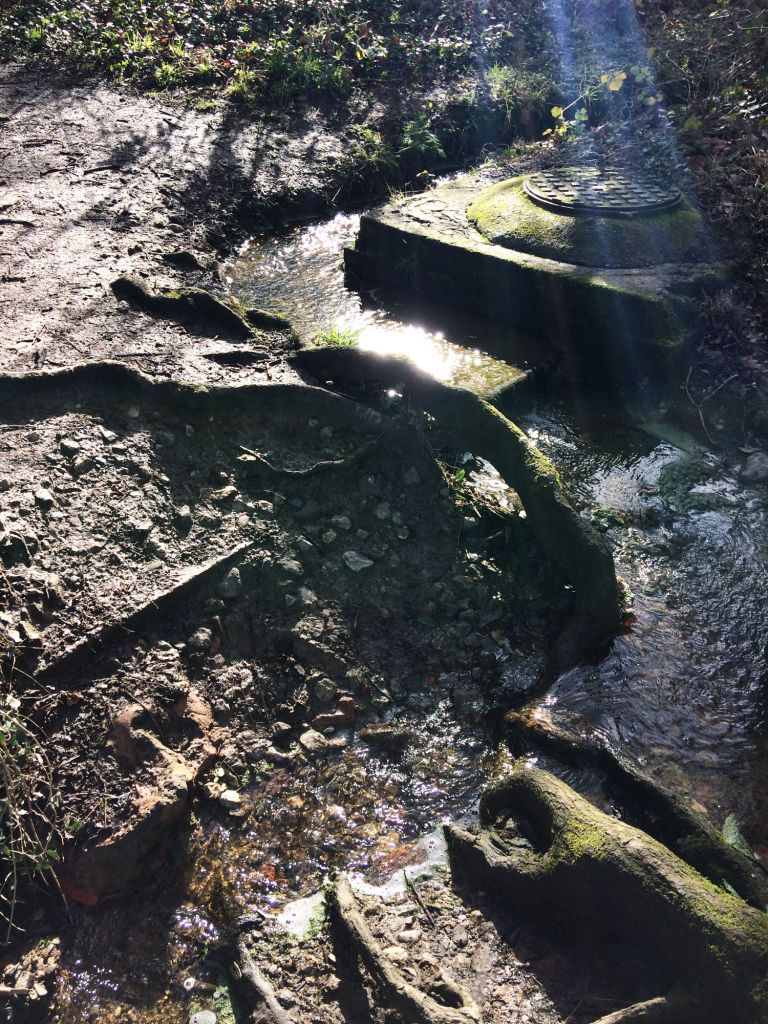
sunlight falling on banks of a waterway, with tree roots and a drain set in concrete

You love the summer, and yet the winter brings her own magic, a deeper, richer flavour. You found yourself when you let yourself rot down among the leaves and be born anew. Your bones picked clean and refreshed by this very land, your roots ever deeper grew. 

You wish to help others find this within themselves, convinced if we all had this connection to our spaces, we would find ways through our problems with climate change, finding our roots, our centre. 

You admit perhaps it may look different for others, they may find their salvation elsewhere. Maybe this is for you alone. Your own connection, your own space. Each to their own. Maybe this is the gift you bring to this world, profoundly you-flavoured, a gift no one else can share. Words meant to come from your mouth alone. By living it, you may inspire others to find their own path. 

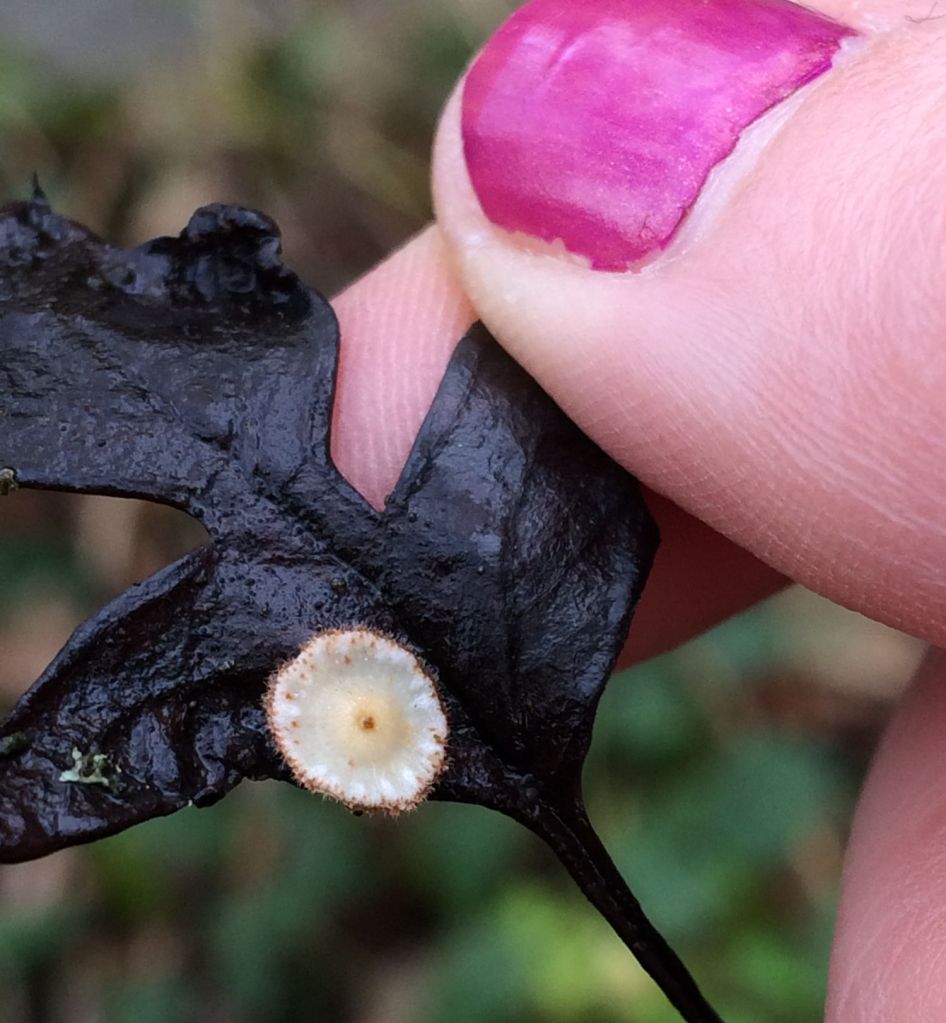
Close up of a fragment of mushroom funghi held by fingers with pink painted nails

Find out more about Emma at https://www.emmaplover.com/. Words and photographs © Emma Plover.

Categories
Posts Walk Reports

Making maps at dusk: reflections on walking the Shrewsbury Skull

This post contains mentions of supernatural activity, historic deaths, execution and suicide.

On 31st October 2025, a cool but luminous Halloween evening, the Shrewsbury Skull walk was launched as a public walking event. The light was already thinning by late afternoon, the sky clear but brittle, and by the time dusk arrived the town felt poised – streets holding their breath, shadows gathering in corners and alleyways.

For five years previously, Walking the Stirchley Skull, devised by Walkspace members Andy Howlett, Fiona Cullinan and Pete Ashton, had taken place as an annual event. In his essay Walk Your Neighbourhood Skull this Halloween, written for the book Night Time Economy published by Floodgate Press, Andy articulated a loose but evocative recipe for the skull walk: a blend of psychogeography, ritual, storytelling, and embodied attention, mapped onto the outline of a skull traced through familiar streets.

The Shrewsbury Skull came about when I moved to Shrewsbury in October 2024. Unable to join the Stirchley walk that year, I decided instead to create an alternative version, adapting the skull to a new town and terrain. This was done with the assistance of Andrew Howe (not to be confused with Andy Howlett), another Walkspace member already resident in Shrewsbury, whose local knowledge proved invaluable in shaping the route.

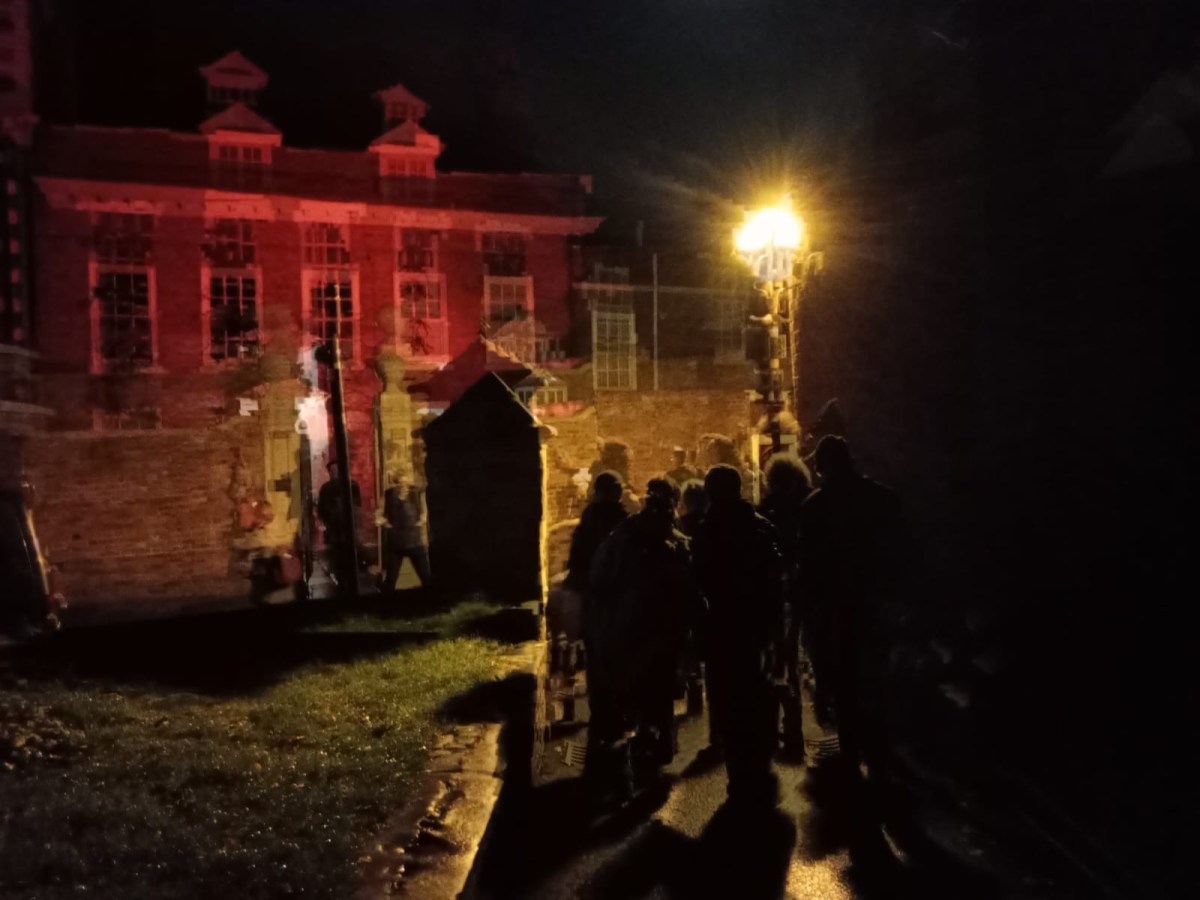
Photo © Andy Howlett

The first Shrewsbury Skull walk, held in 2024, was deliberately modest: a limited event with only a small group of invited guests taking part. It functioned primarily as a recce – an exploratory walk intended to test whether the skull could be convincingly mapped onto the town and whether the rhythm of the route held together at night. The intention from the outset, however, was that it would eventually become a public event.

For the 2025 walk, the event was advertised across social media and through The Shrewsbury Scoop, a new local listings platform. At 7pm, fourteen intrepid explorers gathered outside the Grade I listed St Chad’s Church. The church is believed to have been originally founded by King Offa, and its circular churchyard sits slightly apart from the bustle of the town centre, already lending the meeting point a ritual quality. St Chad’s graveyard also contains the grave of Ebenezer Scrooge – a former prop from the 1984 television adaptation of A Christmas Carol, starring George C. Scott. Sadly, due to vandalism, the churchyard itself is not accessible in the evenings, and so we stood outside its railings, peering in at the darkened paths and headstones.

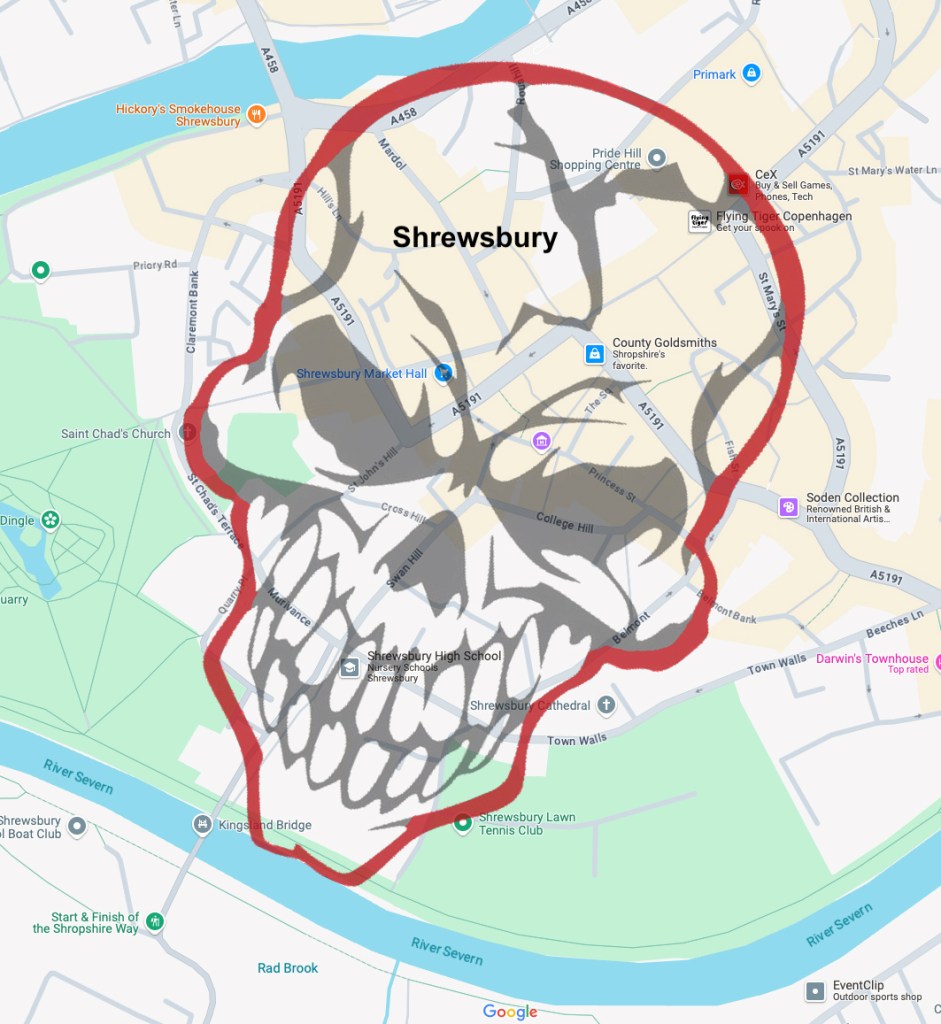
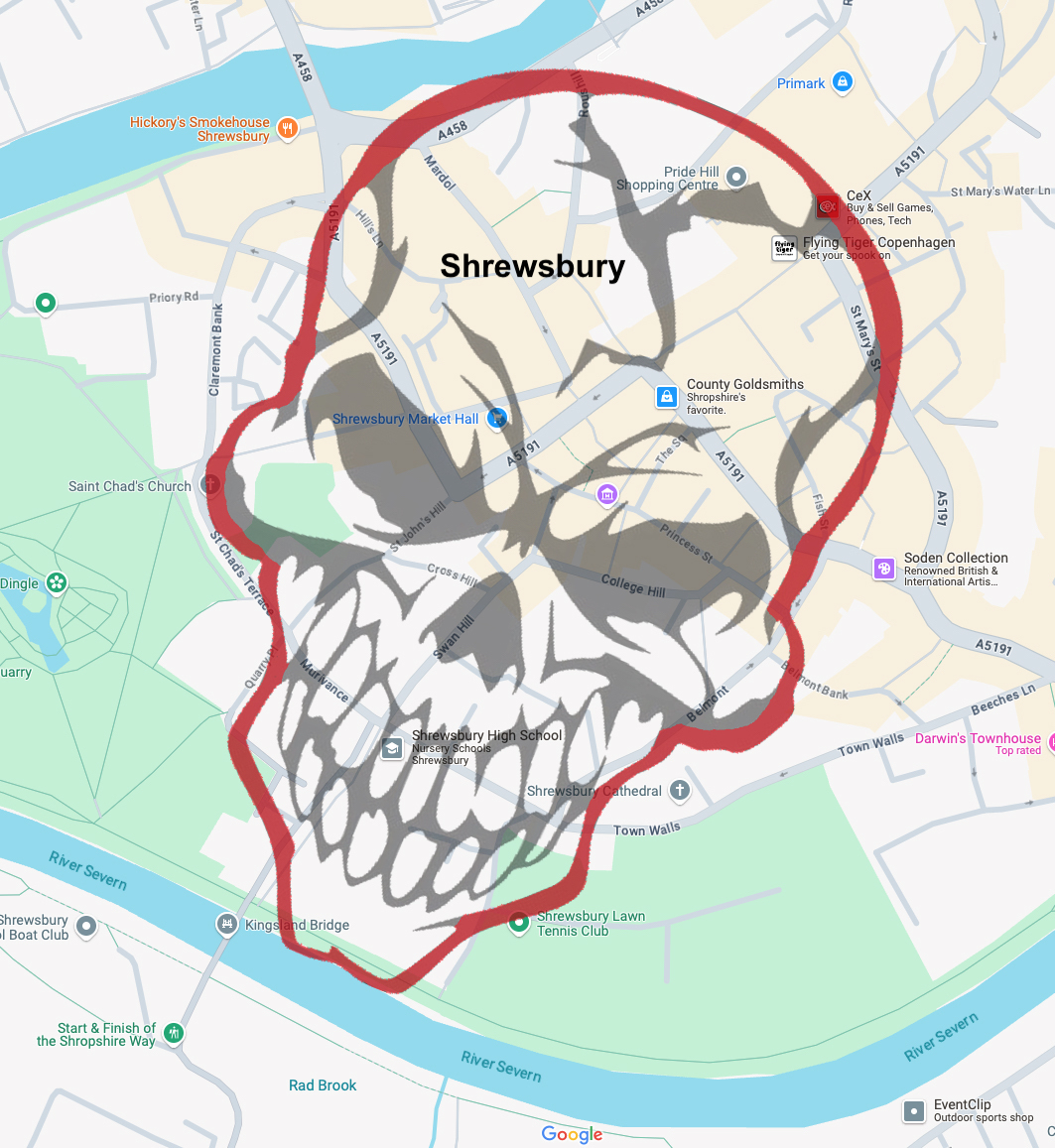
Map of the Shrewsbury Skull

Although the route had been planned in advance, one decision still had to be made: whether to walk the skull clockwise or ‘widdershins’. Widdershins is an old term meaning ‘against the way’ or to travel in the opposite direction to the sun’s course, and as Andy Howlett writes, “this can be an effective way of invoking darker energies” (Howlett, 2024). Given the date, the hour, and the appetite of the assembled walkers, this method was unanimously selected.

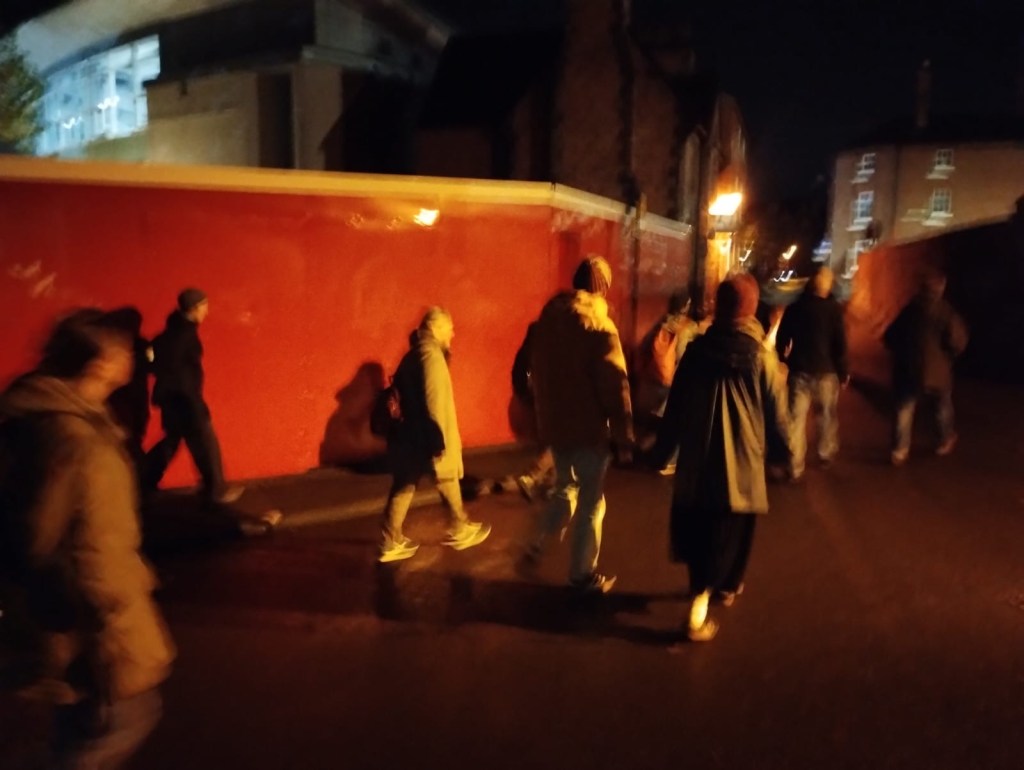
Photo © Becky Dawn

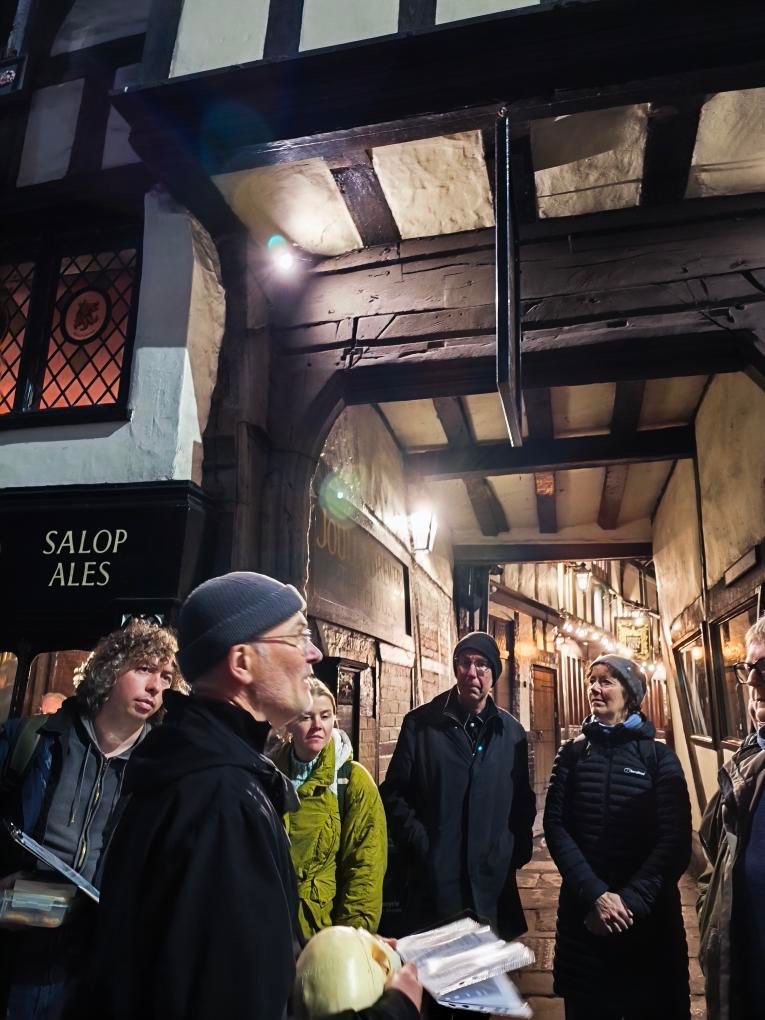
Shrewsbury is particularly well-suited to a night-time walk. Its medieval street plan remains largely intact, with half-timbered buildings leaning over narrow streets and numerous alleyways known locally as ‘shuts’ threading between them. At night, these shuts compress sound and light, amplifying footsteps and fragments of conversation, making it easy to imagine other presences moving just out of sight.

As we walked, various stories were recounted: tales of historic figures such as Captain John Benbow, who switched sides during the Civil War and was executed by firing squad, his grave now lying in the Old St Chad’s churchyard; and Ludovick Carnavon, after whom Carnarvon Lane (one of Shrewsbury’s many shuts) is named, a route that dates back at least to 1460. Alongside these were stories of visitors from the ‘other side’, including repeated sightings of men milling about Barracks Passage, thought to be soldiers killed at the Battle of Bosworth Field who returned to Shrewsbury because they had been warmly welcomed there in life.

From Barracks Passage we wandered up Wyle Cop (from villa-coppa, the town on the hill), a street with a long and bloody history. H. T. Timmins captured this past in a rhyme recalling the mutilatory executions once carried out there:

They hew and they hack and they chop,
And to finish the whole they stick up a pole
In the place that’s called Wylde Coppe,
And they pop your grim, gory head on top.

(Timmins, 1899)

Photo © Paul Wakelam

Partway up Wyle Cop stands The Nags Head, a pub reportedly haunted by the ghost of a coachman who hanged himself there in the 17th century. Footsteps, crashing noises, and the sound of heavy breathing are said to mark his presence – details which felt especially vivid as we passed beneath its darkened windows.

At The Parade, once the site of the town infirmary, further hauntings were noted. These include a figure thought to be a former visitor to the soup kitchen that operated in the basement during the 1700s, as well as the infamous ‘grey lady’. She was reportedly seen at the foot of patients’ beds, who by morning had passed away (Wood, 1979, p.79).

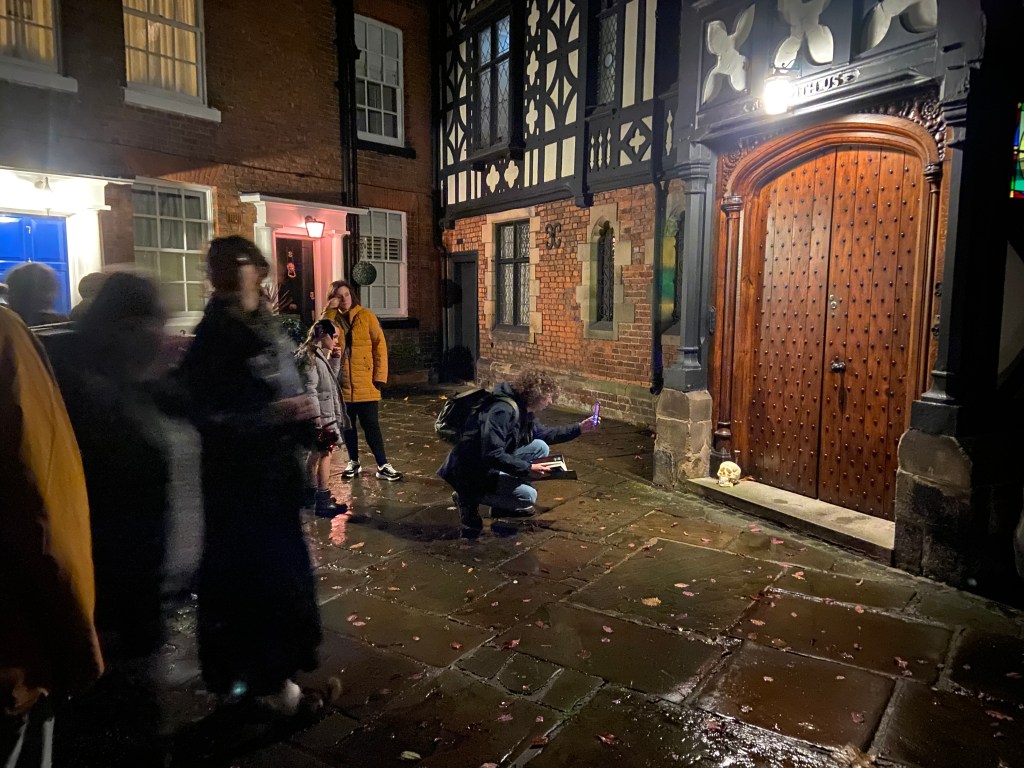
At various points we consciously leaned into the structure of the skull itself. As Andy Howlett suggests, it is possible to “turn the walk into an anatomy lesson: when you reach the point on the skull where the ear would be, tune in to the soundscape of the night by walking in silence. When you come to the mouth why not get out some tasty treats?” (Howlett, 2024). Accordingly, when we reached the ‘mouth’ we paused to indulge in offerings that included ‘soul cakes’ served from a skull, before continuing on. Later, upon reaching the ‘ear’, we walked the final stretch in complete silence, attending closely to the scrape of shoes on stone, the distant hum of traffic, and the occasional burst of laughter drifting from unseen streets.

The walk concluded back at St Chad’s Church. Before dispersing to the Admiral Benbow for drinks, we were encouraged to “consider the transformation that has been enacted tonight. Stand for a moment with the ghost of your former self. These streets will never look at you in the same way again” (Howlett, 2004). On Halloween night, with the town dimmed and subtly altered, this felt less like metaphor and more like a simple statement of fact.

Do keep an eye on our public walk announcements here on the Walkspace blog and in our newsletter over 2026.

References

Howlett, A (2024) ‘Walk Your Neighbourhood Skull’ in Night Time Economy, Birmingham, Floodgate Press.

Timmins, H.T. (1899) ‘Nooks and Corners of Shropshire’ cited in Palmer, R. (2004) The Folklore of Shropshire p35, Almeley, Logaston Press.

Wood, M (2007) Haunted Shrewsbury, Stroud, Tempus Publishing.

Categories
Posts Reviews

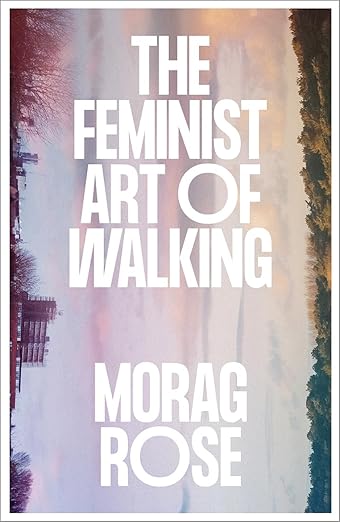
The Feminist Art of Walking with Morag Rose

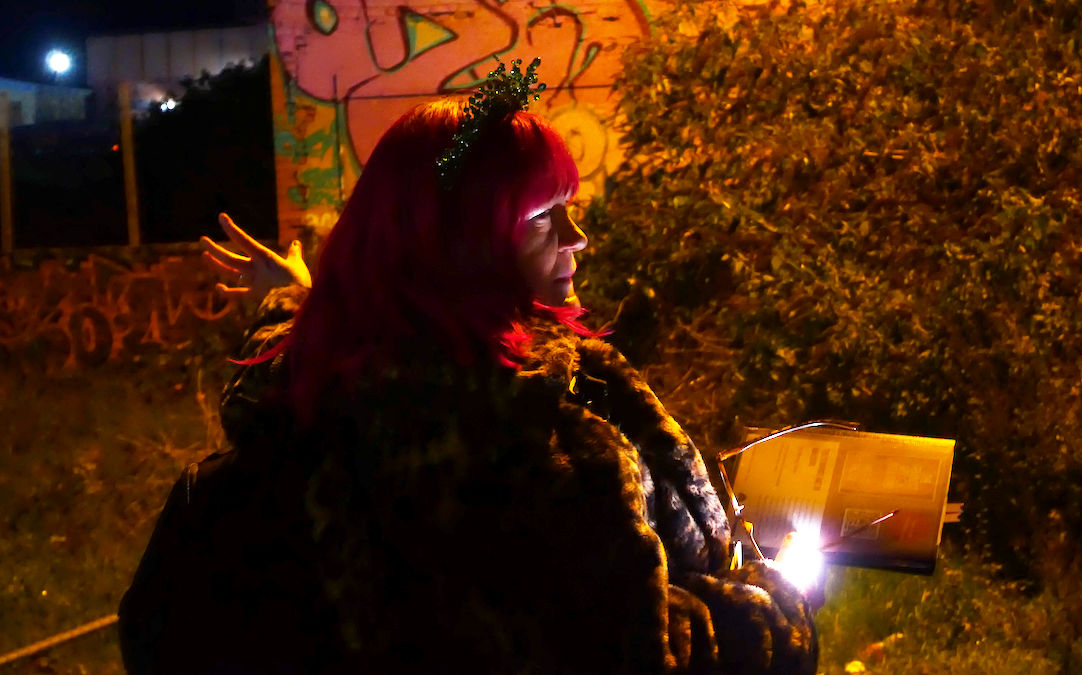
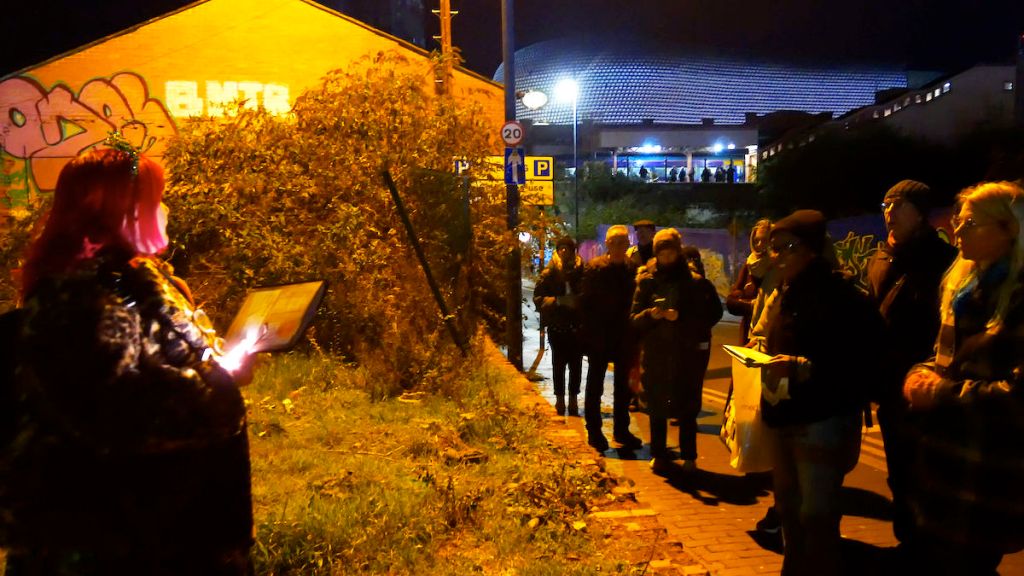
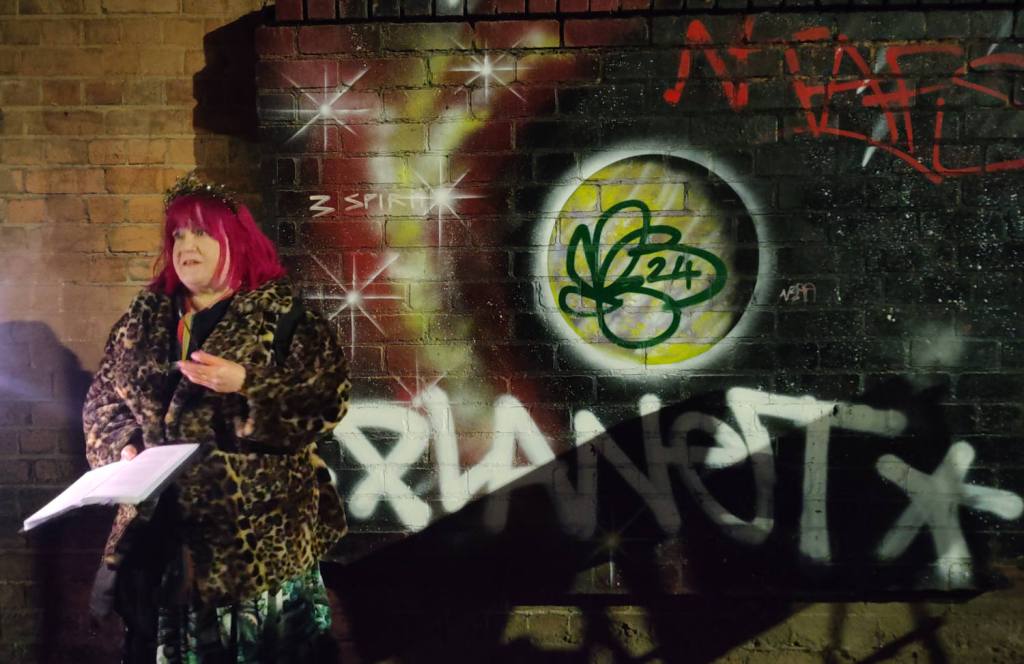
Close your eyes for a few moments, and take a walk in your mind. Wandering urban backstreets and city corners, you pause at a piece of graffiti where a woman with bright pink hair is speaking into the night beneath a spray-painted cosmos of planets and stars. A group of curious-looking people in warm coats stand around her, listening intently. To the average passer-by, we are an intriguing collection of oddballs standing around, loitering on an almost freezing November night. They would be right.

Photo © Andy Howlett

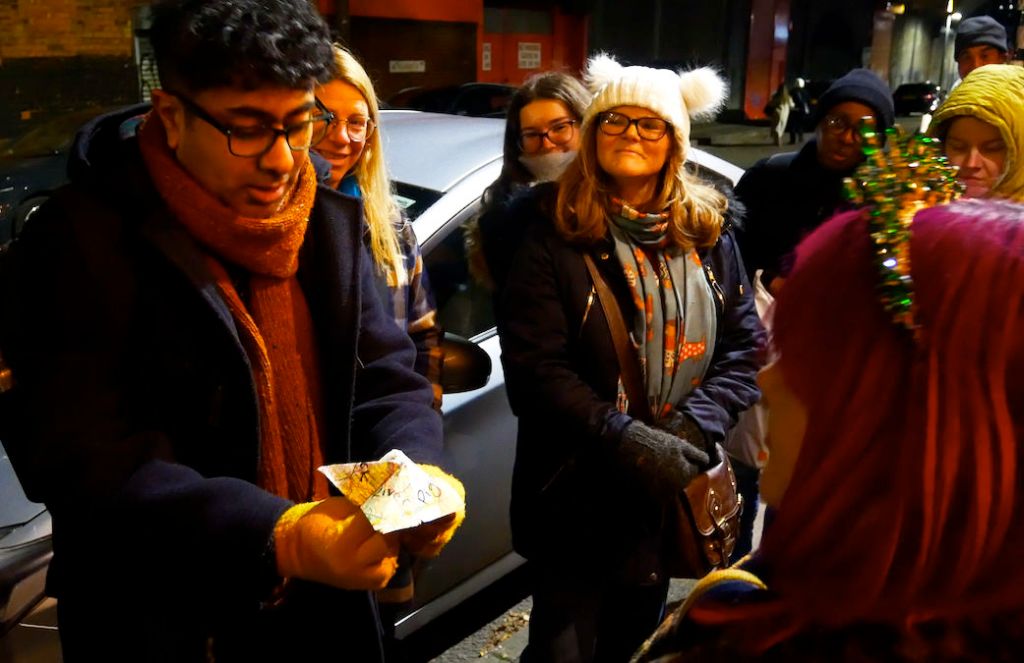
We gathered on that chilly evening for a book launch with a difference. Morag Rose, author of The Feminist Art of Walking, led us on a walk around the streets of Digbeth before her launch event at Voce Books. We stayed close to the bookshop for the duration, doing more loitering than walking whilst Morag gave several readings from the book. As founder of the Loiterer’s Resistance Movement (LRM), Morag is accustomed to reclaiming the art of loitering with intent. A Manchester-based not-for-profit collective of artists, activists and urban wanderers, the activities of the LRM form a radical context for much of this unique publication. 

“I am a loiterer because I am curious, I want to explore and ask awkward questions.” – Morag Rose

Rose claims the mantle of anarcho-flaneuse, alongside performance artist and part-time lecturer in Geography at The University of Liverpool. Her new book is based partly on a PhD thesis about women walking the city, as well as LRM activities and her lived experience. She actively campaigns for better-designed public spaces to make walking and belonging easier for those living with disabilities and from marginalised groups. Rose points out that the “assumption that walking is simple: one foot in front of the other, easy does it, primal, instinctive. This assumption is a fallacy that all bodies are alike and walking comes ‘naturally’ to all”

As for many creatives, the pandemic offered opportunities to say new things about walking and how we get around (or don’t). The Walking Publics/Walking Art: Walking Wellbeing and Community During Covid-19 initiative was an AHRC-funded project by Rose and her collaborators, which explored the potential of the arts to sustain, encourage and more equitably support walking during and following the pandemic. Our lockdown months were when I reoriented my own work towards walking art, having received an Arts Council development grant, which led to a PhD in landscape and inclusion. As a researcher in this field, I can confidently say that walking art is no longer the terrain of lone, white male artists, but an inclusive field nurtured by collectives such as Walkspace. As Rose writes, walking provides “an opportunity for multi-sensual exploration and a deep connection with space, place and communities”. Through the medium of creativity, these opportunities are extended far and wide.

Photo © Andy Howlett

Tracing our footsteps back to the book, Rose builds particularly on feminist perspectives to explore the act of walking in an inclusive and intersectional way. Integrating queer and disabled perspectives, the book also outlines issues around privilege. The Feminist Art of Walking makes assertive strides into questions of where we walk and who public space is for. Taking the reader on a journey through several locations, Rose examines mostly urban locations, with references to the rural. Beginning in Manchester, the book meanders through Liverpool, Sheffield, Eastbourne and smaller communities. The Eastbourne chapter pinpoints the start of Rose’s journey in thinking about how women walk, and the fear-based narratives that inform so much of women’s wayfinding. Rose writes of learning her ‘gender limits’ in younger life, through all-too-common experiences of harassment and intimidation. She asserts that women’s need to protect themselves is “embedded in our daily routine”, a narrative that the LRM attempts to undo. As Rose writes: “I am a loiterer because there are places I feel scared to go alone”. Most chapters in The Feminist Art of Walking are set in England, except for a spin through Ebbw Vale and Rose’s Welsh ancestry. As a resident of Cymru, I particularly enjoyed this chapter and the author’s comments on connections to place and ancestry. 

“There wasn’t an actual photograph in my pocket in Ebbw Vale as I feared a relic would get crumpled or put though the wash. I don’t think I need it – the dialogue is in my head. If I do fancy a visual nudge, there’s a galaxy of images on my phone. We all walk with ghosts, ancestors and descendants wherever we go, it’s whether we choose to let our imaginations tune into them that determines the conversations we have (…) Wherever I walk now, my mother and nan are here, in my genes, my dreams, my wayfinding and my wonky footprints”. 

After the official launch at Voce books (co-organised by Walkspace) our group of temporary loiterers disbanded, all the wiser and a little bit more at home in the world. This is a book about belonging on a deep level, and sharing experiences of what it means to be here. Rose reminds the reader that “you belong here and if that is not obvious then create your own welcoming committee”. Using the metaphor of desire lines, Rose asserts that a path made through intuition may well be walked by others, deepening the grooves and creating bolder paths.

The Feminist Art of Walking does just that, encouraging people of all genders and expressions to move in resistance and solidarity. What strikes me most about this book is the potentiality within its pages, and the power inherent within a simple, everyday walk. As Rose writes, walking is a source of belonging and community, solace and standing up for what we believe in; all within a passing hour, or as Rose puts it “everything and nothing written with our feet”. 

Morag Rose and Digbeth graffiti. Photo Emily Wilkinson

The Feminist Art of Walking is available at Voce Books (online, or if you’re in Birmingham) for £16.99, from bookshop.org or your usual bookseller.

Categories
Posts Thought Pieces

From Birmingham to Knighton: Why community matters more than ever

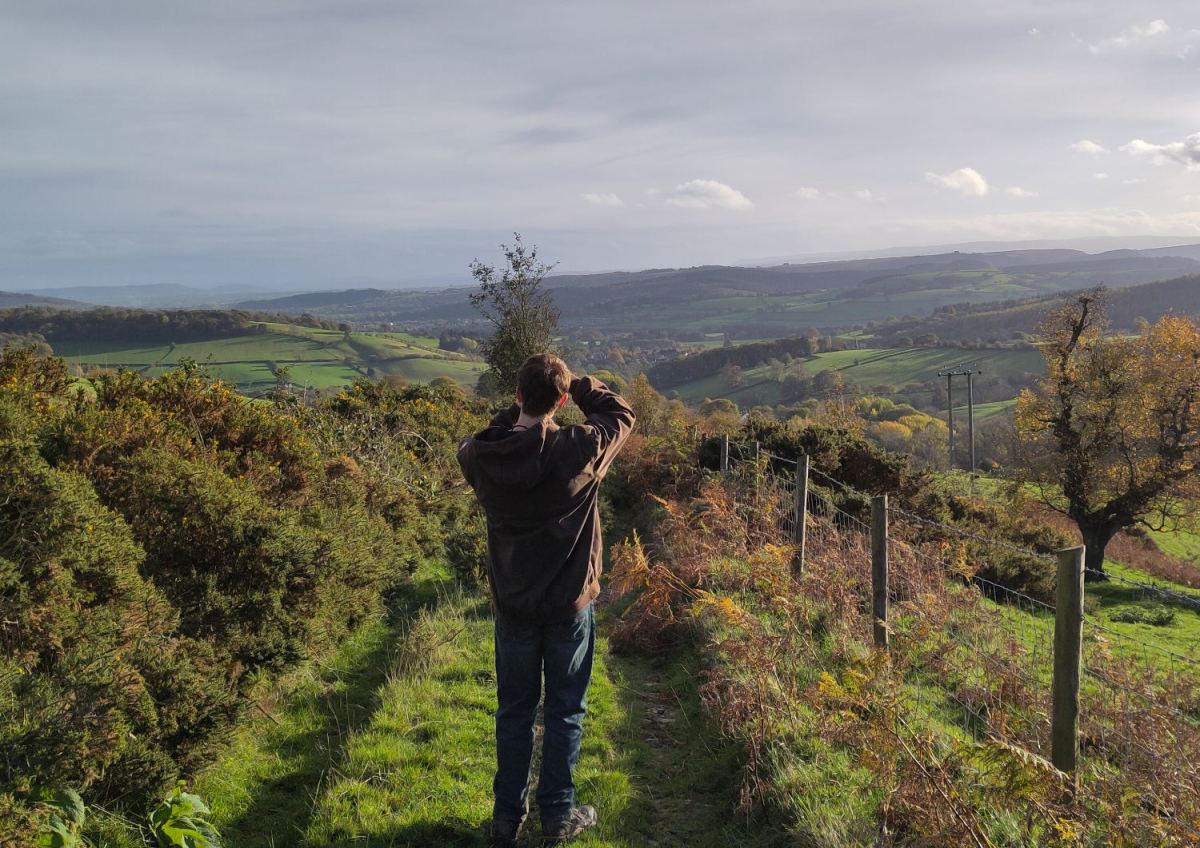
A few weeks after moving from Birmingham to Knighton in Powys, my son and I walked from the town to neighbouring Presteigne and back along the Offa’s Dyke Path. In the mist and drizzle of the morning, the ancient earthwork guided our steps as we crossed fields and old drovers’ lanes as it must have done for countless others over the centuries. That walk, with its mix of history, landscape and companionship, reminded me that paths are more than routes on maps: they are threads stitching together people, places and stories. That walk has since framed some thoughts on what Knighton has taught me about community.

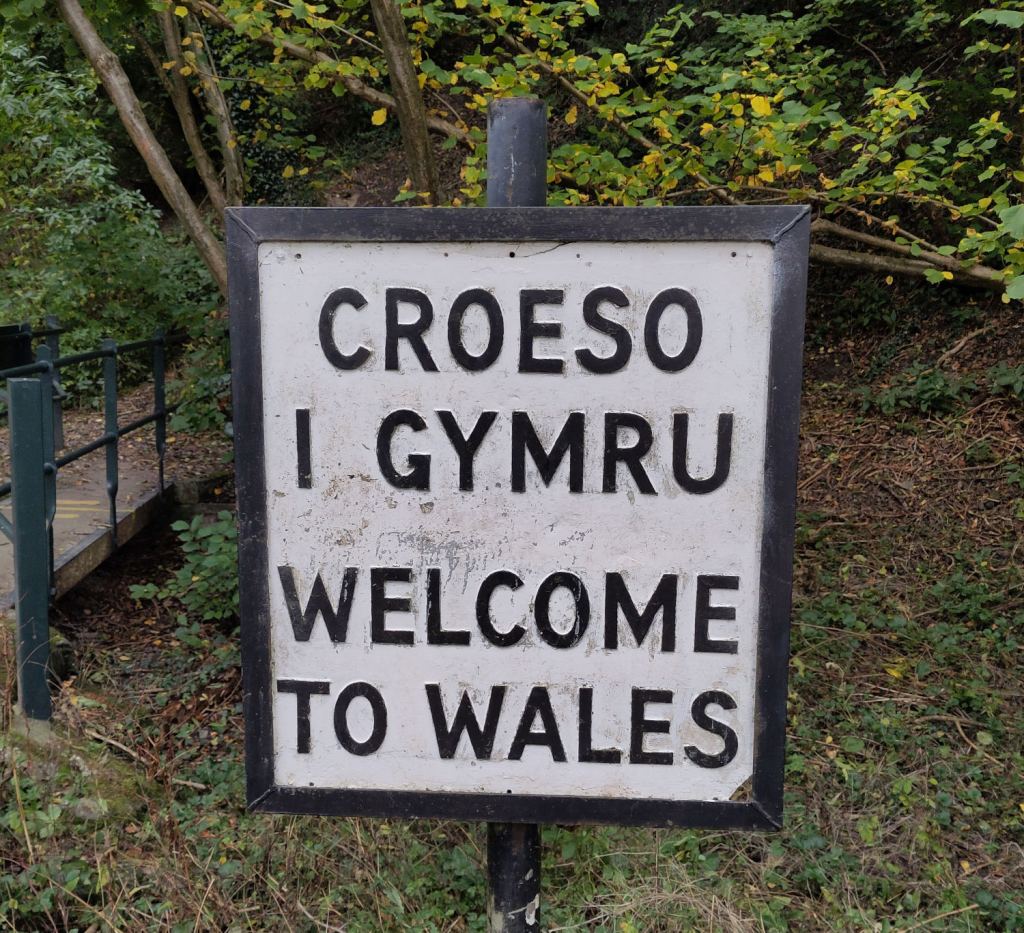
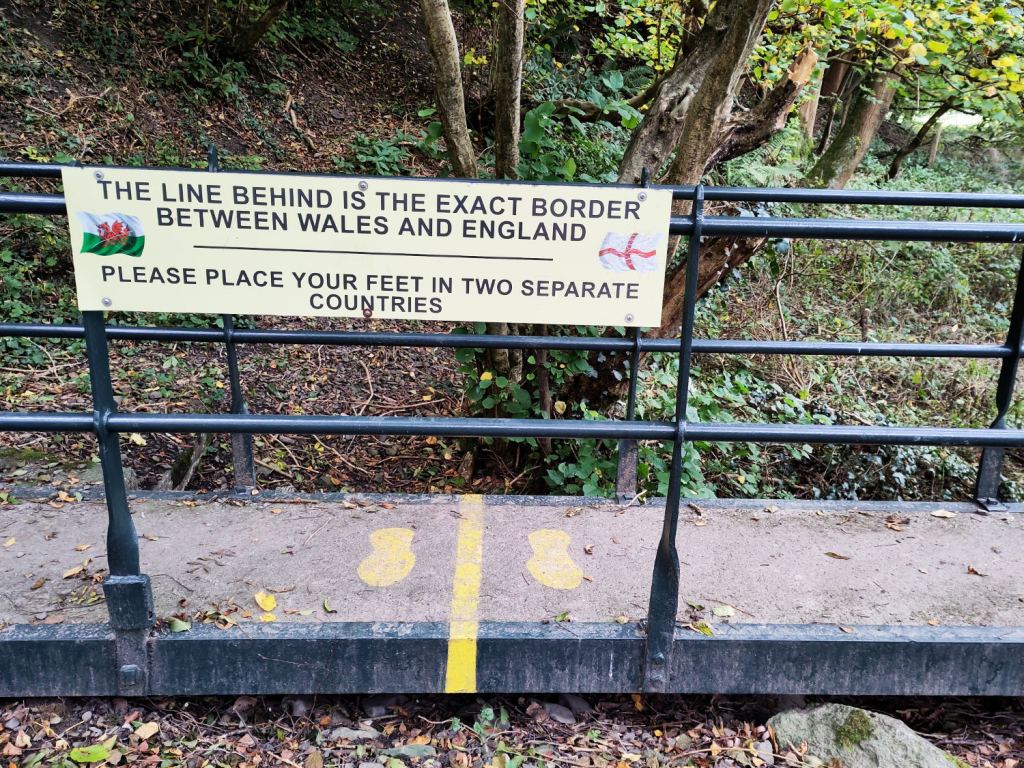
Knighton sits exactly on the English-Welsh border. Its Welsh name Tref-y-Clawdd or ‘The Town on the Dyke’, is a reminder of a layered history. The town is beautiful: hemmed in by wooded, rolling hills and criss-crossed by ‘the narrows’, higgledy-piggledy lanes that run between houses replete with gnomes, stone lighthouses and pot plants on steps. Yet beneath the charm lies a demographic reality: Knighton has a predominantly older population. Like many rural areas, it attracts retirees, while younger people often move away for education and work. The result is a community rich in heritage but stretched thin when it comes to energy and resources.

Within weeks of arriving, I jumped into local cultural life. I became the social media coordinator for the Knighton & District Concert Society, joined the committee for the Knighton Festival, and was invited to join the Tourism Committee. These groups are small, powered by volunteers who have carried the load for decades. They are the beating heart of Knighton’s cultural scene. Their resilience and dedication are remarkable, but they also need fresh energy to sustain the work.

Fabric of rural social life

Rural communities are more than geographic clusters; they are patchworks of relationships, trust, and shared meaning. When those ecosystems weaken, everything else – economic resilience, mental health, public services and possibly even democracy – begins to fray. Sustaining them requires people willing to do unglamorous work: attend evening meetings, open bank accounts, put up posters, bid for grants, deal with contractors, make sandwiches, and give up evenings and weekends. This is the work of belonging. And while it is demanding, it also brings rewards: time given freely builds bonds that money cannot buy.

Compared to cities, rural ties often run deeper. Family networks, neighbourly reciprocity, and shared traditions create a closeness that urban life with their promise of anonymity (and the quick tempers that it facilitates) can sometimes lack. I left Birmingham after the third time I was assaulted – this time when someone threw a brick at my head. It is commonplace for younger people to move away to the economic opportunities of cities, but those who remain, and those who return, need to balance the fabric of loyalty and care without feeling smothered.

Why social capital matters

Social capital isn’t just a warm idea. Communities with strong social ties cope better with crises, innovate more effectively, and offer richer lives to their members. In rural areas, where formal services are often thin, social capital is the safety net. It’s the neighbour who lends you logs for the stove in winter, the one who grits the shared walkway, lends you tools, or leaves cooking apples on your doorstep. It’s the volunteers who coach the junior rugby team, and the committee that keeps the arts alive.  Here, volunteers just about keep the Offa’s Dyke Centre and the Knighton Museum open.

But social capital doesn’t happen by accident. It is built through participation, common endeavour and trust, and through the slow, sometimes frustrating work of showing up, listening, compromising, and creating together.  People need to know that their efforts will be rewarded and reciprocated before they start. In game theory, this is known as “tit-for-tat plus” – or “giving the benefit of the doubt’ in simpler terms. If we think we’ll never see the other person again, why bother saying hello?

Culture as a connector

Henry Hemmings, in his book Together, argues that shared experiences are the glue that binds us. Festivals, concerts, and community arts aren’t luxuries; they’re lifelines. They create spaces where people of different ages, backgrounds, and beliefs can meet – not as avatars, but as neighbours.

Knighton’s concert society and festival are perfect examples. They bring world-class music and vibrant ideas to a small town. The Talland Quartet from the Royal Northern College of Music, who performed the first of this season’s concerts, were brilliant: young, energetic, and committed to bringing culture to far-flung corners of the country. Behind the scenes, volunteers juggle budgets, marketing, logistics, and online payment software. It’s hard work, but without it, the cultural life of the town would wither. We look with admiration to chi-chi Presteigne (Llanandras in Welsh) and smile wryly at the global renown of Hay-on-Wye (Y Gelli Gandryll), but Knighton’s efforts are no less vital.

The moral imperative

Jonathan Haidt’s The Righteous Mind reminds us that morality isn’t just about abstract principles; it’s about the foundations that allow us to live together. One of those foundations is loyalty: not blind tribalism, but a commitment to the groups that sustain us. In an age of unseeing digital tribes and their blinkered acolytes, we need to rediscover loyalty to our real-life communities. Try burning a digital log on your stove in December.

Social media can be a double-edged sword. While it can atomise and distract, it also helps rural communities connect and discover what’s happening in towns just down the road. The challenge is to use it as a tool for connection, not a substitute for presence.

Lessons from Knighton

My short time in Knighton has taught me this: community doesn’t just happen. It is forged through effort, through resisting the pull of doomscrolling, through the willingness to give more than you take. Rural life is complex and demanding, but deeply rewarding. I’ve made more friends in six weeks here than in twenty years in Birmingham.

When I sit in a committee meeting, surrounded by people who have been doing this for decades, I feel a sense of continuity that no algorithm can replicate and no amount of secret spite or can compensate. When I see a packed hall for a concert, I see the payoff of countless unseen hours. This is what sustains a town. Shared endeavours and human interactions are what sustain us: not digital likes and ‘followers’.

Walkspace: Turning paths into possibilities

Knighton isn’t just a place on the map – it’s a landscape alive with stories. The Black Hill of Bruce Chatwin’s On the Black Hill is nearby, and the Radnor Hills rise in the distance. Walking here is part of the culture: besides the Offa’s Dyke Centre, Knighton even has its own walking festival. When we walk these paths, we’re not only tracing ancient routes walked by sheep drovers of old, Owain Glyndwr and King Offa; we’re part of something much bigger.

This is where Walkspace comes in. Walkspace isn’t just a website or a WhatsApp group. It’s a cooperative of artists and walkers, powered by volunteers and guided by a shared vision. Every walk, every photograph, every reflection adds to a collective tapestry. As members, we’re not just participants but co-creators of a community with extraordinary potential.

Knighton reminds us why this matters. Its paths, lanes and narrows (and miniature nautical statuary) invite us to slow down, to notice, to connect not only with nature but with each other.  Walkspace and other community groups are more than platforms; they are movements. Rare spaces where creativity and community meet.

Knighton is teaching me that the work of community is never finished. But it matters more than ever. In a fractured, polarised and increasingly isolated world where most people would rather stare at a phone than smile or talk to each other, the simple act of turning up and helping people can be genuinely radical. Choose effort over convenience, togetherness over isolation. Our communities, services and maybe one day even democracy, depend on it.

Pictures: © Dan Carins, 2025

Categories
Posts Upcoming Events Walkspace Erratics

Walking the SHREWSBURY Skull this Halloween

Inspired by the long running ‘Walking the Stirchley Skull‘, the Shrewsbury Skull has been devised by members of Walkspace’s Shropshire contingent as a spooky walk within the historic setting of Shrewsbury Town Centre.

The Shrewsbury Skull was created by Paul Wakelam and Andrew Howe by superimposing a skull image on a map of the town centre, within the course of the River Severn, and then walking the outline in the real world on Halloween night last year. This year they’re ready for company.

The walk will take place on Friday 31st October at 7:30pm and will start and finish outside St Chad’s Church, a 13 minute walk from the train station. The walk is free to attend and open to both locals and those from further afield. Costumes are entirely optional but if you wish to bring a skull-themed object or mask you are very welcome to do so.

Please book your place by emailing: walkspace.uk@gmail.com

This is a circular walk of approximately 2 and a quarter miles, mostly over pavement, with some moderately steep inclines and one set of steep steps. Toilets are available in pubs along the route. The walk will last around 90 minutes with the option of retiring to one of Shrewsbury’s many fine pubs for a de-spook.


Please note, the original Stirchley Skull walk will NOT be taking place this year. We are officially passing the torch. If you wish to organise your own skull walk with friends, you can do so wherever you live by following these instructions.

Categories
Posts Upcoming Events

Peaks and Cairns of Dudley – a creative ramble

Walkspace is delighted to be contributing to A Dudley Day Out, a day-long celebration of Dudley’s green spaces featuring guided walks, a buffet lunch and creative collage. This event is the culmination of the Dudley’s Path to Nature Recovery project by Birmingham & Black Country Wildlife Trust.

Walkspace artists Daniella Turbin and Andy Howlett will be facilitating one of the day’s four walks. We hope you will join us!

Taking inspiration from local landscapes, overlooked heights, and the legacy of Dudley’s own “God’s Mountaineer” Bert Bissell, this walk will explore how the dramatic geography of the Black Country has long inspired journeys of imagination and endurance.

Drawing on Daniella’s background in long-distance walking and rock climbing, and Andy’s practice of walking-as-art, this journey will launch a playful black box treasure trail, featuring postcards hidden across the hills with original artworks and writings that connect Dudley’s peaks to far-flung places like Ben Nevis, the Humber Bridge, and the Ural Mountains.

Along the way, participants will take part in a gentle water ritual at the Severn/Trent watershed line, build a miniature “peace cairn” in honour of Bissell, and design their own postcards inspired by the landscape and lore.

The walk ends at a venue in Dudley Town Centre, where a buffet lunch will be served and there’ll be time to reflect, connect, and contribute to a collective collage on the project so far.

Please note, this walk is not suitable for under 16s due to health and safety.

Meeting Point: Bury Hill Park, Oldbury further details will be shared upon booking

Arrival Time: From 9:50am, setting off at 10am

Duration: Approx. 2-4 hours

Terrain: The ground is variable, including roads, rocky paths, grassy areas, stiles, steps and significant inclines that some may find difficult. Wear sturdy footwear, dress appropriately for the weather, and bring plenty of drinking water, snacks, and sun cream.

Toilets: Available at The Lakeside pub near the start and venue at the end

This event is part of Dudley’s Path to Nature Recovery, a project launched in 2024 by Birmingham & Black Country Wildlife Trust, thanks to support from their funders. The project connected local communities to nature across Dudley’s rich landscape of hills through five interlinked strands: conservation work, community engagement, citizen science, partnership development, and the creation of new walking routes.

Categories
Posts Upcoming Events Walkspace Erratics

Midsummer Spaghetti Pilgrimage – CHANGE OF START TIME! 10AM!

PLEASE NOTE: This walk starts at 10am NOT 11am as previously advertised. This is to avoid the hottest hours of what will be a very hot day. RESPECT THE SUN! If you wish to attend you MUST email: walkspace.uk@gmail.com

Three years ago we led a pilgrimage to Spaghetti Junction to celebrate its 50th birthday. We explored some of the ways the famous motorway interchange could be considered a sacred site, a “confluence of confluences” and a gateway to the underworld. Great as it was, this walk barely scratched the surface and so we’re making a return visit for this year’s Summer Solstice. We hope you’ll join us to honour the Great God Interchange.

In recent years the artist and writer Jen Dixon has joined the ranks of Walkspace and her work reveals new layers of sacred significance to the site now known as Spaghetti Junction. Her INTERCHANGE field guide posits the site at Gravelly Hill as not merely a motorway junction, but a place of “physical and spiritual interchange over hundreds, if not thousands, of years.”

Jen will be joined by Andy Howlett to help untangle the watercourses, crossings, caverns and megaliths that come together to form this utterly unique environment. Discover the Hawthorn Brook. Cross the ancient ford. Enter the Dwarf Holes. Honour the Holy Oak. Draw back the thin veil between worlds and leave your offering.

The pilgrimage will begin at 10am in Chamberlain Square, central Birmingham on Saturday 21st June. Meet Andy and Jen beside the fountain. From here we will make our way down to the Birmingham and Fazeley Canal which we shall follow all the way to Spaghetti Junction along the towpath – a distance of about 3.5 miles. After observances round and about the Interchange, we’ll aim for a picnic lunch at around 12:30-1pm beside Aston Reservoir.

To book please email: walkspace.uk@gmail.com

Bring a packed lunch, plenty of water, sun cream and wear sturdy shoes. The terrain is mostly pavement and towpath with some uneven and sloping sections, cobbles and narrow tunnels. Buses 65, 66, 67 and 68 all take you back to Birmingham and can be caught on Lichfield Road. Aston Station is also a 10-15 minute walk from the walk’s finishing point. For your evening festivities we heartily recommend Acid Solstice in Digbeth.

“Today, the curved spaghetti roads rest on their concrete megaliths to form cavernous realms, from which the old beings might still be communed with.”
Text and image © Jen Dixon