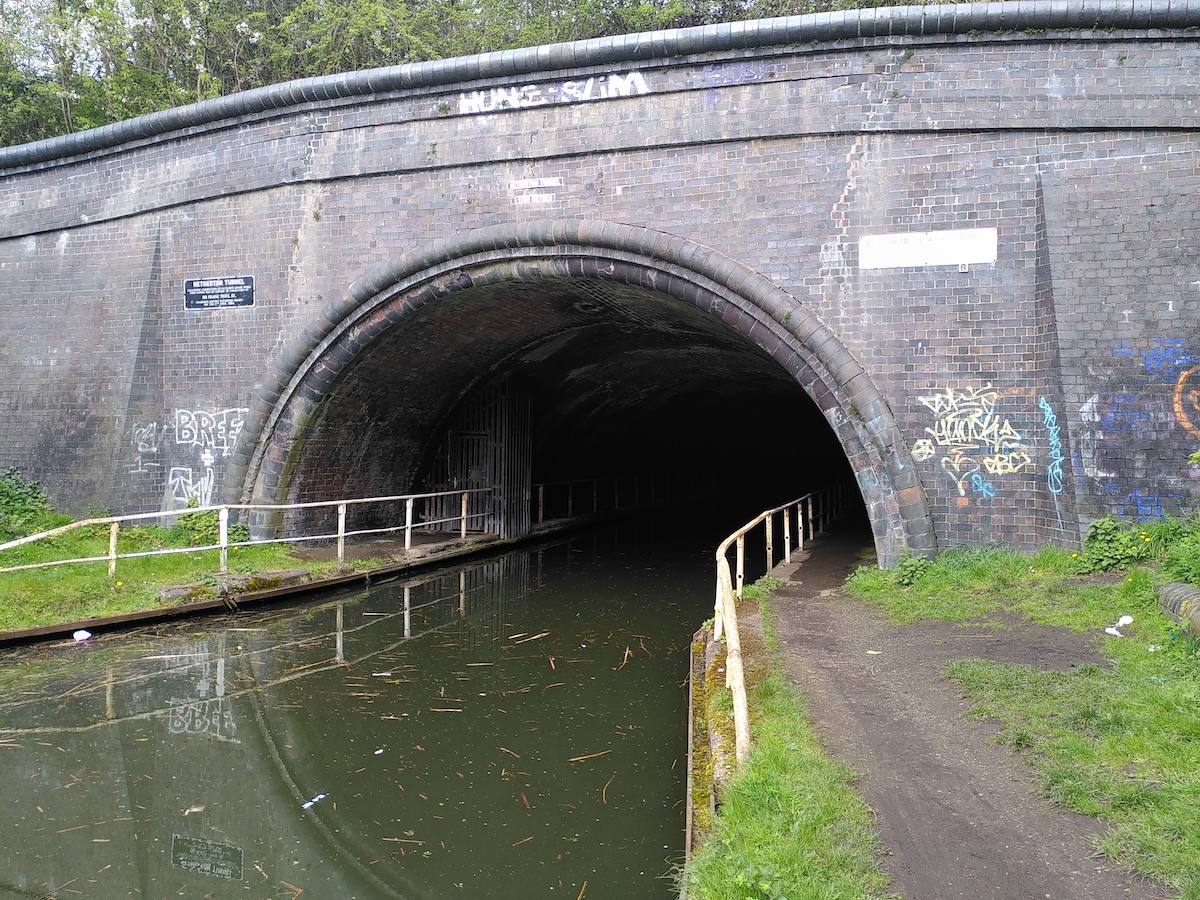
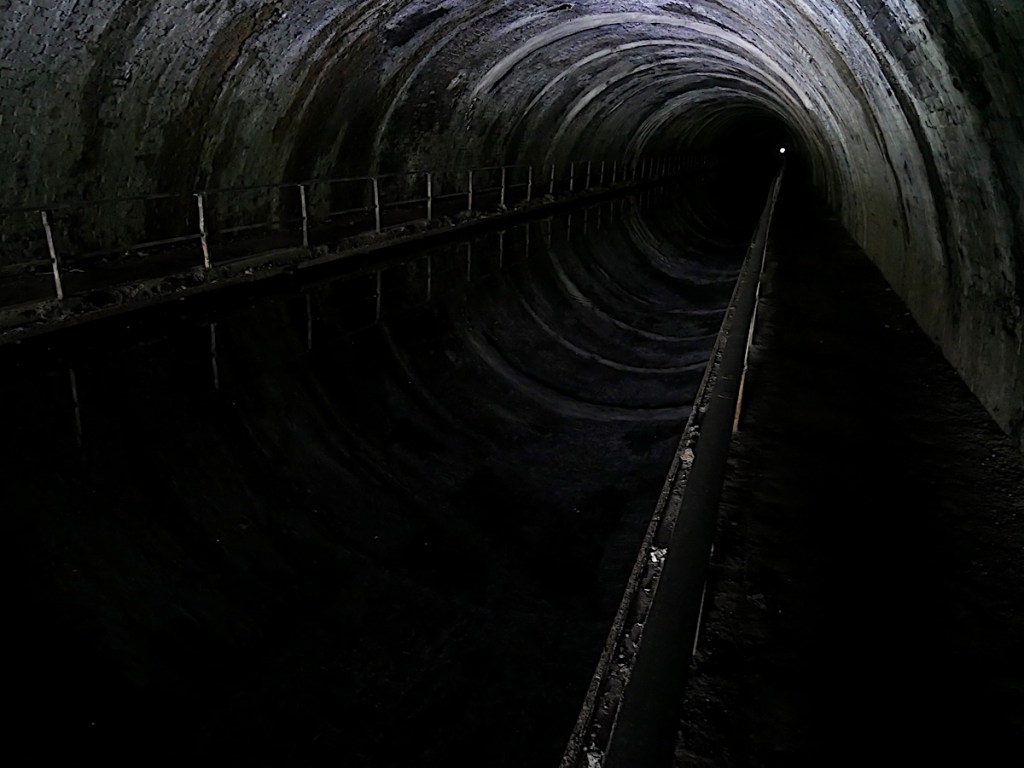
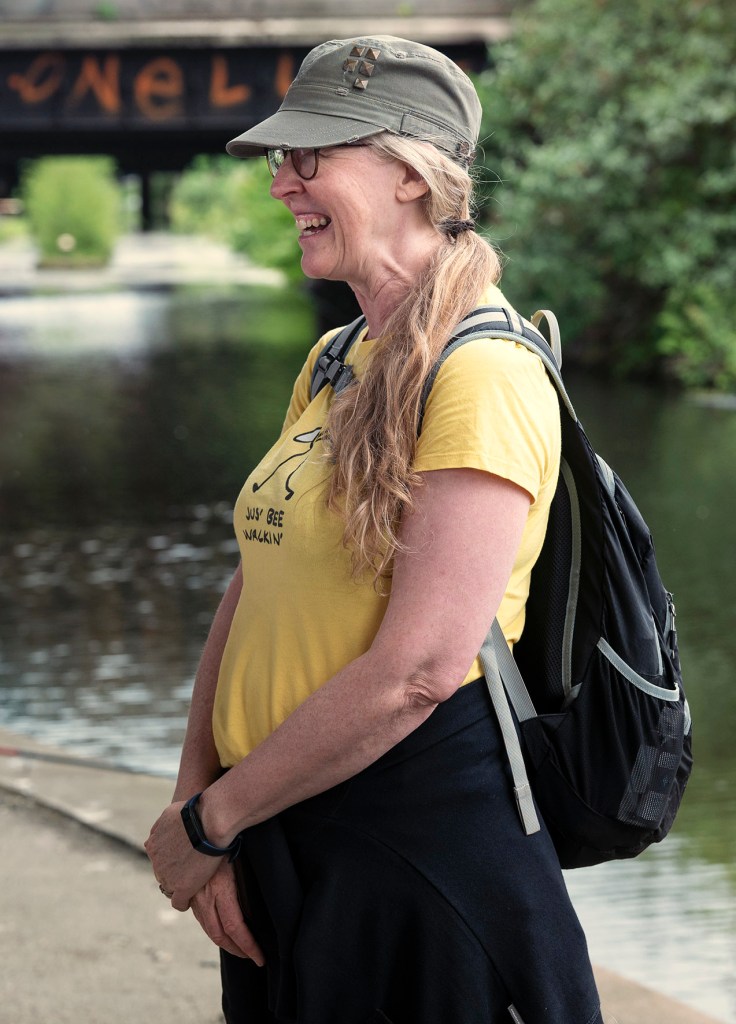
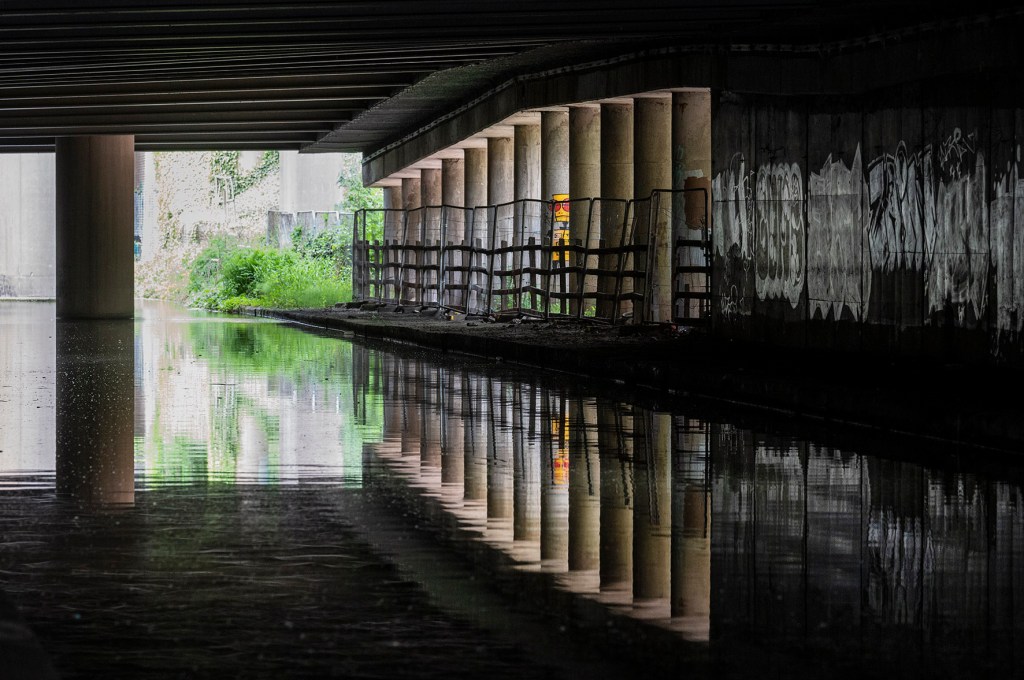
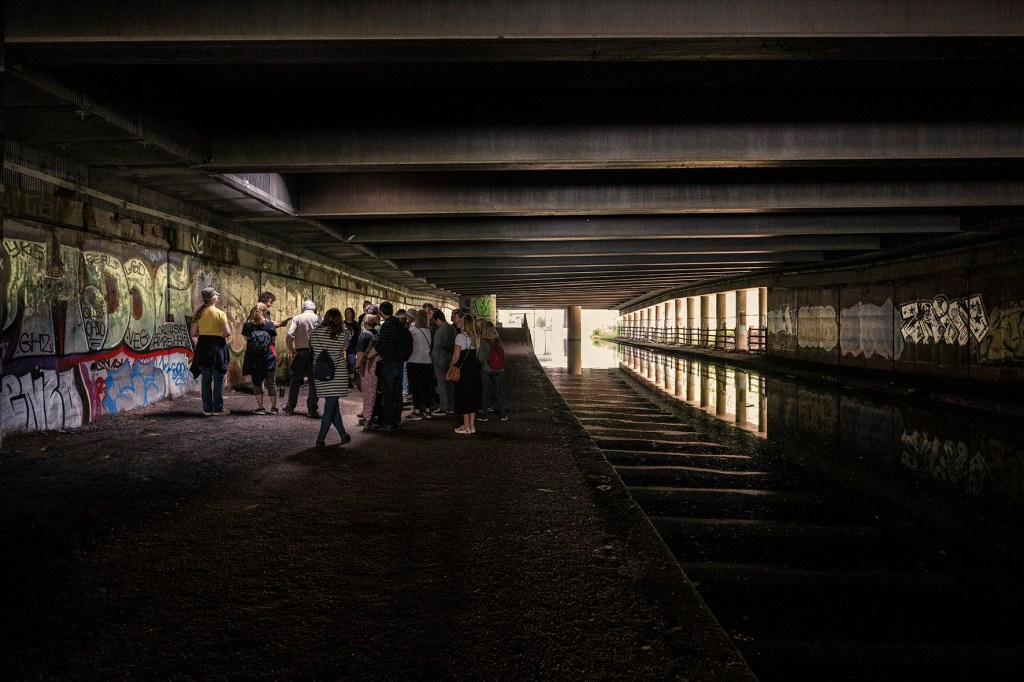
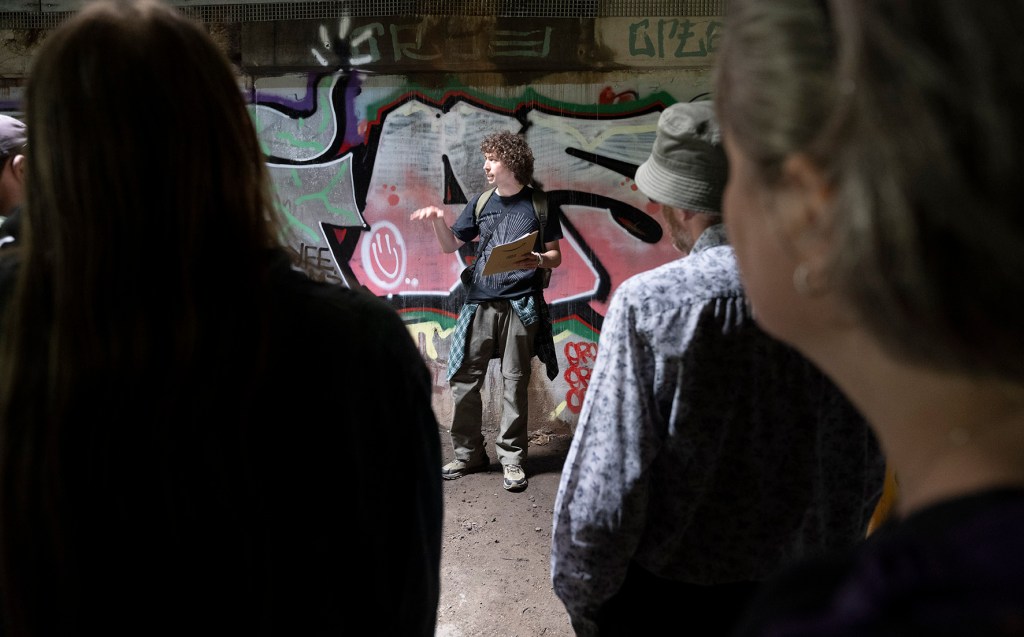
For June’s Erratic we’re venturing deep into the bowels of the Black Country with a chilling walk through the longest canal tunnel in the West Midlands. The Netherton Tunnel was dug between 1855-1858 and stretches 1.7 miles beneath the Rowley Hills. It is accessible to the public via towpaths either side of the canal.
Adding to the spookiness, the tunnel is unlit save for the natural light that enters through eight ventilation shafts spaced evenly across its length. These are the only connection to the world above. At the innermost point of the tunnel you are 105 meters below the ground and all you can see is a pinprick of light far ahead, and the same behind.
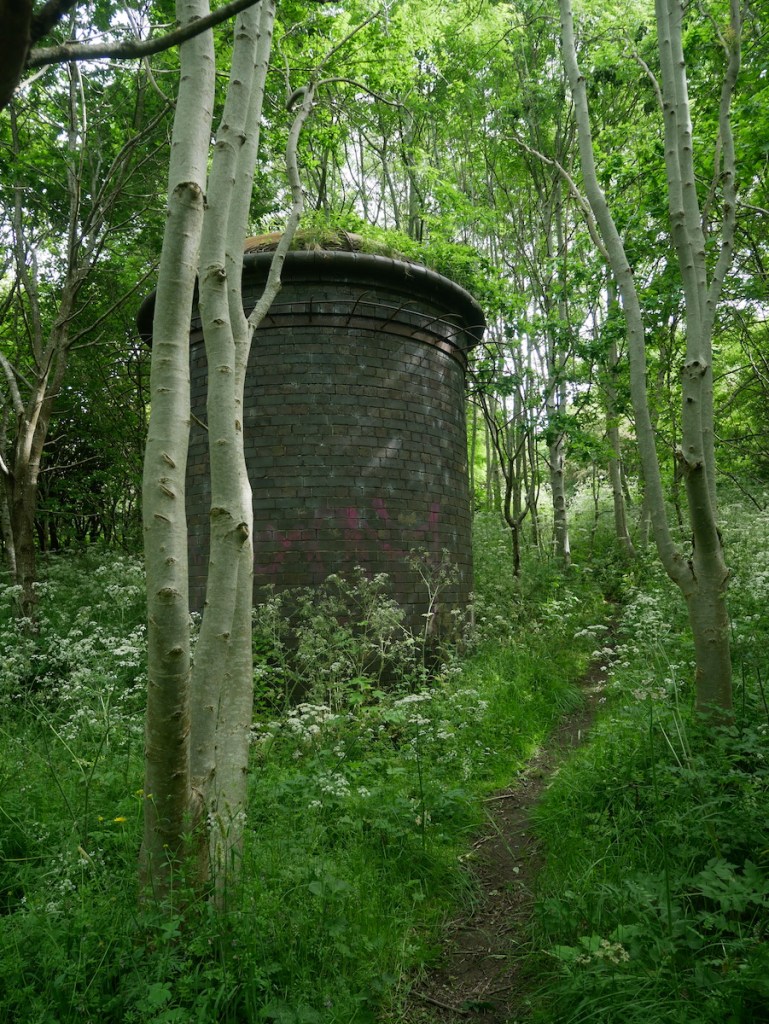
Above ground the ventilation shafts are visible as cylindrical chimneys, or “pepper pots” as they’re locally known. They sprinkle the suburban landscape and can be found in woods, on roundabouts and in gardens. Legend has it that eight of these shafts can be counted inside the tunnel but only seven have been identified above. Where is the missing pepper pot? Will we find it?
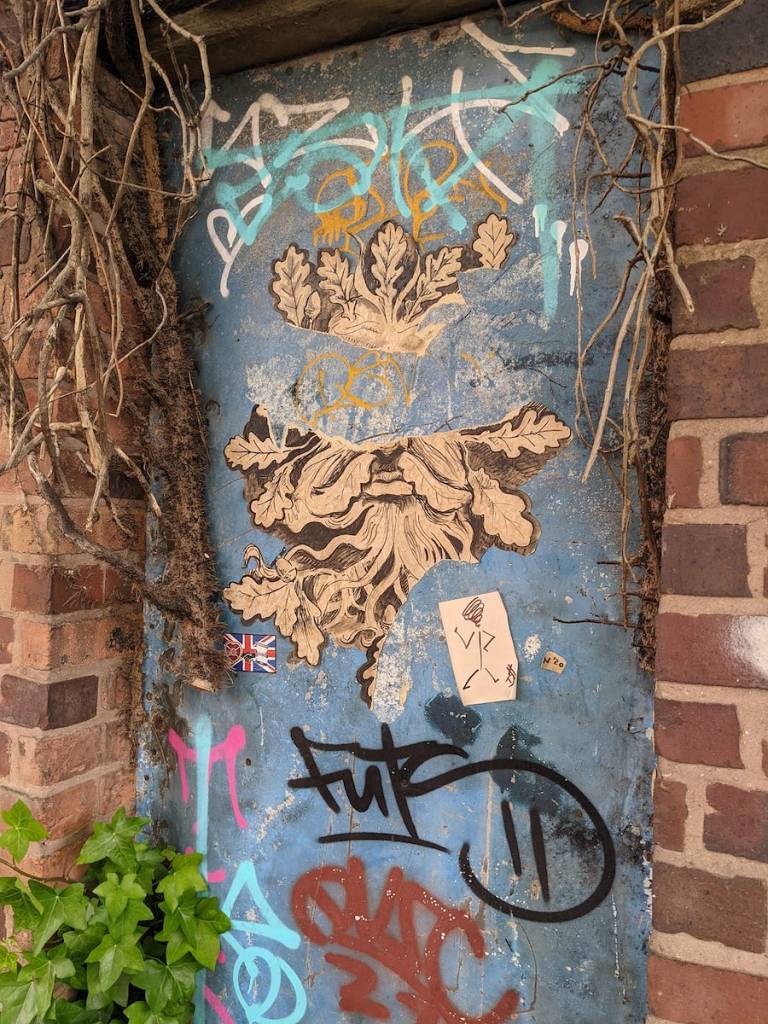
Have you seen a pepper pot like this one?
This walk begins and ends at Dudley Port Station. We shall enter the tunnel through the north portal, a twenty minute walk from the station. Assuming we all make it through, we shall emerge about 45 minutes later in Bumble Hole (grow up) nature reserve where we can drop by the visitor centre and use the facilities. The return journey will be above ground, tracing the route of the tunnel by walking between the pepper pot chimneys.
This is our longest Erratic to date by some distance: we estimate a 6 mile round trip. If you think you have what it takes, meet Andy and Andrew at the main entrance to Dudley Port Station at 10am, Saturday, 25th June. No need to book. Bring a torch, a packed lunch and sturdy footwear as the towpath can be uneven and wet in the tunnel. The terrain will be pavement, grassland, towpath and roads with some steep climbs on the way back. We aim to be back at Dudley Port Station by 2pm.
Any queries, email: andyhowlett@hotmail.com
The walk will go ahead whatever the weather. We recommend signing up to our mailing list and/or checking our social media feeds to stay informed in the unlikely event of a cancellation.
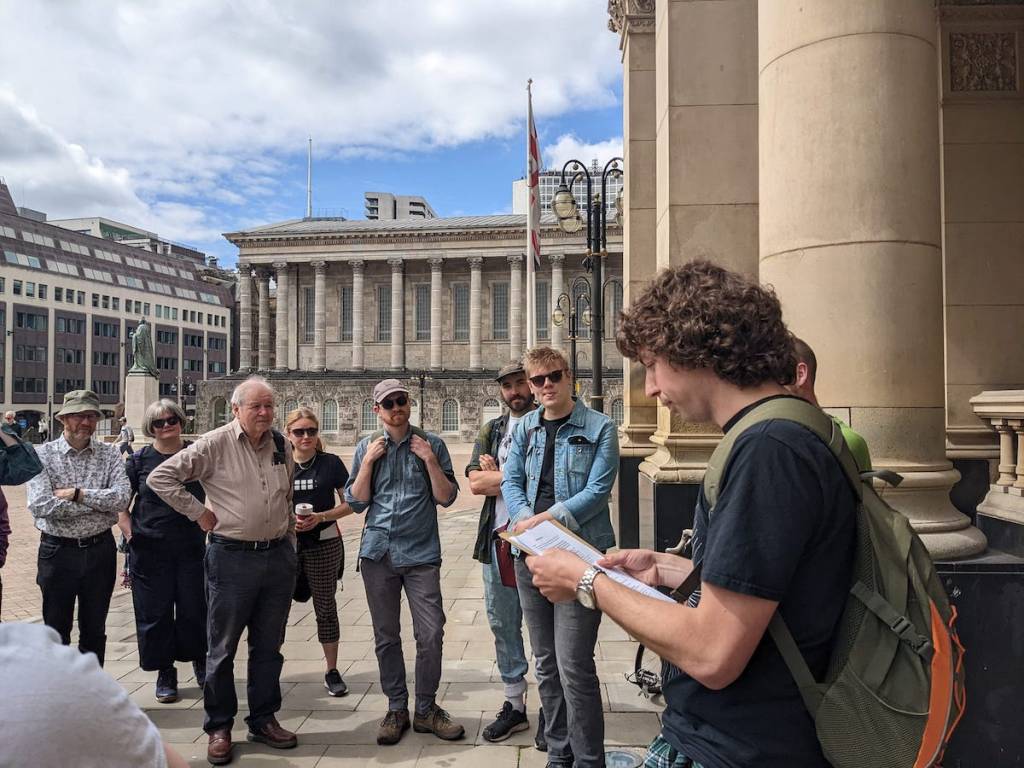
For May’s Erratic we teamed up with Flatpack Festival for a pilgrimage to Spaghetti Junction to celebrate its 50th birthday. We had a great turn out of 25+ people and the weather was kind, which all made for a delightful and profound day.
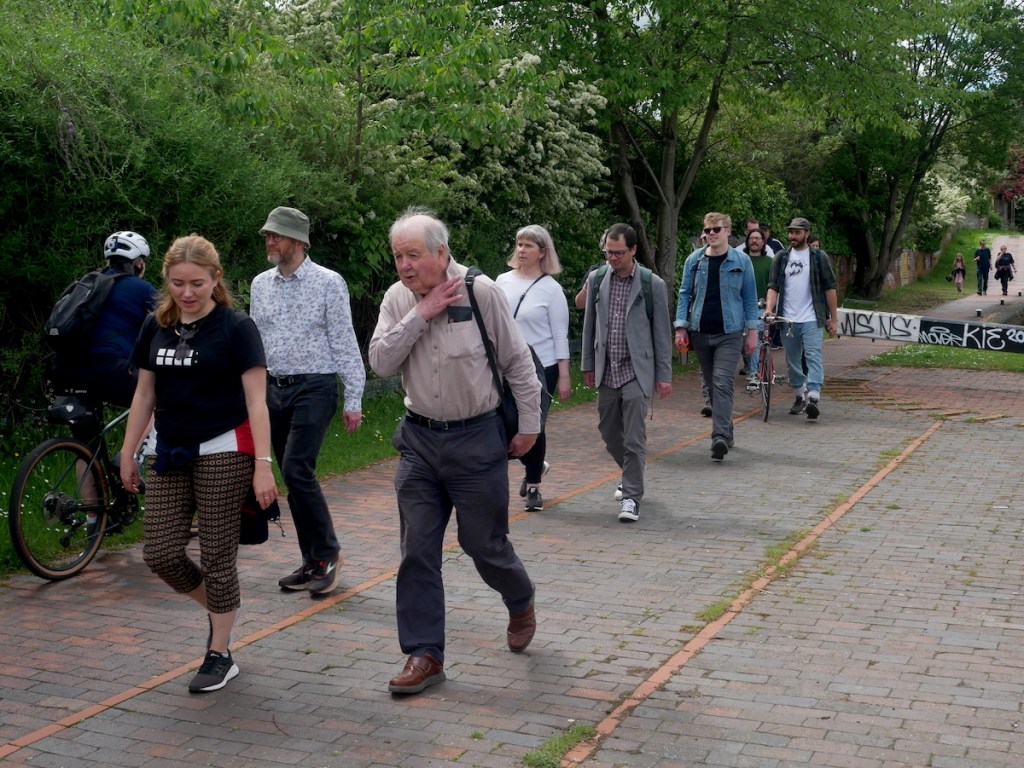
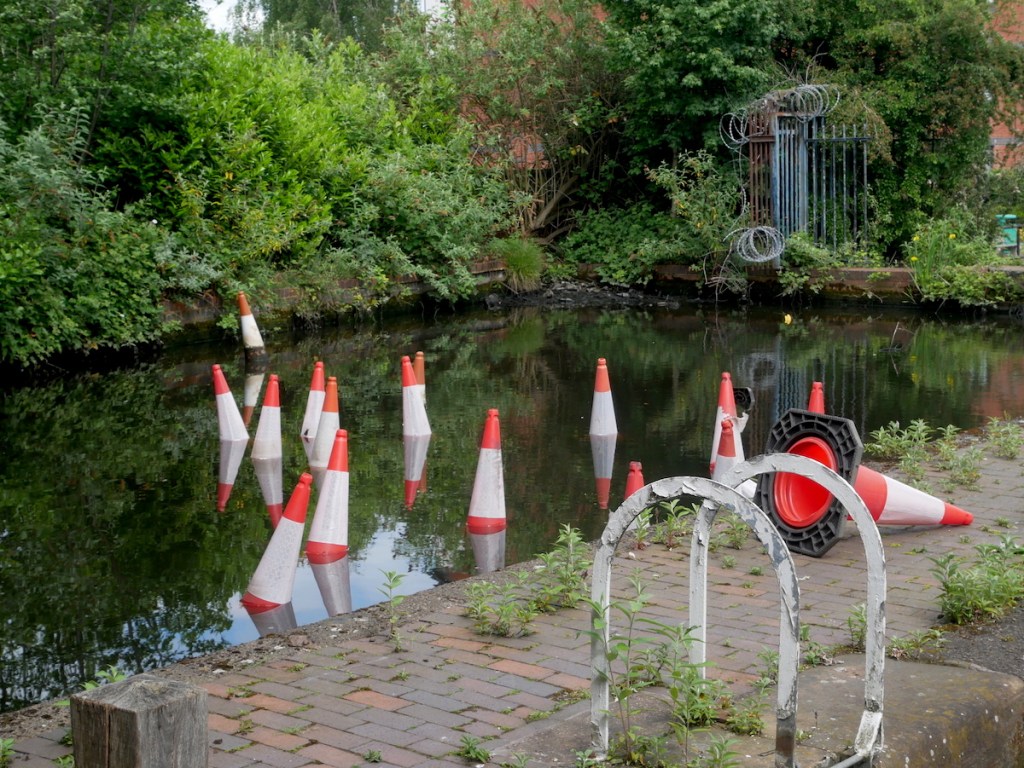
The walk began in Victoria Square and from there we made our way down to the Birmingham and Fazeley Canal which we then followed the rest of the way to Spaghetti Junction; a total distance of 3.5 miles. We took in the sights, basked in the sun and considered the significance of Spaghetti Junction as a “confluence of confluences”: a meeting point for two motorways, multiple trunk roads, three canals, two rivers and a brook.
Upon arrival we performed a sacred rite involving the music of Black Sabbath and water from the Grand Union Canal. This was in tribute to the artist Bill Drummond who witnessed a miracle here in 1973 and who chose this site to begin and end his ongoing twelve year world tour The 25 Paintings.
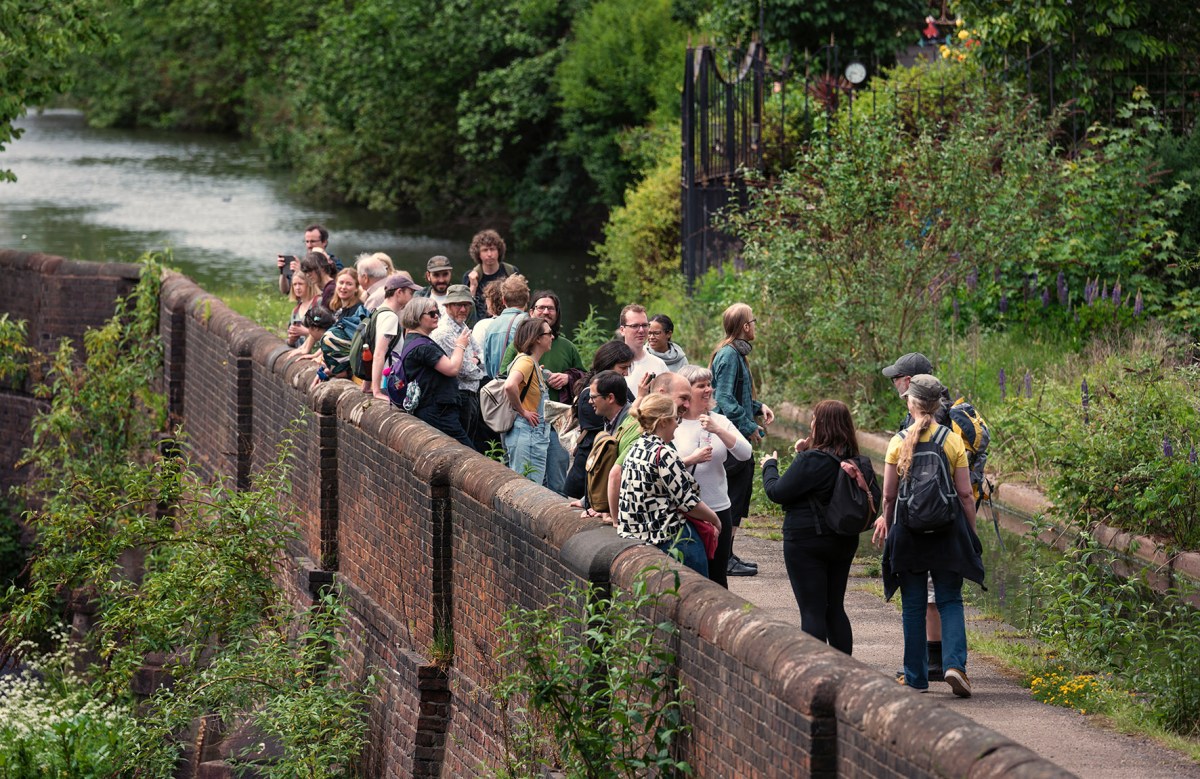
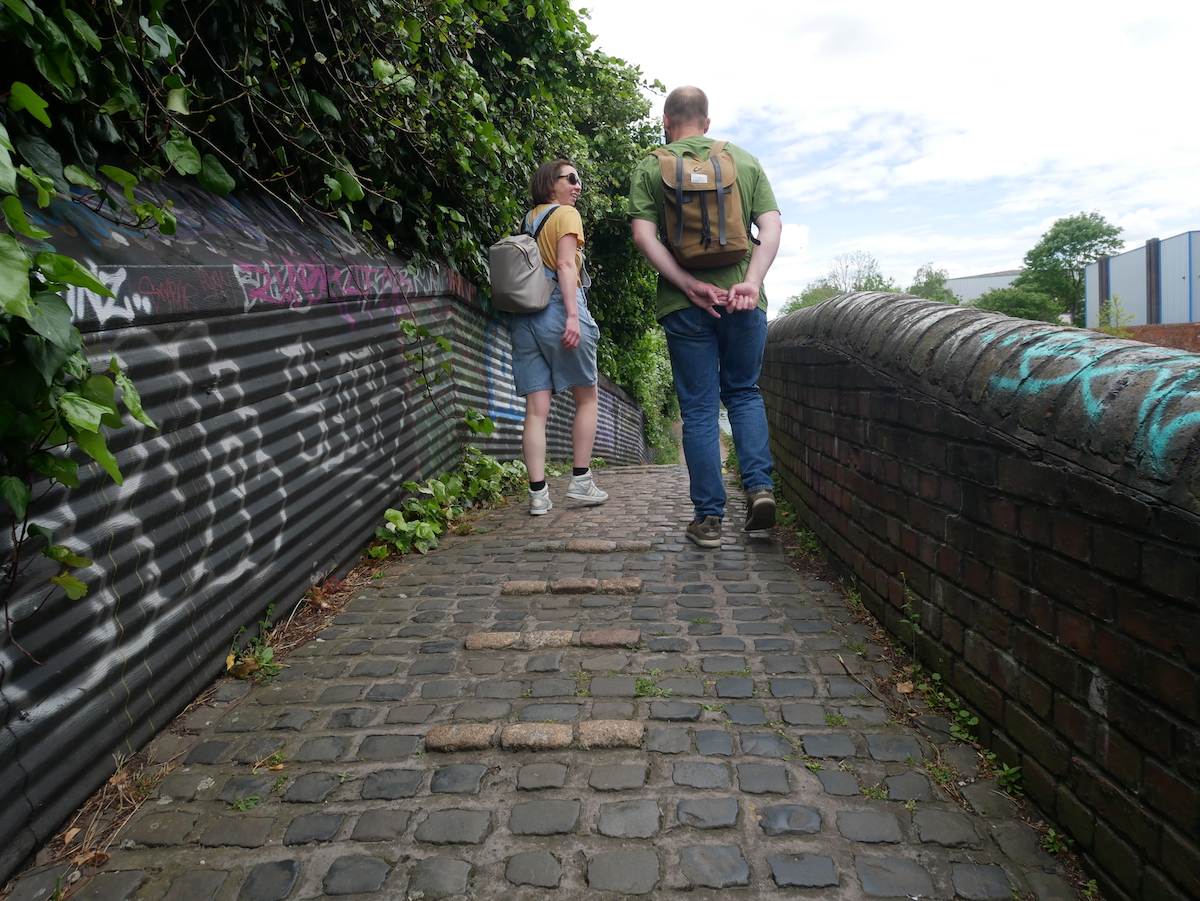
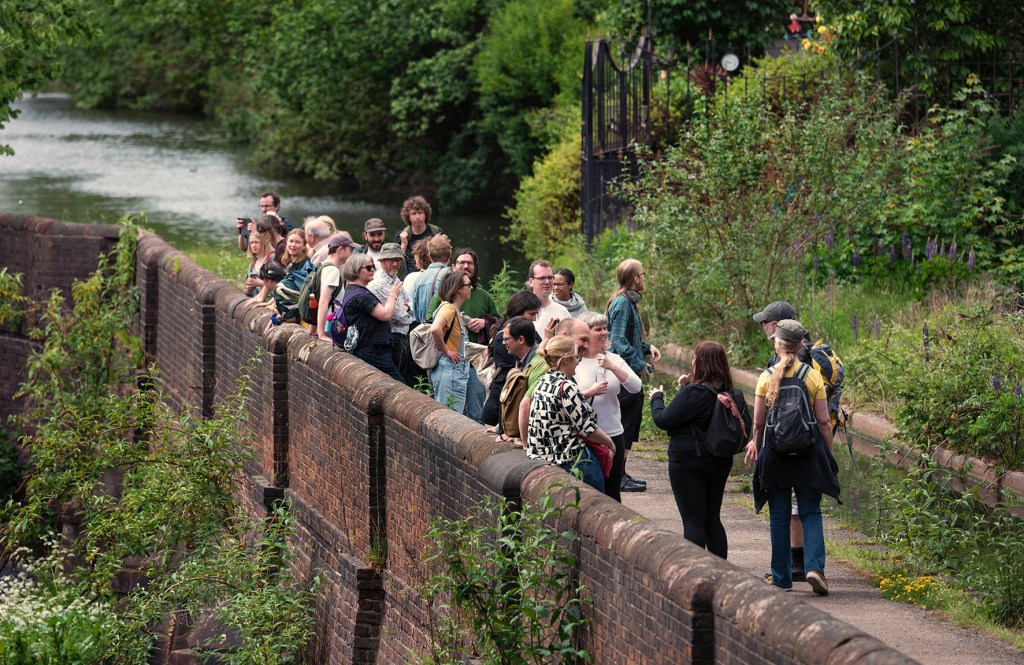
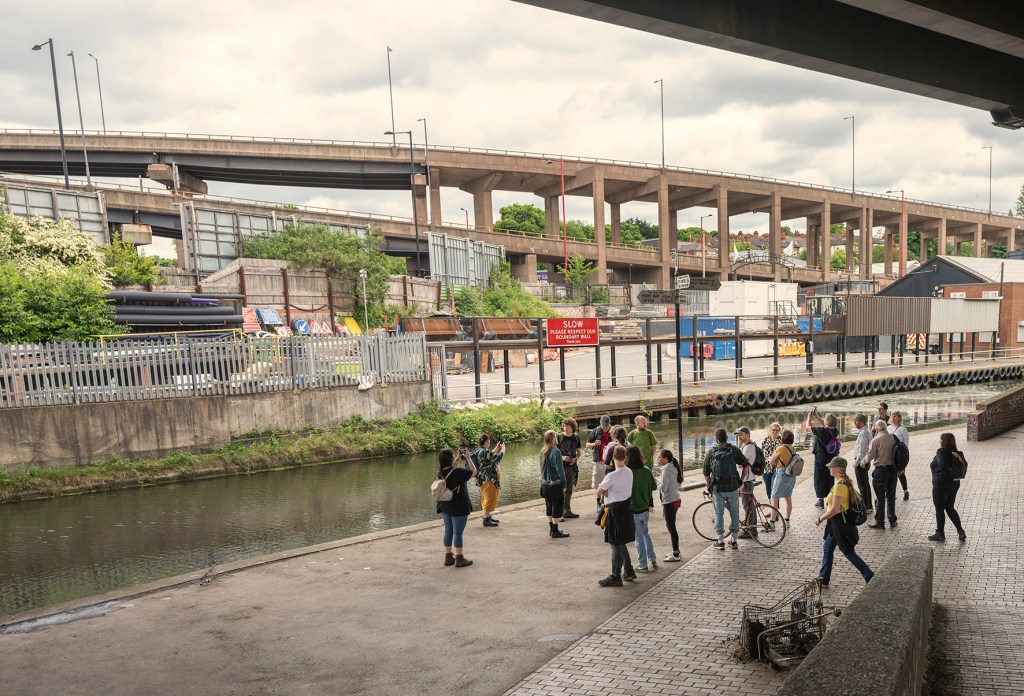
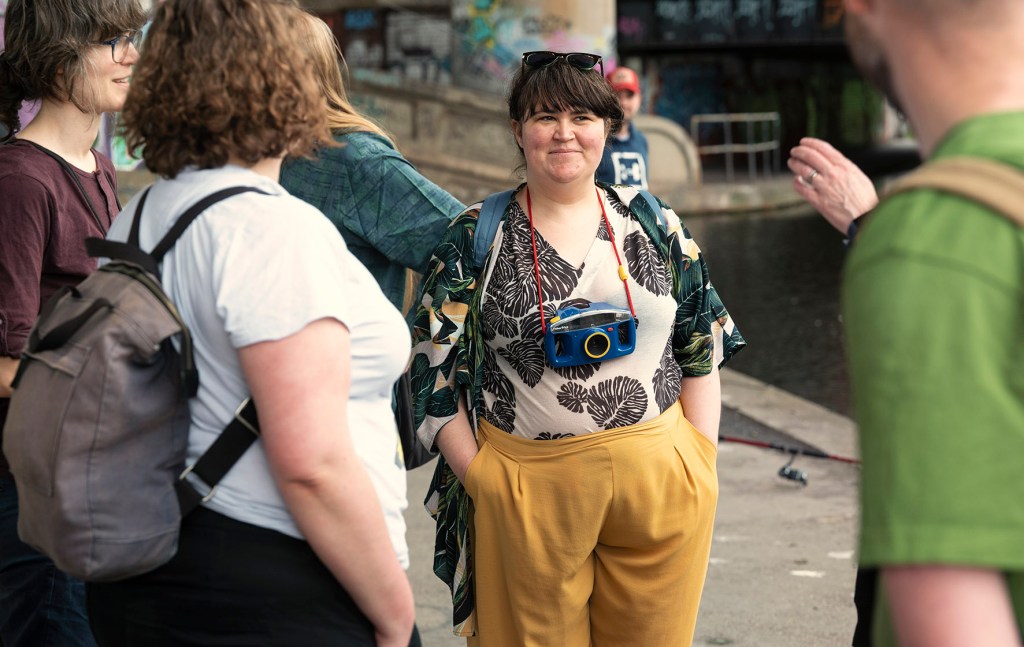
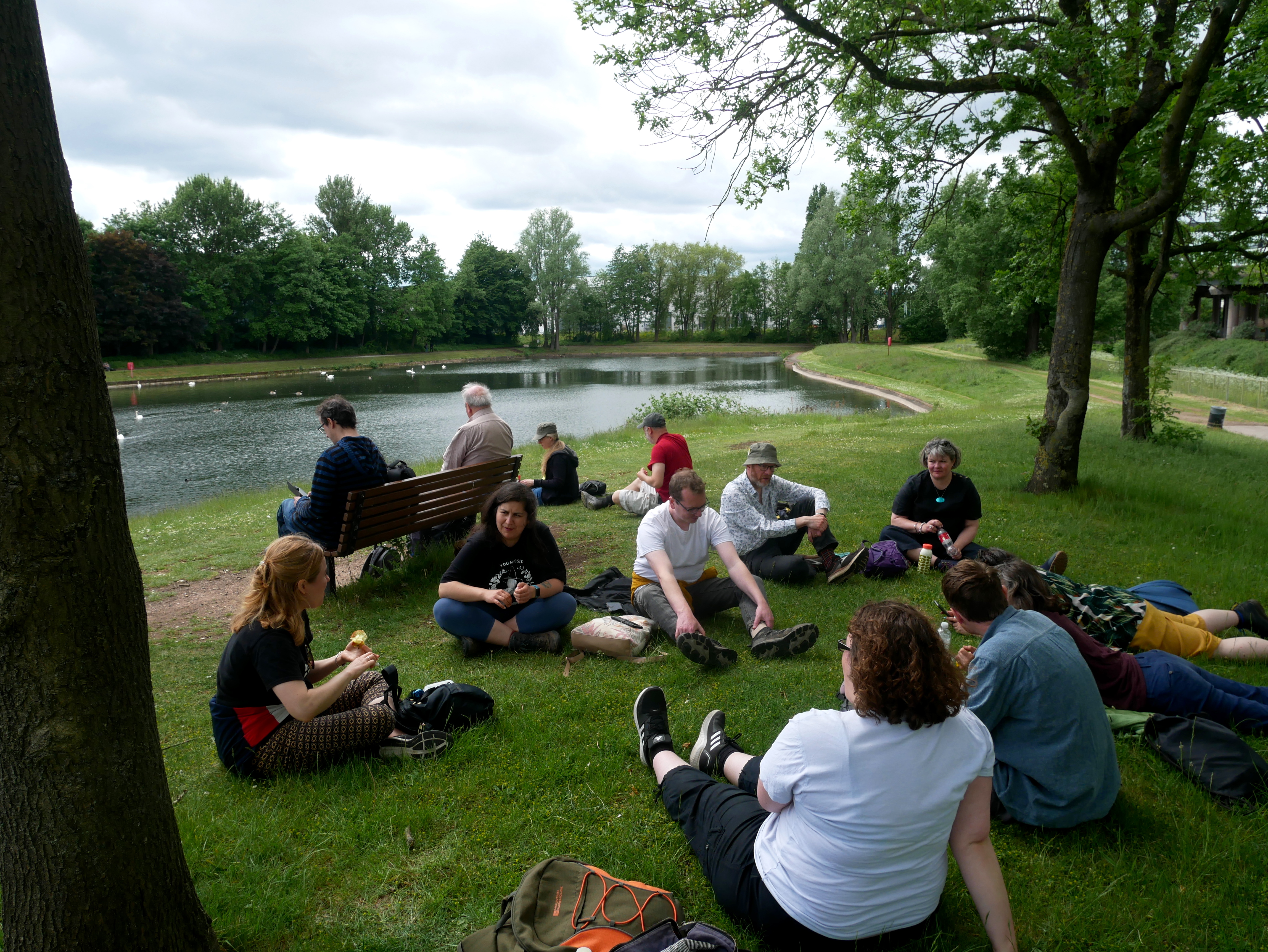
We finished with a picnic on the banks of Aston Reservoir before making our way back into town (by train this time) for the final night of the festival. We were fortunate enough to have the event documented by a professional photographer, the hugely talented Katja Ogrin and so we include some of her pictures below, alongside others taken on the walk. Thanks to all who came! Details of next month’s Erratic up soon.
Walkspace has a strong cohort of flaneurs, the “connoisseurs of the street;” urban roamers who stroll the streets and parks of the city. Who delve with delight into canalside tunnels and under brutalist bridges, who wander through suburban estates and industrial sites, who walk the concrete and tarmac ways in a quest for urban stories and strange erratics. Walkers who revel in the expression of human doing and being that a city is.
But there is a (very) tiny cohort of Walkspace members for whom urban roaming is trial rather than a joy. These are folks who delve into nettle infested woods, wander down rutted muddy tracks or stagger breathlessly up high tussocky hills. I am firmly in the second group. Having escaped 14 years of suburban and city living almost nothing could tempt me to walk its grey streets again, not even the pleasure of a Walkspace walk, with lovely Walkspace people.
(I really need to invent a name for rural flaneuring – considering all the livestock we encounter maneuring comes to mind)
So when Andy and Robson decided to host another Walkspace Erratic, I thought it would be fun to accompany the group, but at a significant distance. Herefordshire, where I live, has quite a few erratics of its own as ancient glaciers carved swathes across this landscape. I reached out to Kate Green, who I suspected is a fellow maneur and we hatched a plan to hunt down the Whetstone, a large erratic situated somewhere atop Hergest Ridge. We’d start our walk the same day and time as the Birmingham erratic walk and share pictures live on the Walkspace WhatsApp.
Hergest Ridge is the name of Mike Oldfield’s difficult second album and also a large hill, rising above the small town of Kington. It’s right on the border between Wales and England with Offa’s Dyke LDP traversing straight across its top. From the summit of the hill several barrows and hillforts can be seen on the neighbouring hills. Hergest Ridge has an elevation of 426m and if you ever fancy doing a spot of Marilyn bagging, Hergest Ridge should be on your list.
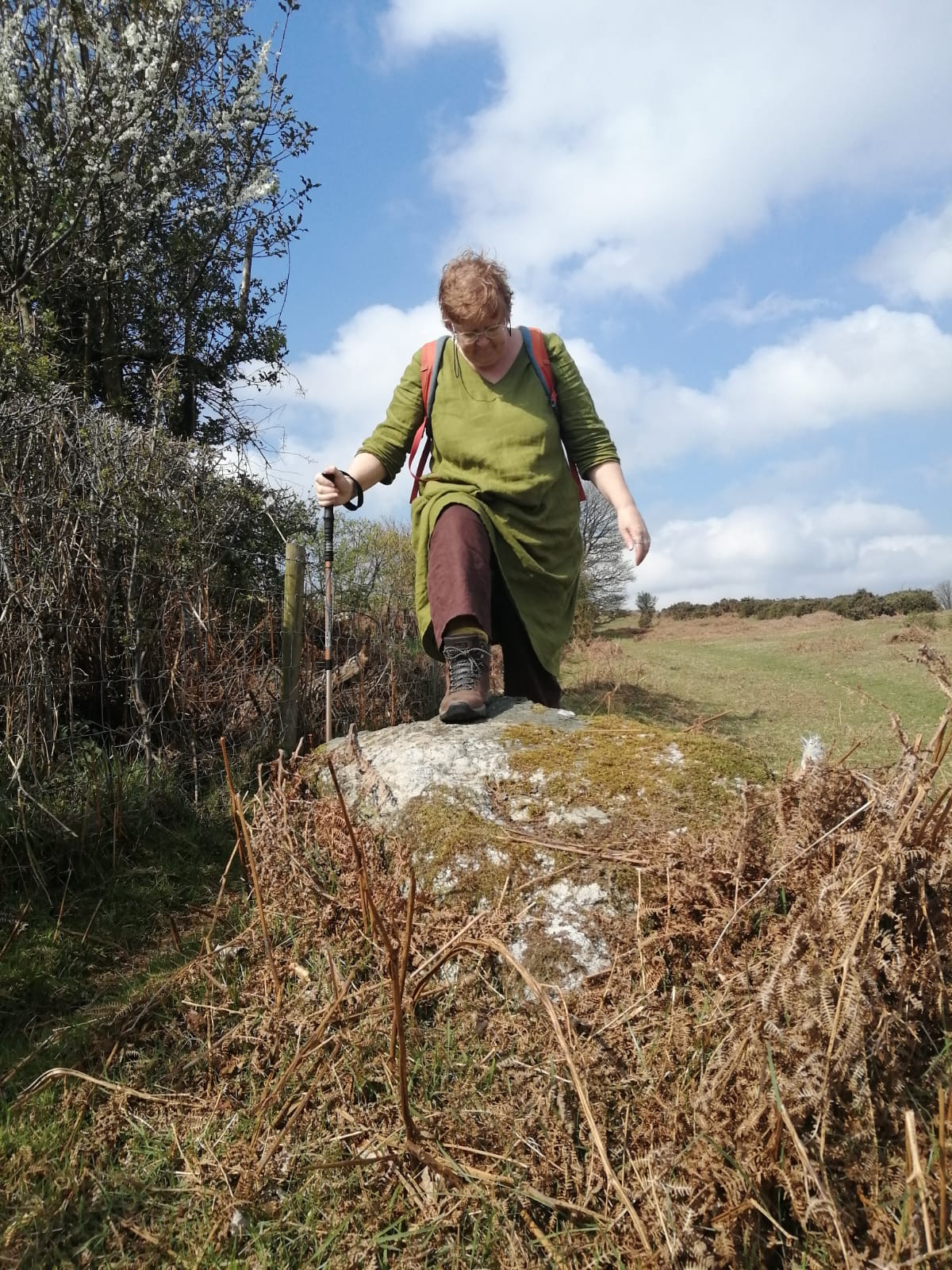
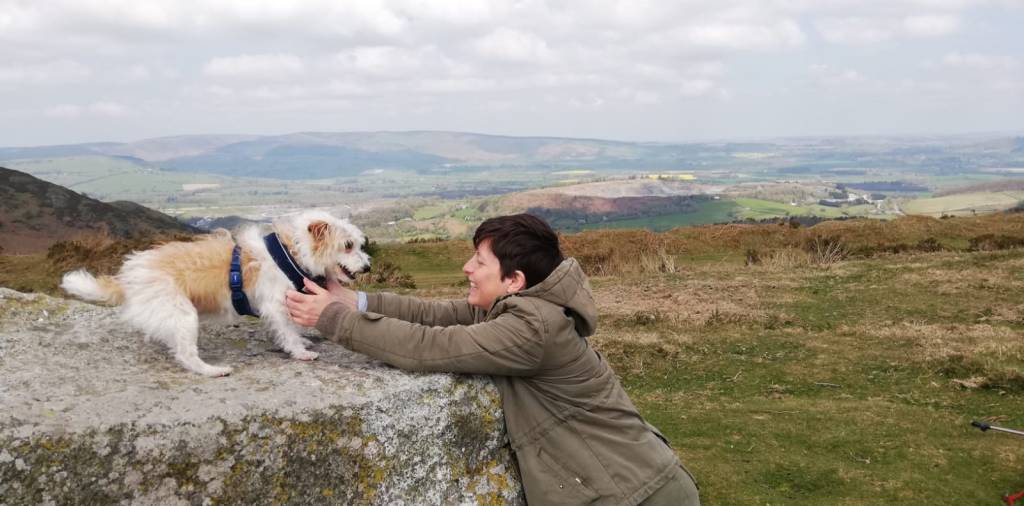
Kate drove us to Kington as I am still rather nervous of all the one-car-wide roads around here and we were joined on our quest by Dot, a small shaggy-haired bundle of irrepressible canine enthusiasm and joy. It was a steep trek from the carpark to the top of the ridge and while I laboured my arthritic joints up the slope, Kate went slightly mad and began spotting potential erratics left, right and centre. We knew the approximate location of the Whetsone (ie, it was on the hill) but we hadn’t really done any homework and just wandered erratically (ahem) over the landscape, enjoying the wind and space and the song of skylarks.
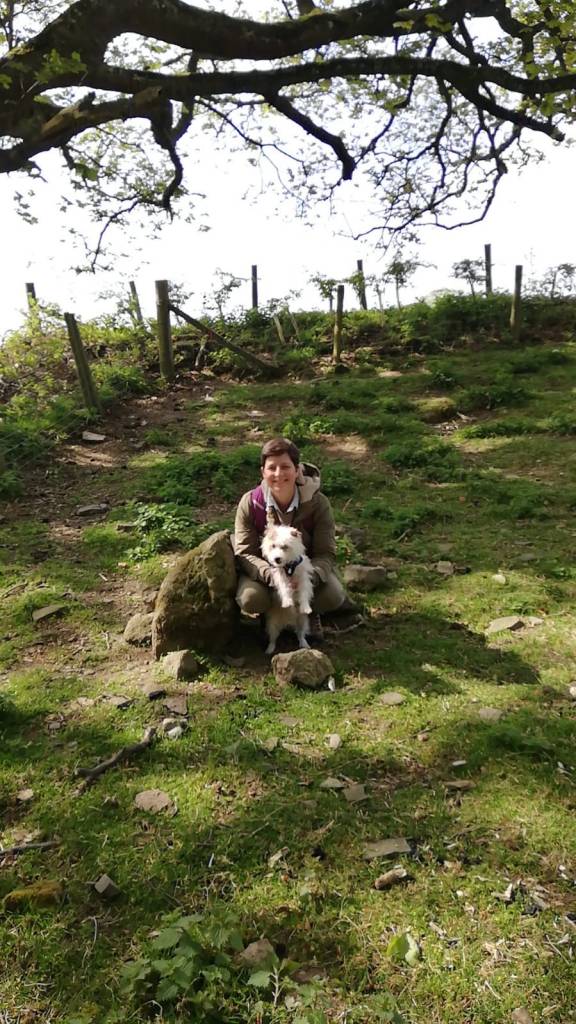
Kate and Dot…kruse
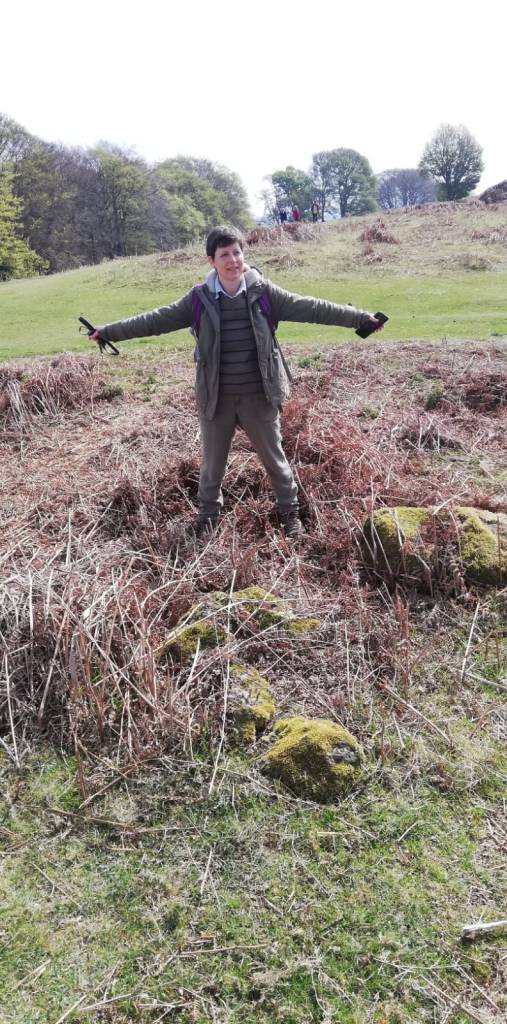
Soon Kate spotted more stones and we both began to flex our maneur muscles, tuning into the landscape of The Ancestors and divining a potential layout of tracks and stones that could be the remnants of an ancient stone circle. It actually got genuinely exciting as we discussed how the ancestors might have used the hill, imagining rituals and burials and ourselves following in the footsteps of those long dead, mysterious people who dotted the hills all around the Ridge with barrows, standing stones and hillforts.
All the while Dot bounded around, cheerfully sniffing and leaping onto the smaller stones, rushing everywhere with cheerful gusto. Despite only having six inch long legs I’m sure Dot covered more than twice the distance we did.
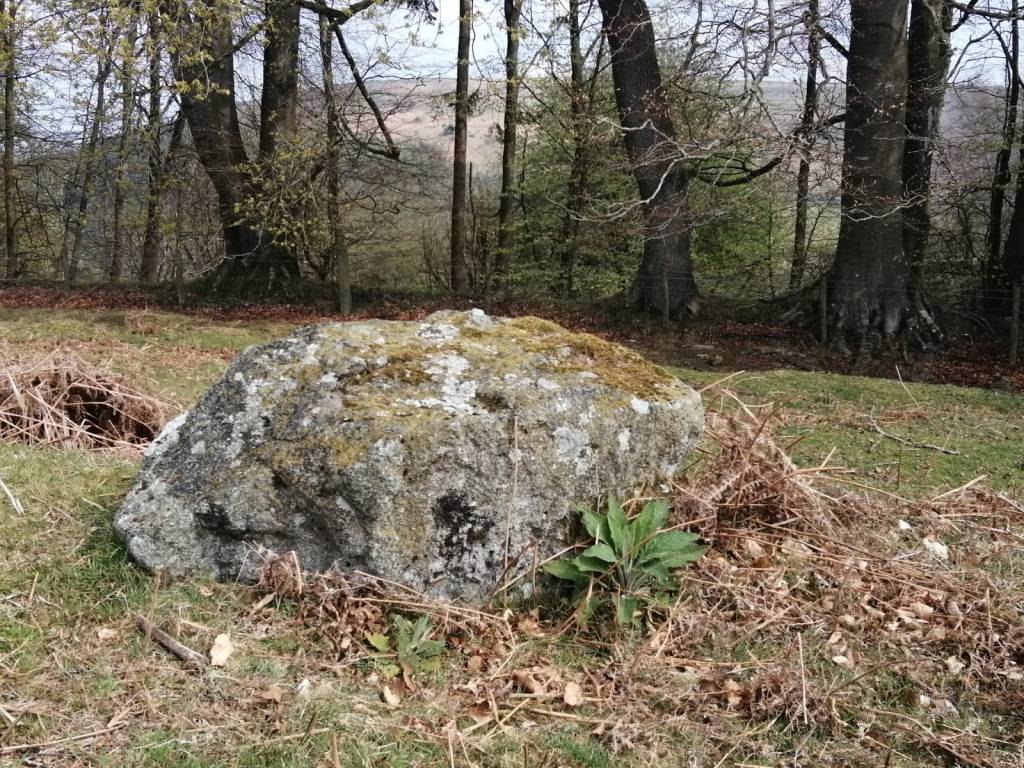
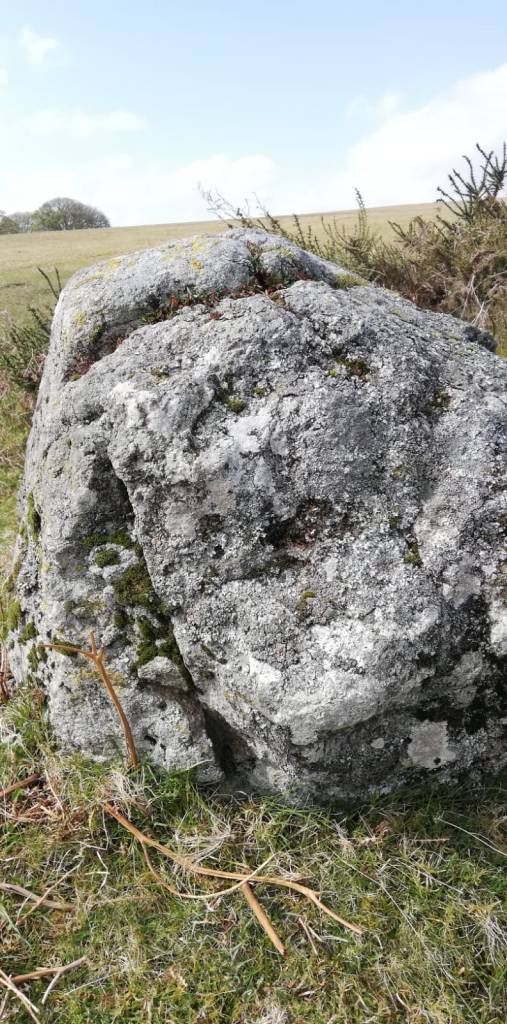
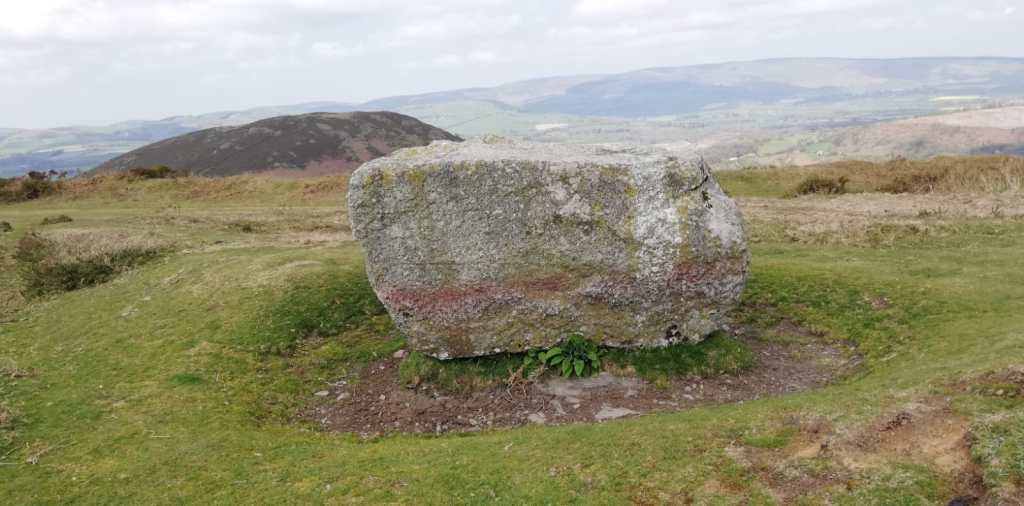
When we finally found the Whetstone itself I was astonished by how big it was. We wondered if it was completely natural, or if it had been carved in any way. Kate found a portion of the stone that seemed to form a perfect and comfortable seat. Maybe it had been a King’s Seat once? We knew the stone had played a significant role in the history of the local people and had once been a place where food had been distributed to lepers, which seemed rather hard on the lepers, considering its elevation.
It was really nice to be walking at the same time and on the same quest as the Birmingham based cohort and I for one would really like to do something like this again. Perhaps a canal versus river walk or a rural v urban industrial walk. Although quite honestly, any walk that includes Dot (and Kate!) would be a walk worth doing.
…kruse is a neurodivergent, experimental artist and writer, whose practice includes drawing, writing, storytelling and phenomenological research.She is interested in the connections between landscape, mythmaking, magic and story.For more of her writing see her excellent Wayfaring blog.
For May’s Erratic we’re delighted to be teaming up with Flatpack Festival for a pilgrimage to the almighty Spaghetti Junction. Two days after Flatpack draws to a close, Gravelly Hill Interchange (to give it its formal title) will celebrate its fiftieth birthday. That hallowed day in 1972 when environment minister Peter Walker cut the ribbon was a defining moment for Birmingham’s motor city ambitions. Since then it’s fair to say that the junction has been on a bit of a journey, but whether you love it or hate it this is surely a moment worth marking.
In its time Spaghetti Junction has been mythologised as both a cathedral to the car gods and as a gateway to hell. It’s evidently a place of great significance for the city, for better and for worse, but perhaps its main resonance is as a place of confluence. Gravelly Hill is the meeting point of two motorways, several trunk roads, three canals, two rivers and a brook. It’s been a site of crossings and convergences for centuries and it was once the source of Birmingham’s drinking water.
Throughout history and across cultures, river confluences and sources have been revered as sacred sites and pilgrimage destinations. Temples have been built over them, sacred rites performed and ritual bathing observed. At 50 years of age, it seems right that Birmingham’s own super-confluence receives pilgrimage status. Pilgrimage sites are understood as places where miracles happen and visions are received. In 1973 the artist Bill Drummond had an ominous heavy metal vision while stranded beneath Spaghetti Junction in the dead of night. Since 2014 he has returned to the site at least once a year. Did he witness a miracle? Will we?
Our pilgrimage will begin in Victoria Square at 11am, Sunday 22nd May. Meet outside the entrance to the Council House – no need to book. The walk from town is about 3.5 miles and will take around 2 hours. There are frequent buses and trains back to the city centre. The terrain is mostly pavement and towpath with some uneven and sloping sections, cobbles and narrow tunnels. Those who wish to pay homage but don’t fancy the walk can join us at Salford canal junction* at 12:45pm.
Those who wish to picnic on the shores of Aston Reservoir should feel free to bring a packed lunch. Unless the weather is truly apocalyptic, the walk will go ahead. Please note the pilgrimage is one-way only. Return will be by public transport. Nearest train station is Aston. Buses back to city centre are 65 and 67 from Salford Stadium. Any queries please email: andyhowlett@hotmail.com
Salford Junction
*Salford Junction can be accessed via Lichfield Road just before Salford Circus
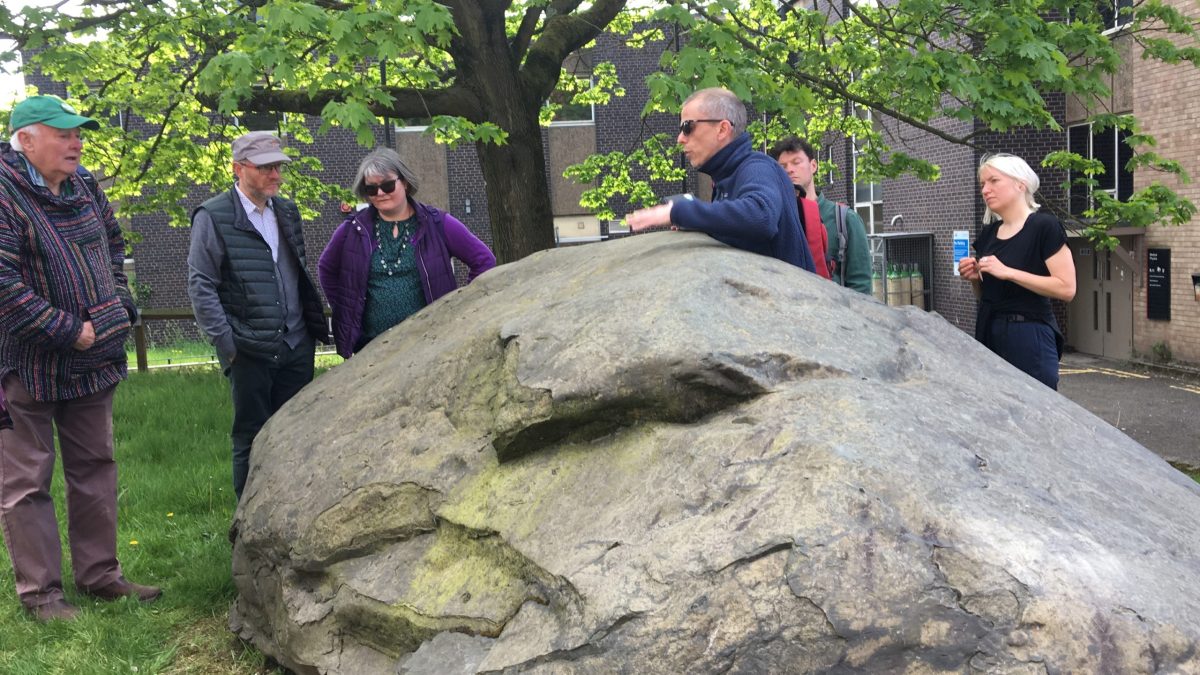
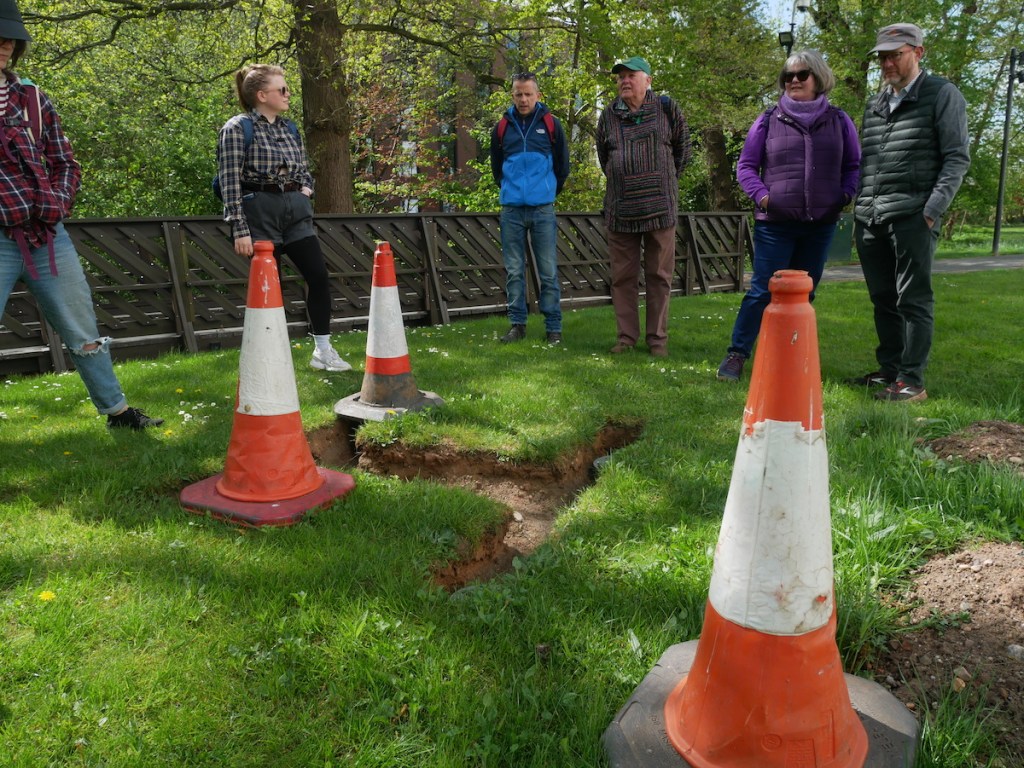
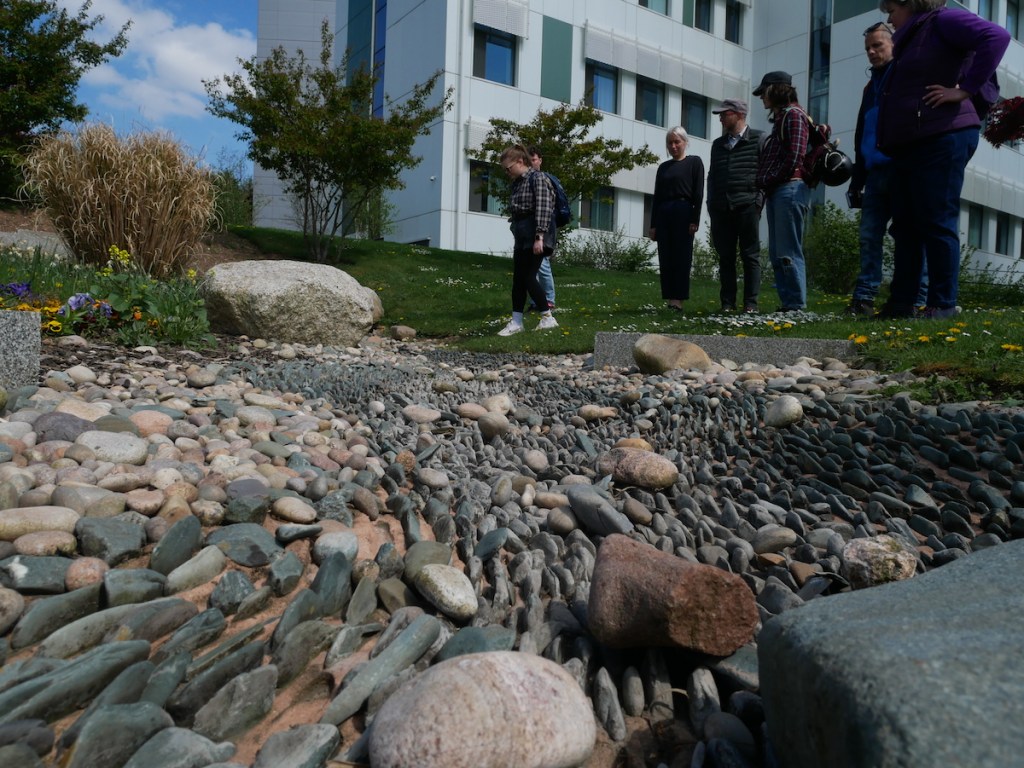
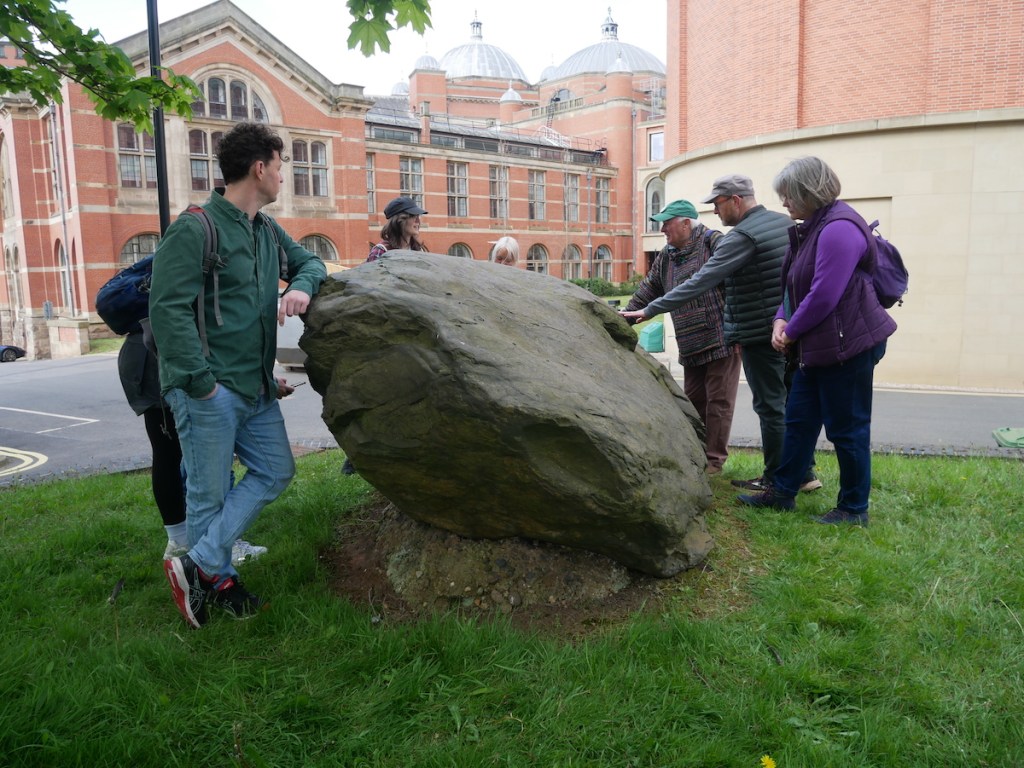
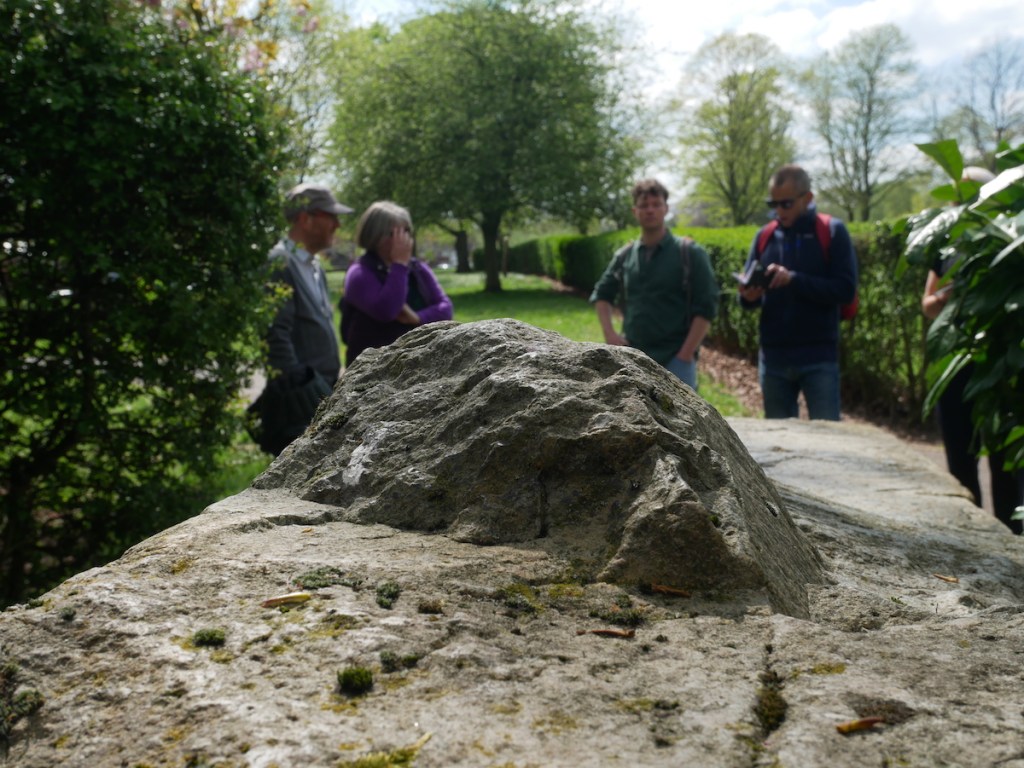
We relaunched The Walkspace Erratics last Sunday with a delightful springtime boulder hunt. We took the name “Erratic” from the glacial erratic boulders which were deposited across the region in an ice age 450,000 years ago. Robson and Andy felt it was time to pay tribute and so devised a walk from Cannon Hill Park to Selly Oak Park via The University of Birmingham.
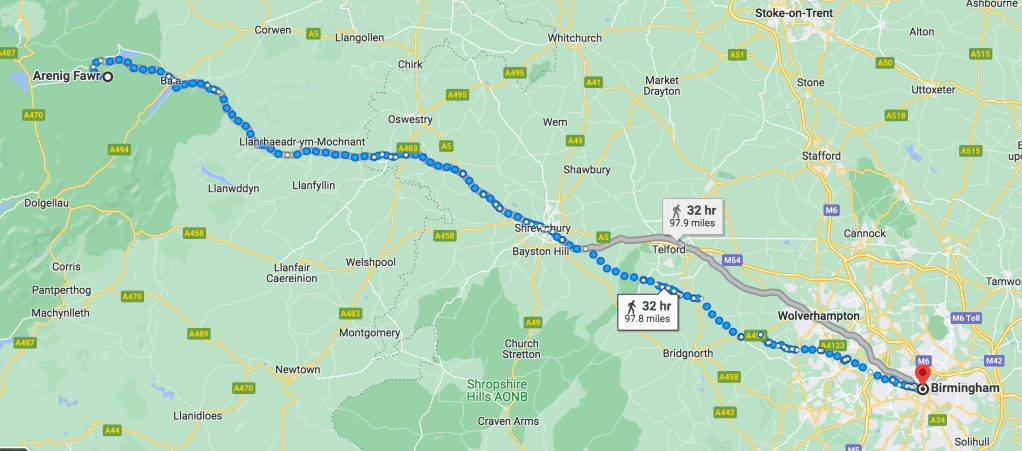
The boulders were formed in a volcanic eruption 450-460 million years ago and later travelled from the Arenig mountains in Wales to the West Midlands on an ice sheet. Eons passed, the ice retreated and the boulders now litter the alien shores of 21st Century suburbia. They can be found lurking in parks, graveyards, roadside verges, beer gardens and hidden in walls and buildings.
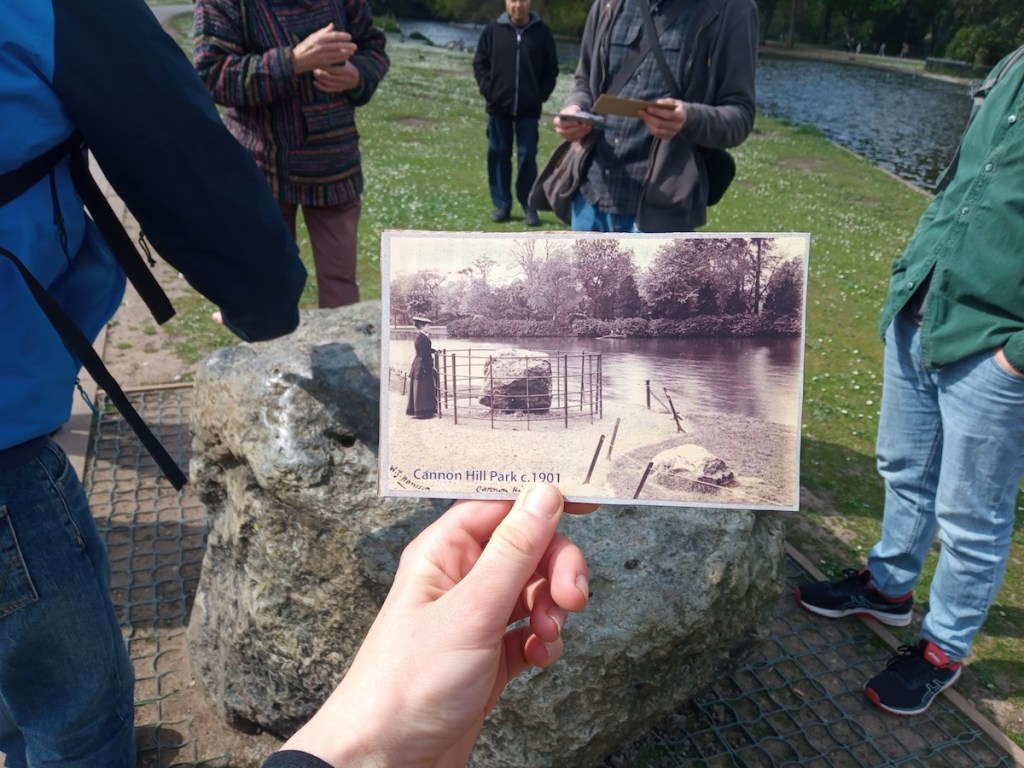
The word “erratic” comes from the Latin errare meaning to wander, roam or stray. The restless rocks are still on the move: many have disappeared since the great age of discovery in the 19th Century. The picture below shows the Cannon Hill Park boulder in 1901 and beside it is another, smaller boulder. The main boulder remains but its little cousin has upped and left. Forget Paris, the original flâneurs are here (for now).
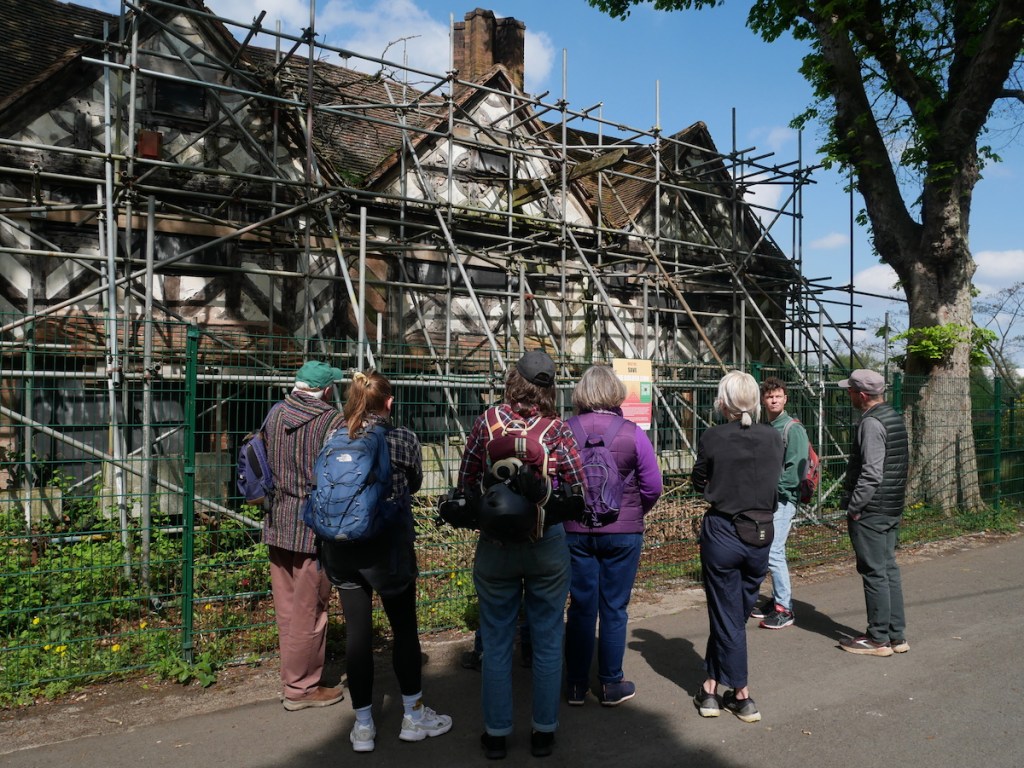
The concept of “roaming heritage” doesn’t just apply to boulders though; Cannon Hill Park also contains erratics of a very different kind. The Golden Lion Inn hasn’t travelled quite as far as the boulders but it has moved further than most buildings are likely to. A rare 16th Century survivor, it originally stood on Deritend High street, two miles away. In 1910 it was dismantled and removed to make way for a road-widening scheme and then re-erected in its current location and used as cricket pavillion. It was listed in 1952 and then left to fall to ruin. The support scaffolding is now as much a part of the building’s heritage as the C16 timbers.
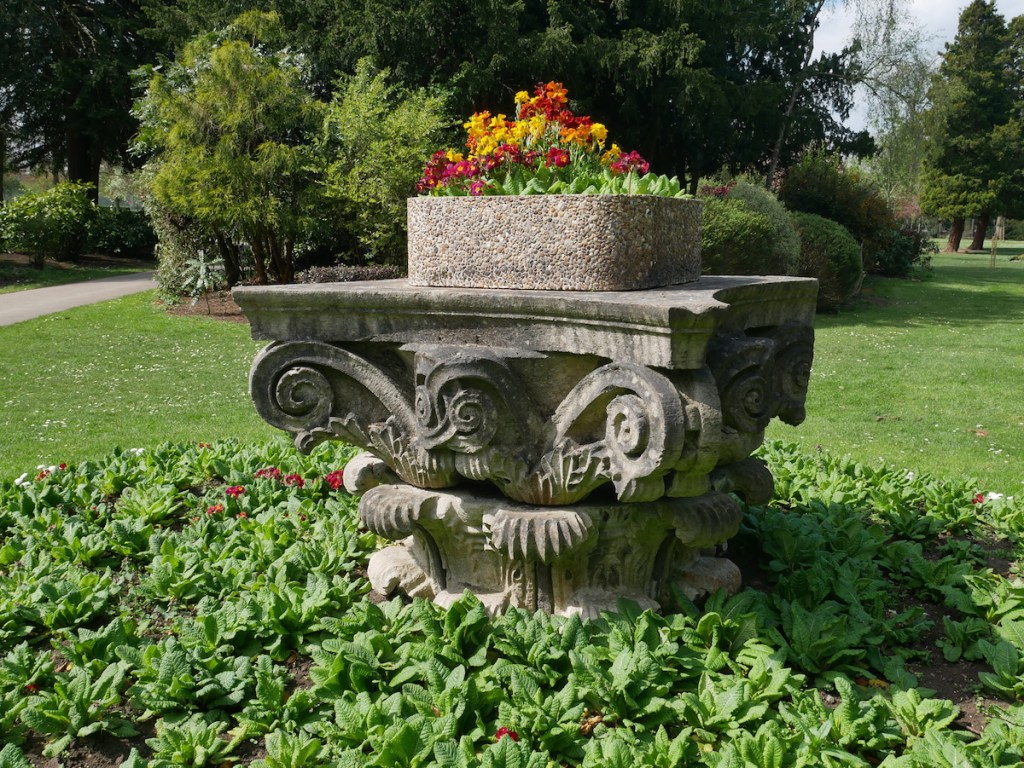
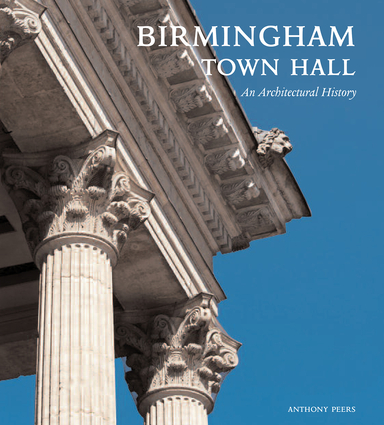
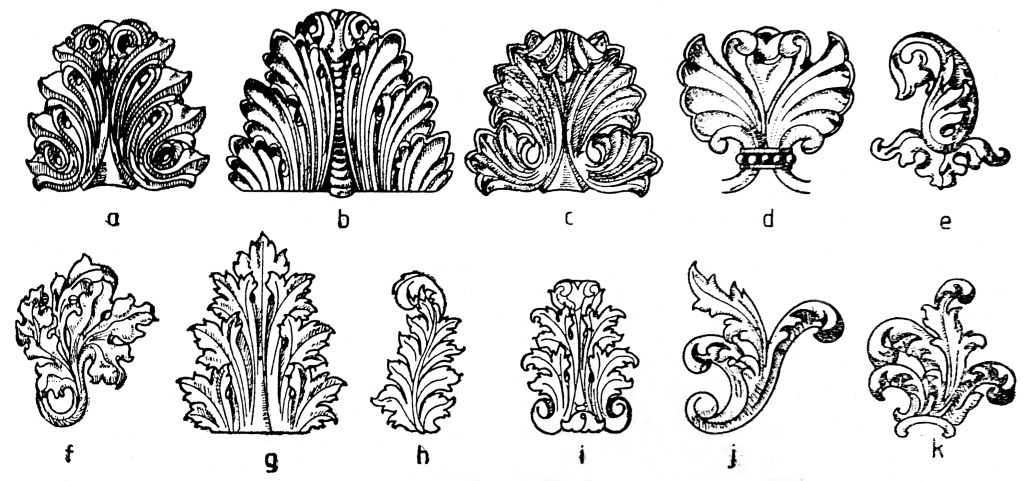
A few hundred yards away, beyond the crazy golf course, you’ll find two more “erratics” hiding out as flowerbed ornaments. These ornate stone structures are in fact spare parts from the Town Hall in the city centre. They’re called capitals, ie. the bits at the tops of columns, as seen here on the cover of Anthony Peers’ book.
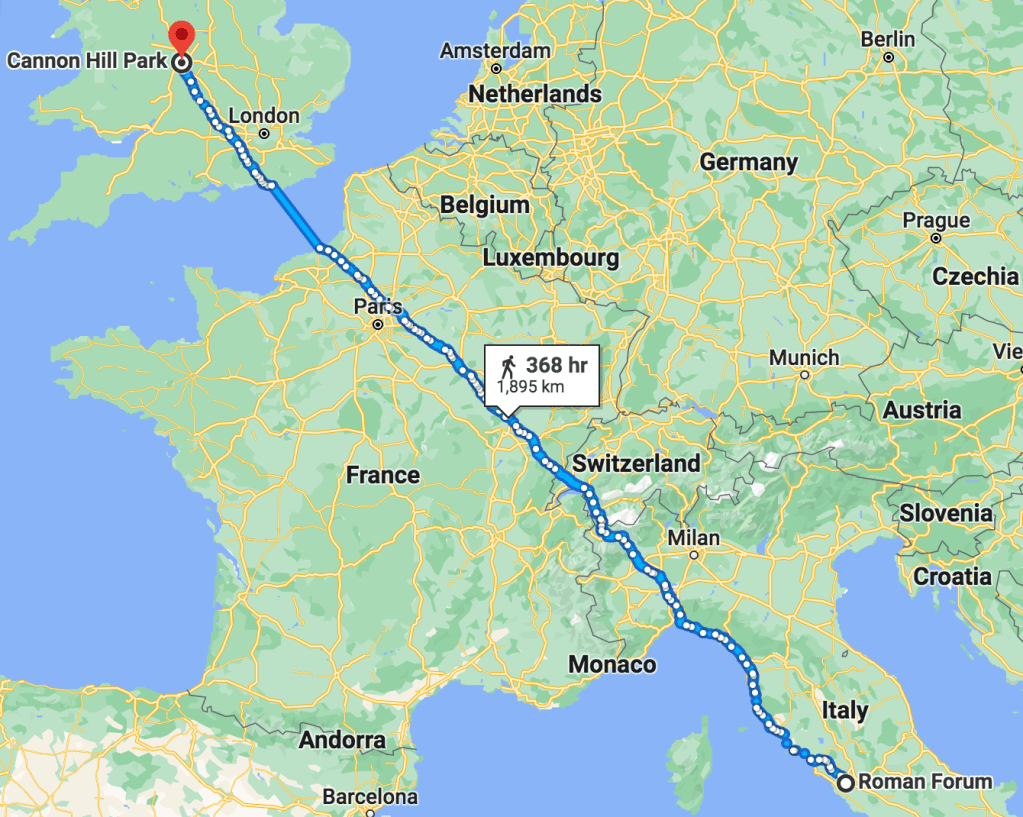
The capitals may have only travelled a couple of miles but the Town Hall itself is a copy of the Temple of Castor and Pollux of ancient Rome. The leaves in the design are acanthus, a genus native to the Mediterranean and one of the most commonly occurring motifs in classical architecture.
To quote Crab Man: “Once you become sensitive to these ‘erratics’ you will begin to navigate a landscape from which such anomalies, large and small, repeatedly pop up.” (Counter-Tourism: The Handbook, 2012, pg 137)
The boulders cover far more ground than we were able to in a single day so there are plenty left for future walks. Stay tuned for more boulder action but in the meantime we hope you can join us for our next Erratic, a pilgrimage to Spaghetti Junction with Flatpack Festival on May 22nd.
We named our series of public walks the “Erratics” after the glacial boulders that were deposited across South Birmingham in the ice age. For our first Erratic of 2022 we thought we’d visit some of these boulders to pay tribute. The rocks cover more ground than we can in a single walk so we imagine this will be the first of many.
Originally formed in a volcanic eruption 450-460 million years ago, the boulders later travelled on an ice sheet from the Arenig mountains in North Wales to the West Midlands: a distance of nearly 100 miles. When the ice melted around 400,000 years ago, the boulders remained and can now be found dotted around the suburbs in parks, graveyards, roadside verges and hidden in walls and buildings.
The word “erratic” comes from the Latin errare meaning to wander, roam or stray. You may think the boulders have remained stationary since the glacier retreated but no, they’re still on the move. Many have been dug up and moved for purposes of development and more still seem to have disappeared without a trace. Northfield’s “Great Stone” has to be kept in a walled enclosure to ensure it stays put.
At Walkspace we feel a great kinship with these geological flâneurs but what other examples of “roaming heritage” might we discover on our walk? What other artefacts have travelled distances great and small to wash up on the alien shores of 21st Century suburbia? Join Andy and Robson for a journey into deep time and discover your own inner-erratic along the way.
Where? When?
Meet outside the Midlands Arts Centre, Cannon Hill Park next to the little silver pyramid at 11am, Sunday 24th April. The walk will cover a distance of about 2.5 miles, lasting around 90 minutes and finishing at Selly Oak Park. The terrain will be pavement and grass with a couple of steep inclines. No need to book, just turn up. Except in the event of unceasing torrential rain, the walk will go ahead.
Any queries? Please email: andyhowlett@hotmail.com
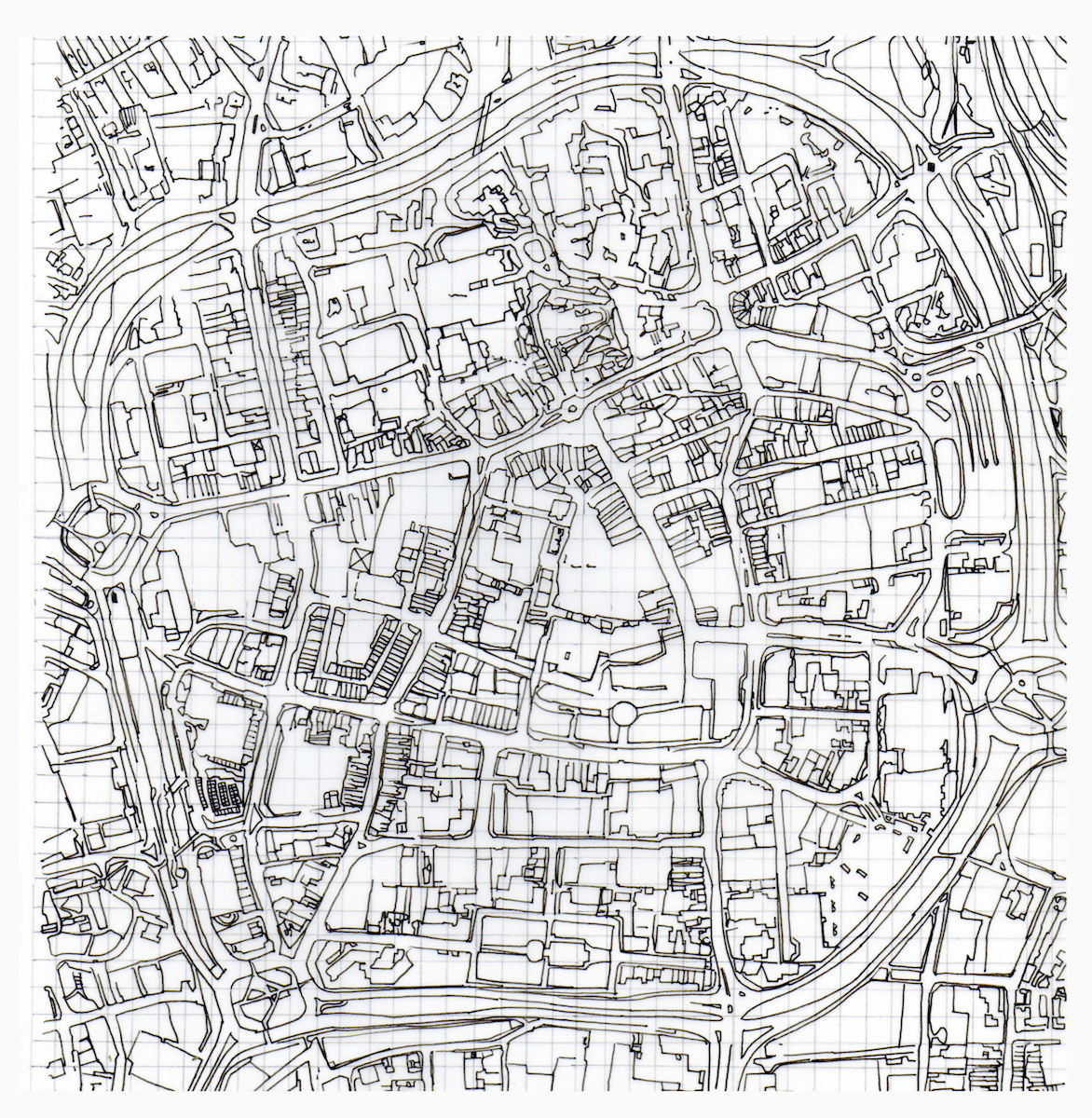
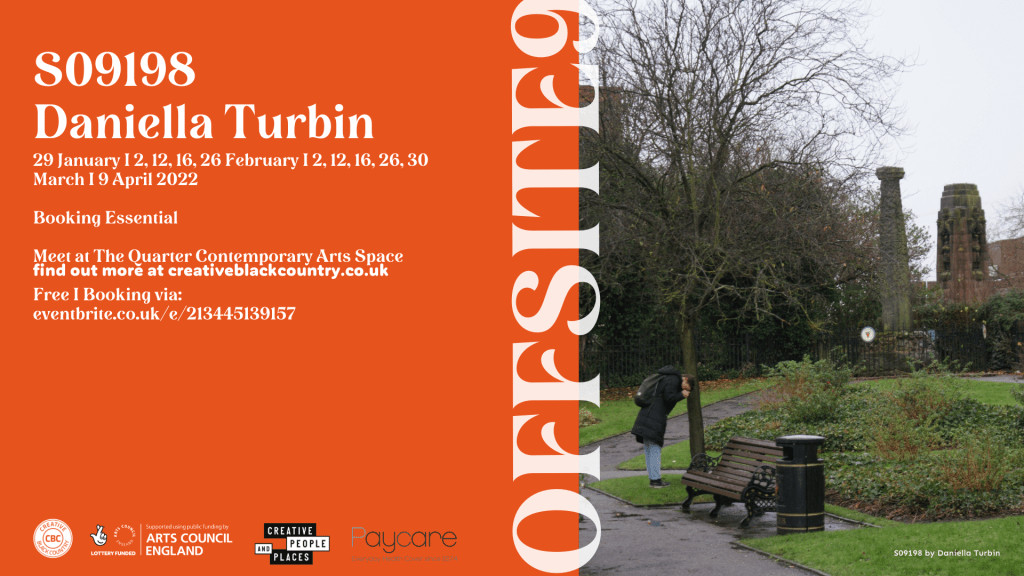
Join local artist Daniella Turbin for a walk around the City of Wolverhampton. S09198 is the unique grid reference for the centre of the City of Wolverhampton, and throughout the duration of British Art Show 9 you are invited to explore every underpass, street, and building within this one kilometre square.
Sign up to take a walk with the artist and together map and record the city through photography and walking. This project will take place throughout the duration of British Art Show 9, and will finish with the creation of a public map of the city on the scale of 1:100.
The remaining dates are: March 2nd, 12th, 16th, 26th, 30th, and April 9th. Walks are scheduled between 9.30 to 17.30 and last approximately 90 mins, they start and finish at The Quarter Contemporary Arts Space. The walks are free but booking is essential.
This OffSite9 project has been commissioned by Creative Black Country as part of Arts Council England’s Creative People and Places scheme, and supported by Paycare.
We are delighted to announce that the first ever Walkspace short film night will be taking place this Thursday, 17th February at Artefact in Birmingham. Our collective of walking artists has ballooned since our humble beginnings in early 2020 and this event will showcase some of the moving-image work produced by the membership.
Expect hand-drawn animations, video-essays and super 8 pilgrimages, covering everything from motherhood, walking in lockdown, wild swimming, “extreme noticing” and the Cinderloo uprising of 1821. Featuring work by Adele Mary Reed, Andrew Howe, Fiona Cullinan, Daniella Turbin, Laura Babb, Andy Howlett, Rachel Henaghan and Pete Ashton.
The night kicks off at 7pm and admission is on a pay-what-you can basis. Tickets on the door.
Cover image from “Mother Anglia” by Adele Mary Reed
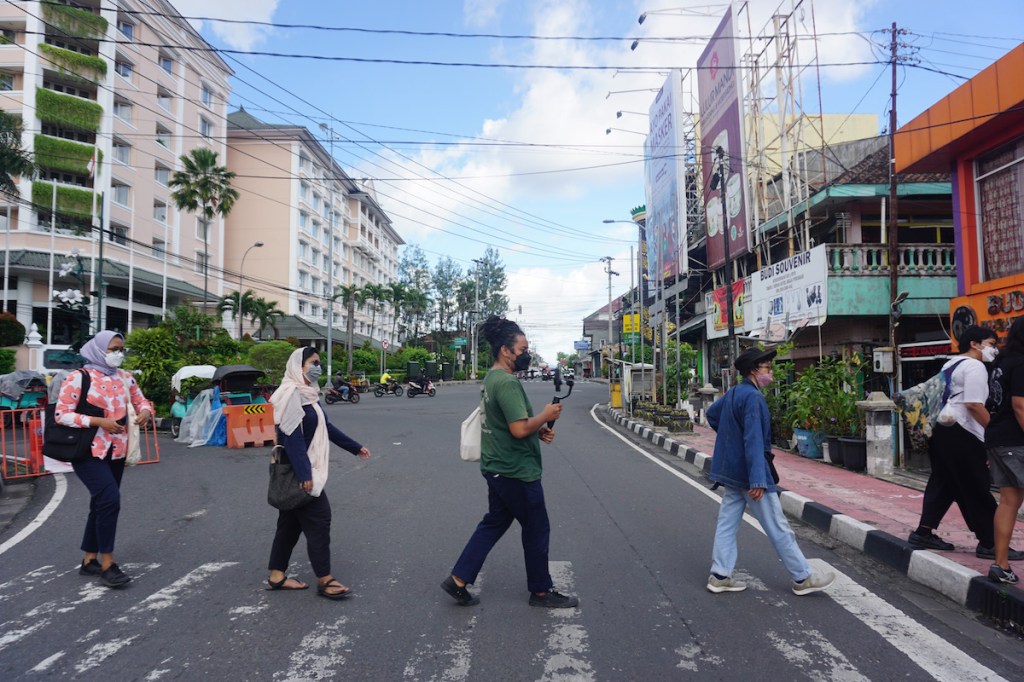
Two walk-based art collectives over 7,500 miles apart have been walking in parallel to see what pedestrian life is like in each other’s motor cities. Now they are sharing their stories in a new exhibition and zine, launching in both countries in February 2022.
The British Council-supported project brought Walkspace in Birmingham, UK, together with Jalan Gembira in Yogyakarta, Indonesia, for a cultural creative exchange through the act of walking. Artists in both cities explored themes such as pedestrian safety, public versus private space, gentrification/redevelopment, and the nature of walking.
What is it like to walk in a city dominated by cars and mopeds? What pedestrian portals lie off-road where drivers can’t go? Is it safe to walk alone? What lies behind the scenes?
The result is ‘Parallel Walking: Between Here and There, Between the Seen and the Unseen’ – an exhibition and zine comparing Birmingham and Yogya’s perspectives on the urban walking experience. The show runs for two weeks at Artefact Gallery in Stirchley (5-19th Feb); a mirror exhibition will appear on noticeboards at a community watch post called ‘pos kamling’ in Yogyakarta (10-15th Feb).
A schedule of public walks, walk-based film night, zine launch (12th Feb) and online discussion will accompany the show.
Walkspace is a 36-member collective in the West Midlands for artists and writers who use walking in their creative practice. It was approached in August 2021 by Jalan Gembira, a female-led walking practitioners group in Yogyakarta, Java, which translates as ‘happy road’.
Three Birmingham-based walking artists were commissioned for the project.
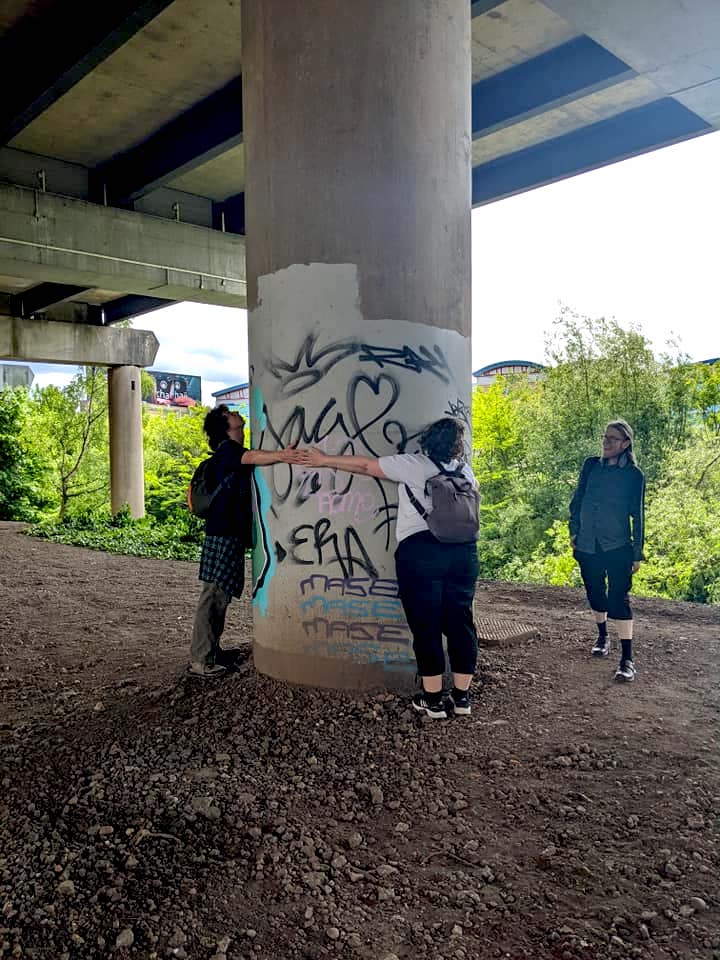
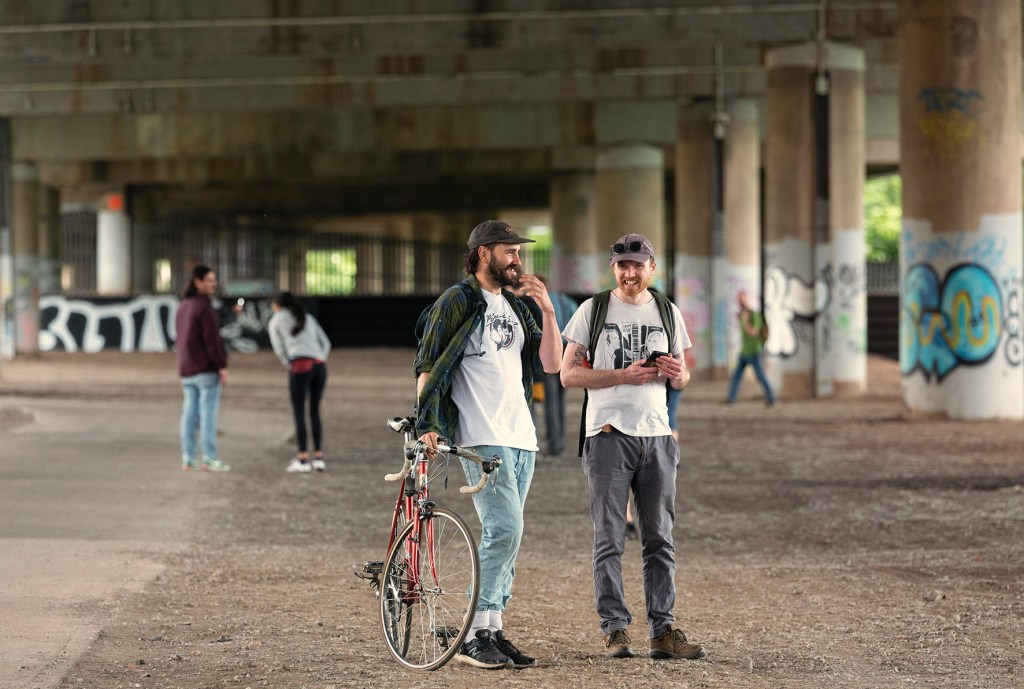
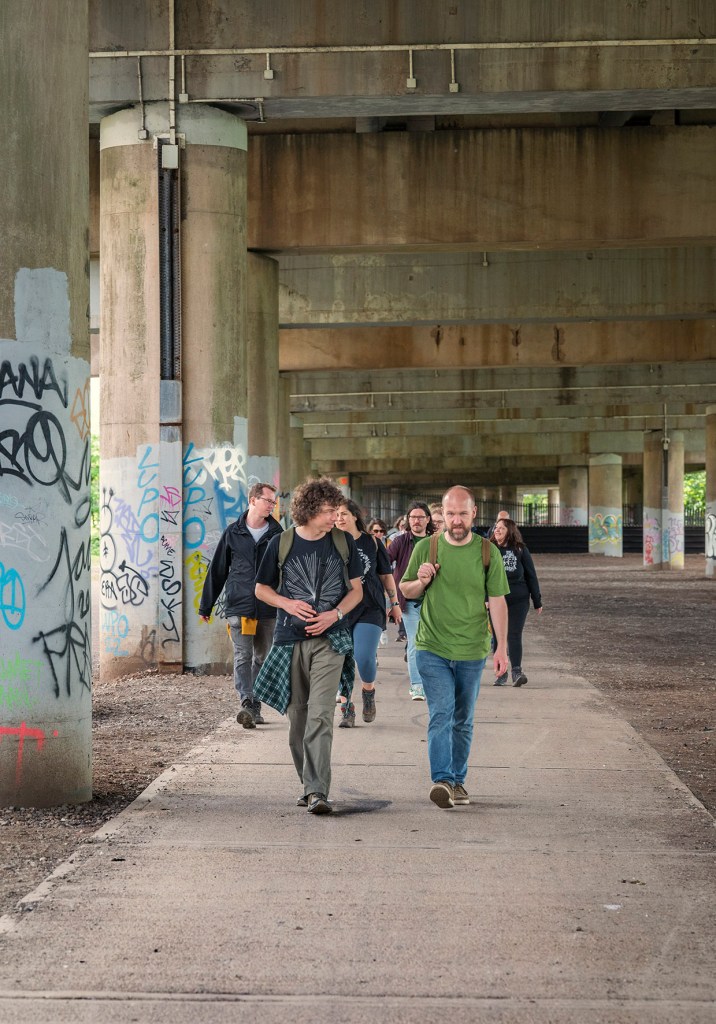
Andy Howlett started mapping the city’s ‘pedestrian portals’ through experimental group drifts starting underneath the Aston Expressway at Lancaster Circus
Beth Hopkins aka Bethany Kay used field recordings and composition to create ‘Ode to Chad’ – a song to Birmingham’s Chad Brook river which flows through public and private space
Fiona Cullinan – walked a series of alley, walkways and footpaths alone to create ‘Female Calculations’, a photo collage and film exploring subjective female safety algorithms.
In Yogyakarta, Jalan Gembira also invited three artists to explore Ratmakan, a riverside village that is being redeveloped and styled as a tourist area – something which feels at odds with the reality of life for those living there, and echoing gentrification impacts in the UK.
As part of the cultural exchange, Walkspace is recreating a ‘pos kamling’ watchpost and noticeboard inside Artefact Gallery. It will also encourage visitors to indulge in the Indonesian hangout culture of ‘nongkrong’ – chilling out with friends in the space – as part of the exhibition.
Lead artist for the UK project, Fiona Cullinan, said:
“Getting the chance to work with Indonesian artists was a fantastic opportunity. I’ve visited Indonesia a few times so it was interesting to go deeper and learn about the arts collective scene while working on the project. We couldn’t meet in person so we had to find new ways to show each other our streets and share our experiences of urban walking.
“Whatever challenges our cities throw at us, a lot of people have rediscovered the joy of walking in the last two years. For Walkspace, the act of creative walking goes beyond basic A to B pedestrianism. It’s like ‘walking-plus’ whether that plus is art or photography or songwriting or zine-making or meditation or something else that opens up a place in new ways.”
Jalan Gembira said:
“In reality, walking can be a way to understand the city we live in. For instance, we would not notice the changes that occurred in the city had we not directly experience it with our senses. We only see things through motor vehicles when we pass through and only get quick glimpses of the city.”
Beth Hopkins, who performs with Birmingham avant-pop band The Nature Centre and solo as Bethany Kay, said:
“Having the chance to explore a hidden corner of my city and respond to the sounds and places that the Chad Brook carves its way through was a real treat. By wading through private access areas and seeking out the brook, I felt like I was in some small way illuminating a piece of Brum that would otherwise have been hidden to public eyes and of course sharing the secret with our Indonesian colleagues.”
Jalan Gembira is a walking practitioners collective based in Yogyakarta, Java, that has been walking together since 2016. They post their walks to @jalan.gembira.
The British Council is the UK’s international organisation for cultural relations and educational opportunities. We build connections, understanding and trust between people in the UK and other countries through arts and culture, education and the English language. Last year we reached over 80 million people directly and 791 million people overall including online, and through broadcasts and publications. Founded in 1934 we are a UK charity governed by Royal Charter and a UK public body. We receive a 15 per cent core funding grant from the UK government.
The British Council’s Connections Through Culture programme has been running in the UK and East Asia for the past 16 years to foster international collaborations through arts and culture.
Artefact is an artist-led gallery, workspace and and bar in the heart of Stirchley, South Birmingham.
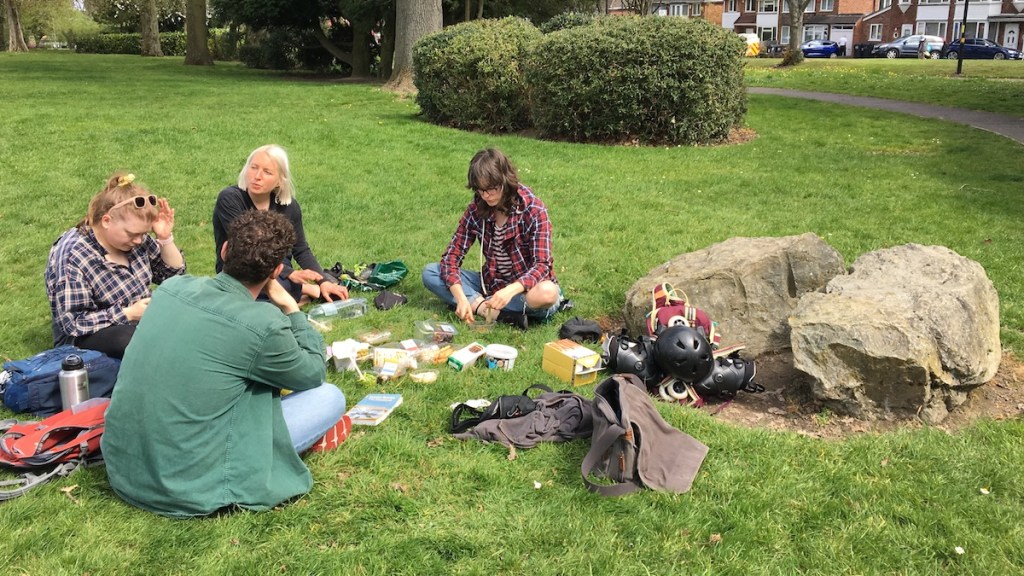
A couple of weeks ago Andrew Stuck came to Cannon Hill Park in Birmingham to interview me for his excellent Talking Walking podcast. We talked Walkspace, filmmaking, “extreme noticing”, erratic boulders and the upcoming Parallel Walking exhibition. We saw a kingfisher, a miniature model of the Elan Valley Reservoir and I gave some suggestions for creative walks that listeners might like to try out themselves. Many thanks to Andrew for a very enjoyable walk and talk! Listen here.












 Walkspace