What does walking mean to you? I guess, seeing as how you are reading this, walking is something you enjoy. I wonder why? What is it that you like about it? I wish you could tell me.
For me, walking is powerful medicine. Walking is what humans are designed to do and those of us who can do it will reap many physical benefits from it. Walking is also medicine for my mind and very probably for your mind too. Walking helps us think, improves our brain function, teaches us to be more alert and aware of our surroundings. But most of all, walking is medicine for my soul. I walk to enter my church.
My church is the land. I enjoy walking best in wild places, where that connection to the land and the other non-human people in it is vivid and strong. But even in the city and sometimes on agricultural land I can find that connection and take enormous joy in being surrounded by green, living things, especially trees. Trees are the pillars that hold up my church.
Have you ever planted and nurtured a tree? I hope you have because it is a wonderful thing to do. When we moved to our present house our long suburban garden was nothing but grass and a concrete path to a broken shed. Birds whizzed over our green desert but never stayed. So I planted two apple trees, a quince and three maples. The squirrels planted an oak and two hazels and the birds planted (deposited really) three hawthorns and came to visit (one year we counted thirty different species of bird here). The maples I grew from seed and they are now, at 11 or so years old, beautiful and tall young saplings. The apples and quince are also beautiful and give lovely fruit and the wild, squirrel-planted oak is a joy to watch growing. I hope it will become a mighty tree, but as we are only renting, I do wonder if it will make it.
But think of it, to watch the birth and growing of beings that might live two hundred, three hundred, maybe even as much as nine hundred years! To stand taller than a being that one day will be taller than your house, to see how the trunk and spreading branches begin their first tentative growth. It’s an honor.
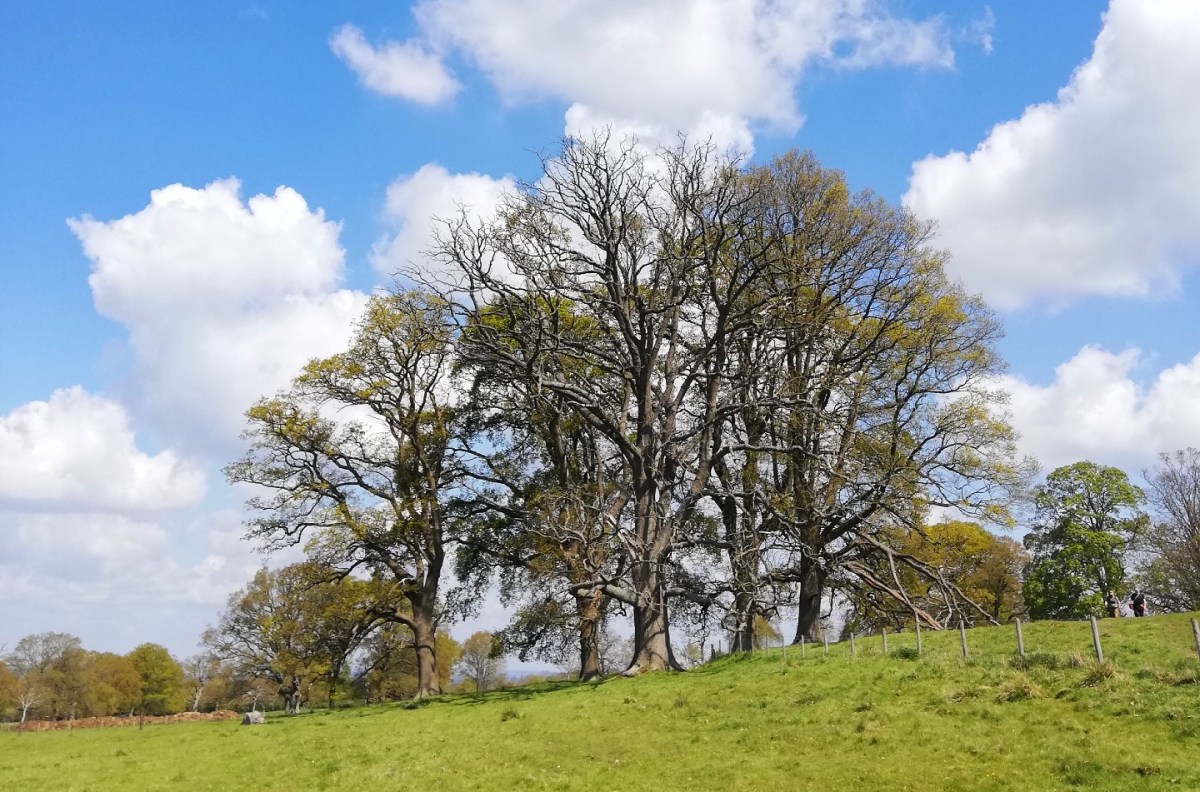
In my church there are many cathedrals. Living temples. One might be a stand of beautiful beech on an old long-barrow, another might be a row of elegant limes on a city street, yet another might be a single ancient yew in a churchyard or deep in a wood. When I stand among these fully grown, mighty beings I am moved to spontaneous prayer, a deep joy and lifting of my soul. Only English cultural taboo at ‘making an exhibition of myself,’ stops me from kneeling or prostrating at these arboreal cathedrals, but it’s what I want to do. I am in awe of their age, of their form, that they are harbour and home to countless non-human beings, of their importance in the living cycle of Earth, of their deep-rootedness.
I love their many different shapes, leaf forms, leaf colours, blossoms, fruit and nuts. I love drawing their shapes with my eyes. I am grateful they are here in the city, bringing the church even into the street, car park, industrial estate.
So when Fiona Cullinan asked me if I wanted to make a contribution to the Urban Tree Festival I knew I had to do something that combined walking medicine with the church of trees. A Pilgrimage to the Trees is a set of instructions, a one page printable zine, that invites you to walk out of your door and go find a tree to admire and praise. The instructions in A Pilgrimage to the Trees ask you to observe some common things any urban walker is likely to encounter and use those things to determine how the walk will unfold. How these instructions work mean that every walk you do using them will take you to a different place and hopefully to a different tree.
I have included a short poem in the zine that you can read to the tree as an offering of thanks (if you share my embarrassment of doing odd things in public the poem can be read silently. The trees will know you appreciate them anyway). And one day, if you are walking in a park or wood and come across a stout red haired druid person face down in front of a tree, pass quietly by. It’s only me saying my prayers.
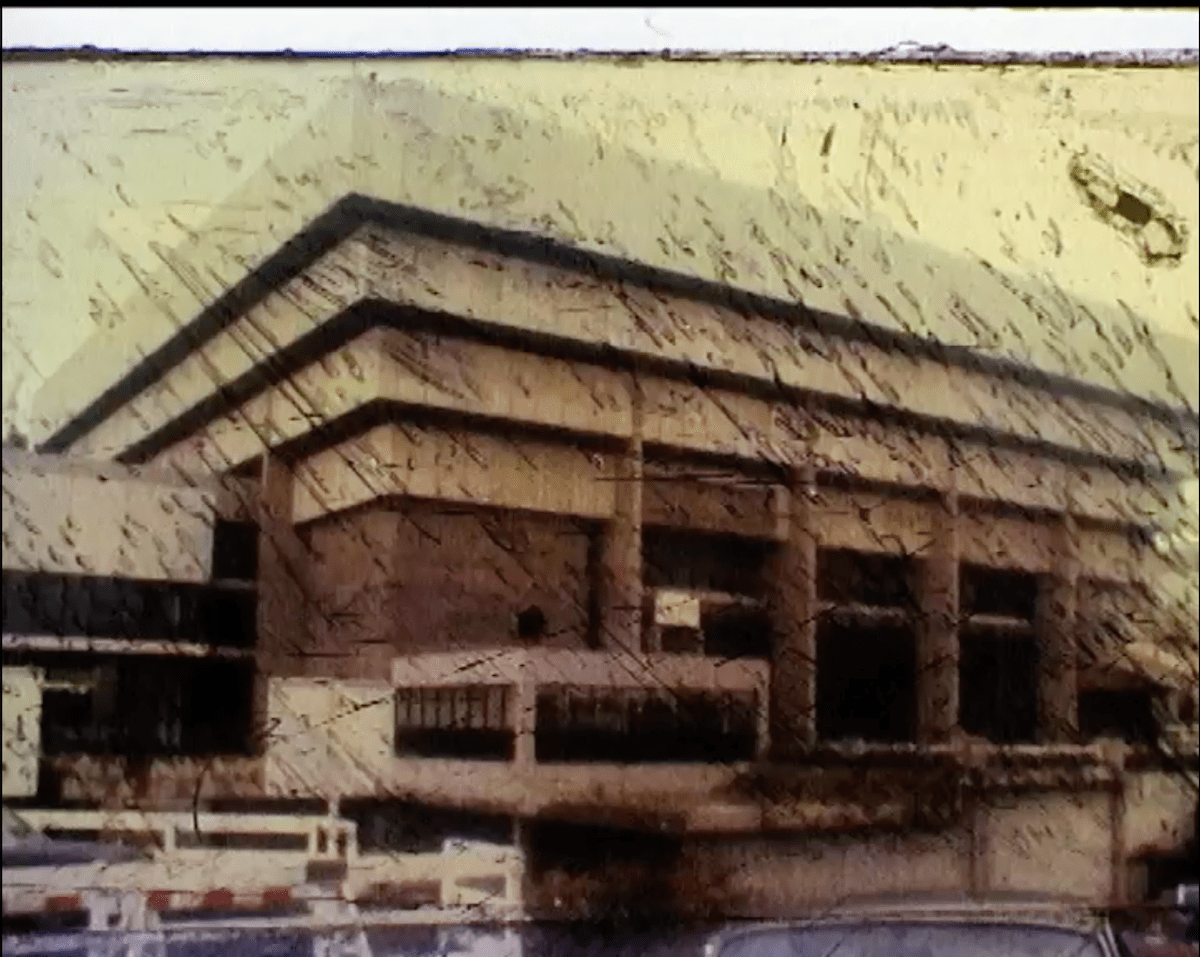
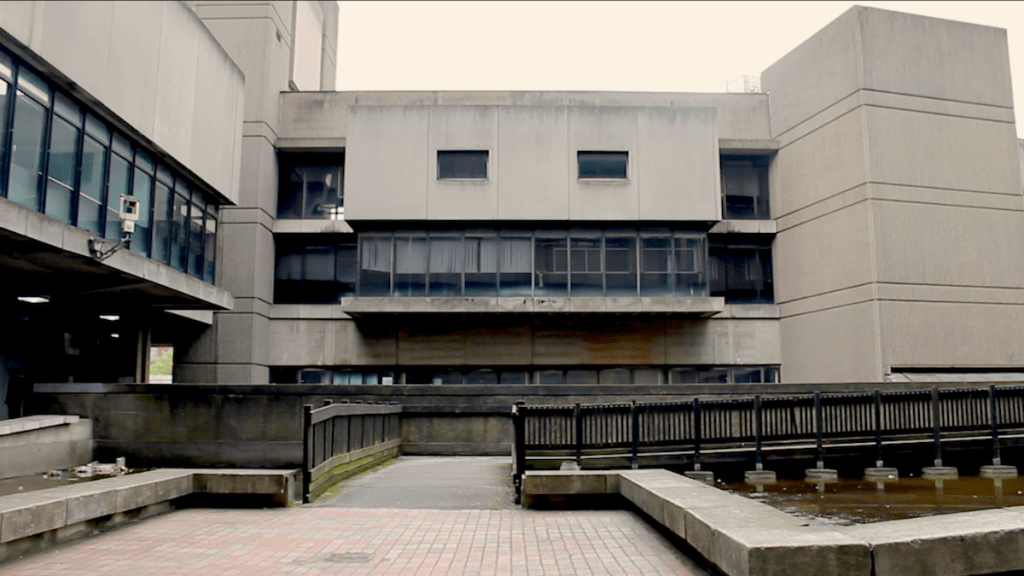
For the past several years I’ve been working on a feature-length essay-film about Birmingham Central Library and the death of Modernism. The film is called Paradise Lost, History in the Unmaking and it could be described as a psychogeographical detective story in which I investigate the ruins of yesterday’s future in an effort to understand the forces that shape a city. If this sounds like your sort of thing then book your ticket to the online premiere now! The event is on May 24th as part of Flatpack Festival and is followed by a Q&A hosted by Christopher Beanland, author of Concrete Concept.
In an interview with Flatpack I talk about the film’s themes and give some insight into the creative process, including the central role that walking has played throughout.
Paradise Lost is essentially a feature-length video stroll. It’s structured like a walk, in that it sets out without a clear sense of a destination, and it meanders a bit and discoveries are made almost by accident. Bit by bit the story is pieced together and hopefully it all resolves into something satisfying by the end.
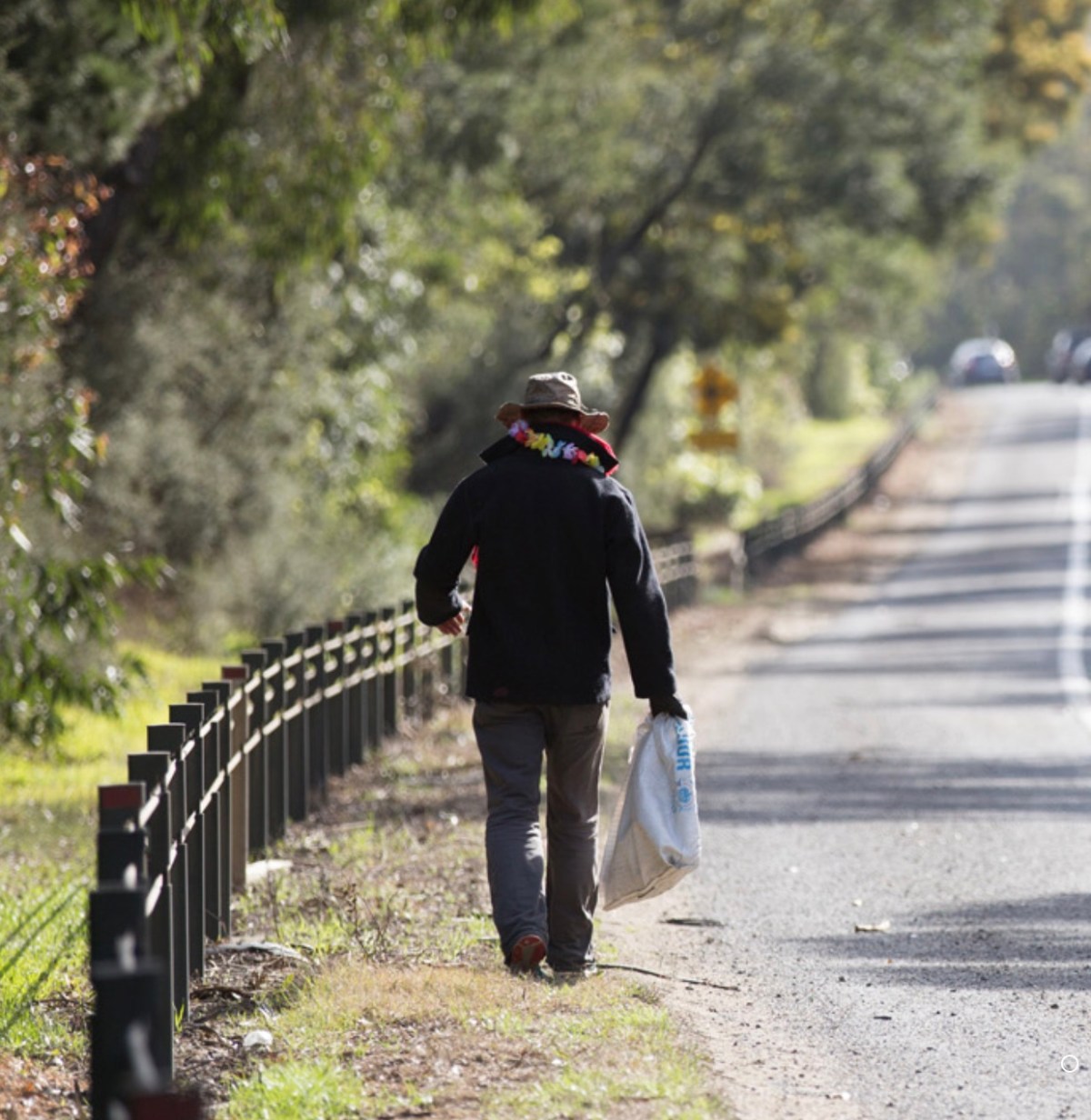
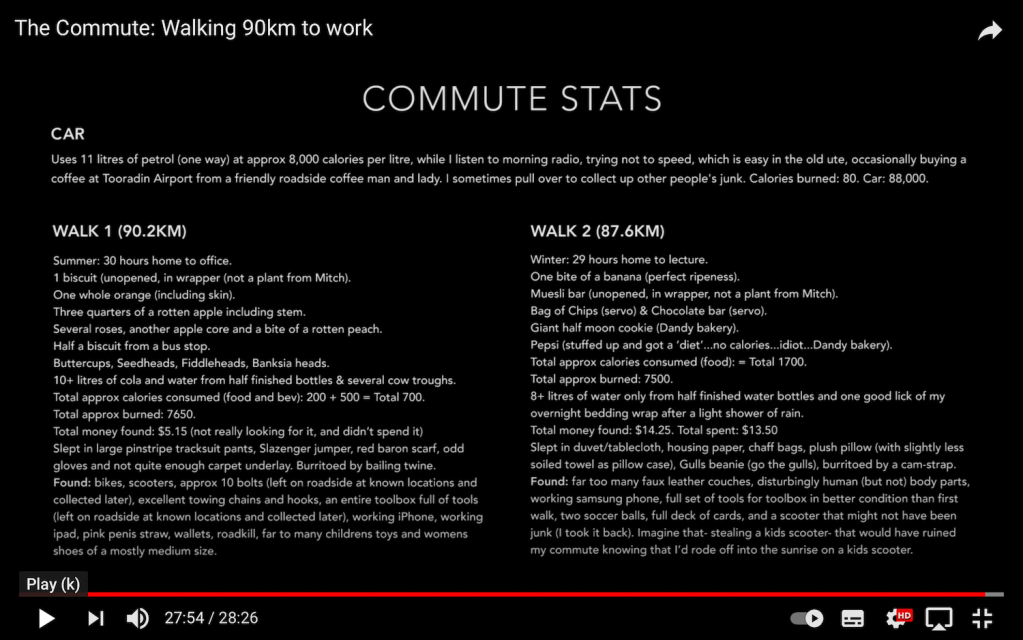
As an Australophile, I enjoyed watching Beau Miles video, ‘The Commute: Walking 90km to work‘, in which he ditched his car and walked to Monash University in Melbourne to deliver a lecture about adventuring. Fresh from the adventure, so to speak. Or not so fresh given the nature of the commute.
It was recommended to me so I’ll recommend it on to Walkspacers.
Beau Miles (bit of nominative determinism there) is a modern-day explorer who is trying to resurrect that feeling of adventure without having to fly half way around the world to do it. “I walked 90km to work a bunch of years ago to see if a stripped-back adventure could give me the kind of buzz that far away, exotic, heavily planned expeditions have given me over the years. It did.”
For the walk he appears something of a jolly swagman, setting off with no food, water or shelter, and living off the stuff that people throw away or inadvertently lose to the roadside. Part of the fascination is seeing what he will find and what he will stoop to eat… it is sometimes horrifying to watch him eat old food or half-empty plastic bottles of pop. He must have a stomach of iron or a carefully honed sense of smell for decay.
But he is not a hobo, not poor and not an itinerant in need of work – and therein lies a different distaste for some. It’s not that he sets out to be a swagman – and yet it clearly forms part of the rules of the walk in order to generate adventure.
It created a lot of discussion and debate in our household around the privileged nature of the walk and the filming vs the insights gained, issues highlighted and human challenge overcome.
Personally I was interested to see what thoughts that walking for two days with no funds, fuel or food would bring. About walking and humanity and philosophy and plastic littering and the basics of survival. There are things you get to thinking about when you push yourself this way that wouldn’t occur to you otherwise.
A few quotes that struck me:
“If there is one thing that is rhythmical it is walking. You know. It is so repetitious … You really just become a metronome.”
The paradox of being anti-littering but living off the litter that he hates: “First sit down. Quite serendipitous when someone throws away a couch. Bastards.”
Why do this at all? “It’s about putting value on such a thing, much like baking your own bread or taking karate lessons. I think that experiences like this are the essence of being human, which to me is our ability to question everything we do.”
But also there is the personal development: “Everything changes you. You cannot take away what just took place. That is now with me, it is part of me, it part of the fabric of Beau, it it my world view, it’s how I teach, it’s how I see the world, it’s how I see that road from that point on, and yes a lot of it will filter away as I get further from the walk, but it’s still there.”
Check out Beau Miles’ YouTube channel: He does a lot of crazy stuff from sleeping 30ft up a 100-year-old gum tree to seeing if he can build a cabin for his wife during the pandemic without her knowing.
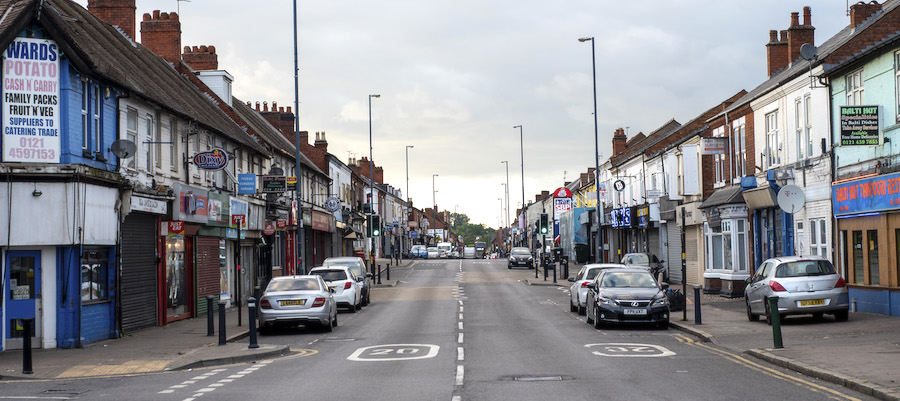
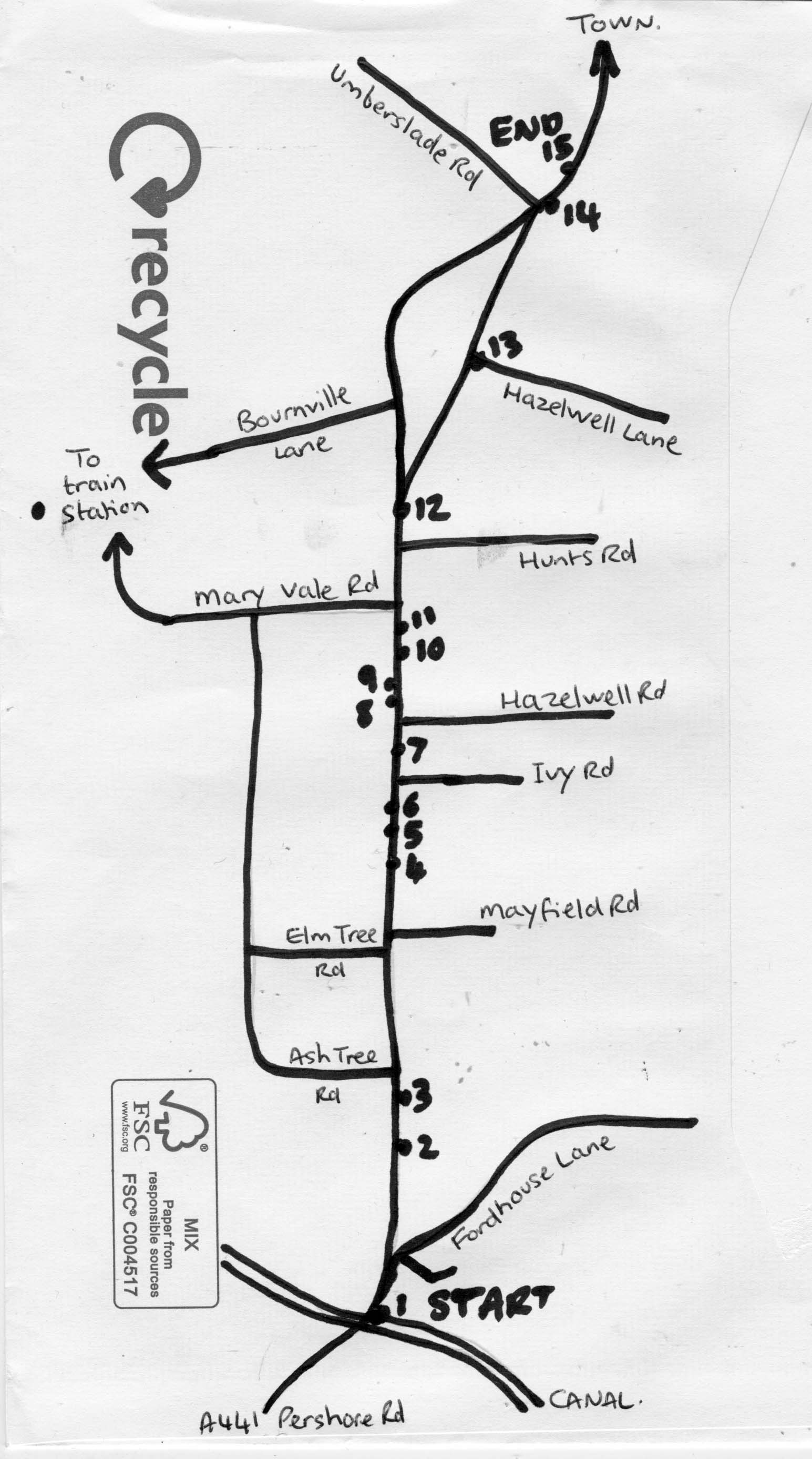
This short tour runs the length of Stirchley high street and combines local landmarks, art, architecture, innovation, history and curiosities. It starts at a high point and descends to a flat bit. This is the first of some Stirchley taster walks, perfect for everyone who wants something every time.
We start on Bridge 75 of the Worcester & Birmingham Canal, at the junction of Pershore Road and Lifford Lane. Pause to take in the double aspect view, first of the canal through the gateway and then, as you meander down the Pershore Road, of the Birmingham city skyline.
Cross over the treacherous junction at Fordhouse Lane and hug the pavement past residential houses to a set of shops, passing Stirchley’s only charity shop serving the neuro-divergent community, and our main brothel, Kitty’s Massage Parlour. Look for heart-shaped shutter decorations and windowless frontage.
A few doors along, a lawnmower is glued to the external wall. This is Tomlinson’s tool hire shop. Peer into the window to spot homemade Stirchley droids such as R2D2, a robot Minion and more.
From the future to the past – get your ancient Rome on by imagining you’re on the old Roman road of Icknield Street running from Gloucestershire to South Yorkshire, because you are, albeit in its distant future.
An example of Stirchley waymarking can be found on the next block, past Mayfield Rd, in the form of a single name etched into a paving stone: ‘Ricky’. It’s hard to know when this piece was made but it is thought that the author might be a child as it’s not joined-up writing.
A few steps further is a gap in the buildings. Reminiscent of precision bombing, this is in fact the old entrance to Whitmarley Engineering factory, a former MG Rover supplier, that was briefly turned into a free school and guerrilla exhibition and performance space in 2011 before being razed to make way for a housing estate. [Correction: Stirchley historians say this gap was not a factory entrance but housed Stirchley’s second fire station. From around 1960s it was a yacht builder and chandlery. The mystery deepens.]
On the same block look up to see an etched grey doorway named Ann Place. Pause to consider the potential romance betwixt Ann and Ricky.
Past Ivy Road, there is a red stork perched above Artefact Café. This is one of Gavin Rogers’ flock of migrant red stork sculptures that landed across Birmingham in 2018/9. All Brummie families were immigrants at some point so raise your hat to your fellow importee.
Cross over the school pedestrian crossing to a small cluster of miniature must-sees. First is the postbox, which displays the baffling notice: ‘Await delivery of stamp before inserting a further coin.’ Do you understand what this means? If you do, revel in your smugness.
Walk to the first building on your right and examine the unusual design feature of interlaced corner bricks. Now look up to see a carved wooden tiger, fangs bared, staring down at you from inside the window.
Staying on the left side of the high street, pause at the surprisingly imposing building at 1429 Pershore Rd. Formerly a Lloyds Bank, it became the Belgian and Netherlands Consulate after a bank employee called David Cooper became the honorary consul for Belgium and suggested his former work premises as a suitable location. Until recently hopeful visa applicants would travel on the 45 bus to queue here.
Look across the road to see the Stirchley Gorilla perched above the carpet shop. The polycarbonate primate has become a Stirchley landmark, possibly erected in homage to Birmingham’s famous King Kong statue. It cost £7,500, was made in the Philippines and shop owner Mr Khan bought it because: “We have a flat roof and I thought King Kong would look good sitting on it.”
While under the Gorilla’s gaze, ponder the street protest of 2018 where tenants of the flats behind unionised and gathered to draw attention to their poor housing conditions, and the generally inadequate state of affordable housing in Stirchley.
Cross for a closer look and continue walking towards town. A few shops along is an EF Cash & Sons doorstep sign. This former business was best known for Cash’s embroidered name tags, sewn into generations of school clothes. Bird watchers may spot a pigeon or 20 living in the hoardings above the shop. Don’t forget, bird poop on the head brings good luck.
Walk past the derelict graffitied building and pigeon roost to the fork in the road. At the ghost of a cobbled pavement in front of the British Oak public house, take the right fork. This stretch has many temporary artworks in its ever-changing streetgallery: from paste-up artist Foka Wolf’s Arnold Schwarzenegger chomping on Seven Capital hoardings to ‘No fly-tipping installation art pieces’ on Hazelwell Lane.
As you emerge from the gyratory road system, past Skinnys Ink tattoo parlour, cast your eyes to the skies to see a Top Cat figurine sitting on a satellite dish above TopSat Digital. Everyone loves a visual pun.
Cross at the pedestrian crossing and enter the alleyway at the side of the Balti Bazaar for a freaky fairground side show. Here you will find not one but two hall-of-mirrors doors in the restaurant car park. Take a warped photo of yourself as a memento of your visit to Stirchley.
Finish by retreating to The Bournbrook Inn next door for sustenance and a lively discussion about how the Bourn might be a brook but the Bournbrook runs through Selly Oak, this one is just the Bourn and how it’s a fair mistake but that the pub should be renamed the Bourn Inn really.
Map pins
This walk has been curated from pins on the Survey of Stirchley map. Visit Walkspace’s Mapping Stirchley project for many more local curiosities.
Birmingham skyline view
Robots of Stirchley
Stirchley Street – part of the old roman road of Icknield Street
Every journey starts with a single step. In 2016 mine was finally getting around to sorting out my crappy online passwords. I took a short cybersecurity course and decided to pay it forward by offering help sessions in a local café. This grew into The Interrogang – a monthly reading group for data issues. In 2017 I became an ‘Ingenius’ at The Glass Room London, an interactive exhibition into data privacy visited by 20,000 people. I wanted to bring this home to Birmingham so I started a newsletter called Observed City which ran for a year. Together with Open Rights Group Birmingham, we set up a mini version of the Glass Room exhibition at my local library.
Now this series of steps has moved from activism to art in the form of a walk commission by The Dazzle Club – a research collaboration which explores surveillance in public space. For the Birmingham Dazzle Walk, I proposed using age-related camouflage as counter-surveillance measures to walk silently and invisibly across the city.
In the style of a surveillance report, here is the walk log.
++
Birmingham city centre, 18 March 2021
6.15pm the Electric Cinema, Station St
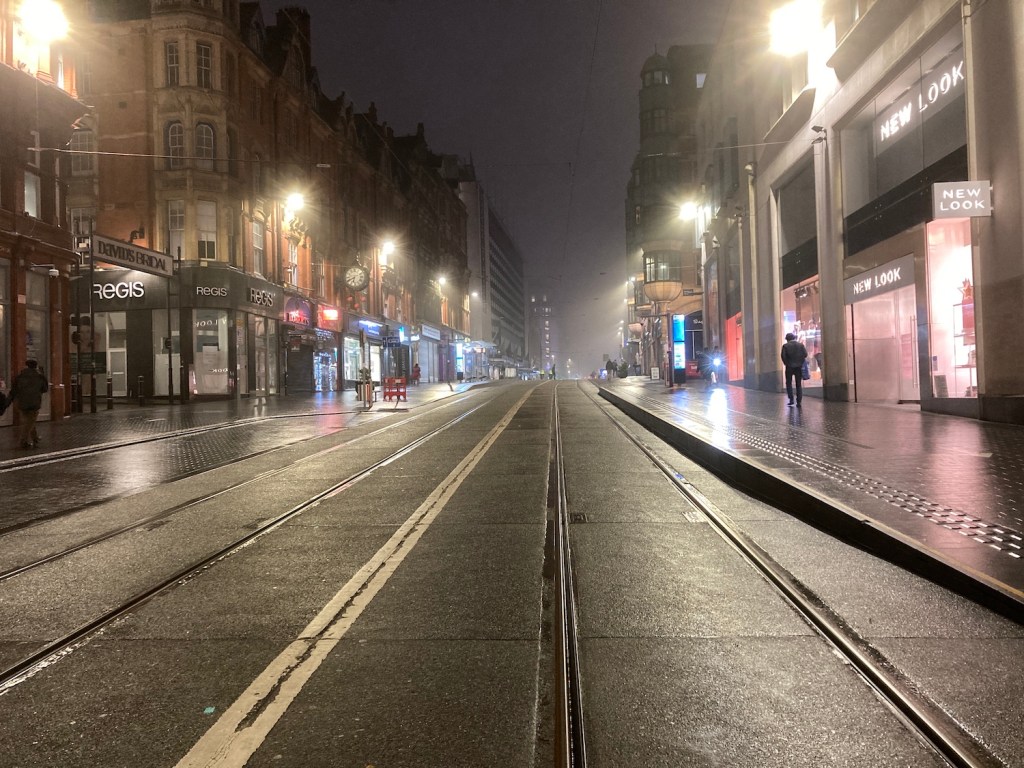
I meet my walk guest – the neurodivergent, experimental artist and writer, Kruse – to lead her through a city that was once the UK’s CCTV capital, with an estimated 100,000 CCTV security cameras in 2020. I am only allowed one walk invitation due to lockdown restrictions. The city is empty. I find this perturbing, threatening; Kruse finds it bliss.
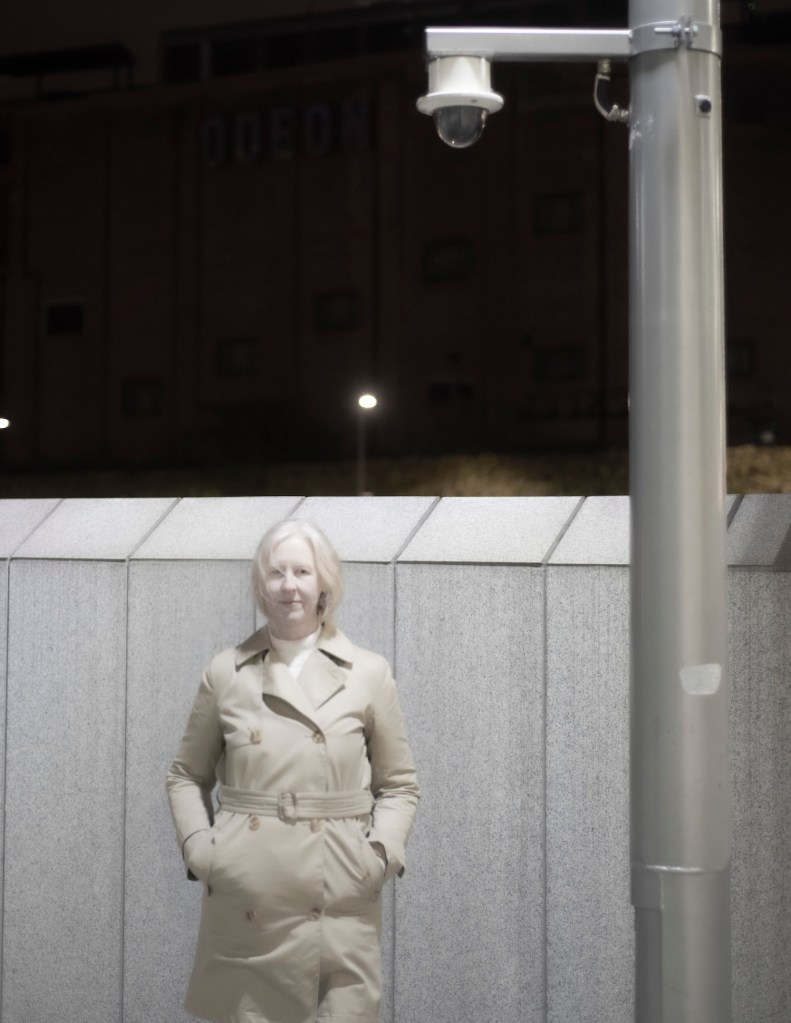
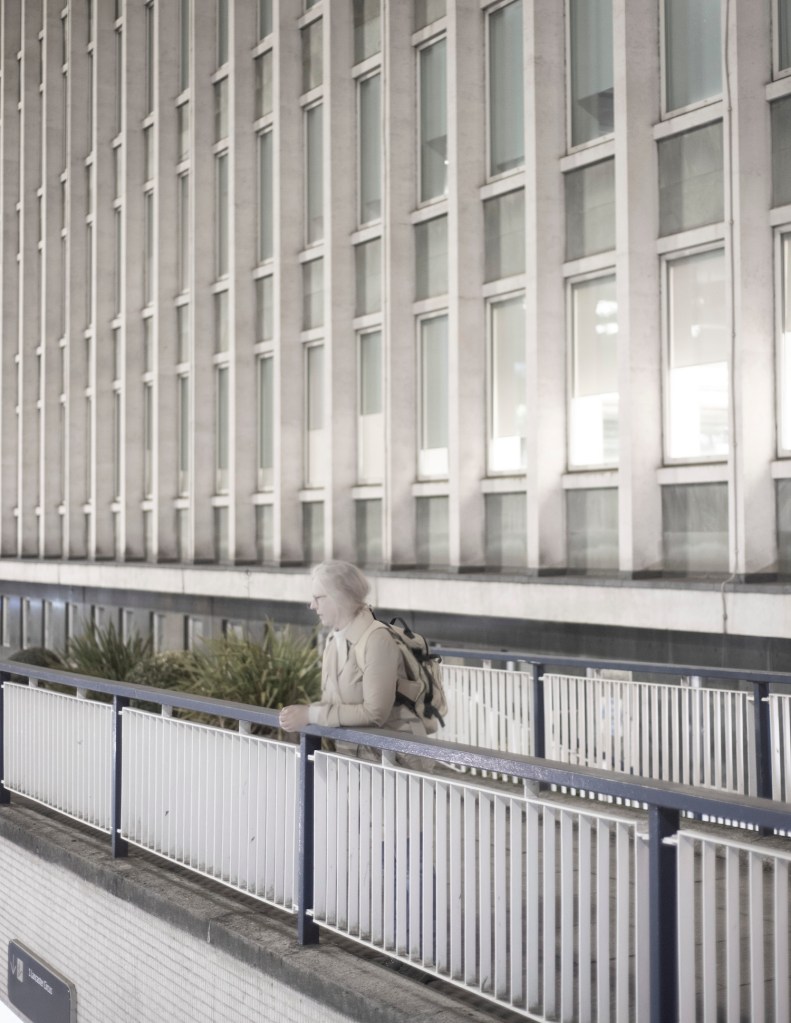
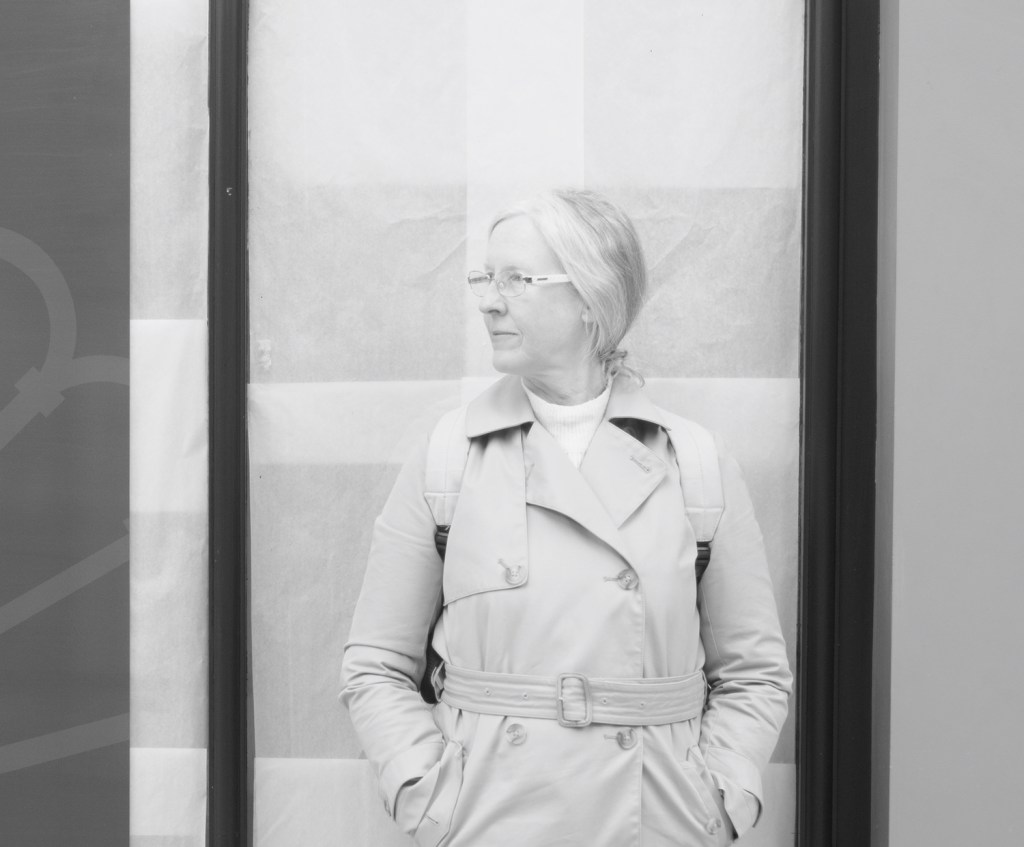
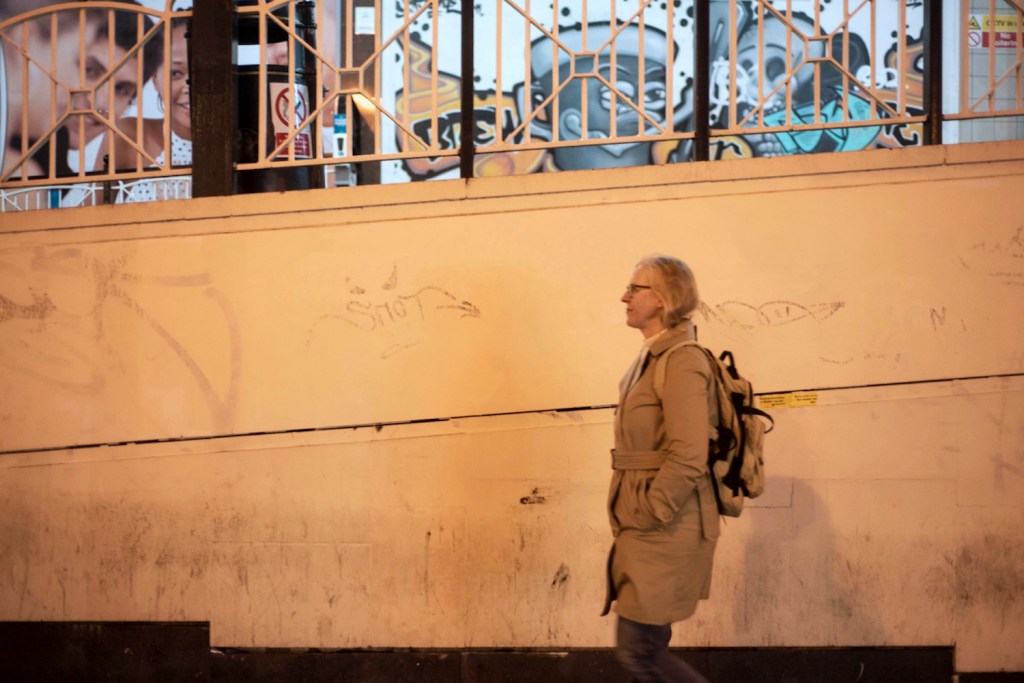
In my bag is make-up to help erase the shadows and features that demark my face. Kruse applies a white foundation. We look like blank ghosts. As women over 50, we are already invisible in society. We enhance that with low-contrast clothing – a beige mac, a light hat, jumper, skirt and gloves.
We take a single photo of our beigeness, blending against the station wall, and turn off our phones so we won’t be digitally tracked by the data emitted from our devices.
We are now silent.
We start to walk.
6.30pm Birmingham Media Eye 1, Grand Central / New St Station
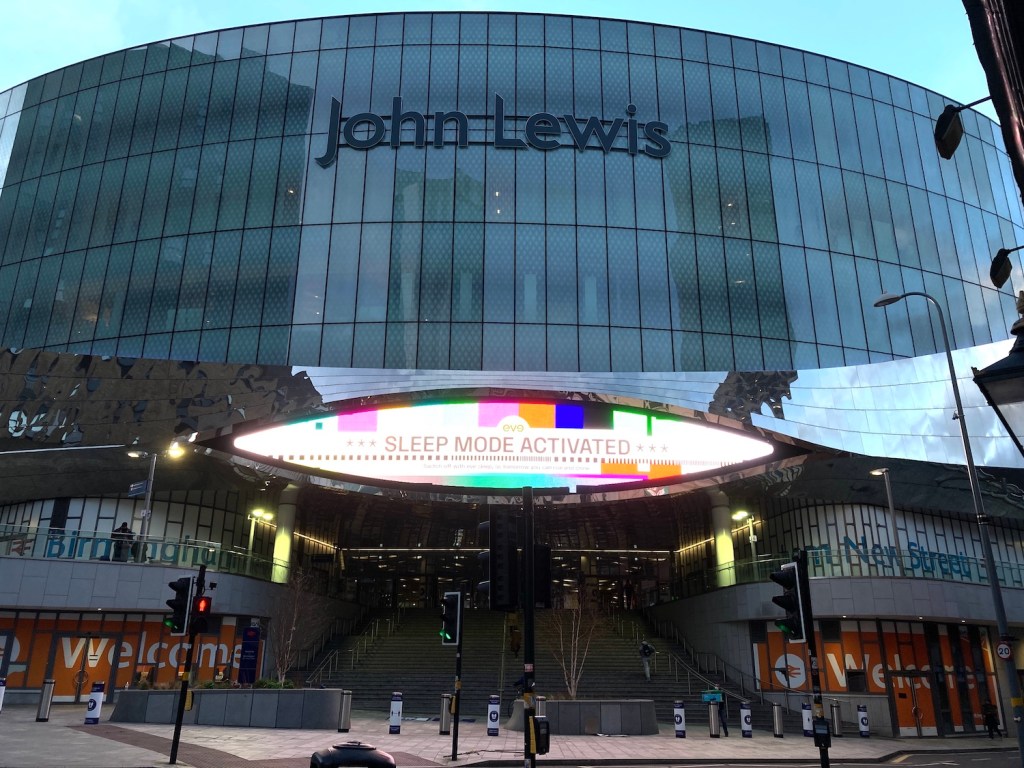
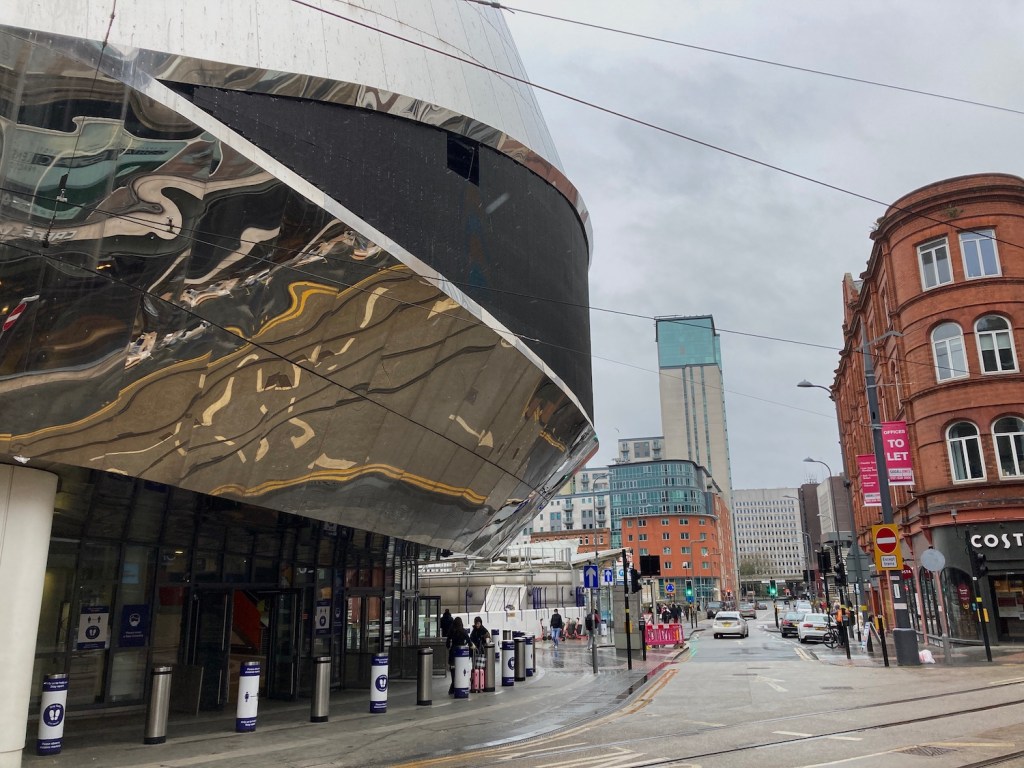
The walk begins in twilight under one of three huge ‘Media Eyes’ staring out from Grand Central shopping centre above Birmingham’s main New Street train station. Each eye targets and scans humans for demographic and emotions-based data in order to serve ads. These Orwellian Big Brother eye-shaped screens look down on public space, profiling us for its own commercial profit. The largest screen is 28.80m wide x 5.28m high. Somehow they have passed the city’s planning process. My references for these are not benign or benevolent: they represent dystopia, control and a removal of freedoms.
How is it ok that they face out from the shopping centre into public space? How is it ok to profile the public for profit without public consent?
6.30pm New St Station
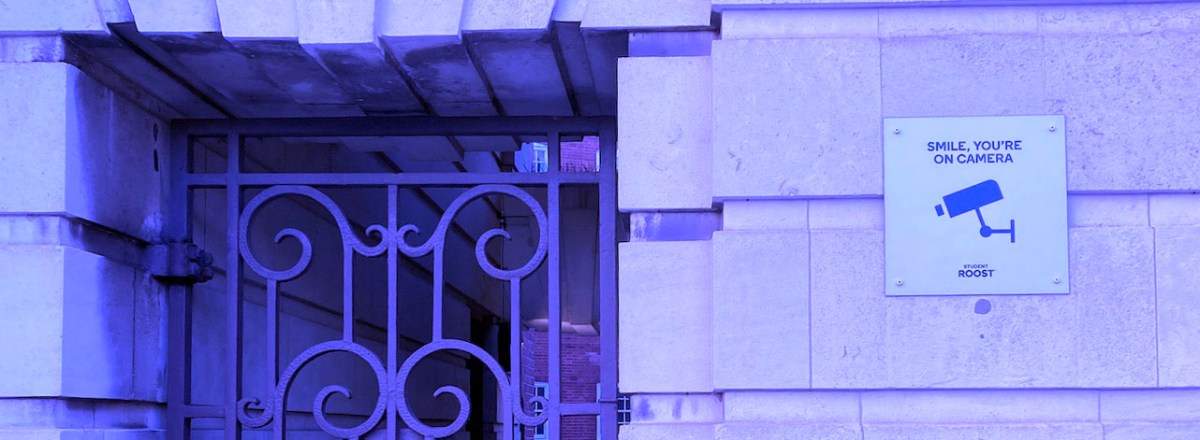
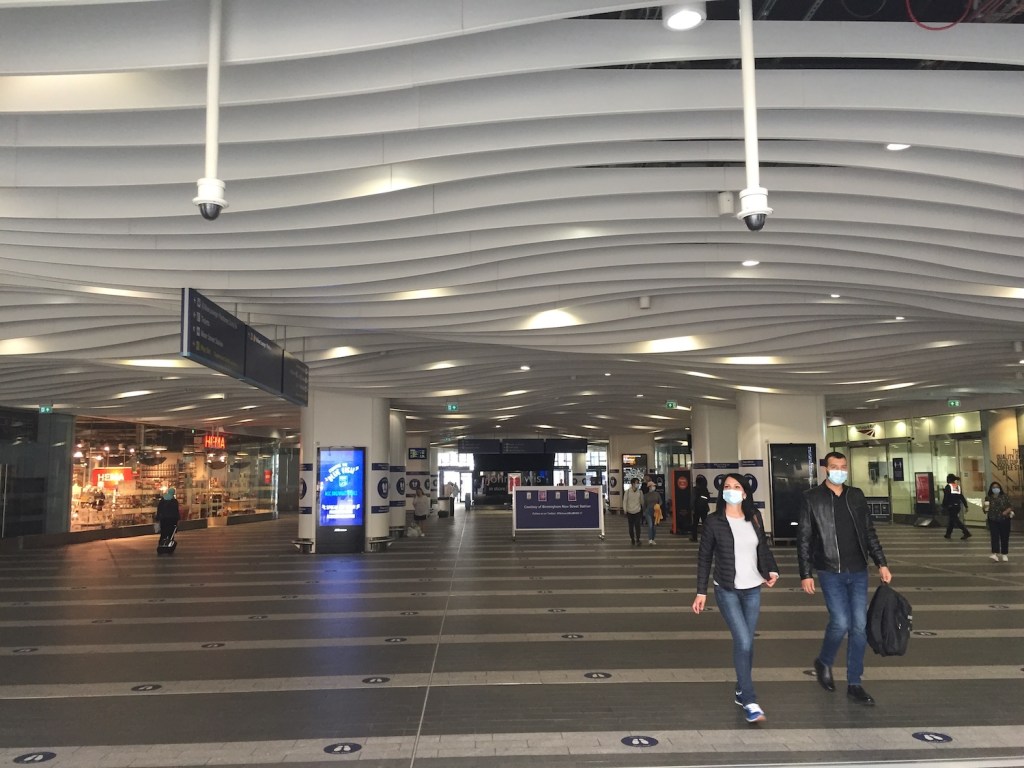
We walk through the station, which drips dome-shaped cameras from the ceiling. They blend in surreptitiously, looking like lights that aren’t on. Last summer I took a photo of them – it seemed a fair exchange as they took images of me. An official challenged me and said she’d have to report me. Apparently I needed a permit to take their photos but they don’t need a permit to take footage of me. I explained what I was doing to two police officers, who were unconcerned. This is where being a white woman over 50 offers privilege.
6.35pm Birmingham Media Eye 2, Stephenson St
We emerge under the largest ‘eye’, which is off or just not displaying ads. A soft-lit emptiness lets us see behind the black screen. There is a single green light – it is on. We watch the watchers for a short time then we remove our masks and head into the city’s main shopping streets.
6.40pm New St to Corporation St
It is eerily quiet except for the occasional screaming of the trams and some gulls far overhead. A man further ahead claps a beat to fill the silence. The auditory soundtrack of an empty city is intense. We blend into the walls and pavements but in the darker areas feel exposed and vulnerable in our beigeness.
I lead but we walk side by side. This is the ‘grey man’ theory of invisibility – don’t act unusually, blend in with the crowd. The ability to remain unseen can be a powerful protection, particularly to women walking at night. The case of Sarah Everard has raised the hackles of every woman. I am glad to be walking with Kruse in the empty streets. The last time I came to town in November I was followed briefly – on a Saturday at 5.30pm in Brindleyplace, a highly surveilled and patrolled area. Cameras do not protect and they are not always a deterrent.
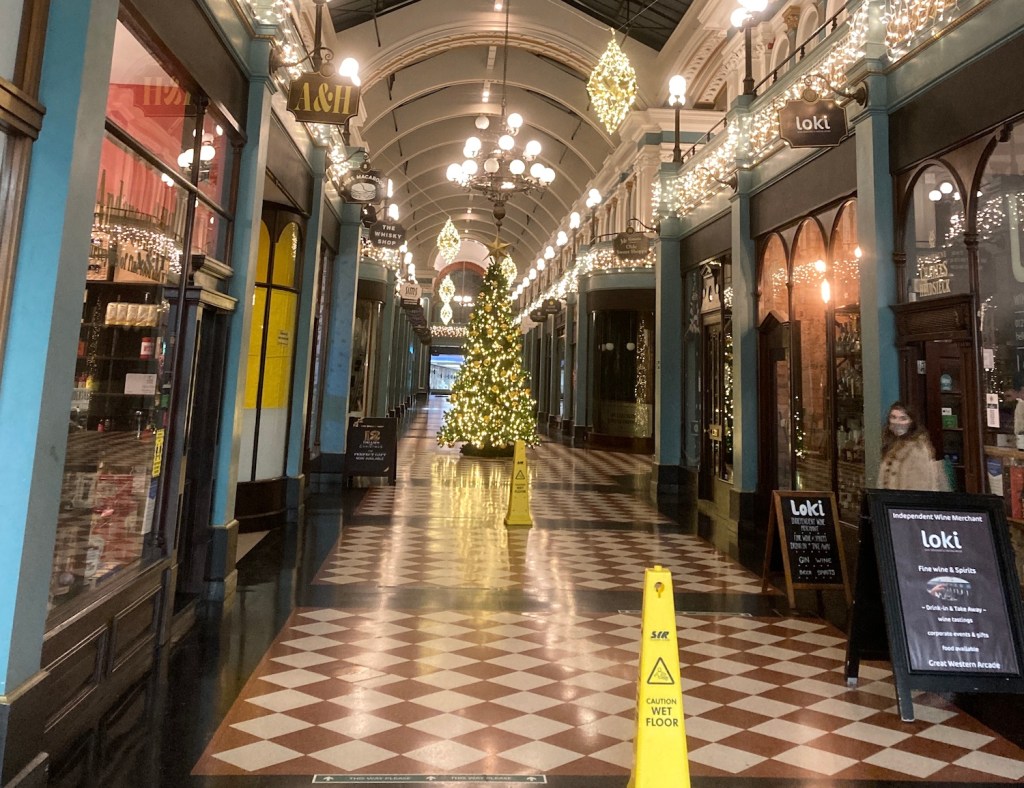
6.45pm Great Western Arcade
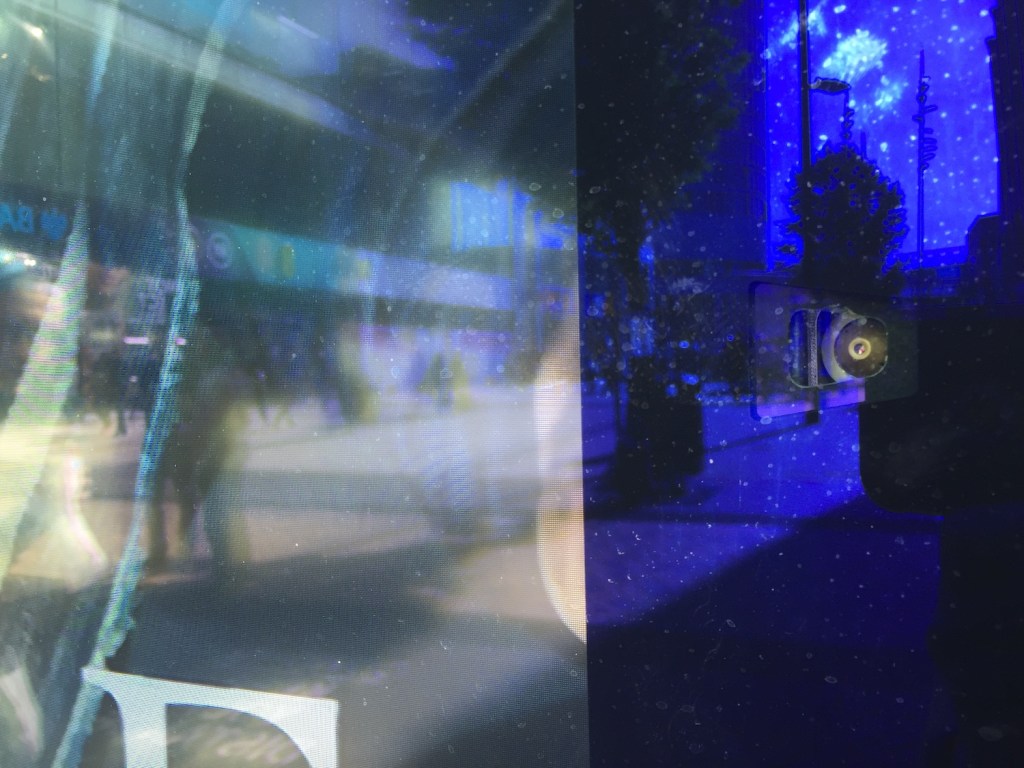
At night the cameras are less visible but they are still there in trees, on buildings, integrated into street furniture, behind digital billboard screens, on strategic street corners. It’s harder to spot the cameras as the walk progresses but I am becoming attuned.
In the Great Western Arcade, the tech is there at the start and end of the 545m-long Victorian walkway. It is deserted. I can hear our soft heels tapping on the tiles and our ghostly images reflect in the closed shop windows.
6.50pm Colmore Circus Queensway to Priory Queensway
The Gaumont Cinema used to be here. I saw The Sound of Music there as a child, six times, and remember standing in the long queues. It was full of life and people. Now it is empty office blocks and paved walkways. I spy a Victorian-style lamppost but with domes where there should be lights. Like us, are the cameras trying to remain unseen?
Town used to be a place to come to escape and enjoy the pleasures on offer. Now we are watched and recorded and followed everywhere we go. How does this change how we act and how we feel about coming here? Does it feel safer or oppressive? What has been lost? What has been gained?
In our youth, my generation had the freedom to walk without relentless surveillance and tracking, and this freedom has been lost – a loss normalised and embraced first with CCTV and now with digitalisation and smart city initiatives. There is no choice in this.
Town used to be about people, now it is all about technology. Is it in service of its citizens or other interests?
6.55pm Corporation St
It is almost fully dark now. As night falls, invisibility brings power in remaining unseen but also powerlessness in having to hide from potential predators. Being a woman, the night often feels shut off, but this walk feels good as we reclaim the space. Often I clock eyes with people when I walk because I am hypervigilant and always on alert. But now we weave unseen like ectoplasm through groups of people at bus stops and outside takeaways who don’t seem to register us at all.
7pm Birmingham Control Centre, Lancaster Circus
The turning point of the walk is the Birmingham Control Centre, one of the leading CCTV control centres in Europe with commercial clients across the city and also direct links to West Midlands Police.
Its Google profile images are straight out of a Hollywood movie. Four watchers (men?) monitor several hundred screens and the scene is bathed in electric blue. Another stylised purple has a single man walking (stalking?), casting an ominous shadow with his footsteps. A third in red has someone typing in a code to enable (disable?) an alarm. In reality, 1 Lancaster Circus is brutalist Birmingham 1970s concrete. On every corner, top and bottom, a camera points.
We cross underneath the Aston Expressway and look up, watching them knowing they are watching us. Then we turn and stand with our backs to it, instead overlooking the subways that subjugate pedestrians to walk below the city.
I imagine myself appearing on their screens, visible but indefinable. I feel subversive, a citizen spy in a beige mac. A female Bourne. Maybe a Hollywood response is how data privacy becomes a more sexy topic to engage with rather than one that is always at the bottom of the to-do list.
Akiko Busch, in ‘How to Disappear: Notes on Invisibility in a Time of Transparency’, says: “Invisibility can be corporeal or ethereal. It can be chosen or conferred. it can be power or powerlessness. It can be desired or despised. It can be ambiguous and full of intrigue, or straightforward and even banal.”
This walk also walks this line.
7.05pm Aston University campus
We enter the campus, another highly surveilled area. It is well lit. They are well versed in privacy and offer degrees in cybersecurity. I once came to a cybersecurity conference here. There are countless cameras.
We follow behind three young female black students who are dressed head to toe in black. They are our mirror opposite and seemingly in perfect disguise against the night. But they are more at risk of biases in facial recognition algorithms than any other demographic. Facial recognition systems consistently show the poorest accuracy in subjects who are female, black and 18-30 years old. I want to invite them to walk with me.
As an older women I am becoming increasingly invisible as my value to society declines. I am also discovering age-related biases that manifest digitally and ultimately exclude. Last year, my UK passport application failed the automated check saying ‘we can’t find the outline of your head’. My slowly whitening hair against the white photobooth background had confused the system – not for the first time. At the data privacy exhibition The Glass Room London in 2017, Adam Harvey’s facial recognition exhibit MegaPixels often failed to register my face at all – or, if it did, it produced matches that were only 60% accurate.
A middle-aged white women misidentified in a white space is not a big deal, but…
7.10pm Wattilisk, Birmingham Crown Court, Newton St/Dalton St
This gift of age-related camouflage – greying hair, pale features and low-contrast clothing – offers a natural ability for non-detection against my home city’s well-known prevalence of cameras.
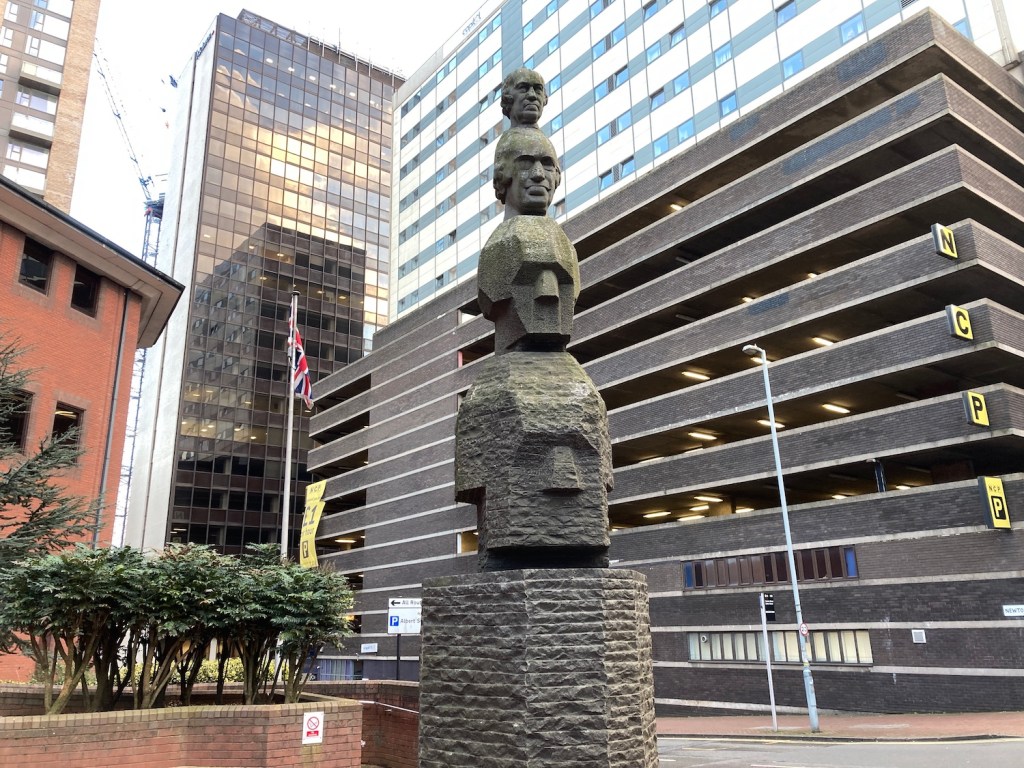
If cameras struggle to find either the outline of a head or facial recognition markers from my blonde facial features then perhaps I am free. I am a human female ‘Wattilisk’ – a city sculpture that abstracts the head of city engineer James Watt until it is becomes unrecognisable as an individual. Or, working in the opposite direction, I can decide to become visible and identifiable once more.
The Wattilisk embodies the simultaneously empowering and disempowering nature of invisibility. As a symbolic totem pole of facial recognition, it also offers an interesting discussion point.
7.15pm Dale End
Dale End is a road valley that dips between the law courts and the main high street shops. It is less well lit and one of Birmingham’s crime spots. It is also the busiest section so far with small groups gathering outside McDonald’s and cycle couriers collecting takeway food. Here is life and a glimpse of the city as it was. For middle-aged women needing to pee, it is also the only place we find that offers a comfort break.
As we enter the high street, the digital advertising infrastructure increases in volume – two tiny cameras on either side of each.
7.20pm Birmingham Media Eye 3, front of New St Station.
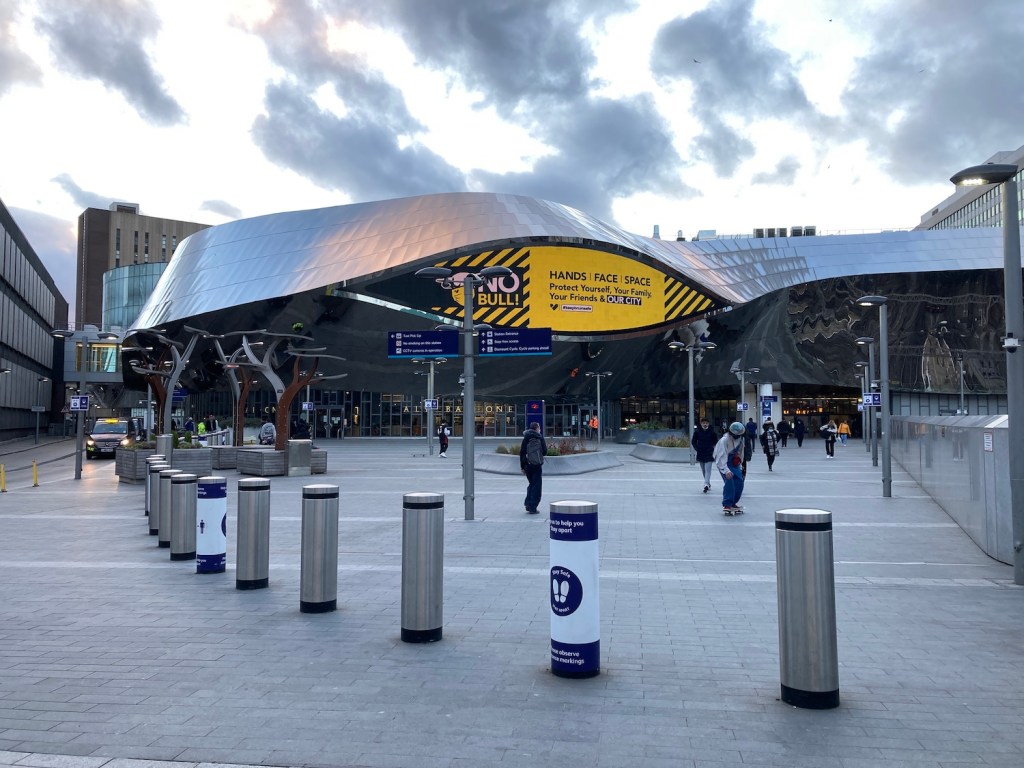
The walk ends at the third and final Media Eye. It posts government Covid-19 messages about ‘Hands, Face, Space’ then advertises a mattress then goes black. The system is broken. Perhaps we can build back better. Insert your own LOL, according to your opinion on this.
The station plaza has street lamps and tree sculptures with a dozen or so dome-cameras hanging from them. I stand underneath and blend.
Kruse is incredulous: “There are so many cameras.”
…but hardly any people for them to watch.
It is night and it is lockdown but I am filled with the strongest vision that this is our future – a city devoid of citizens – because who wants to go somewhere to be profiled, predicted and exploited? All that remains are orange or turquoise-branded delivery cyclists dropping food supplies at speed to the outskirts where there are fewer cameras endlessly watching and to where Birmingham’s citizens have retreated.
I turn my phone back on and on multiple apps my ID pops up.
I am back in the digital matrix.
I am logged.
Fiona Cullinan is a writer, editor and a co-founder of Walkspace, with an art practice exploring themes of infrastructure, privacy, diaries, memory, feminism and ageing. Further writing can be found at: fionacullinan.com.
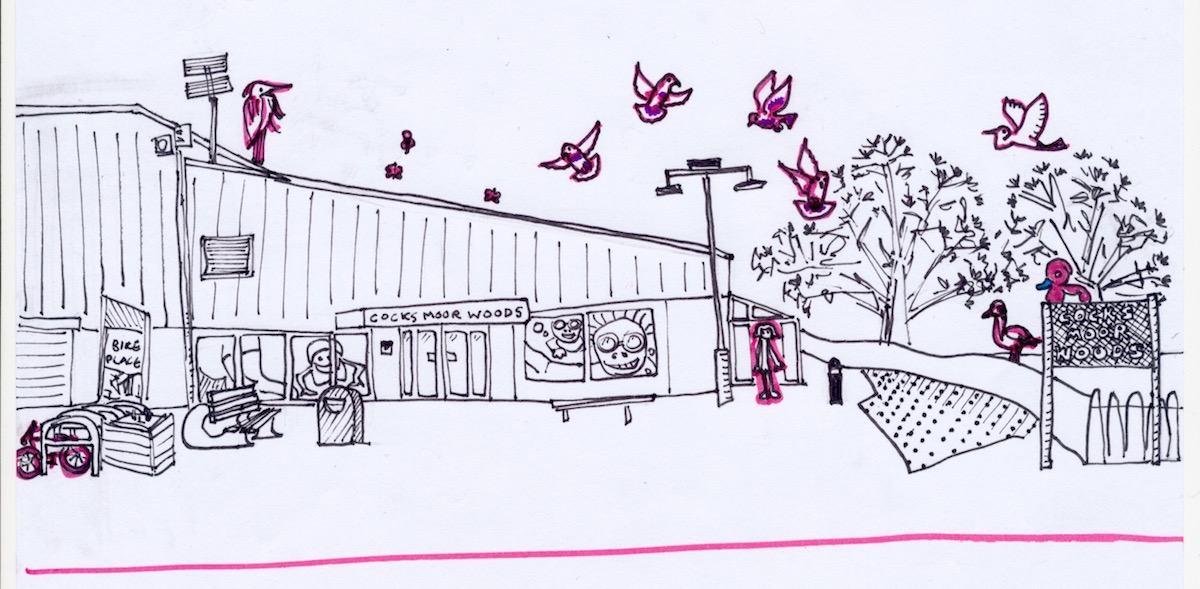
I arrive to see Andy walking from the side of Cocks Moors Woods Leisure centre. I know he is nostalgic for this place after visiting as a child.
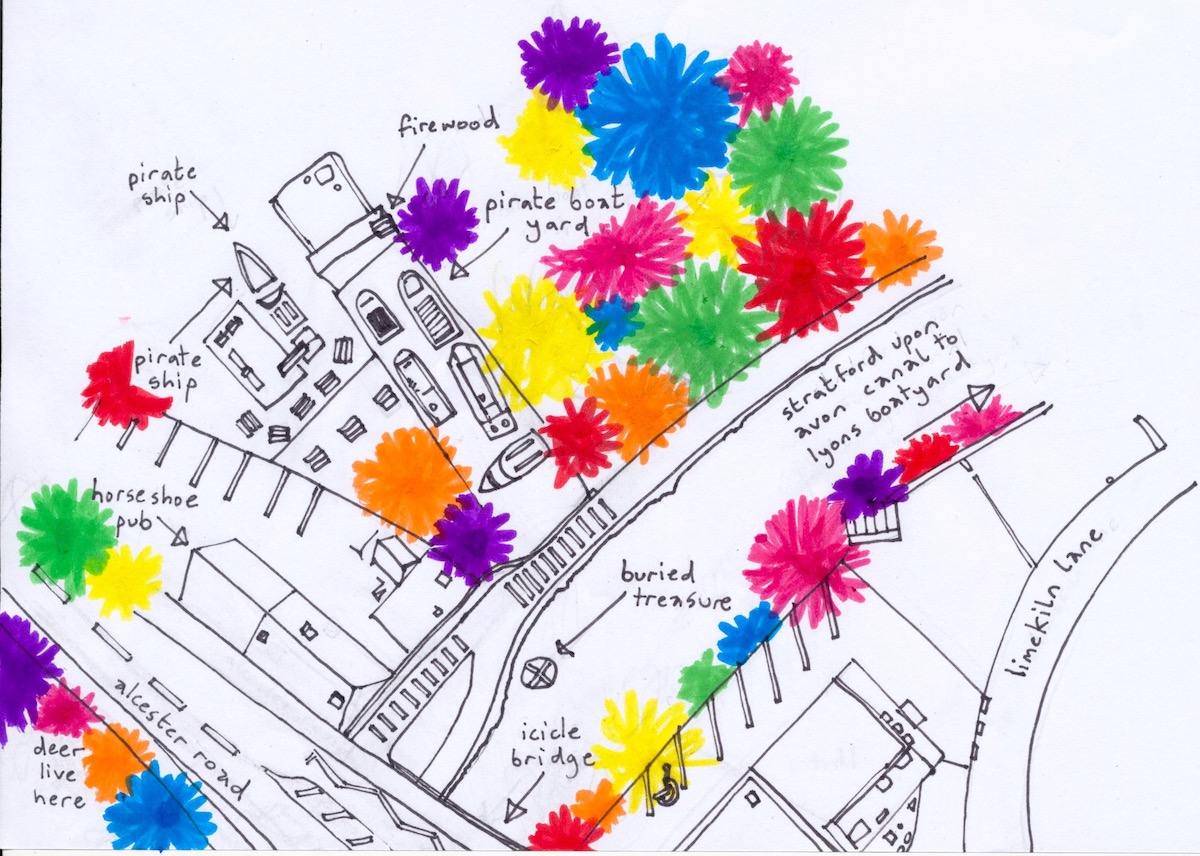
Along the Alcester Road, over the bridge, past the Horseshoe pub and left onto the canal.
Andy comes this way on his bike but hasn’t looked at the boat yard before. Just as I mention that people live there, an inhabitant of the boat steps out and looks up. Perhaps the landlord of the Horseshoe pub that is being renovated? That or a pirate. Kids play on the piratical climbing frame in the pub’s play area and know more than their older counterparts of what lies beyond.
I interrogate Andy on where he has been cycling and it transpires that the other end of our walk is near where he grew up. Armed with this useful information I slide him down a muddy slope onto Cocks Moors Woods golf course. A stressful prospect for me as I am a nervous rule breaker.
I see my second butterfly of the day and am overjoyed. Brown with colourful spots – I think it is a painted lady showing off her freshly healed tatts. But later I learn it is probably too early for that sort of thing. Yesterday, I saw my first bumblebee of the year.
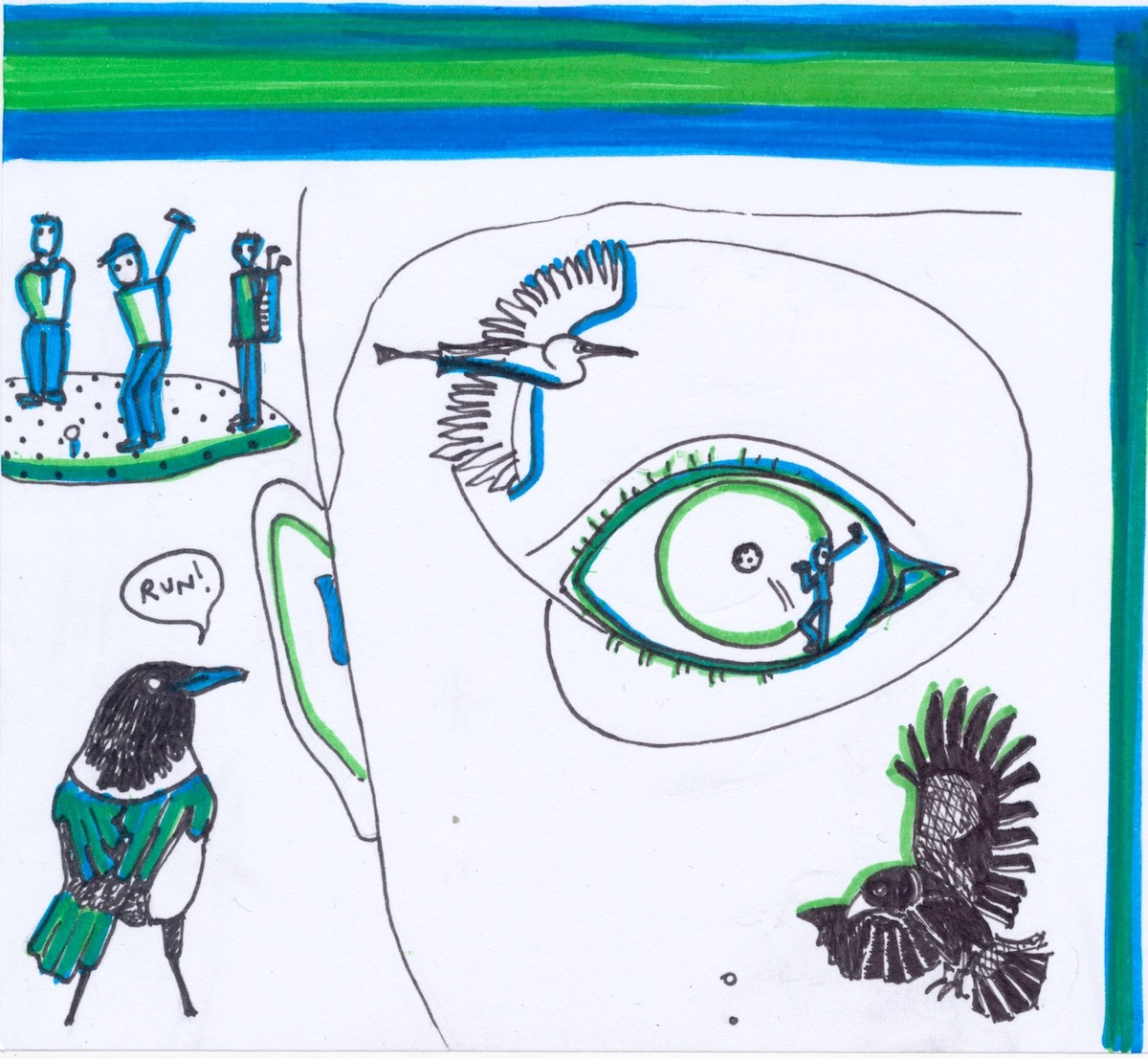
I hear a thwack! and eight… or maybe one and a half minutes later, a golf ball plonks down in front of us. I kick it absentmindedly before turning to see its owner. They are walking towards us – the golfers are attacking! How did that ball spend so long in the air? We barely make it out alive but there’s a bunch of club wielders on our opposite side. Flanked! I watch in dread as one of them hits the ball right in our direction…but then Andy points out a little egret.
The myth of the golf ball who transforms into an egret is a great one and sings praise to the resilience of the little bird. It mingles with some crows like ancient warrior monks and out of the tree pops a magpie! It finally dawns on me that a magpie is the lovechild of an egret and a crow. How naïve I’ve been all these years.
We come to what seems deceptively like a country road. As we slip through a hole in the metal fence (courtesy of a renegade angle grinder) I am wary of a dog walking family, but my hypervigilance is shattered as I say ‘Hello,’ and realise they are waiting to enter the golf course in a calm and seemingly well-rehearsed manner.
We cross the narrow brick bridge over the stream into Chinn Brook Nature Reserve. Two joggers go past, one struggling less than the other.
The sun is bright, bright, bright and the trees are budding.
Andy tells how his film about Birmingham’s lost concrete library is developing to be shown at this year’s Flatpack Festival and I’m excited to see it. This is where our existing nostalgia converges into a walking theme of nostalgia for things we’ve never known.
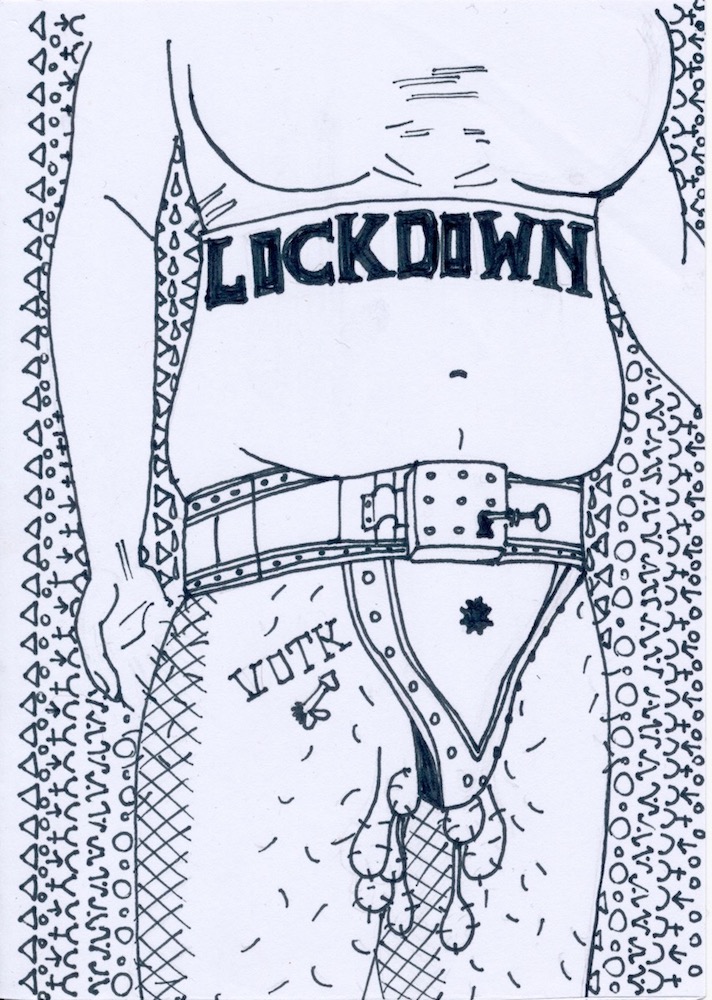
Andy asks if this brook has any link to Carl Chinn. I don’t think so, but I hate to assume. I mention the rap I’m writing which features Carl Chinn serving as a plot link between someone’s cuddly dick and Swingamajig festival via the Peaky Blinders. It’s for a drag act at ‘Valley of the Kings’, the informal night I run. Andy asks about it – little does he know I will later send him a poster featuring eight dangly testicles hanging out of a chastity belt – but what is life if not made up of these wondrous surprises.
We walk some more, through a green alleyway where a lady is wearing a full-on protective mask. It feels like we are in the Russian film ‘Stalker’ and she knows that we should be throwing a sheet tied to a stone before proceeding into unknown territory.
We duck into an overgrown pathway where two dogs are admiring the first flush of ramsons. I have previously seen something exciting and cooing in these parts and am hoping it wasn’t a mirage. We squelch towards the houses that back onto this park and discover a batch of brown and white pigeons in a cage! They must belong to neighbours of the birds I am taking Andy to see. It would appear that pigeon fanciers are abundant in these parts.
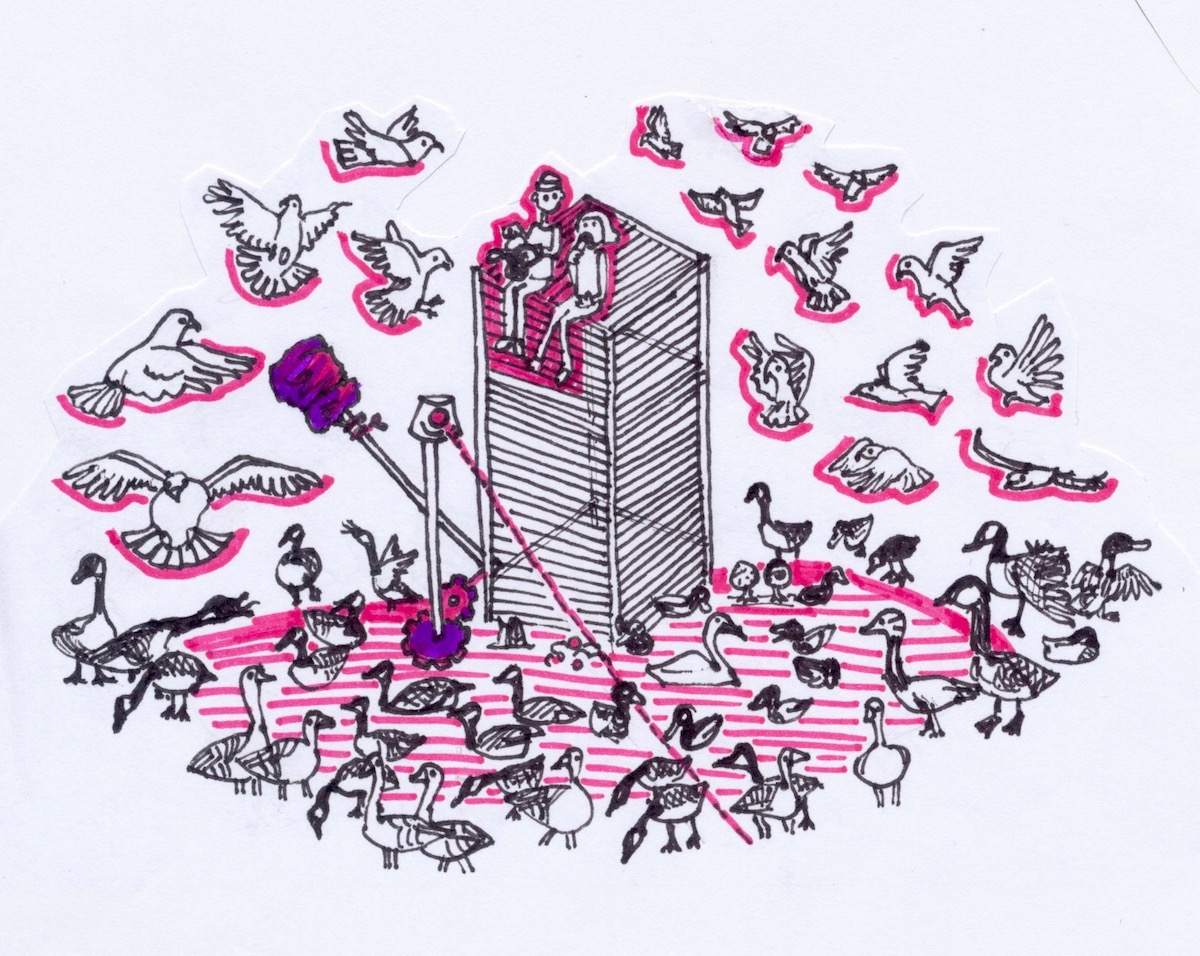
Squelching forwards, a cage towers above us and we hear the purring of white pigeons roosting behind barricades and barbed wire. As I point them out, a big stick with what looks like a bin bag, thrusts up and hits the lumbering cage. The birds erupt high into the bright, blue sky and we are in a cloud of neon purple and pink as the surprising flappers circle above us. Flashes of intense colour nestled under their wings. We realise the stick must be part of a giant automaton that whacks the coop whenever someone steps over a trigger beam or panel, we should probably start throwing a rock with a hanky ahead of us.
It’s not the first time today that we will look up to nature at its most bizarre.
We watch the pigeons for a long time. Eight… or maybe one and a half minutes later, we emerge into a large field, Andy points to a stream and says – that must be Chinn Brook. I am confused then say “Yes”.
This happens again at the end of the walk which, funnily enough, might be the moment Andy realises that I am perpetually perplexed by shifting memories. Andy marvels at what a funny part of the body it is for a brook to be named after. I miss the humour of this as I try to remember if the nearby Haunch Brook, that looks like a bent leg, is actually named after a leg or not.
Anyway, I take him over to Trittiford Mill Pool to see the lonely bar-headed goose and the tundra geese. I tell him my fantastic story about how that bar headed goose must be an escaped convict and is the world’s highest- flying animal reaching 7000m. I refer him to the video on the BBC website of someone slow clapping a goose in an oxygen mask as it flies into a wind tunnel. Quite miraculous.
We stand and look at the geese and the gothically-beautiful, tufted ducks with their blue bills and are profoundly and simultaneously moved to start snacking. Andy has a nature bar which I suppose helps him adapt to his environment whereas I have some rich tea biscuits in a plastic poo bag.
Now we enter the most exciting part of the walk – if this were a graph we would be soaring up to the top edge of the paper.
It is the marshy reed bed formed from what I think is the River Cole and I am excitedly looking for the heron and little egret I’ve seen hanging out together recently.
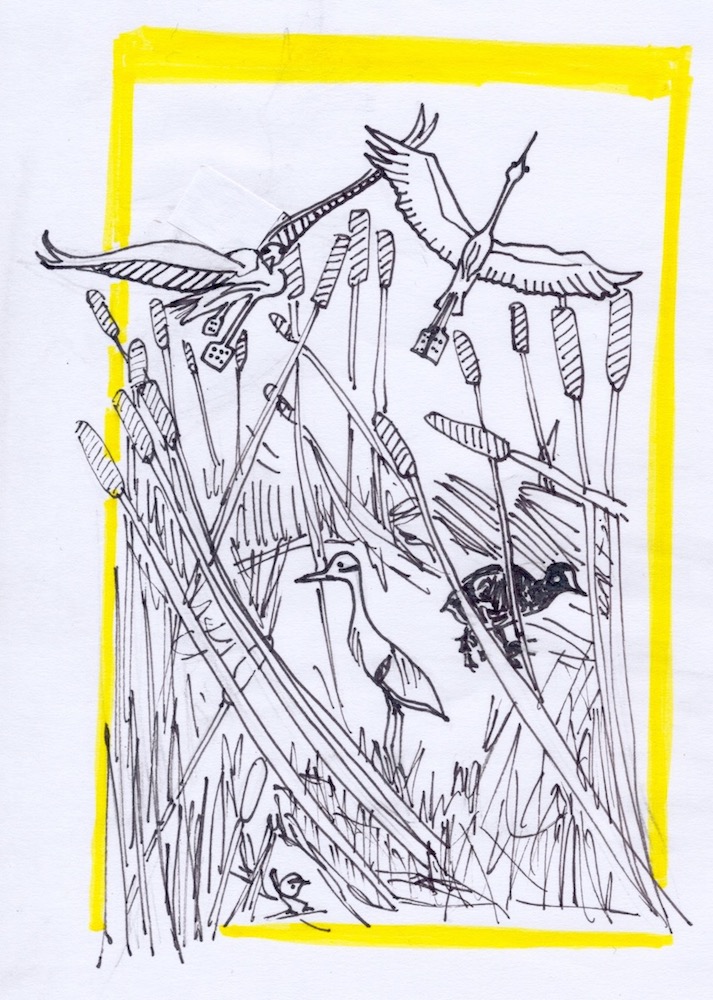
Only slight disappointment to see there is nothing…BUT WAIT – two hulking masses almost too slow to be flying, lurch overhead with dangly legs like spatulas. They are circling the reeds! Then behind us – another heron skulking on a tree branch!?! What is happening? Are the parents of a teenage heron coming to check up on it? Is it a grand day in the Birmingham heron calendar? How many herons are in Birmingham? Three in one place seems worryingly excessive if you ask me! If only I’d taken the nature bar when Andy offered – maybe I would take this all a bit more in my stride.
So, we carry on after the absolute mayhem that is lingering herons.
Now we go to a bit I have only visited once before. The underworld of Solihull Lodge, an unkempt mess of fallen tree trunks and river twisting together. It really is beautiful. Then we are in Solihull Lodge and we talk about the nightmarish memories we have of Shirley and Solihull.
I overshoot the moment to turn right for the canal, but Andy exclaims “I KNOW HERE!” He has recognised a bend in the road not at all from eleven metres but with intense clarity from ten metres away! It is a jubilation! We turn around and Andy leads us to the canal.
It is a great walk so far. I am in vaguely unknown territory and congratulating myself for coming this far away from my house and being such a reliable tour guide.
On the canal, Andy talks about Desmond Morris for some reason, and pulls out a notebook with the script from when he reconstructed Desmond’s destroyed surrealist film by reading out the scene overviews. It is fantastic to hear him recite it with dramatic, yet dulcet tones and I expect to trip over an elephant’s skull at any minute.
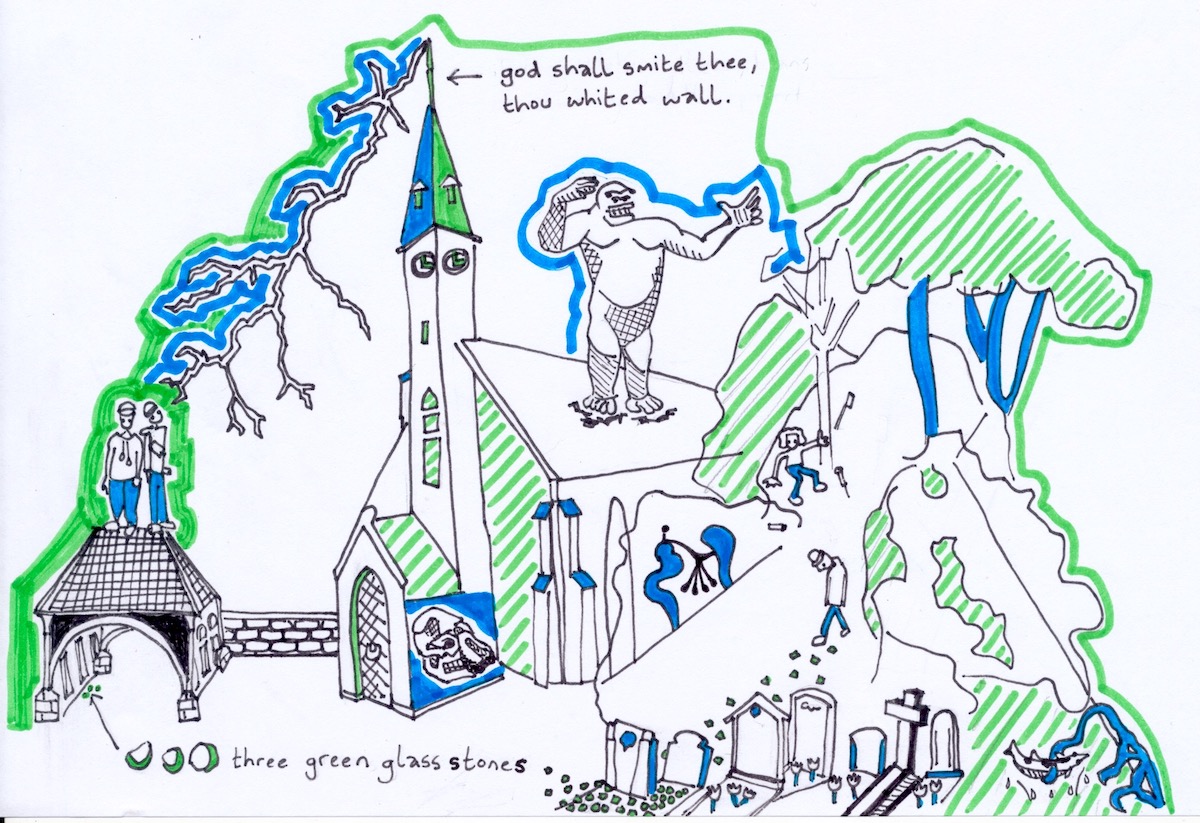
We dip into some mud on the right of the canal and emerge into a picturesque cemetery. We are nostalgic over the Victorians who would picnic in cemeteries and have a healthier attitude to death. We remember the Victorians with their healthy attitudes to death, taking photos with the corpses of their loved ones.
We loop the church seeing the typical titchy-witchy back door and read the brilliant carved tattoo-like messages in the arch entrance where the benches have been removed. I suppose to prevent anyone from sitting there for free and drinking (maybe this church is sponsored by the local pub). We make a guess that we are in Yardley Wood Cemetery (it turns out we were loitering around Christchurch, the parish church for Yardley Wood).
On leaving, we see a group of teenagers ignoring a sign that has asked anyone who isn’t a mourner or is in a group of friends to stay out of the cemetery. I smile and say, “Imagine growing up hanging out in a cemetery”. Andy supposes they will have a healthy relationship with death.
On that mildly threatening note we climb down a firework strewn slope back to the canal.
Andy tells me about a film called ‘King Rocker’ and I start listing the 1990’s rock pop scene that I know of second- hand. Referencing Club Katusi and the many gig posters from promoter Arthur Tapp and the Catapult Club gigs at the Jug of Ale pub. Andy hasn’t heard any of these bands, so I make a mumbled promise to email them over. A small-town Andy and a big city, gender queer, depressive letting their musical memories converge on the edge of a grimy canal which harbours quite gnarly tree roots, big puffs of moss and some really jumpy fish.
I become violently bored (or maybe overwhelmed with memories and nostalgia for things I haven’t known,) so Andy advises me to stare at the path until I get home.
All I see are pebbles for the rest of the walk. Sometimes we look at the tumbling gardens of the canal side houses as they struggle not to collapse into the canal.
He asks me what I am doing and is absurdified to discover that I followed his advice (I think he is a surrealist trickster).
When we get back, I am knackered because there were a lot of pebbles, but Andy is full of excitement to try and glimpse inside his childhood leisure centre. As we walk around the building, I am overjoyed at the second or third time I have heard the story of the boy who put sugar instead of salt on his chips … wait for the punchline…and then cried as he ate them! Andy spontaneously giggles as he tells it. Childhood mischief bubbling out of his eyes like that poor boy’s hilarious tears. It happened here!
Blacked out windows illuminate the mystery of the dog walkers on Cocks Moors Woods. The golfers I’ve been so afraid of are the local community just moseying onto the field. I didn’t need to be worried but am glad I avoided being clonked on the head at the beginning of our perilous escapade.
I hear a yelp of delight. Where I had seen a wall made of plain old bricks, Andy has spotted a HOLE IN ONE! Reaching up to the tiniest of chinks in the brickwork I see the looping of the water slide. It looks much better than from the inside. The pressure out here is a lot more open, not so moist and the sound is less like a thousand bullets ricocheting off tiny sheets of glass.
Completing the journey by hopping over a fence to look into more abandoned areas, Andy collects his bike. I embark on the remaining fifteen minutes of my walk – absolutely exhausted and trying not to limp. Once safely home, I take a page from Andy’s book, writing our journey down. Without it I wouldn’t have been able to sort what happened out of the crumpled-up mess of memories and anxiety swarming through my brain.
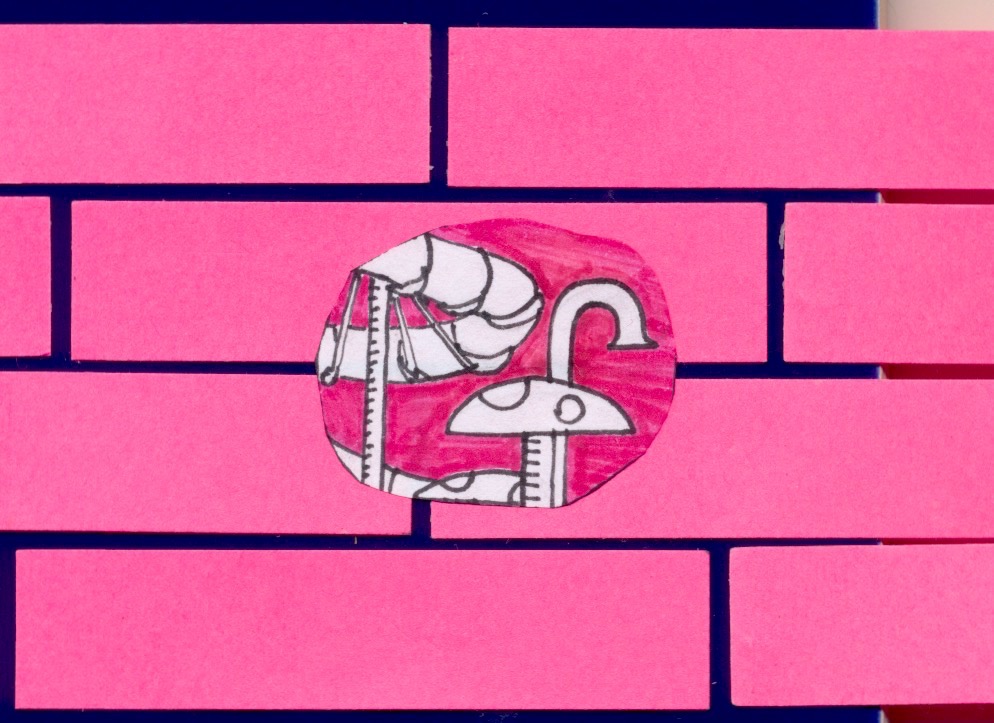
But luckily, I did! If our walk was a graph it would have ended with us flying into the sky with origami herons and pigeons made of neon pink post it notes.
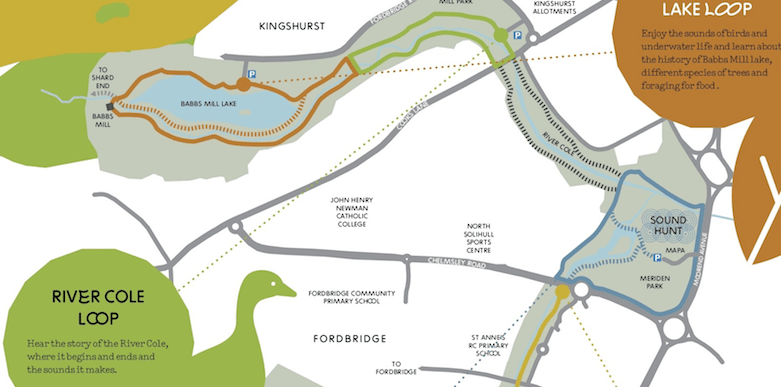
The excellent people at SOUNDkitchen have created another immersive journey of audio encounters, this time exploring the green spaces of the B37 postcode in Solihull. This self-directed walk can be undertaken at any time using the SOUNDwalker app.
“Discover the hidden sounds of bats and underwater life, listen to wind and rain on metal structures, learn to identify different trees and forage for food guided by local people passionate about wildlife.”
New Walkspace member Daniella Turbin has set herself the ambitious target of walking every square of the UK Ordnance Survey Maps. This sixty second animation documents her journey along the course of the River Severn and comprises sixty hand-drawn frames created from photographs taken on a 35mm film camera.
“The River Severn runs right the way from North to South Worcestershire, joining the village of Upper Arley with the town of Tewkesbury. As a walking artist I decided to take this journey by foot and create a video in response to this journey.”
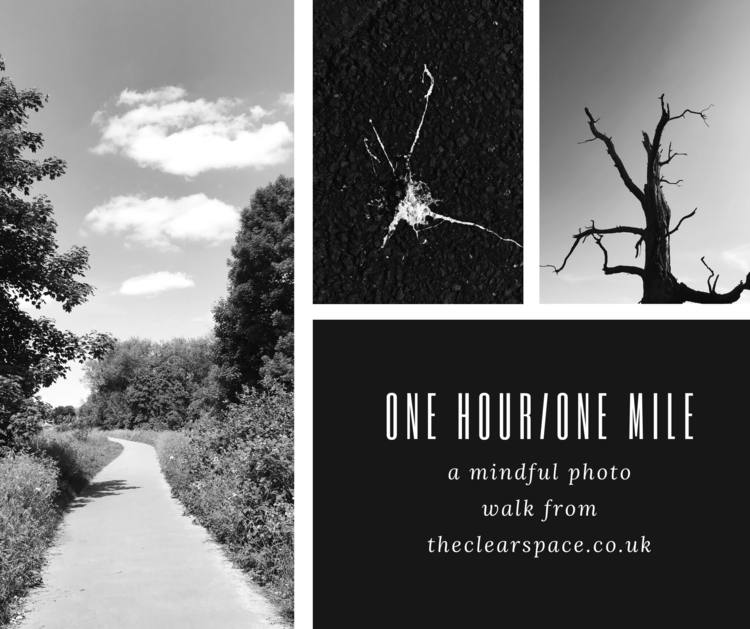
Join Laura and The Clear Space on March 16th for this socially distant and Covid safe mindful exploration!
We’ll use a combination of mindfulness and photography to really slow down and explore the environment. Our initial zoom workshop will involve a guided mindfulness session, and you’ll also receive a brief, along with some mindfulness and mindful photography exercises to follow on your One Hour / One Mile self-guided mindfulness photo walk.
You’ll carry out your walk using mindfulness and mindful photography techniques to engage with your environment and document your exploration.
You don’t need any experience of mindfulness or photography to take part, and the only equipment you’ll need is a camera phone or a disposable camera.
There will be an optional debrief via Zoom on the 30th March at 7pm, where we’ll talk about our experiences and share our findings.
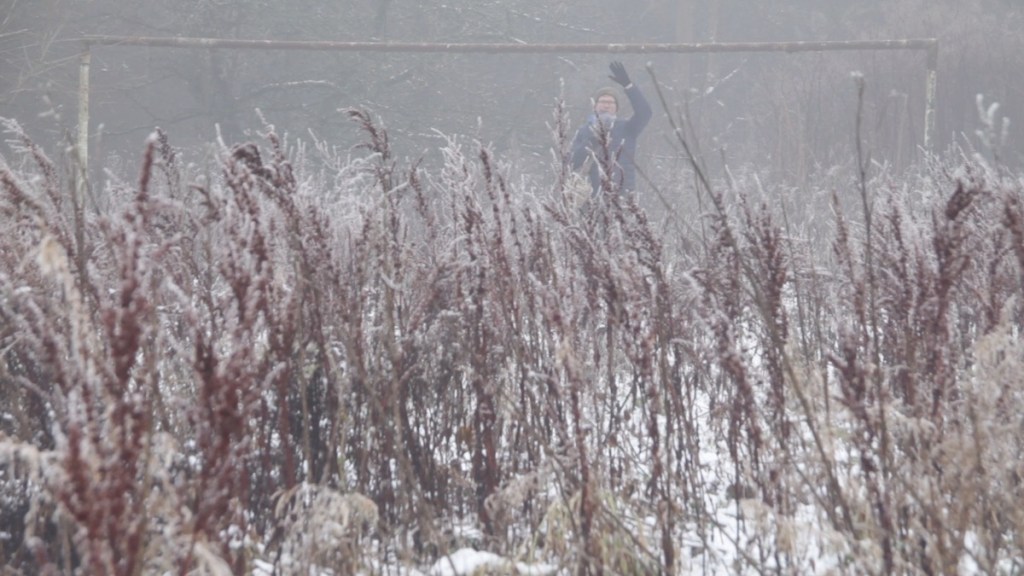
I’ve used Mind (the charity) both personally and as a professional mental-health worker a lot over the years – they’re just about the most useful resource in Britain for mental health support. So I’ve decided to walk around my local park every day throughout January to raise money for them. This might not seem much but it’s this type of simple activity that keeps a lot of us going. To make it a bit more of a challenge, however, I’ll be taking my camera with me each day in order to make a diary-film about this experience within my local environment, which I hope can be an additional and beneficial outcome for others. It’ll involve walking, looking, listening, talking and maybe even some singing…
That was my mission statement when I began this project at the start of January. One of the fun things about setting yourself simple restrictions, however, is allowing the improvisation of daily making within an uncontrollable environment loosen those restrictions almost immediately. This is my second attempt at a long-form diary film within the past few months and I’d recommend it to anyone wanting to embrace a lack of preciousness and the idea that what we cannot plan for can be often more interesting and rewarding than what we think we want.
You can watch the film, which is updated weekly until the end of January, here:
And your donation would be greatly appreciated here.
About Owen
Owen Davey (sometimes known as OD Davey for musical purposes) is a Manchester based writer, director and performer, working in song, film and the gallery. In 2014 he founded Video Strolls, a nonprofit that curates art and film events that explore place and journeying.
He is currently an AHRC North West Consortium funded and Disabled Students Allowance supported PhD candidate at the University of Salford, doing practice-based research into ‘The Enfoldment of Song and First Person Filmmaking’.





 Walkspace