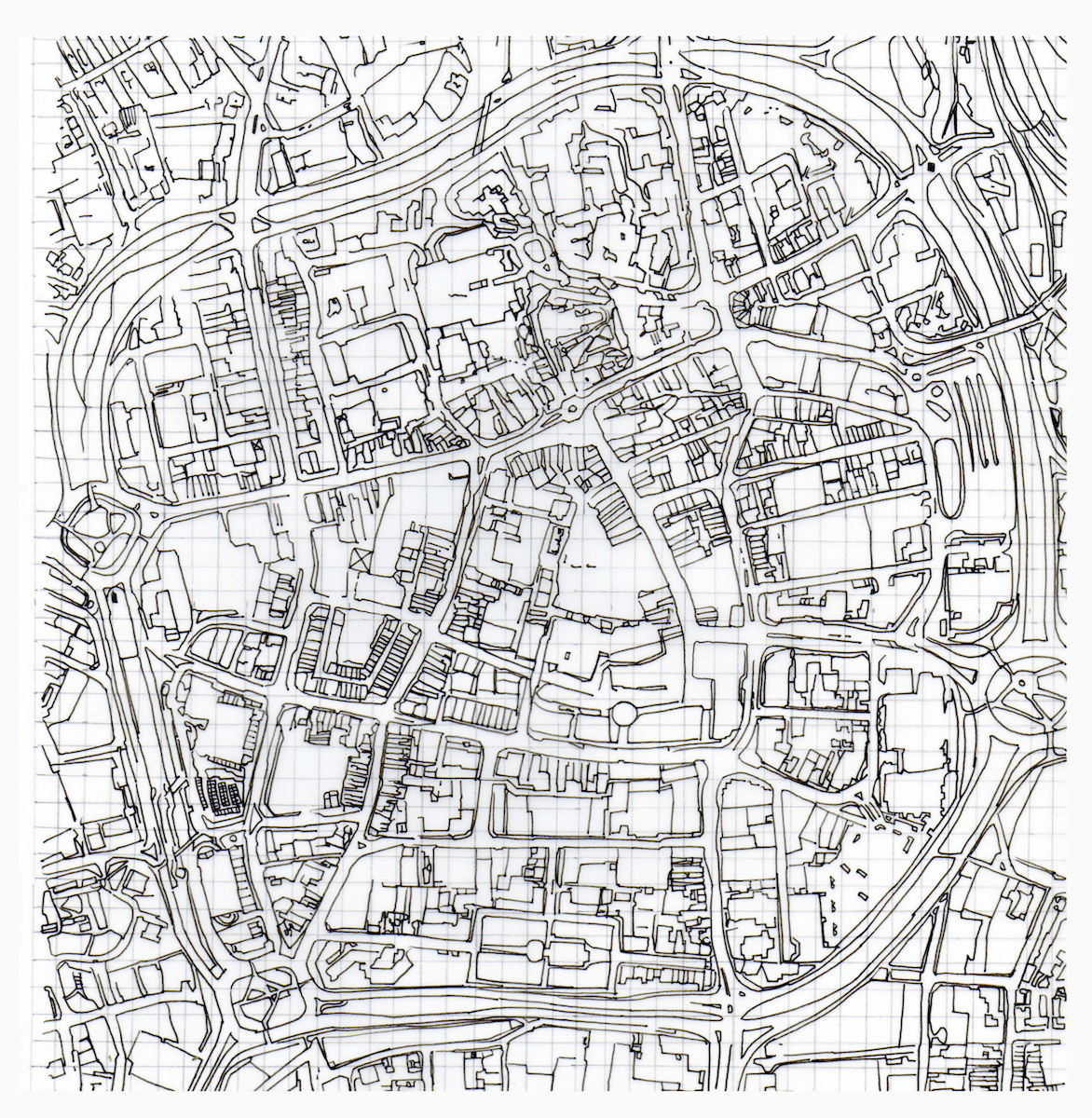
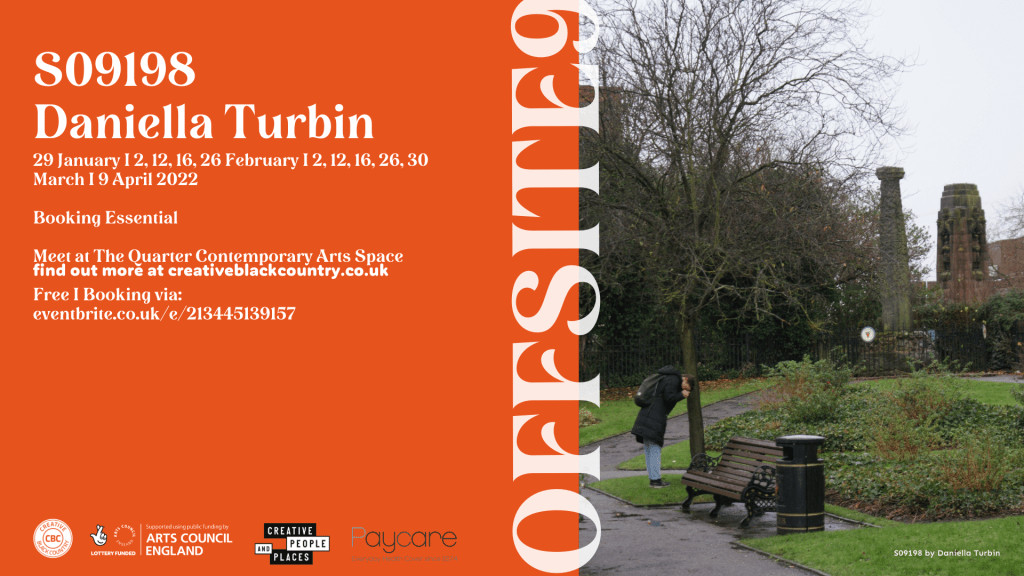
Join local artist Daniella Turbin for a walk around the City of Wolverhampton. S09198 is the unique grid reference for the centre of the City of Wolverhampton, and throughout the duration of British Art Show 9 you are invited to explore every underpass, street, and building within this one kilometre square.
Sign up to take a walk with the artist and together map and record the city through photography and walking. This project will take place throughout the duration of British Art Show 9, and will finish with the creation of a public map of the city on the scale of 1:100.
The remaining dates are: March 2nd, 12th, 16th, 26th, 30th, and April 9th. Walks are scheduled between 9.30 to 17.30 and last approximately 90 mins, they start and finish at The Quarter Contemporary Arts Space. The walks are free but booking is essential.
This OffSite9 project has been commissioned by Creative Black Country as part of Arts Council England’s Creative People and Places scheme, and supported by Paycare.
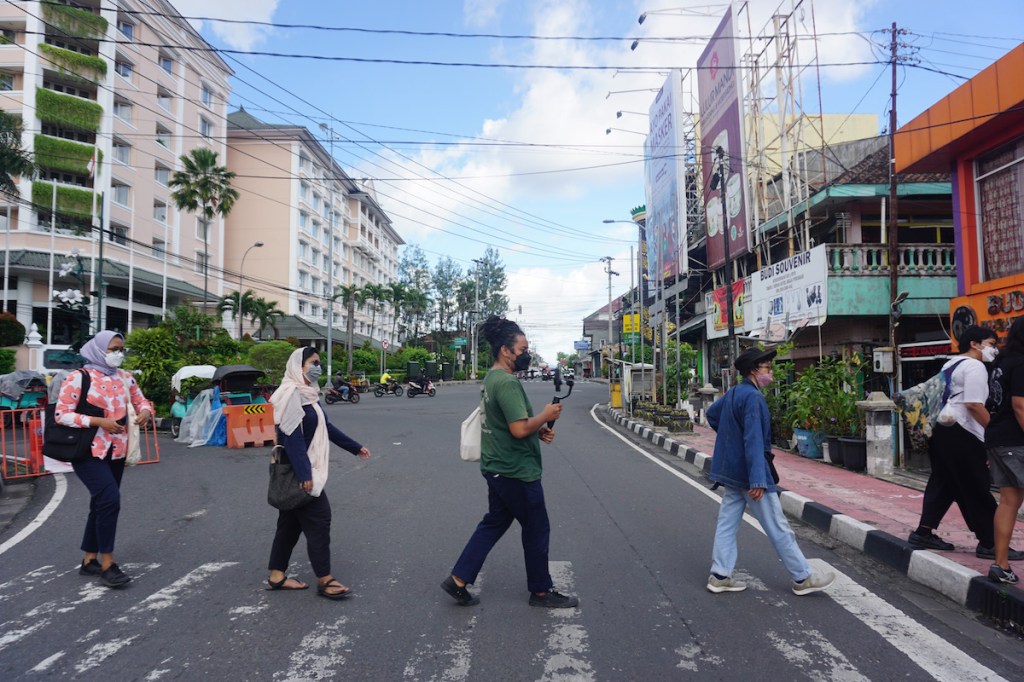
Two walk-based art collectives over 7,500 miles apart have been walking in parallel to see what pedestrian life is like in each other’s motor cities. Now they are sharing their stories in a new exhibition and zine, launching in both countries in February 2022.
The British Council-supported project brought Walkspace in Birmingham, UK, together with Jalan Gembira in Yogyakarta, Indonesia, for a cultural creative exchange through the act of walking. Artists in both cities explored themes such as pedestrian safety, public versus private space, gentrification/redevelopment, and the nature of walking.
What is it like to walk in a city dominated by cars and mopeds? What pedestrian portals lie off-road where drivers can’t go? Is it safe to walk alone? What lies behind the scenes?
The result is ‘Parallel Walking: Between Here and There, Between the Seen and the Unseen’ – an exhibition and zine comparing Birmingham and Yogya’s perspectives on the urban walking experience. The show runs for two weeks at Artefact Gallery in Stirchley (5-19th Feb); a mirror exhibition will appear on noticeboards at a community watch post called ‘pos kamling’ in Yogyakarta (10-15th Feb).
A schedule of public walks, walk-based film night, zine launch (12th Feb) and online discussion will accompany the show.
Walkspace is a 36-member collective in the West Midlands for artists and writers who use walking in their creative practice. It was approached in August 2021 by Jalan Gembira, a female-led walking practitioners group in Yogyakarta, Java, which translates as ‘happy road’.
Three Birmingham-based walking artists were commissioned for the project.
Andy Howlett started mapping the city’s ‘pedestrian portals’ through experimental group drifts starting underneath the Aston Expressway at Lancaster Circus
Beth Hopkins aka Bethany Kay used field recordings and composition to create ‘Ode to Chad’ – a song to Birmingham’s Chad Brook river which flows through public and private space
Fiona Cullinan – walked a series of alley, walkways and footpaths alone to create ‘Female Calculations’, a photo collage and film exploring subjective female safety algorithms.
In Yogyakarta, Jalan Gembira also invited three artists to explore Ratmakan, a riverside village that is being redeveloped and styled as a tourist area – something which feels at odds with the reality of life for those living there, and echoing gentrification impacts in the UK.
As part of the cultural exchange, Walkspace is recreating a ‘pos kamling’ watchpost and noticeboard inside Artefact Gallery. It will also encourage visitors to indulge in the Indonesian hangout culture of ‘nongkrong’ – chilling out with friends in the space – as part of the exhibition.
Lead artist for the UK project, Fiona Cullinan, said:
“Getting the chance to work with Indonesian artists was a fantastic opportunity. I’ve visited Indonesia a few times so it was interesting to go deeper and learn about the arts collective scene while working on the project. We couldn’t meet in person so we had to find new ways to show each other our streets and share our experiences of urban walking.
“Whatever challenges our cities throw at us, a lot of people have rediscovered the joy of walking in the last two years. For Walkspace, the act of creative walking goes beyond basic A to B pedestrianism. It’s like ‘walking-plus’ whether that plus is art or photography or songwriting or zine-making or meditation or something else that opens up a place in new ways.”
Jalan Gembira said:
“In reality, walking can be a way to understand the city we live in. For instance, we would not notice the changes that occurred in the city had we not directly experience it with our senses. We only see things through motor vehicles when we pass through and only get quick glimpses of the city.”
Beth Hopkins, who performs with Birmingham avant-pop band The Nature Centre and solo as Bethany Kay, said:
“Having the chance to explore a hidden corner of my city and respond to the sounds and places that the Chad Brook carves its way through was a real treat. By wading through private access areas and seeking out the brook, I felt like I was in some small way illuminating a piece of Brum that would otherwise have been hidden to public eyes and of course sharing the secret with our Indonesian colleagues.”
Jalan Gembira is a walking practitioners collective based in Yogyakarta, Java, that has been walking together since 2016. They post their walks to @jalan.gembira.
The British Council is the UK’s international organisation for cultural relations and educational opportunities. We build connections, understanding and trust between people in the UK and other countries through arts and culture, education and the English language. Last year we reached over 80 million people directly and 791 million people overall including online, and through broadcasts and publications. Founded in 1934 we are a UK charity governed by Royal Charter and a UK public body. We receive a 15 per cent core funding grant from the UK government.
The British Council’s Connections Through Culture programme has been running in the UK and East Asia for the past 16 years to foster international collaborations through arts and culture.
Artefact is an artist-led gallery, workspace and and bar in the heart of Stirchley, South Birmingham.
A couple of weeks ago Andrew Stuck came to Cannon Hill Park in Birmingham to interview me for his excellent Talking Walking podcast. We talked Walkspace, filmmaking, “extreme noticing”, erratic boulders and the upcoming Parallel Walking exhibition. We saw a kingfisher, a miniature model of the Elan Valley Reservoir and I gave some suggestions for creative walks that listeners might like to try out themselves. Many thanks to Andrew for a very enjoyable walk and talk! Listen here.
Walkspace is happy to announce our first funded project – an international walking arts collaboration with Jalan Gembira in Indonesia.
Jalan Gembira is a female-led walking practitioners group based in Yogyakarta, Java. The name translates as ‘happy road’ and reflects the enjoyment they have recently discovered from walking and exploring their city.
Back in August, they invited us to partner in their application to the British Council’s Connections Through Culture programme, which fosters international collaborations through arts and culture. (Thankyou to Louise at BOM for the introduction.) In September, we were delighted to hear that we had been awarded funding for our proposed project.
The full project title is ‘Parallel Walking: Between Here and There, Between the Seen and the Unseen’. Like Birmingham, Yogyakarta is a ‘motor city’ where walking is secondary to the car/motorbike/moped, where public space has been eroded by private interests, and where the infrastructure of the city can make walking feel unsafe for pedestrians. These were just a few shared themes we identified in our initial talks.
Over the next three months, we will be working and walking in parallel, gaining insights and developing our practices through showing each other our streets. We want to hold up a mirror to each other’s cities as part of our cultural exchange.
The ‘Parallel Walking’ project will run from November until the end of February. It will involve three UK artists (Beth Hopkins, Andy Howlett and Fiona Cullinan) and three Indonesian artists (Deidre Mesayu, Kurnia Yaumil Fajar and Riksa Afiaty). The mix of participants includes musicians, illustrators, collagists and walking artists. Together they will explore the identified themes through their own practices, perspectives and while walking in parallel in their cities.
We will be producing a joint zine of material from the walks and hold a simultaneous parallel exhibition – ours will be at Artefact in Stirchley, Jalan Gembira’s will be on ‘pos kamling’ – community watch posts in the neighbourhoods where they walk.
The exhibition/zine is scheduled for early February.
[Update: Event cancelled – subscribe to newsletter to stay in the loop for future events / dates. ]
With winter coming, and many of our local walking routes exhausted after several lockdowns, this Erratic led by Katy Hawkins is an opportunity to learn and practice tactics for enhancing our wandering and wellbeing.
Katy uses creative means to enliven our time spent outdoors. Tactics include:
interacting with trees
practicing texture curiosity
drawing as meditation
using language to notice more
Katy is also interested to hear methods of your own, and hopes to bring together all tactics shared and gathered as part of an illustrated booklet to be posted back out to contributors.
This walk will begin on Bournville Green, B30 2AD, at1:30pm, Saturday 20thNovember. It will last approximately 1.5 hours and will be followed by optional coffee & cake at Kafenion. The terrain will mostly be pavement, roads and grass. You are advised to bring a notepad and pen or pencil and, conditions permitting, be prepared to take your shoes off (optional).
Although the Erratic walks are free to attend, booking in advance lets us know what sorts of numbers to expect and also makes it easier for us to communicate any changes or announcements.
This year we invited members of the public along to join in our annual Stirchley skull walk. I say annual… the first one only took place last year under rule-of-six lockdown restrictions but someone on the walk said we should do this every year and so an ethereal manifesto has started to form. Check out the inaugural skull walk to get a skull overlay for your own local streets.
Of course, an unwelcoming storm of horizontal rain and icy winds blew through just before the walk but eight people still turned up to follow an invisible skull outline around the streets of Stirchley in south Birmingham on a wet Sunday night.
Andy Howlett baked the soul cakes and led the 90-minute walk which criss-crossed between this world and the next. And despite fewer houses decorating the front yards this year, there were still plenty of real signs that the spirits were at large.
Messages in the landscape
No! Keep out! Danger of death! Stay safe! Too late! Ends! RIP! Emortal! Warnings of graves being dug. All the signs were there that this was no ordinary walk.
Sounds of the spirit world
At the top of the skull, the spirit sounds came to us in the rustling of tree leaves and whistling of the wind through the back alleys of Stirchley East. We paused at the top of Hazelwell Park and a bat flapped out of the tree line. A flagpole screeched by Selco. And a broken streetlamp flapped overhead against its pole like something out of Twin Peaks. Naming no names, some started saying the words on street signs out loud in monstrous or ghoulish or hissing tones: “Schoooool!” “Caaaaution!” “Travisssss Perkinssss”
Faces in strange places
From van doors to grit bins to cloud formations viewed from the darkness of Wickes’ car park, the other side communicated its presence through pareidolia. Witches on broomsticks in the sky. Shadows demons lurking in the corners. Beaked hooded figures in the River Rea of blood. Screaming faces etched into Bournville Lane’s Victorian housing.
Portals to the underworld
On Halloween, the portals between worlds open up everywhere. From drain covers in grass verges with moss embossed runes to the gateposts of hell to people frozen into stone bollards guarding entrances and exits. And then there are the snickets, ginnels and alleyways where time itself seems to shiver and ripple as humans pass through to the other side.
The End
After the walk, the participants looked visibly relieved to have made it back. A few went to the pub to sate their thirst. Others peeled away to trains or home. For us, we walked home all alone, past graves and tombstones. Where the bunny rabbits were waiting for us…
Stay safe, everyone. See you next year for Skullwalk 3: Rise of the Walking Dead?
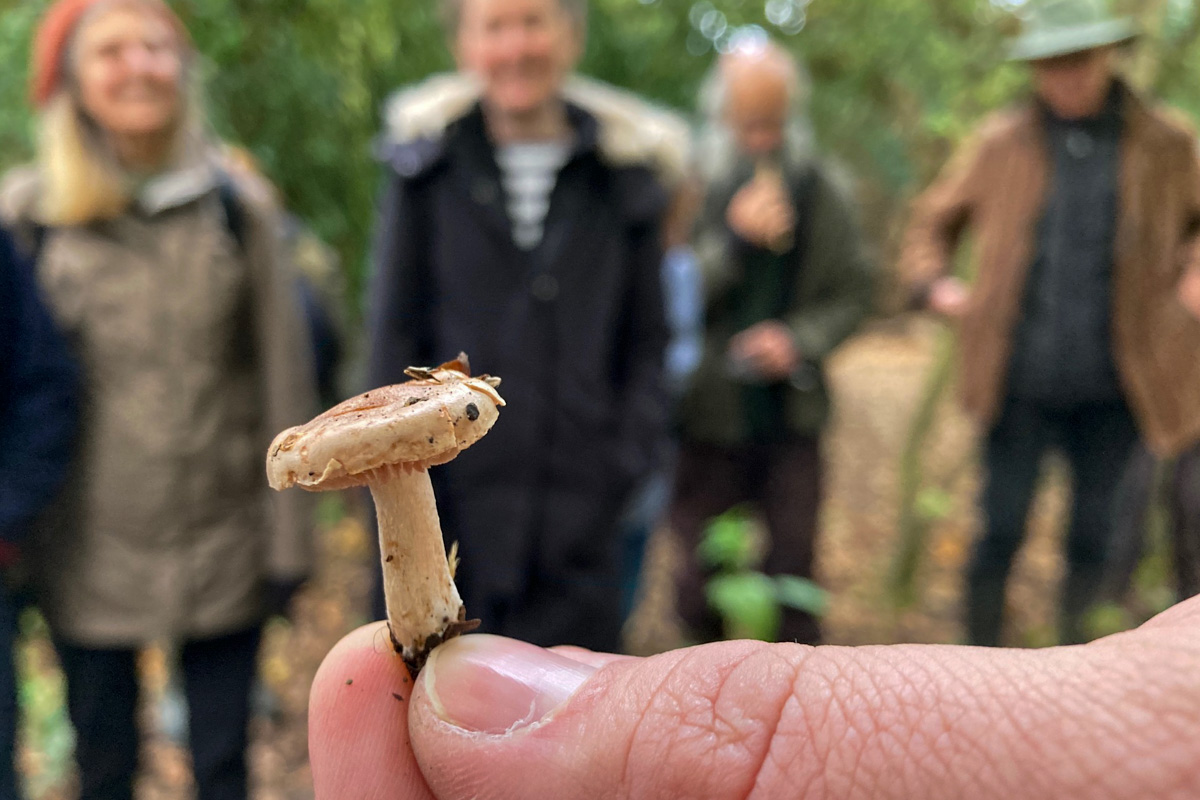
To be fair, I could have picked any of the names to headline today’s two-hour, ‘sold out’ Lukas Large fungi walk around Moseley Bog. But Dead Man’s Fingers were one of my favourite’s with their pointy black protuberances that look nothing like what anyone would imagine a mushroom to be.
There was also:
The amethyst deceiver, which changes colour, almost like camouflage.
The white saddle or elfin saddle, a convoluted spore shooter that looks a bit like a biology book diagram.
Clustered brittlestem – which grows in clusters with er brittle stems.
Brown roll-rim – the only fungus known to have killed a mycologist (someone who studies fungi). Julius Schaeffer died after eating it. Apparently it can cause an allergic reaction which leads the body to kill own blood cells. “Eating one is a bit like Russian roulette,” says Lukas.
Trooping funnel – which grows in troop lines or rings.
Birch brackets – which grow on birches and have lots of medicinal properties.
Apricot clubs – a lovely yellow coral fungus.
Sheathed woodtufts – shiny!
Inkcaps – I think these were the ones that were highly poisonous if alcohol is consumed a few days before or after.
I think the photo below is of the red cracked bolete – which drops spores out of pores instead of gills on the underside…
Candlesnuff – because that’s what it looks like.
Hairy curtain crust which commonly grows on oaks.
Shaggy inkcap aka lawyer’s or judge’s wig.
Green elf cups – although some walkers thought it was blue. Maybe teal? Anyway, this vivid coloured small mushroom also discolours the decomposing wood it grows on.
From what I can gather, the 2021 ‘mushroom season’ (Sept-Nov or until the first severe frost) is a good one. Certainly once we started looking in the Moseley Bog nature reserve they were everywhere, popping their heads above ground, on trees, in mud in order to spread their spores.
There are 15,000 species in the UK, all running on a limited number of describable characteristics – shape, size, colour, texture, gills, tubes, webbing, caps, cups, smell, sap, relationship with nearby trees. Even Ray Mears doesn’t fully trust his fungus ID skills when eating in the wild.
Or as someone said at the start: “All mushrooms can be eaten once, not all can be eaten twice…”
Thanks again to Lukas Large, Natural Sciences Curator at Birmingham Museums, who led the walk. You can check out his Flickr stream for some great photos.
We found out about him from fellow Walkspace member Jacob Williams, who led one of our members walk on a journey to the Centre of the Earth and urged us to look out for Lukas Large’s next walk. Follow him on Twitter @lukaslarge.
Or just get out there and look. But as Lukas says: “If you want to go foraging for fungi, please do it ethically. Many of our nature reserves and country parks are the last fragments of nature in a sea of people and agriculture, so the fungi there are precious and should be left for wildlife and other people to enjoy.”
All photos: Pete Ashton (except for amethyst deceiver and white saddle by Fiona Cullinan)
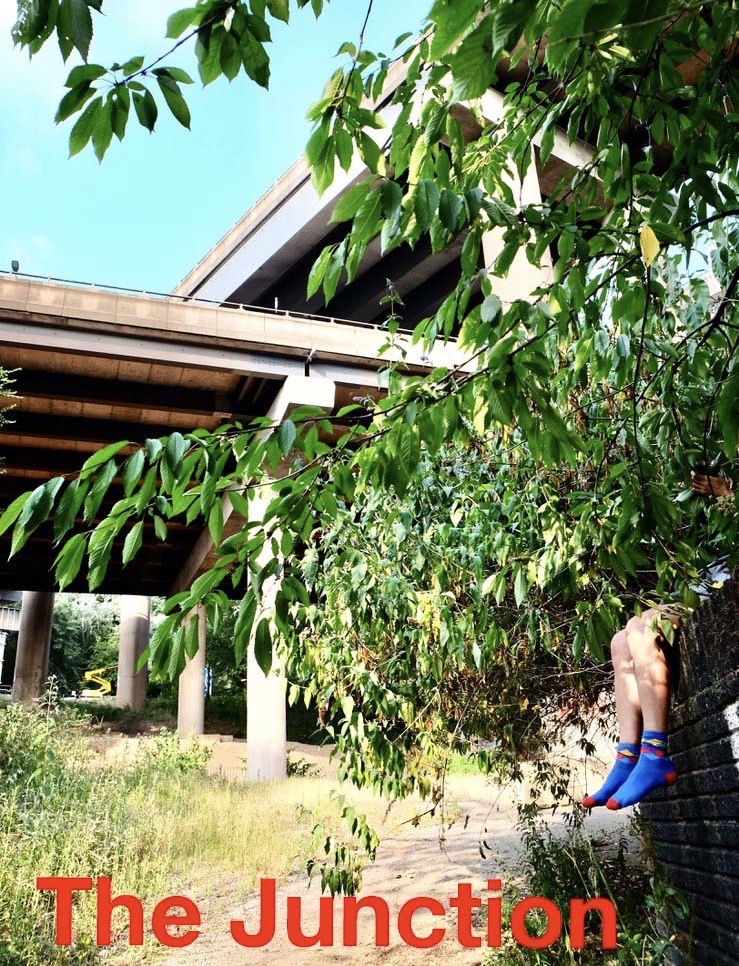
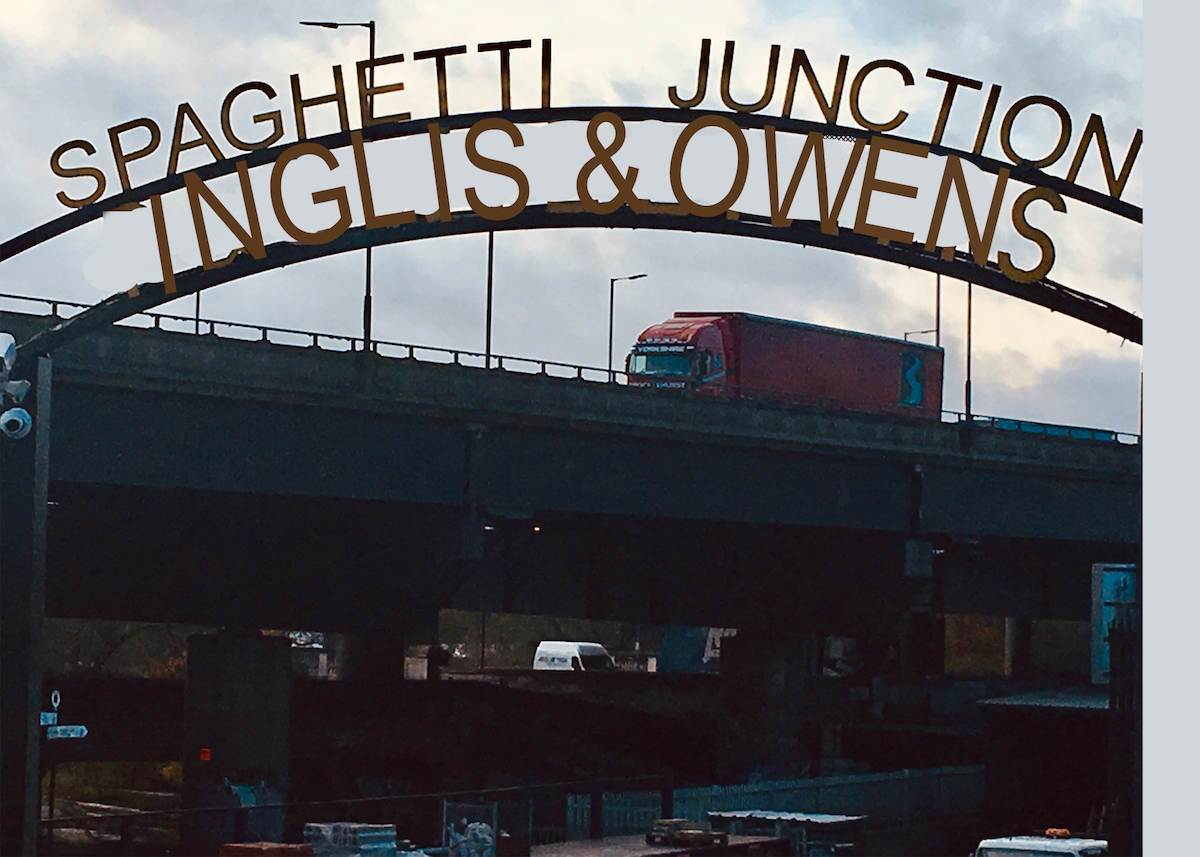
We wanted to celebrate this overlooked landmark, its construction created the Motorway system and it is vast. We spent two years meeting up in Birmingham (we live in Edinburgh & Sussex respectively) and explored the site on foot throughout the seasons. We both grew up in the Midlands and Spaghetti Junction was part of our childhoods.
What we found was two Junctions. Beneath concrete superstructure lies an older, darker junction ,a network of rail line, river, canals and foot/cycle paths intersected by feral undergrowth.
The Junction is part of a wider series examining places of significance throughout England. We are working on a project looking at the Thames Estuary and in the future we want to look at the border with Scotland.
About the Artists
Emily Inglis and Rachel Owens go on walks and make art; their creative collaboration is based on a thirty year friendship and the interplay of tensions and class differences contained within it.
After the success of the first Walkspace Erratic last month, we’re continuing this series of public walks with a visit to Solihull where Walkspace member …kruse will be helping us to find balance.
The equinoxes are a time when the amount of sunlight and darkness in the day is equal. Can we use this time as an invitation to balance our own lives and find some equanimity to carry us through the long haul of winter towards the Spring Equinox?
This walk will leave from outside Solihull Station at 6:30pm, Tuesday 21stSeptember* and will take around 1.5 hours. We will walk from the station to a local wildlife area, home to all sorts of creatures, including reed buntings, owls and buzzards. The walk will finish back at the station.
Although the Erratic walks are free to attend, booking in advance lets us know what sorts of numbers to expect and also makes it easier for us to communicate any changes or announcements.
Liz pauses us as we emerge onto the terrace above the canal. All around is a social throng of teens, twenty-, thirty- and fortysomethings. They line the floors of the Mailbox, drinking, dining, flirting, peacocking and people-watching. After months of restrictions, the UK’s third lockdown is easing and it’s a beautiful sunny Saturday evening in central Birmingham. The mood is celebratory. The olds are mostly vaccinated, the young at least partly so, and everything feels just a little bit more hopeful for the future. Humanity is in its brightest colours.
This is either going to be the most triumphant or the most uncomfortable part of our attempt to ‘crone the city’.
==
Croning the City
Who are these women? Are they important in some way? Why are they carrying stuffed toys? Why are they walking in a line? Why is a photographer snapping them? Where did the middle one get that dress? What is the story here?
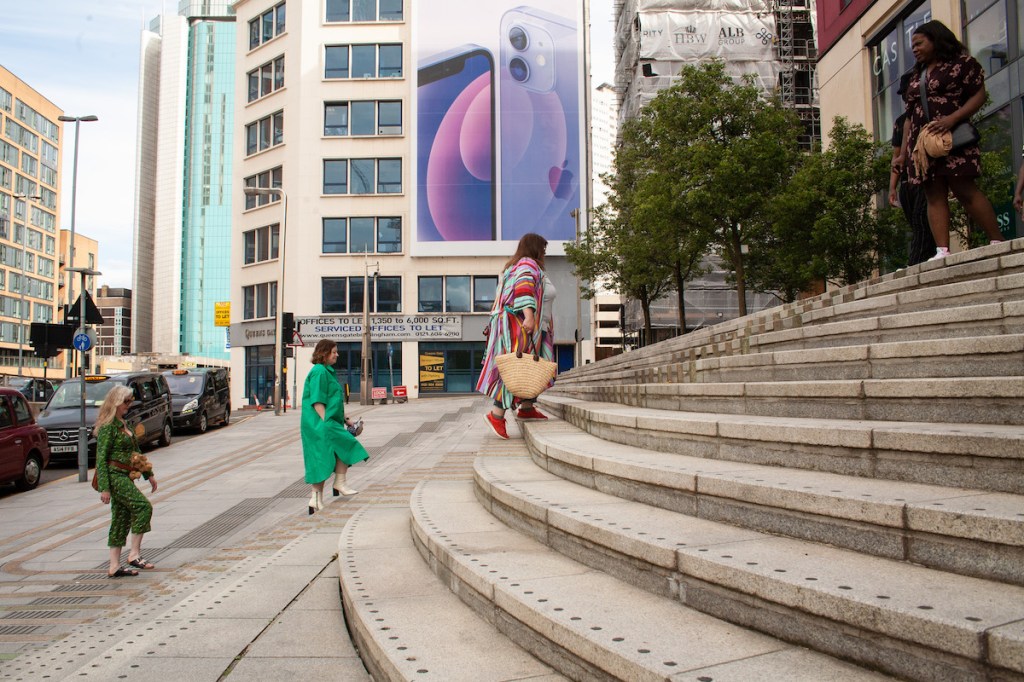
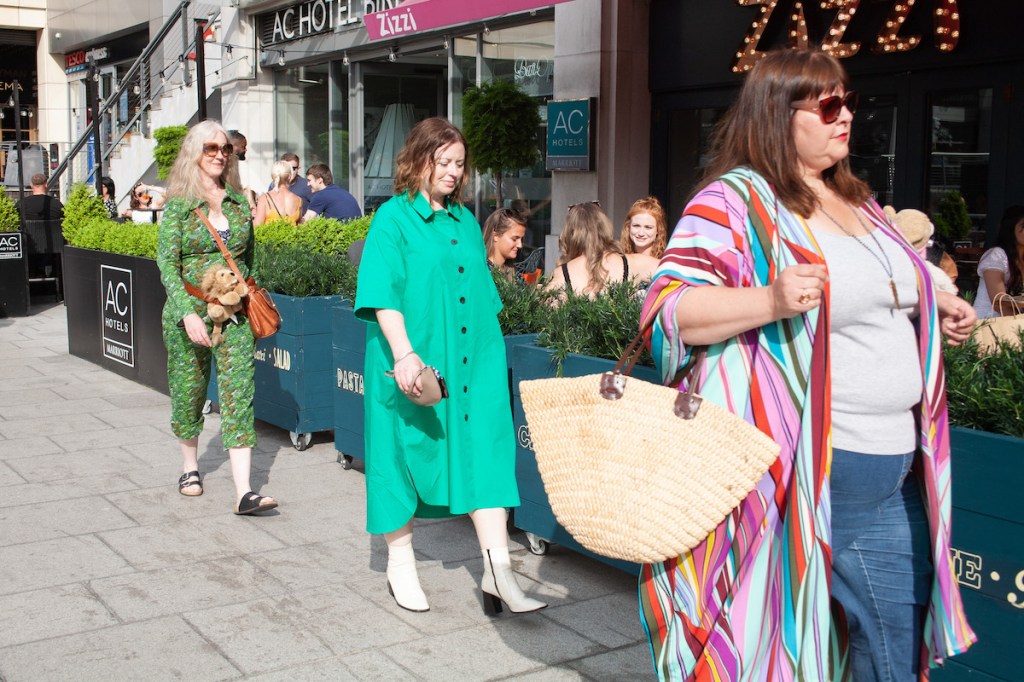
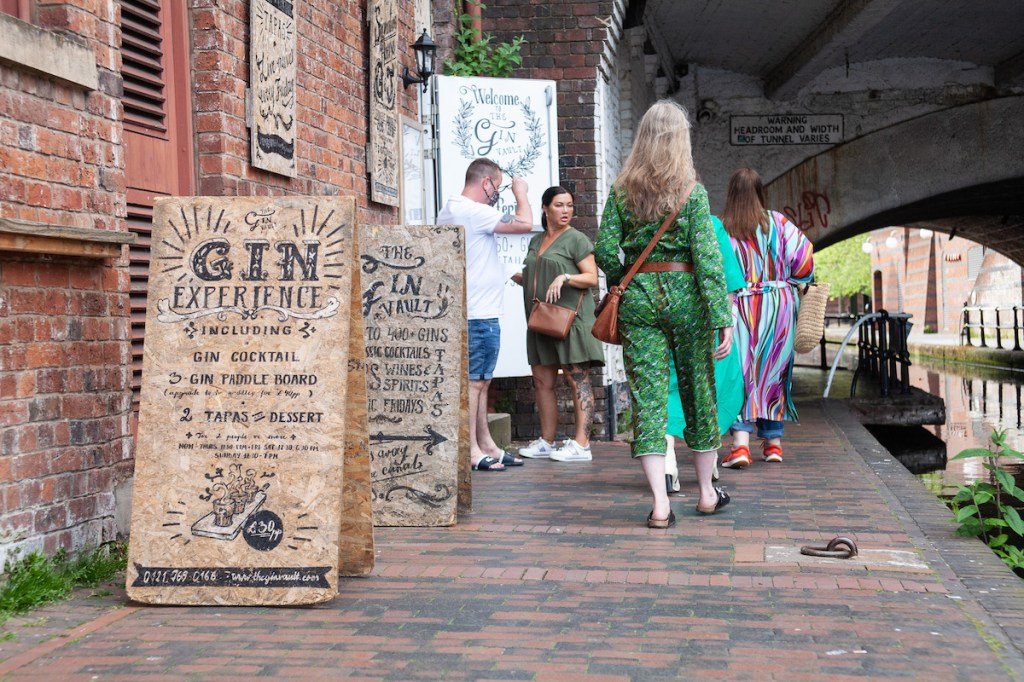
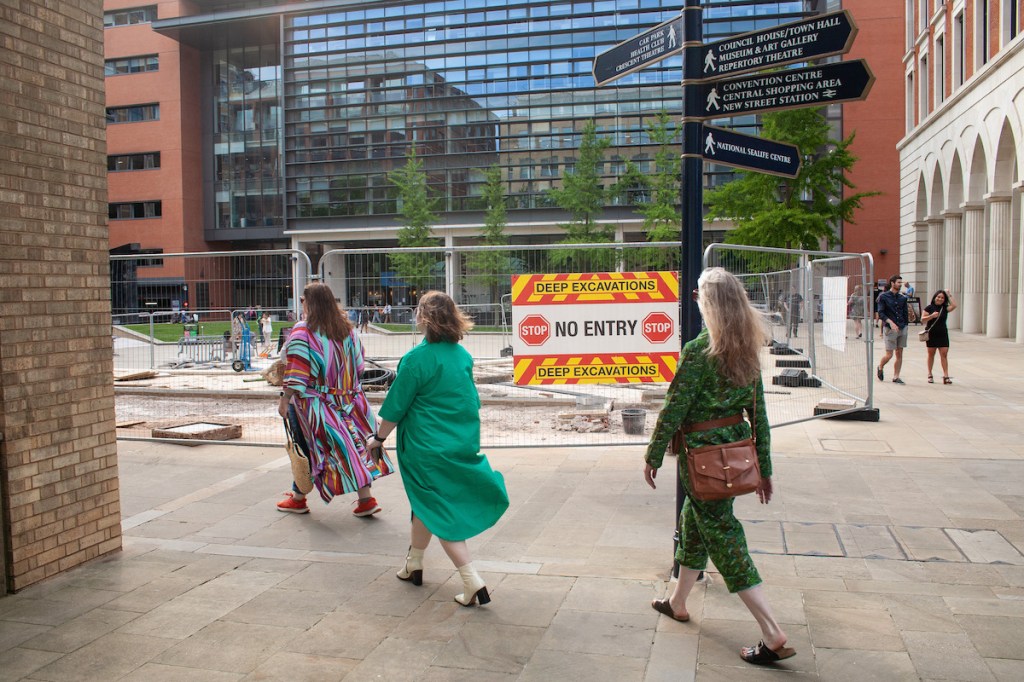
Three crones walk in silent, single file.
The crones walk through city infrastructure that can feel forbidding to all women – underpasses, canal towpaths and tunnels.
The crones walk where women of their age wouldn’t ordinarily be present – past strip-club streets to the party zone on a Saturday night.
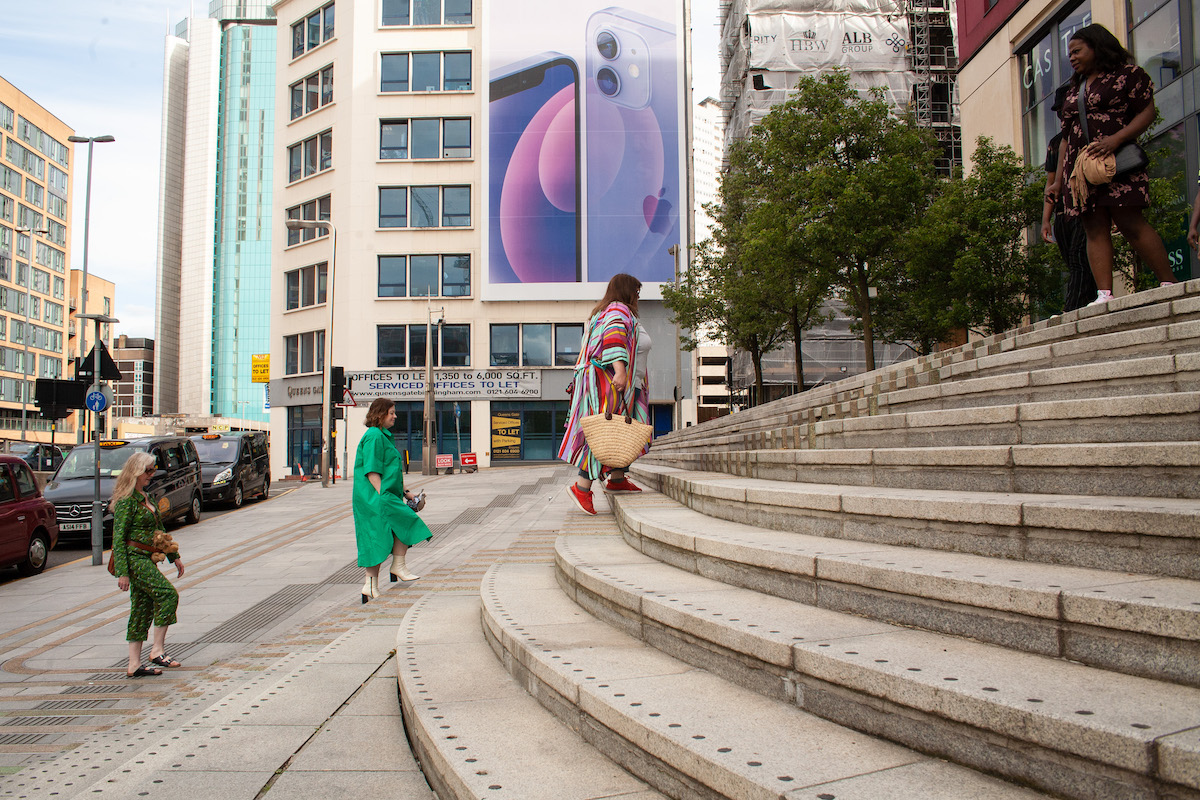
The crones walk where they are most visible – across sweeping bridges and staircases, through a train station, a high-end mall, past tables of people-watchers.
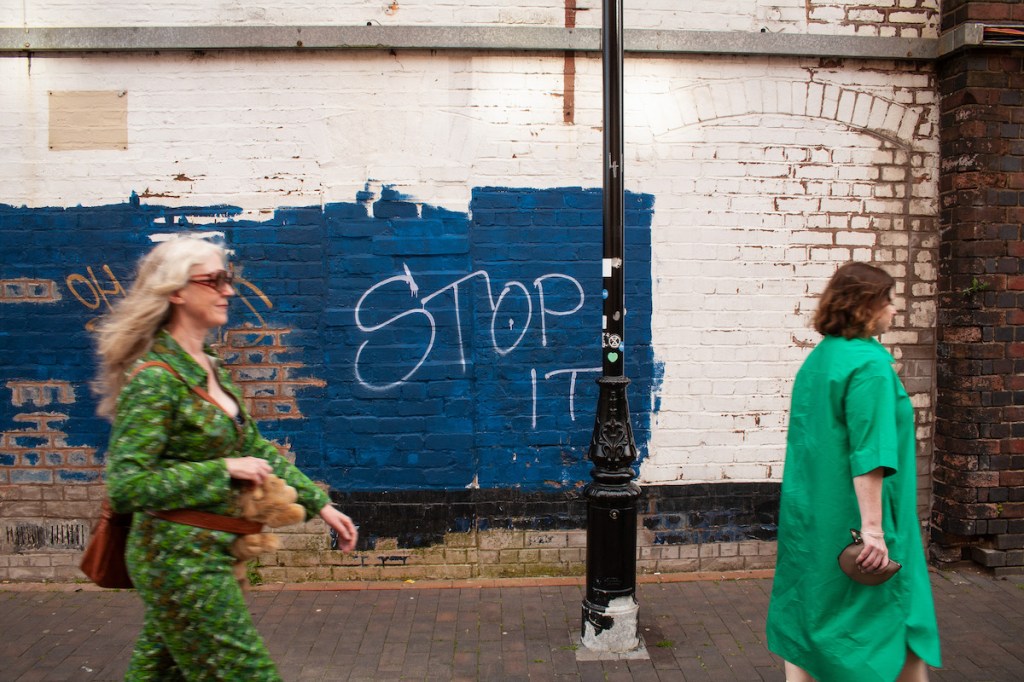
The crones are dressed in bright colours. Two carry props of toy animals. They walk in a resolute but unhurried fashion.
A photographer trails them, running ahead, to the side, crouching into position to frame the women against the city.
The crones are glanced at, stared at and the subject of both whispered comments and open exclamations… They are also frequently not noticed at all.
The crones appear briefly on a hot Saturday night in the city and just as quickly fade away, leaving only small, temporary traces in the lives of others.
==
Can we do a watched walk?
“I was thinking about [how women walk] and wondered if we could do a watched walk? How could we encourage the most people to have a memory of us walking through a city?”
– Liz
Six weeks before the Crone Walk, I posted a photo from my second all-female Dazzle Walk – a walk designed to make us digitally invisible to the city’s prevalent surveillance cameras. The murder of Sarah Everard was causing widespread outrage and factoring into post-Dazzle Walk discussions about how women walk. How did being invisible in the city make us feel. Safe? Threatened? Subversive? If cameras didn’t protect us, what would? More female pedestrians? Walking with others?
I invited female friends to join me on a series of walks together in the city, perhaps alternating on the themes of visibility/invisibility. Those who volunteered were 40 and 50-year-olds, the age when women tend to become invisible and less valued within a society that favours youth and patriarchy. Age, gender and visibility quickly became a factor in this next walk.
Having spent a year thinking about walking invisibly – on Dazzle Walks, Dark Moon Walks and Night Hikes – walking with the sole purpose of being seen seemed an interesting counterpoint. What might the opposite of an invisibility walk look like? How could we as deprioritised older women become visible again?
==
At New Street Station, the photographer (Matt Murtagh) is documenting the walk at our request. He takes some pre-walk photos as a warmup and we present ourselves one by one for the camera.
Our self-generated poses mimic those of fashion models, cougars and various other female stances selling desirability. As a middle-aged woman who is none of those things, they nevertheless rise up in my mind. I want to look attractive – this is how I perceive that to happen. It’s what we see everywhere in advertising and women’s media – women bent into weird accentuating shapes. These images are culturally embedded and inescapable. And so at home, we drop a hip, or stick out a foot, or position our bodies in some way that is deemed to be more attractive than simply standing still. It’s what we know.
We submit to our close-ups but it feels awkward, perhaps because it foregrounds our struggle with the desire to look good for the camera. We trust Matt and yet we are fighting a culture that says we must look younger, thinner, happier, prettier, sexier. I feel tension between this and my crone-aged self. I want to be authentic yet here I am posing and breathing in the middle-aged spread.
==
On ageing in a patriarchy
“… I feel at my most confident now … I am more myself … more powerful now that society has decided I’m less useful … No one says thanks or recognises us … At the mercy of my hormones … I’m angrier now the oestrogen has gone … We are all knackered … I’m worried about losing my desire/desirability … I’m happy to be less visible …”
– Snippets from pre-walk discussions
The experience of ageing is different for men and women. For women, the menopause draws a distinct line based on our reproductive organs shutting down. With it comes a hormonal rollercoaster with 30-40 recognised symptoms that may go on for a decade. At 53, I’m two years in and there is no ignoring the pile up of symptoms, which can be mild or debilitating from one day to the next.
The traditional maiden, mother, crone archetype provides a neo-pagan view of the different life stages of women. I’ll be honest, it isn’t an area I’m familiar with, unless the archetype can also mean tomboy–careerwoman-other. I viewed ‘crone’ with as much suspicion as all the other labels and cultural stereotypes that afflict women throughout their lives – as yet another put-down.
Crone feels like the most loaded word of the archetype. Images of witchy Baba Yaga, fairy godmothers and old hags in rags immediately spring to mind. But crone archetypes also symbolise ‘wise women’, finally able to take a step back from the concerns of maidenhood and motherhood and enjoy a potentially very different, transformative ‘third act’. My own mother is an example here, transformed from shy Irish maiden to immigrant mother-of-three to founder of the Acorns Children’s Hospice shops (From Little Acorns…).
With age can come wisdom and growth. This is a theme of our pre-walk chats. The crones discuss how much more confident we are in many ways now that we are older. Our knowledge and experience makes us more powerful in our work, more confident in our sexuality, and more articulate in our voice and expressions.
Yet in a youth-oriented patriarchy, we are also now more likely to be overlooked, less likely to be listened to, passed over for work or jobs, and seen as less desirable or less valuable somehow due to age. The unspoken biological question surfaces: what do we have to contribute to society now that our reproductive work is done?
==
People are giving us plenty of side-eye as we pass them on the pavements near New St Station. We are not walking ‘normally’. We are in single file and slow but purposeful. At the Hill St crossroads, we stand juxtaposed next to three maidens, waiting for the green light. All of us are dressed up but our older bodies are more lived in, our middles way less defined, our outfits less figure-hugging. We are the same but 30 years in the future. I try to think of somewhere our generations interact without the power relationships of age: parent and child, teacher and student, line manager and employee. Nothing comes to mind.
We reach The Mailbox. A huge former Royal Mail sorting office, now a destination for high end goods and services. There is a sense of us rising up. We emerge from a concrete underpass up a sweeping stone staircase, then escalators, then lifts. The situation also feels heightened – we are about to enter the entertainment district.
A couple of expensively-dressed young women look up briefly from their drinks. I feel assessed. I don’t think we look old so much as out of place. Not thwarting expectations of ageing so much as thwarting expectations of what we should be doing in that space. “What are we doing here if not shopping?” asks Liz in her route prompts.
==
How do you perform ageing?
“He said: ‘Ah you know a woman’s middle-aged when she’s wearing leopard.’ The casual sexism and ageism of that comment has stayed with me for 12 years”
– Jenny
“… [Ageing] is a multiple, ambiguous and contradictory process which provides us – continuously and simultaneously – with images of our past, present, lost, embodied and imagined selves”
– Helene Moglen, Aging and Trans-aging, Bodies in the Making
The Crone Walk had a sense of occasion, a ‘happening’. Pre-walk, it felt as if we were preparing for any night on the town. We discussed dress codes for greater visibility but instead of little black dresses and heels, the talk was of robes that made us look like cult leaders, or functional boiler suits, or “something with a leopard-esque print” that plays into the everyday sexism and ageism of cougar/MILF/GILF sexual stereotypes.
We talked of challenging these stereotypes but also of lost or alternate or potential selves. Dressing up for the walk could be part of the process of ‘becoming’ this other self.
Accessories included comfortable walking shoes and props such as stuffed toys (hinting at eccentric cat lady and megalomaniac villain stereotypes, roles we were over-associated with or that were associated with men).
The female ritual of ‘getting ready’ felt familiar to our younger selves. The fun, the anticipation, the mirror checks – perfectly lampooned in Rachel Bloom’s The Sexy Getting Ready Song from the TV show Crazy Ex-Girlfriend – but more loaded with meaning. We were getting ready to perform ageing; we were dressing up for the city and for how we wanted to write our older selves into its landscapes.
How do you feel as you walk through the different spaces? (comfortable/uncomfortable, accepted/imposter, safe/scared, included/excluded, anonymous/watched?)
What can you see? Who is seeing you? Who is missing?
==
Liz pauses us on the packed terrace above the canal. She later admits she has disliked walking all her life until lockdown equated it with freedom. Here, she is a majestic walk guide, a female crone cult leader in a billowing robe of many colours, stroking her beloved toy cat, and surveying new kingdoms to conquer. Jenny aligns herself next to Liz; she looks serene and confident in the most vivid green dress. I follow in a dinosaur-camouflage boilersuit, with a toy lion stuffed in my belt. I’m wearing a bikini underneath because it’s hot and as a reference to GraceGraceGrace – three gen-age artists who partly inspired this work.
Before us, people are everywhere, enjoying their first freedom in months amid a summer heatwave. Matt runs ahead and crouches down to snap us. This draws attention. The act of photography literally makes us visible – people see him and then look at us. I feel self-conscious but also part of the scene. We may be costumed crones but everyone else is dressed up for high visibility, too. “I love your lion!” shouts a young woman to me as we pass the people-watchers.
On a high metal walkway over the canal junction to Gas St Basin, Liz pauses again. Two women dining at a restaurant beneath are staring up. To give them a better view, we lean on the railings. They look at us, we look at them. They whisper conspiratorially. It doesn’t really matter what they are saying. We are here, we are seen, we are discussed. I’m enjoying this. I almost wave at our whispering younger sisters to let them know we are benevolent but that might break the spell so I resist.
As we approach the canal tunnel to Broad Street and Brindleyplace, a woman now exclaims at Jenny. “OMG I love your dress, I love that green, I could never carry it off!” Seen.
We end the walk at the Ikon art gallery, chosen by Liz as “somewhere all of us will feel safe thanks to our interests and somewhere where it’s entirely acceptable to be dressed unconventionally”. We’ve made it. We are elated. We can’t wait to talk about how it went.
==
Snapshots
How did it feel? Who did you see? Who is seeing you? Who was missing?
“Like we were gliding through the city, the slow pace, the single file, the deliberate nature of the walk. No one got in our way until the tunnel. It flowed, we flowed.”
“Felt invisible at times – people were busy in their own worlds but it was nice. We could look around and enjoy the city. Our purpose wasn’t rushed.”
“The silence was important.”
“There was an urge to smile.”
“Felt quite processionary.”
“Felt benevolent towards my younger self.”
“The standouts were homeless people – wearing black or grey clothes and sitting still.”
“The over-65s, children and normally dressed people were missing from the scene.”
“We blended in – we were in context of everyone else and everyone was dressed up. What would it be like if we went out on a Tuesday or on a morning commute?”
“Did we get into different characters in our minds?” “Not so much. I think it was enough to dress up with intent – as heightened versions of ourselves.”
“I felt a peace from our walk I really did not anticipate.”
“It was a lot of fun! I think there’s something very interesting in an event existing to be photographed and how meaning is created through that process.”
“It felt authentic. That embodied experience once it shifted from sweaty awkwardness to being a part of something was so grounding and liberating.”
==
The power of a walk
“I have long been fascinated by how people understand themselves using landscape, by the topographies of self we carry within us and by the maps we make with which to navigate these interior terrains”
– Robert MacFarlane, The Old Ways
“To be a crone is about inner development, not outer appearance”
– Jean Shinoda Bolen, MD and author of ‘Goddesses in Everywoman’
Afterwards it occurs to me that we were mostly seen and acknowledged by women. This fits with losing the male gaze, which was firmly on the maidens of Brindleyplace, but also reflects a lack of older female role models in society. If we could speak to that lack by being more present, it sends a signal that female life doesn’t end when your ovaries switch off.
Our aim was a ‘watched walk’ – to be seen in the city and to claim some space for older women where we had little or no presence. It was a journey that was by degrees self-conscious, eloquent, colourful, conspicuous, fun, celebratory, defiant and bonding. The experience of ‘croning the city’ was more vivid for the participants than the watchers.
Walking as a crone enabled us to think about our own interior worlds of wants and anxieties around gender and ageing. It gave us space to explore where we are at with ageing, what being menopausal means, and how we might see ourselves now and in future.
Taking a stance against encroaching invisibility let us respond to it both individually and as a group. It let us play with cultural stereotypes but also feel the feminine power of coming together after a year of not having such gatherings. And it was fun. The dressing up. The conversation. The chance to get know some funny, smart and intelligent women better.
One surprising factor in the Crone Walk was the photographer. It quickly became clear that the act of photography was not just about documenting the walk but was integral to the work. It facilitated us being seen time and time again.
The photos, when they came, were almost superfluous. Matt’s final selection of 100 photos offered a perfect broad scope of shots from all angles and across all the environments we walked through. But they only provided a singular view – that of the photographer. ‘Croning the City’ was a more intense experience than the photographs could ever show. Walkspace mentor and artist Pete Ashton raised the point that we should be careful not to confuse the art and the documentation. To avoid the photos being seen as the work, the crones decided to publish only one image from the walk (since extended to five images.)
Another surprise… I had thought the Crone Walk would need a leader to make it happen but leadership was also superfluous. In that way that women excel at when they come together, the walk immediately became a collaboration with decisions made by all. It felt good to be part of a group where everyone had an equal voice.
For the record, the collaboration consisted of:
several pre-walk discussions of what we wanted to do and why, walk practicalities and ‘what is art?’
an immediate formal post-walk discussion
an informal post-walk dinner sharing more general experiences around growing older
a week later, an artist briefing and a group crit of the photos.
There is so often much benefit in how women come together; and in how we walk together too. Walking in a group provided us with a safe space to act. It gave us a sense of solidarity with the changes we are facing as a result of the menopause and a sense of solidarity with others who may also struggle to be heard or seen in society. Through the idea and act of crone walking together, we were able to explore female ageing and take some positive action over it.
==
What next?
‘Croning the City’ turned out to be more than I had hoped for. I hope it won’t be the only crone walk. Perhaps next time we will appear in a different context from a Saturday night out in the city. Perhaps a morning commute or a protest march or walking in other places where crones need to be seen or where our maiden/mother/allies exist.
We could adopt entirely new crone characters or re-invent ourselves for the camera, taking cues from Cindy Sherman’s photographic work. Or maybe it will develop in a completely different way. Into a womanifesto. Or a game. Or a script for a play perhaps.
It doesn’t really matter. Ultimately, the crone age is all about potential and change. Crones go through the change. We have the ability to become agents of change.















 Walkspace